The most intensive Vietnamese class isn’t automatically the best fit. Where to Learn Vietnamese in Singapore depends on what you want to say, how you learn best, and how much time you can protect each week. A busy schedule or a need for real conversation practice can make the right format matter as much as the course itself.
It’s reasonable to compare group, private, intensive, and online lessons before committing. You want more than a broad promise: you need a clear path to useful conversations, supportive instruction, and a routine you can sustain. Consider how often you’ll speak aloud, how feedback is delivered, and whether travel fits your week.
This guide compares class formats and teaching approaches to help you match lessons to goals such as everyday communication or speaking with Vietnamese-speaking colleagues and family. It also covers what to look for in lesson structure and location. At Learning Explorer, bilingual, certified native-speaker instructors teach conversational Vietnamese through private, group, and intensive formats at the school’s Singapore CBD location, directly above Tanjong Pagar MRT. Use these points to find a learning setup that feels practical, engaging, and achievable for you.
Key Takeaways
- Start with your real-life reason for learning Vietnamese, then compare classes against the conversations you want to have.
- Compare group, private, intensive, and online lessons by interaction, flexibility, personal attention, and how well each fits your routine.
- When deciding Where to Learn Vietnamese in Singapore, weigh teaching approach and practical speaking and listening practice alongside location.
- Plan around your weekly availability first, then choose a format and consider how travel or lesson mode may affect attendance.
- Explore how Learning Explorer’s conversational Vietnamese course and private, group, or intensive formats may fit your learning preferences.
Where to Learn Vietnamese in Singapore: Start With Your Learning Goal
Vietnamese may be part of your plans for family conversations, travel, community connections, or workplace communication. Each goal calls for different practice, so begin with a situation you genuinely want to handle. Instead of simply aiming to “learn Vietnamese,” picture a specific moment: introducing yourself to a relative, asking for help while travelling, or exchanging routine updates with a colleague.
That picture gives you a useful way to compare lessons. Ask what you want to understand as well as what you want to say. A learner who wants to follow family conversations may need regular listening practice, while someone preparing for work may want to rehearse clear introductions and familiar professional exchanges. Beginners can start with useful phrases and build listening confidence step by step.
For a brief introduction to the language and its features, explore this overview of the Vietnamese language. You can use that background to think about what you’d like to practise, rather than treating linguistic detail as a barrier to getting started.
To see an introductory lesson on Vietnamese letters, watch this video:
Match Vietnamese lessons to the conversations you want to have
Choose a first milestone you can imagine using outside class. Family goals might include greeting relatives, asking simple questions, or understanding familiar expressions. If travel is your focus, practise common interactions such as asking for directions, ordering a meal, or making a polite request. For workplace communication, start with introducing yourself, describing your role, and managing routine exchanges with colleagues or clients.
These goals help make “progress” more concrete. You might aim to catch the main idea in a short exchange, respond with a relevant phrase, or ask someone to repeat something. You don’t need to master every topic at once. Prioritise the situations that matter most, then build from there.
Set a realistic starting point as a beginner
You don’t need previous Vietnamese study to choose a starting goal. Note any languages you already know, whether you’ve studied a language before, and what kinds of practice helped you stay engaged. Familiarity with language learning can help you understand your preferred pace, but it doesn’t determine how quickly you’ll learn Vietnamese.
Keep your first target practical. For example, focus on introducing yourself and recognising a few familiar words in a short exchange. Vietnamese uses a Romanized writing system and tones, so listening carefully and practising aloud can support your early speaking goals. Treat confidence as something that grows through useful communication, not as instant fluency. This gives you a clearer basis for deciding what kind of Vietnamese lessons will support your next step.
Compare Vietnamese Class Formats in Singapore Before You Choose
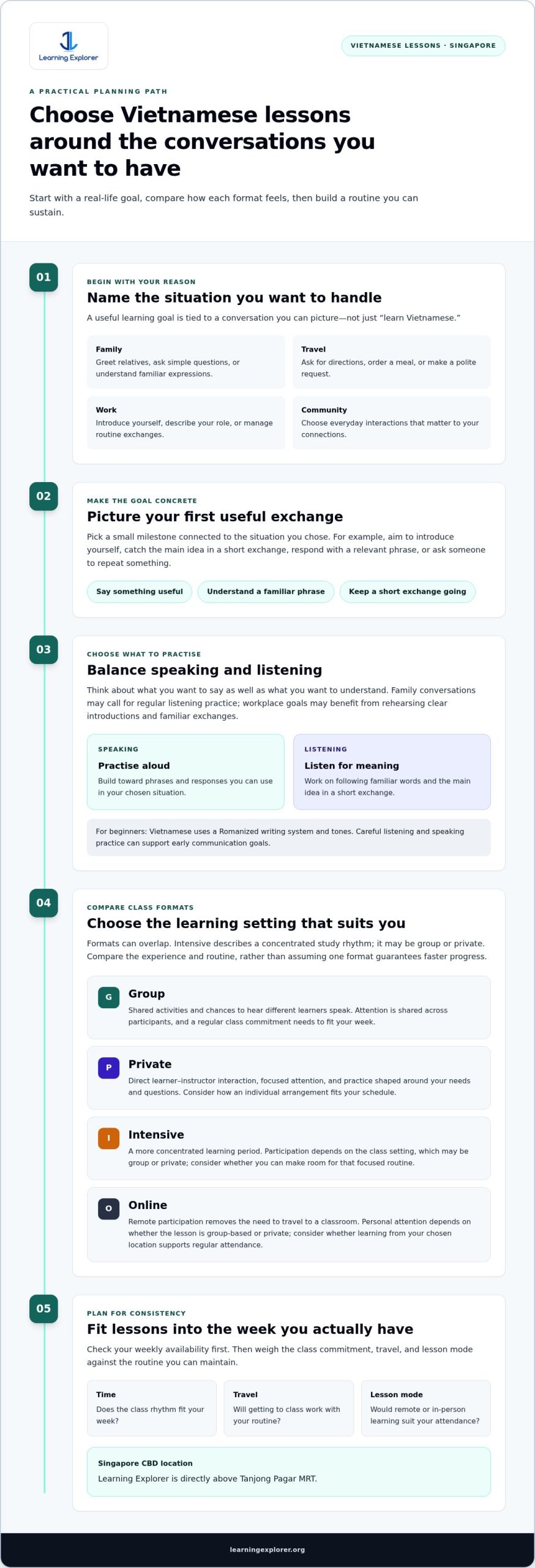
Once you know what you want to practise, compare how each class format fits your preferred way of learning. Group, private, and online lessons describe different learning settings, while intensive learning focuses on a more concentrated study rhythm. These options can overlap, so consider the experience you want rather than treating them as four completely separate course types.
The table offers a starting point. Actual lesson structure can vary, but these broad differences can help you weigh participation, personal attention, flexibility, and routine.
| Format | Interaction | Flexibility and personal attention | Routine to consider |
|---|---|---|---|
| Group | Shared activities and opportunities to hear different learners speak. | Learning follows a shared class structure, with attention distributed across participants. | Works best when a regular class commitment suits your week. |
| Private | Direct interaction between learner and instructor. | Individual lessons can be shaped around the learner’s needs, with focused attention. | Consider how a more individual arrangement fits your schedule. |
| Intensive | Participation depends on the class setting, which may be group or private. | Study is concentrated into a more focused learning period. | Think about whether you can make room for a more concentrated routine. |
| Online | Interaction takes place remotely, with the format depending on the class. | Removes the need to travel to a classroom, while personal attention depends on whether the lesson is group-based or private. | Consider whether learning from your chosen location supports regular attendance. |
Group Vietnamese classes or private lessons?
Group classes can suit learners who enjoy shared activities and hearing a range of voices. Taking turns in practice can help you experience different speaking styles and participate alongside others. Private lessons offer a more individual setting, where practice can focus on your needs and questions. Choose between peer interaction and focused attention based on how you prefer to participate, not on an assumption that one format guarantees faster progress.
Online, in-person, or intensive Vietnamese learning?
Online lessons remove the commute and let you take part remotely, while in-person classes bring you to a shared learning environment. Intensive study may appeal if you want to give Vietnamese more concentrated attention, but consider the time commitment alongside work and personal responsibilities. The broader benefits of learning a new language can be motivating, but your best format is the one that aligns with your goals, available time, and preferred setting.
For a practical shortlist, ask yourself: Do I want to learn with peers or receive individual attention? How much time can I set aside, and would travel make attendance harder? Do I focus better in a classroom or remotely? These questions clarify Where to Learn Vietnamese in Singapore by helping you assess the format as well as the course. Explore conversational Vietnamese class formats as one way to see how group, private, and intensive learning may fit your preferences.
What to Compare in a Vietnamese Course: Teaching, Progress, and Convenience
A course can sound appealing yet leave you unsure what you’ll actually practise. Use a simple checklist to compare how lessons connect to your goals, how teaching is delivered, how learners participate, which format is used, and whether access fits your routine. As you decide Where to Learn Vietnamese in Singapore, look for clear answers to these practical questions, not just a broad promise of progress.
Conversational Vietnamese learning means practising the words and listening skills you need to take part in everyday exchanges. It’s a useful way to judge whether a course supports communication, rather than focusing only on knowing about the language.
- Goals: Does the course support the kinds of conversations you want to manage?
- Teaching approach: Are new words and expressions introduced in a way you can practise and remember?
- Participation: Will you have opportunities to speak, listen, ask questions, and receive feedback?
- Format: Does the class setting suit your preference for group interaction or individual attention?
- Access: Can you realistically attend in person or join online as part of your regular routine?
Use the checklist to compare the learning experience, not just the course description. A good fit is one that makes the next step understandable and gives you a practical way to take part.
Look for practical speaking and listening opportunities
Guided speaking tasks give you a chance to try new expressions in context, pause, and adjust after feedback. Listening practice matters too: real conversations move at a natural pace, and you’ll need to recognise familiar words even when you can’t catch every detail. Look for lesson activities that connect with your own communication goals, so practice feels relevant rather than disconnected from daily use.
Participation should feel purposeful. For instance, learners might practise responding to a prompt, asking a follow-up question, or clarifying a point. These activities let you rehearse both sides of an exchange. They also help you notice which skills need more attention, such as understanding spoken phrases or choosing a suitable response.
Check whether the learning experience supports steady progress
Clear learning stages can make it easier to see what you’re working on now and how it builds on earlier practice. Beginner foundations might include familiar expressions and basic exchanges, followed by chances to use them in more varied situations. The key is a progression you can understand, not a promise of fluency by a certain date.
Instructor feedback can help you spot what was clear, where a phrase needs adjustment, and what to practise next. Look for a learning experience that makes room for participation and repeated practice, rather than expecting you to absorb everything at once. If you’re comparing course options, consider whether you can explain what you’ll practise, how you’ll take part, and how each lesson connects to your communication goal. That clarity makes it easier to choose with confidence and build a sustainable learning routine.
Choose Vietnamese Lessons Around Your Schedule and Singapore Location
A suitable class has to work beyond the lesson itself. Your weekly commitments, travel time, and preferred learning environment all affect whether Vietnamese study feels manageable over time. Use this planning sequence to make the decision concrete before settling on a format.
- Define your weekly availability. Look for realistic windows in your calendar, taking work, family responsibilities, and travel across Singapore into account. Choose time you can protect consistently, rather than an ideal slot that is difficult to maintain.
- Choose a format that fits. Consider whether group interaction, individual attention, concentrated study, or remote access best suits your learning preferences and available time.
- Assess access. Compare the journey to an in-person class with the convenience of joining online. Include the return trip and how each option fits around the rest of your day.
Build a Vietnamese study routine you can sustain
Keep the plan realistic. After identifying a weekly learning window, consider how a little practice between lessons could fit naturally into your day. You might revisit a phrase while commuting, listen again to material from a lesson, or practise saying a new expression aloud at home. These are flexible ideas, not extra requirements. A routine that works with your existing commitments is easier to return to than one that depends on finding large blocks of spare time.
Think about energy as well as availability. A lesson immediately after a demanding workday may feel different from one scheduled at a time when you can concentrate. Build around the moments you can genuinely set aside, and leave room for the occasional change in routine.
Weigh in-person convenience against online flexibility
For in-person lessons, consider how a classroom visit fits into your usual route through Singapore. If you work or spend time in the area where lessons are held, attending may be easier to combine with your day. Map the trip from home or work and account for the return journey, not just the time spent in class.
Online learning may be a practical choice if regular travel makes a classroom commitment harder to keep. It can remove the commute, though you’ll still want a suitable place and time to focus. In-person and online lessons each involve trade-offs: one centres on getting to a learning space, while the other relies on making room for remote study in your own routine. Choose based on the option you can attend and engage with consistently.
Now compare your available time, preferred format, and access needs together. If you’re weighing Where to Learn Vietnamese in Singapore, this simple sequence can help you focus on a class that fits your real week, not just your ideal one. Explore Learning Explorer’s Vietnamese course as a next step in finding a learning format that suits your routine.
Learn Vietnamese with Learning Explorer: Find a Format That Fits
If you’re ready to turn your learning goal into a practical next step, Learning Explorer’s conversational Vietnamese course offers a focused place to begin. Its interactive approach gives learners opportunities to participate and practise useful communication. Whether you’re starting from the beginning or looking to strengthen everyday communication, choose a format that feels manageable and relevant to the conversations you want to have.
What learners can expect from a supportive course
Learning a language takes active participation. In a conversational course, you can work on expressing ideas, listening to others, and using practical Vietnamese in exchanges. Guided practice helps you develop these skills as you take part. A supportive setting can also make it easier to try a phrase, consider feedback, and have another go. Confidence grows through participation, not from expecting every word to come easily at once.
Keep your own purpose in view as you learn. If you’re studying for family communication, you might focus on understanding familiar expressions and responding naturally. If your goal is workplace interaction, useful practice may include introductions and routine exchanges. Your priorities give lessons a clear direction and help you notice progress in communication that matters to you.
Choose a Vietnamese learning format that suits your needs
Learning Explorer offers private, group, and intensive formats. Each creates a different learning experience, so weigh your preference for interaction alongside your available time:
- Private lessons provide an individual learning setting, suited to learners who value focused attention and learning shaped around their needs.
- Group lessons bring shared participation into the experience, making them a fit for learners who enjoy practising alongside others.
- Intensive lessons offer a more concentrated way to engage with study, for learners looking to prioritise Vietnamese in their learning routine.
There isn’t one right format for everyone. Start with the goal you identified earlier, then consider how you learn best. Do you want focused instructor attention, shared interaction, or a concentrated study experience? Next, think about the routine you can sustain. A format that aligns with both your communication priorities and your schedule is more likely to feel like a practical step, rather than another commitment competing for your time.
As you consider Where to Learn Vietnamese in Singapore, use your goals, preferred participation style, and routine to guide your choice. Learning Explorer brings conversational Vietnamese instruction and flexible learning formats together, helping you begin with a clearer sense of what suits you. Take the next step and Explore Vietnamese lessons at Learning Explorer.
Make Your First Vietnamese Learning Step Count
You don’t need to map out every stage before you begin. Choose one small action that connects your interest in Vietnamese to real communication, such as setting aside time to practise or writing down a question you’d like to ask in a future conversation. A clear first step can make a new learning routine feel more approachable.
As you decide Where to Learn Vietnamese in Singapore, keep your personal reason for studying at the centre of the choice. The right learning path is one that helps you take part, stay engaged, and build useful skills in a way that works for you. Progress can begin with a single phrase understood or spoken with a little more confidence.
Ready to move from considering lessons to taking action? Take your next step with Vietnamese lessons and start building toward conversations that matter to you.
Frequently Asked Questions
Is Vietnamese difficult for English speakers to learn?
Vietnamese can feel challenging at first, especially as you get used to its tones and unfamiliar sounds. The Romanized writing system may look familiar, but pronunciation still takes practice. Try listening to a short phrase, repeating it aloud, then listening again to notice differences. In a lesson, you can ask for feedback on a sound or expression that feels difficult. Aim to understand and respond more comfortably over time, rather than expecting perfect pronunciation straight away.
Can I learn Vietnamese in Singapore as a complete beginner?
Yes, you can start learning Vietnamese in Singapore without previous study. Before your first lesson, write down a few situations where you’d like to use the language and any languages you already know. This gives you a useful starting point for discussing your needs and helps you connect new expressions to familiar ideas. A simple way to track early progress is to keep a personal list of phrases you can recognise or use more confidently.
How do I choose between group and private Vietnamese lessons?
Choose based on how you feel most comfortable practising. If speaking in front of others feels intimidating, individual instruction may give you a quieter space to ask questions and work through an expression. If you enjoy learning alongside other people, a group setting may make participation feel more social. Picture yourself practising a short dialogue in each environment. The format that makes you more willing to take part may be the better match.
Can I learn Vietnamese online in Singapore?
Yes, online lessons are one way to study Vietnamese while living in Singapore. They can reduce the time spent travelling, which may help if your day is split between work, caregiving, or other commitments. Set up a quiet place, stable internet access, and a way to hear and speak clearly. If you find it hard to focus at home, an in-person classroom may provide a more dedicated learning environment.
What should a beginner Vietnamese course teach?
A beginner course should introduce practical language foundations and give you ways to use them, not just memorise isolated words. Look for guided practice with listening, speaking, everyday expressions, and pronunciation, along with opportunities to ask questions. You might also value review activities that help you revisit new material between lessons. Before enrolling, compare the course’s stated learning focus with the situations you hope to handle, so the content feels useful to your needs.
How long does it take to learn conversational Vietnamese?
There’s no set timeline for becoming comfortable with conversational Vietnamese. Your starting experience, practice habits, and definition of “conversational” all influence what progress looks like. Choose a personal milestone, such as recording a brief self-introduction, then revisit it later to notice changes in clarity and ease. You can also keep a short log of phrases you’ve used in practice. These markers help you see development without relying on a fixed fluency promise.
Where is Learning Explorer located for Vietnamese classes in Singapore?
Learning Explorer is based in Singapore. To assess whether attending in person suits you, map the journey from your usual starting point and consider how it fits around work or other commitments. Include the return trip in your planning, since the time needed to travel both ways can affect how manageable lessons feel. Comparing that journey with online study can help you choose an option that works with your routine.