What if a friendly greeting feels harder than it should because one small mark changes the sound, while the right form of address depends on who you’re speaking to? That’s a common beginner challenge. Vietnamese uses the Latin alphabet, but its six tones matter, and a phrase translated word for word can still feel out of place. Learning vietnamese greetings and basic phrases means practising more than sounds: connect each expression to its tone, relationship, and situation.
This guide covers greetings, introductions, thanks, apologies, and useful everyday questions, with pronunciation cues and context to help you choose your words. Start with a few phrases, say them aloud, and notice how they fit real exchanges. Patient repetition and guided conversation practice can help you move beyond memorisation and feel more prepared to speak.
Key Takeaways
- Choose a greeting with the relationship and situation in mind, not just its dictionary meaning.
- Use tone marks as pronunciation cues, and practise each phrase aloud instead of relying on an English sound match.
- Build a useful starter set of vietnamese greetings and basic phrases for introductions, thanks, apologies, and everyday requests.
- Practise phrases in short exchanges so you can listen, respond, and keep a conversation moving.
- Use phrase lists to get started, then add guided speaking practice to strengthen pronunciation and confidence.
Vietnamese Greetings and Basic Phrases: Start with the Right Context
A greeting is more than a phrase. It reflects your relationship with the other person, the politeness you want to convey, and the situation. Vietnamese greetings depend on social context: the right words reflect not only what you want to say, but also how you relate to the person you’re speaking with.
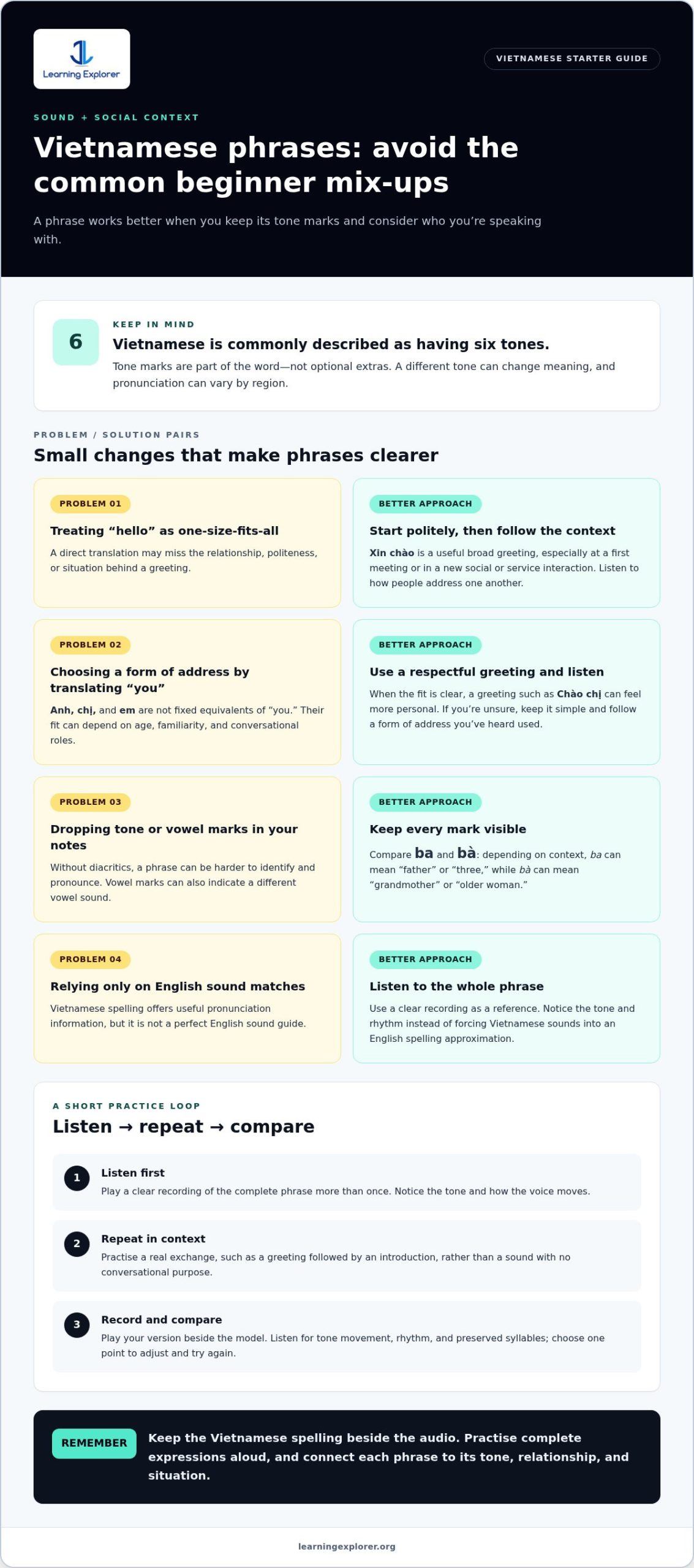
A direct translation of “hello” won’t always tell you which expression sounds natural. Vietnamese uses relationship-sensitive forms of address in everyday speech, and they can be part of the greeting itself. The words anh, chị, and em can refer to people in different ways depending on age, familiarity, and conversational roles. They aren’t fixed equivalents of “you.” For a broader overview of how forms of address fit into Vietnamese grammar, see how pronouns work in the language.
For beginners, xin chào is a useful general greeting to recognise and practise. In familiar or polite exchanges, adding an appropriate form of address can make your words feel more personal and attentive. If you’re unsure which form fits, start with a respectful greeting, listen to how people address one another, and follow their lead.
When should a beginner say “xin chào”?
Xin chào means “hello” and works as a broad greeting, especially when meeting someone for the first time or choosing a polite, neutral opening. It’s useful in a new social or service interaction. In everyday conversation, speakers often pair chào with a form of address, such as anh or chị, when it’s clear which one fits.
- At a first meeting: Xin chào, tôi là Alex. “Hello, I’m Alex.” A simple, polite way to introduce yourself.
- In a polite everyday encounter: Chào chị. “Hello.” Use this when chị suits the person and relationship; otherwise, listen for a form of address you can follow.
Think of xin chào as a reliable starting point, not a phrase for every exchange. A suitable form of address helps connect the greeting to the person in front of you.
How do Vietnamese forms of address shape greetings?
Anh, chị, and em carry information about relationships and roles, so their use depends on who is speaking to whom. Age can matter, along with familiarity and the roles people take in a conversation. Translating each word as “you” can be misleading: the best fit depends on the relationship, not a one-to-one English equivalent.
Begin by listening. Notice which forms people use for one another, then mirror a clear example when you feel comfortable. If you’re uncertain, keep your greeting simple and polite rather than using a form you haven’t understood. This helps avoid sounding abrupt or overly familiar when you mean to be respectful.
Vietnamese Pronunciation and Tones: Read Each Phrase More Clearly
Vietnamese spelling provides useful pronunciation information, but it isn’t a perfect English sound guide. Tone marks are part of a word, not optional extras: changing a tone can change meaning. Vietnamese is commonly described as having six tones, though pronunciation can vary by region. Treat each mark as a cue to listen closely to the pitch and movement of a syllable, rather than trying to copy it with an English sound.
For example, ba means “father” or “three,” depending on context, while bà can mean “grandmother” or “older woman.” The grave accent in bà marks a different tone from the unmarked ba. Vowel marks matter too: they can indicate a different vowel sound, so keep every diacritic in your notes. Keep tone marks visible in beginner phrase notes to preserve pronunciation and meaning.
What do Vietnamese tone marks tell a learner?
Use marks as reading cues, not as English punctuation or decoration. A phrase written without its diacritics can be harder to identify and pronounce correctly. Keep the marks when copying phrases into a notebook or phone, and look at the complete word as you listen. For greeting etiquette beyond pronunciation, Vietnamese greeting customs and etiquette offers useful cultural context.
How can beginners practise saying phrases aloud?
Build a short practice loop. Choose one complete expression, listen to a native-speaker model, then repeat it while noticing the tone and natural rhythm. Don’t try to force a Vietnamese sound into an English spelling approximation. A rough reminder may help at first, but listening and repeating provide a more dependable reference.
- Listen first. Play a clear recording of the whole phrase more than once. Notice which syllable carries the tone and how the voice moves.
- Repeat in context. Practise the expression as part of a real exchange, such as a greeting followed by an introduction, rather than drilling a sound without a conversational purpose.
- Record and compare. Play your version beside the model. Listen for tone movement, rhythm, and whether you’re preserving the phrase’s syllables. Choose one point to adjust, then try again.
Keep the written phrase beside the audio while practising. If your notes show bà as ba, for example, they no longer capture the distinction you’re learning. Over time, connect the written marks to what you hear and say instead of relying on an English-style pronunciation guide.
For feedback as you practise real exchanges, guided Vietnamese conversation practice helps you work on pronunciation while responding in context.
Everyday Vietnamese Phrases for Polite, Useful Exchanges
A phrase is easier to use when you know when it belongs. The examples below cover familiar tasks, from saying hello to asking someone to repeat a sentence. Keep the Vietnamese spelling intact as you practise, and remember that a translated phrase may not fit every relationship or situation in exactly the same way.
Situation labels make a phrase list more practical by showing not only what to say, but when it may be useful.
Which Vietnamese phrases help with introductions and courtesy?
Start with a few versatile expressions, then notice how the exchange and relationship affect the level of politeness. A courteous word can help, but no single phrase makes every interaction automatically polite.
| Situation | Vietnamese phrase | Plain-English meaning | Usage note |
|---|---|---|---|
| Greeting | Xin chào. | Hello. | A useful general greeting, especially for a polite opening. |
| Introduction | Tôi tên là Mai. | My name is Mai. | Replace Mai with your own name; a clear option when introducing yourself. |
| Thanks | Cảm ơn. | Thank you. | Use to express thanks. The relationship and tone of the exchange still matter. |
| Apology | Xin lỗi. | Sorry; excuse me. | Can be used to apologise or politely get someone’s attention. |
| Agreement | Vâng. | Yes. | A polite affirmative response; choose a form that suits the conversation. |
| Asking someone to slow down | Bạn có thể nói chậm hơn một chút được không? | Could you speak a little more slowly? | Useful when you need more time to follow what someone is saying. |
| Asking for repetition | Bạn có thể nhắc lại được không? | Could you repeat that? | A direct, polite way to ask someone to say something again. |
| Explaining you don’t understand | Tôi không hiểu. | I don’t understand. | Say this when you need to make clear that the meaning hasn’t come through. |
What can you say when you need help understanding?
Choose the phrase that best describes the difficulty. Tôi không hiểu tells the other person you don’t understand. Asking them to repeat is more specific if you simply missed what they said. If they’re speaking too quickly, ask them to slow down. These short requests keep a conversation moving without pretending you understood.
Pair a request with a courteous opening or a brief thank-you when it suits the exchange. As you learn vietnamese greetings and basic phrases, practise each one as a complete expression rather than swapping words based only on their English translations. This helps you remember both the purpose and the context of each phrase.
Practise Vietnamese Phrases in Short Conversations
A phrase is easier to recall when you practise it as part of an exchange, not as a line on a page. Start with one clear purpose, such as introducing yourself or asking someone to repeat a sentence. Listen, say the phrase aloud in context, then use it in a short dialogue. This routine connects the words to the moment you need them.
How can you turn a phrase into a short exchange?
Read each dialogue aloud, first slowly and then at a natural pace. Keep the Vietnamese and English side by side so you can focus on what each speaker means instead of translating every word as you speak.
Meeting someone
Speaker A: Xin chào. Tôi tên là Mai.
English: Hello. My name is Mai.
Speaker B: Xin chào, Mai. Tôi tên là Nam.
English: Hello, Mai. My name is Nam.
Asking for repetition
Speaker A: Xin lỗi, bạn có thể nhắc lại được không?
English: Excuse me, could you repeat that?
Speaker B: Được.
English: Sure.
Speaker A: Cảm ơn.
English: Thank you.
The second exchange has a clear sequence: ask, listen, and respond politely. Practising that sequence can make it easier to use a request naturally, even when you need a moment to think.
How should you build a repeatable practice routine?
Choose a small set of phrases for one situation, such as meeting someone or asking for help. Rehearse each complete expression with a clear audio model, then revisit it in a different exchange. Note which phrases feel difficult so you know what to practise next.
- Listen. Play a reliable native-speaker model and focus on the complete phrase, including its rhythm and tone.
- Repeat with context. Say the phrase aloud as if you’re in the situation it belongs to. Picture who you’re speaking with and what you want to communicate.
- Use it in an exchange. Take both speaker roles, or practise with a partner. Change the response or setting while keeping the phrase’s purpose clear.
Practising with a speaker can help you notice differences in tone and phrasing that are easy to miss when reading alone. As you build confidence with vietnamese greetings and basic phrases, guided conversation gives you more opportunities to listen, respond, and receive pronunciation feedback. Explore guided Vietnamese conversation practice to take that next step.
Move Beyond Vietnamese Phrase Lists with Guided Conversation Practice
A phrase list is a useful starting point. It lets you review spelling, meaning, and common situations at your own pace, and gives you expressions to practise. But real conversations don’t always follow a script. Someone may answer with an unfamiliar phrase, speak at a different pace, or take the exchange in a new direction. Practice with another speaker lets you listen, respond, and adjust instead of only reciting memorised lines.
Keep using your notes, but treat them as a launchpad. Review a greeting, then practise responding to different replies. Try introducing yourself, asking someone to repeat a point, and acknowledging the answer. This variation connects vietnamese greetings and basic phrases to the listening and speaking skills you need beyond a rehearsed example.
When does guided Vietnamese practice become useful?
Guided practice can help when you recognise a phrase on the page but hesitate in conversation. A speaker can respond naturally and offer feedback on pronunciation, tone, or phrasing, helping you notice details that are difficult to assess on your own. You can then try the expression again in context. The aim is steady, practical improvement, not a promise of instant fluency.
It’s also a chance to practise responding to changing exchanges. Rather than repeating the same line each time, listen to what the other person says and choose an appropriate reply. Feedback can help you identify where your meaning is clear and what to refine, making each exchange a more purposeful learning opportunity.
How can Singapore learners continue after this phrase guide?
For a structured next step in Singapore, Learning Explorer’s conversational Vietnamese course offers guided speaking practice. Lessons are taught by bilingual, native-speaker instructors, giving learners the chance to hear Vietnamese in conversation and practise using phrases with feedback. Private, group, and intensive class formats offer different ways to continue building speaking experience.
Choose a format that fits how you learn, then bring a few phrases you already know to class. Start with greetings and introductions, then practise listening closely and responding when the conversation changes. Learning Explorer’s Vietnamese course in Singapore builds on self-study with guided conversation practice.
- Private classes offer a focused setting for practising your own speaking goals.
- Group classes create opportunities to hear and respond to different speakers.
- Intensive classes provide a format for concentrated practice.
Phrase lists help you begin. Guided conversation helps you put those phrases to work through attentive listening, clearer pronunciation, and more confident participation.
Make Your Next Vietnamese Exchange Count
Your next step doesn’t need to be a perfect conversation. Choose one small goal for your next interaction: greet someone, introduce yourself, or ask them to repeat a point. Then listen closely and respond to what you hear. Each exchange helps turn vietnamese greetings and basic phrases into useful communication, one moment at a time.
Before practising, decide what you want to notice. It might be the other person’s rhythm, a tone you find challenging, or how a familiar expression changes in a new context. Afterward, jot down one phrase that felt comfortable and one you’d like to try again. This gives your next practice session a clear focus without making learning feel like a test.
Over time, you can move from familiar lines toward responding more naturally when a conversation takes an unexpected turn. Progress comes from staying curious, practising consistently, and being willing to speak while a phrase still feels new. Ready to continue with structured speaking practice? Explore conversational Vietnamese learning with Learning Explorer.
Frequently Asked Questions
Is “xin chào” appropriate in every situation?
“Xin chào” is a useful general hello, but it may sound less natural in some familiar exchanges. If a Vietnamese-speaking colleague usually greets you with a more personal expression, notice their wording and learn that phrase as a whole. Use “xin chào” as a polite opening with someone you’ve just met, then adapt as you become familiar with the conversational pattern.
Can I write Vietnamese without tone marks?
You may encounter Vietnamese typed without diacritics in informal messages, but keep the marks in your learning notes. They carry spelling and tone information, and leaving them out can make a word ambiguous or change its meaning. For instance, save “cảm ơn” with its marks rather than as “cam on.” This also makes it easier to match your written notes to a properly spelled text or audio model.
What is the difference between “dạ” and “vâng”?
Both can be respectful ways to say “yes,” but they aren’t interchangeable in every conversation. “Dạ” is widely used as a polite response, while “vâng” is especially associated with northern usage. The choice can depend on region, relationship, and the exchange. If you hear one used, note who is speaking and to whom, then practise it in a similar example instead of treating either word as a universal reply.
Does Vietnamese sound different in northern and southern Vietnam?
Yes. Speakers may differ in pronunciation, vocabulary, and everyday expressions across regions, including between northern and southern Vietnam. For a beginner in Singapore, choose a consistent audio model for your first phrases, then stay open to variations you encounter elsewhere. Don’t assume a single recording represents every speaker. If a phrase sounds unfamiliar, focus first on its context and meaning before trying to reproduce it.
How do I say “excuse me” when I need someone’s attention?
“Xin lỗi” can mean “sorry” and can also help you politely get someone’s attention, depending on context. For example, you might say it before asking a shop assistant a question. If you address someone directly, include a suitable form of address when you know what fits, then make your request clear. Learn the full expression in a realistic exchange, since English “excuse me” can serve several purposes.
How can I remember Vietnamese phrases between practice sessions?
Group phrases by a real-life task, such as greeting a neighbour, introducing yourself to a new colleague, or asking someone to repeat a detail. Keep the Vietnamese spelling visible, listen to a clear model, and practise recalling each phrase before checking your notes. A short spoken review can fit into a study break. This gives vietnamese greetings and basic phrases a clear purpose and makes them easier to retrieve in context.
Do I need to learn Vietnamese grammar before using basic phrases?
No. You can begin by learning complete expressions and noticing how they work in familiar situations. For instance, practise a greeting and an introduction as a pair before rearranging their words. As you encounter new examples, compare what changes and what stays in the same order. Grammar can grow from phrases you understand, while guided practice helps you respond when a conversation doesn’t follow your script.