The closest classroom isn’t automatically the best fit for your Spanish goals. A Spanish course for beginners in the CBD can vary in price and duration depending on its format and learning plan, so compare what each option includes before choosing.
It’s natural to want a clear sense of how long progress may take, especially when work and other commitments shape your schedule. This guide explains the factors that affect fees and study duration and compares in-person and online options in Singapore’s CBD. Use it to match a class format and pace to your starting point, whether you’re learning your first Spanish phrases or building on skills you already have.
Key Takeaways
- Compare course fees by looking at lesson format, pace, and what the learning plan includes, rather than price alone.
- Choose a class that matches your current Spanish ability, from starting with the basics to developing more advanced skills.
- In-person learning and Zoom can offer different fits for your routine; some physical classes allow online attendance when you can’t get to the centre.
- Use location and transport convenience to narrow down Spanish class options near Singapore CBD.
- Explore the article’s course details to find a learning option that fits your goals and schedule.
Lesson prices and durations
Compare Spanish lessons by total course cost, session length and learning format. A Spanish course for beginners in the CBD may follow a different pace from private tuition or online study. Fees vary by language, proficiency level and course duration. Other cost factors include lesson format and whether materials or registration fees are charged separately.
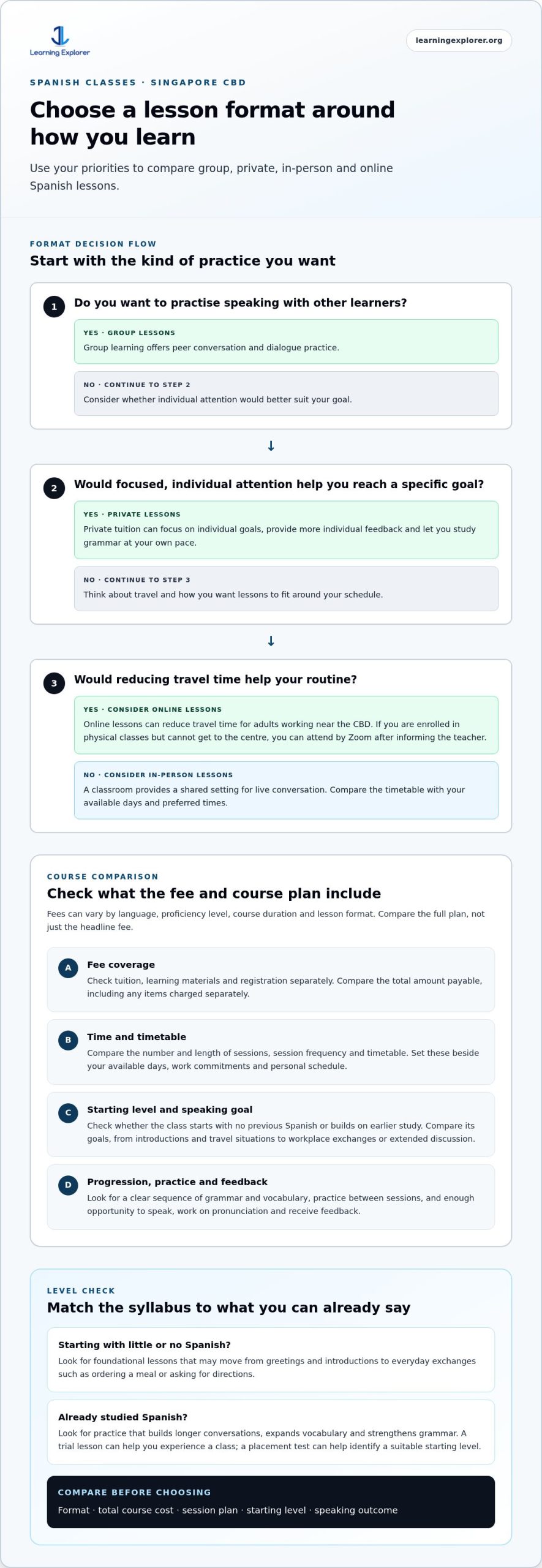
What does the course fee cover? Check tuition, learning materials and registration separately, then compare the total amount payable. For example, a course that includes materials differs from one where learners pay for them separately. Course duration matters too: compare the number and length of sessions, not just the headline fee.
Flexible scheduling can help adults fit lessons around work and personal commitments. Map out your available days and preferred times, then compare them with the course timetable. Someone with changing work shifts, for example, may value a format that fits around their calendar. Consistent attendance helps maintain momentum between classes.
What class sizes and teaching methods do CBD Spanish courses offer? Group lessons support dialogue practice, while private lessons allow more individual attention. Compare how much time each format gives you to speak, practise pronunciation and receive feedback.
Private Spanish lessons offer a focused setting for specific goals, such as practising introductions before a work trip or studying grammar at your own pace. Compare private tuition with group learning by considering individual feedback and total course cost. Group lessons offer opportunities for peer conversation, while private study centres each session on the learner.
Online lessons can reduce travel time for adults working near Singapore’s CBD. If you’re enrolled in physical Spanish classes but can’t get to the centre, you can attend a session online via Zoom after informing the teacher. This option can help maintain continuity when an office commitment or commute disrupts an in-person visit.
Are trial lessons or placement tests available for Spanish beginners? A trial lesson lets learners experience a class, while a placement test helps identify a suitable starting level. Beginners with no prior Spanish can start with foundational learning; learners with past study can use their existing knowledge to guide placement.
To compare course duration, check the timetable, session frequency and opportunities to practise between lessons. Someone choosing between weekly group classes and more frequent private sessions should weigh available study time against the course format. This makes it easier to assess course length alongside work, travel and personal goals.
Adult Spanish courses for beginner to advanced learners
Adult courses can range from first phrases to confident conversation. Compare the level, learning goals and progression before choosing a class.
Course Levels and Beginner Options
Beginner courses suit adults starting with little or no Spanish. Lessons may progress from greetings and introductions to everyday exchanges, such as ordering a meal or asking for directions. Learners with prior study can look for classes that practise longer conversations, expand vocabulary and strengthen grammar. Match the course description to what you can already understand and say.
Course Length and Level Coverage
Beginner course length depends on session frequency, lesson duration and the skills covered. A course focused on introductions covers less ground than one that progresses through everyday conversation and past events. Review the timetable and learning objectives together. Check what learners are expected to understand and say by the final session, then compare that outcome with your goal.
How long do beginner Spanish courses take, and what level do they cover? There’s no single duration or level span across Singapore CBD courses. The timetable and syllabus determine whether learners focus on basic introductions or progress to broader everyday communication.
For a useful comparison, note these details for each course:
- Starting point: Does the class assume no previous Spanish, or does it build on earlier study?
- Speaking goals: Does practice centre on introductions, travel situations, workplace exchanges or extended discussion?
- Progression: Are new grammar and vocabulary introduced in a clear sequence?
- Practice between sessions: Are learners expected to review vocabulary or prepare short speaking exercises?
These points help adults avoid choosing a class that moves too quickly or repeats familiar material. Someone who can introduce themselves but struggles to follow replies, for example, may need more listening and response practice than a complete beginner. A learner comfortable with everyday exchanges may prefer more challenging discussion.
How do reviews and course outcomes compare across Singapore CBD Spanish schools? Reviews can describe teaching style, communication and learner experience, but they don’t provide a standard measure of progress across schools. Compare stated outcomes with your goal, such as handling introductions or sustaining a conversation, rather than relying on ratings alone.
What is the cancellation or refund policy for Spanish courses in Singapore? Course terms explain whether cancellations, transfers or refunds are available and what notice is required. Read those conditions alongside the timetable before enrolling so you understand the commitments attached to the class.
To choose your next step, write down your current ability, one practical speaking goal and the time you can commit. Compare course levels and outcomes against that list. A clear match makes it easier to choose a class that supports steady progress from beginner foundations to more advanced communication.
In-person and Zoom class options
Choose a format that fits Spanish practice into your workday, commute and learning habits. In-person lessons offer a shared classroom for live conversation, while Zoom lets learners join remotely. In Singapore’s CBD, physical classes also offer an online attendance option when travel becomes difficult. Focus on how each format supports your participation, not simply where you sit.
In a classroom, learners can practise short exchanges with the teacher and classmates. For example, a pair can role-play ordering food, switch roles and repeat the dialogue. Face-to-face interaction creates a social setting that can suit adults who focus best away from home or want a regular destination in their weekly routine.
Zoom changes the setting, but learners can still take part in spoken activities. A remote student can respond to the teacher, practise a dialogue and ask for clarification during the session. Choose a quiet place, keep your learning materials nearby and join with enough time to settle in. These simple steps help reduce distractions during a live lesson.
If you’re enrolled in physical Spanish classes but can’t get to the centre, you can attend a session online via Zoom after informing the teacher. An unexpected work commitment, for example, could make the commute impractical, while joining remotely lets you continue learning. This option connects classroom and online learning without requiring a complete change to the course arrangement.
Before relying on remote attendance, follow a simple routine:
- Tell the teacher when you need to join remotely.
- Prepare your device, internet connection and lesson materials.
- Choose a quiet space where you can speak comfortably.
- Keep the lesson activity open, such as a vocabulary exercise or dialogue prompt.
Each step supports active participation rather than passive listening. Keeping a notebook open, for instance, makes it easier to record unfamiliar words during a Zoom discussion. In-person learners can use the same habit to capture useful phrases and review them after class.
Consider the practical trade-off. A CBD classroom means planning travel around the lesson, while Zoom removes the journey but requires a suitable place to participate. If your work schedule changes, online attendance can help you stay involved. If you value the classroom atmosphere, plan your commute and protect lesson time in your calendar.
Choose the format that makes regular speaking practice realistic. An adult working near the CBD might attend in person after work, while someone facing a late meeting could join remotely after informing the teacher. Compare each option with your weekly routine, then choose the format that helps you participate consistently.
What Spanish beginner courses are available in Singapore CBD?
Adults starting Spanish can compare beginner courses by starting point, practical goal and amount of speaking practice. A Spanish course for beginners in the CBD should make clear whether it assumes no prior knowledge or helps learners refresh basic Spanish. The distinction matters: someone new to the language needs a different starting point from someone who remembers greetings but struggles to hold a conversation.
For a first-time learner, look for a course pathway that introduces useful foundations in sequence. Lessons might progress from greetings and introductions to ordering food, asking for directions and describing familiar routines. These situations give beginners concrete language to practise. Compare the learning goals with situations you expect to encounter, such as speaking with Spanish-speaking colleagues or preparing for travel.
Adults who have studied before can look for a different starting point. A learner who can introduce themselves but cannot follow a reply may benefit from strengthening listening and response skills. Someone comfortable with everyday exchanges may want broader vocabulary and more sustained conversation. Write down what you can already say, then use that example to judge whether a beginner course starts too early or suits your needs.
Use these questions to compare course descriptions in Singapore:
- Starting knowledge: Does the course begin with basic greetings, or expect learners to know introductory phrases?
- Practical situations: Does practice include examples such as ordering a meal, introducing yourself or asking for directions?
- Skill balance: Does the course address speaking, listening, reading and writing, or focus more heavily on conversation?
- Next step: Does the learning pathway explain how learners can continue after building beginner foundations?
A conversation-focused course may appeal to adults who want to speak in everyday situations. For example, practise introducing yourself, asking a simple question and responding to the answer. A more balanced course may also include reading short texts or writing basic messages. Check the course description to see which skills it covers, rather than relying on the word “beginner” alone.
Finally, connect the course format to your learning goal. A learner preparing for a trip might prioritise directions, food and travel-related exchanges. Someone learning for personal interest may prefer broad everyday conversation. Choose a realistic goal, compare course outcomes with it, and select the beginner pathway whose examples most closely match what you want to do in Spanish.
Options include beginner pathways for learners with no prior Spanish and courses that refresh basic knowledge for those who know introductory phrases. Some focus on everyday conversation, while others balance speaking and listening with reading and writing.
Where are Spanish language schools and classes located in the CBD?
One Spanish-language school is based at 68 Circular Road in Singapore. For adults comparing CBD classes, location is more than a map pin: your route before or after work can shape how easily lessons fit your routine. Compare the exact class address with your usual starting point, such as your office, home or nearest MRT station.
Start with a simple route check. Note where you’ll travel from, the lesson time and your preferred transport. Someone leaving an office near Raffles Place, for example, may plan differently from a learner travelling into the CBD from elsewhere in Singapore. The address alone doesn’t show how convenient a particular class will feel on a weekday.
Use these practical steps to assess a classroom location:
- Mark your starting point: Use your office, home or regular MRT stop.
- Plan the whole journey: Consider the route to class and the trip home afterward.
- Allow for transitions: Factor in the time needed to leave work, reach the building and find the classroom.
- Compare lesson days: A route that works after work may feel different on a weekend or during a busy workday.
For example, a learner heading to 68 Circular Road from work can map the journey before choosing a regular class routine. A student travelling from outside the CBD can compare the trip with other weekly commitments. These examples help turn a location into a practical decision, rather than choosing solely by the neighbourhood name.
Building access matters too. In a multi-floor building, allow time to enter, find the lift and reach the classroom. Add the building name and unit details to your travel plan once you have them. This preparation can make it easier to fit an after-work lesson between your final meeting and class.
Location also affects how you use the time around a lesson. A nearby class may fit naturally after work, while a longer journey may call for a different lesson time or remote attendance. Think through your usual week: identify the days when you can travel comfortably and those when commuting would be difficult.
When comparing CBD options, record each school’s address, your starting point and the journey you expect to make. Then consider whether the location supports the routine you want to keep. A convenient route can make regular attendance more manageable, while a distant classroom may suit learners who prefer a particular schedule or teaching format.
Choose a location based on the route you’ll actually travel, not just its CBD label. Start with 68 Circular Road as one known Spanish-learning location, then compare its position with your own commute and weekly plans. That gives you a grounded way to assess whether an in-person class fits your routine.
Learning Explorer: Conversational English Course
Learning Explorer offers a Conversational English Course for adults who want to build everyday English alongside their Spanish studies. It may suit learners who use English at work or in daily conversations and want structured language learning for practical communication. Focus on English if that’s the skill you want to develop next; keep Spanish as your priority if it remains your immediate goal.
Consider the course when you’re ready to work on English conversation or when stronger English communication would support your personal or professional plans. Learning Explorer also offers a Business English Course for learners focused on workplace communication. Choose the option that matches the situations you want to handle, then take the next step at your own pace.
Contact Learning Explorer or visit learningexplorer.org to explore the course.
Turn your Spanish goal into a learning plan
Your next step is to choose a real situation where you want to use Spanish. It could be introducing yourself, chatting with a colleague or handling a conversation while travelling. A clear goal helps you focus on the skills you want to practise and decide what kind of learning routine feels sustainable.
If you’re considering a Spanish course for beginners in the CBD, think about how you’ll make space for regular practice alongside work and daily commitments. Start with the goal that matters most, then explore a class that can help you work towards it. Progress begins with a manageable first step, not a perfect schedule.
For a conversation about Spanish classes and your learning goals, contact Learning Explorer about Spanish classes. Take the next step when you’re ready, and give yourself room to build confidence one conversation at a time.
Frequently Asked Questions
What are the schedules for beginner Spanish courses in Singapore CBD?
Beginner Spanish schedules follow each course’s timetable and lesson format, so there’s no universal CBD class schedule. To find a workable fit, note your regular work commitments, commute time and preferred study periods. Then compare those constraints with the class timetable. Someone finishing work near the CBD, for example, may prefer a class that starts after their usual workday, while another learner may plan study around daytime commitments.
How much do beginner Spanish courses in Singapore CBD cost?
The course price varies by language, proficiency level and course duration, and is provided after a quote request. For a useful budget comparison, distinguish tuition from any one-time registration and materials fees, then consider the total course commitment rather than a single fee component. This helps you compare course structures without mistaking an administrative or materials charge for the full tuition cost.
Are there evening, weekend, group, or private Spanish lessons in the CBD?
Group and private lesson formats are available, while evening or weekend timing depends on the course timetable. Group lessons give learners opportunities to practise with others; private lessons focus each session on individual learning needs. Intensive classes are another option for learners who prefer a concentrated study plan. Set your preferred days and learning style first, then compare those needs with the available class arrangements.