Could the right Business English course be the one that practises a challenging client explanation, rather than the one with the longest finance vocabulary list? In Singapore, professionals need to communicate clearly in meetings, presentations and client conversations, often while explaining complex information. If you’re searching for business english for financial services singapore, it can be difficult to tell which course descriptions translate into useful practice. A general syllabus may not reflect the communication tasks your role or team handles.
This guide helps you compare courses by what learners need to do at work, then choose a format that fits individual or team needs. You’ll find practical criteria for assessing role relevance, learning formats and provider fit, along with questions to ask before enrolling, including whether finance-related scenarios can be incorporated. Learning Explorer offers a Business English Course in private, group and intensive formats. Ask the school about current schedules and whether lessons can be tailored to your team’s financial-services context. With a clear shortlist, you can choose learning that supports more confident, professional communication and fits a busy workweek.
Key Takeaways
- Start with the communication tasks your team handles, then define what stronger workplace English should help learners do.
- When comparing business english for financial services singapore options, ask providers to show how lesson activities connect to your goals.
- Compare private, group and intensive classes against learners’ preferred practice setting and work schedules.
- Use a checklist to assess instructor credentials, curriculum alignment, practice relevance, course format and fee transparency.
- Explore Learning Explorer’s Business English Course and corporate training, and ask whether finance-related scenarios can be included.
What Business English for Financial Services Singapore needs to cover
In Singapore’s financial-services workplaces, professionals may need to explain information clearly, contribute to meetings and communicate accurately with clients and colleagues. A useful Business English course applies professional language learning to these everyday tasks. It develops communication skills, not financial expertise or a finance qualification.
That distinction matters. A learner may understand a product or report well but still want to organise an explanation, ask a precise follow-up question or make a concise point in a meeting. Singapore’s role as a regional business centre, reflected in its economy of Singapore, makes clear workplace communication a practical consideration for finance teams.
For an example of finance-focused English conversation, watch this video:
Which financial-services communication tasks should learners practise?
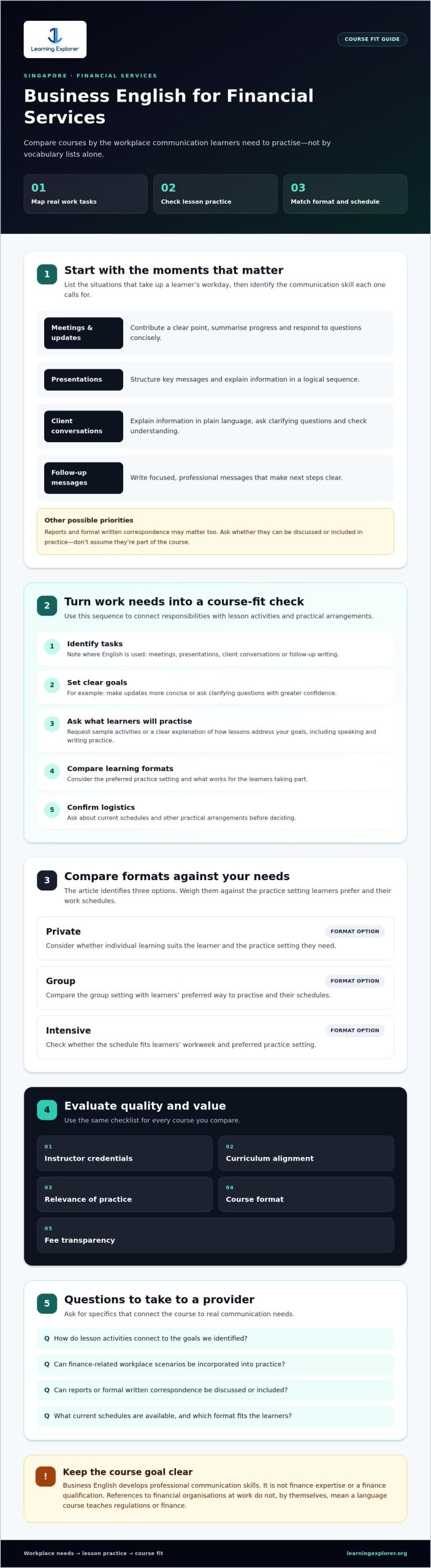
Start with the situations that take up a learner’s workday. For teams comparing business english for financial services singapore options, mapping workplace tasks to communication skills can show whether a course supports real needs or focuses mainly on general vocabulary.
| Workplace situation | Communication ability to practise |
|---|---|
| Meetings and team updates | Contribute a clear point, summarise progress and respond to questions concisely. |
| Presentations | Structure key messages and explain information in a logical sequence. |
| Client conversations | Explain information in plain language, ask clarifying questions and check understanding. |
| Follow-up messages | Write professional, focused messages that make next steps clear. |
Reports and formal written correspondence may also be priorities. Ask a prospective provider whether these can be discussed or included in practice, rather than assuming they are part of the course.
How Singapore’s workplace context shapes course fit
A finance professional working in Singapore’s CBD might collaborate with colleagues across functions, explain a point to a client, then contribute to an internal discussion. References to MAS or SGX may arise at work, but their presence doesn’t mean a language course covers regulations or finance training. Roles vary, so identify the communication moments that matter most before enrolling.
Write down a few tasks that feel challenging, such as giving a concise update or checking a client’s understanding. Share those priorities with providers and ask what practice they can offer. This makes it easier to judge whether the course fits your role without confusing stronger English communication with technical finance instruction.
How to assess whether a Business English course fits finance work
A course description can sound relevant without showing what learners will actually practise. Use a simple evaluation process to connect workplace responsibilities with lesson activities, format and practical arrangements. This makes it easier to compare business english for financial services singapore options.
- Identify tasks. Note where you use English, such as contributing to meetings, presenting information, speaking with clients or writing follow-up messages.
- Set goals. Turn each task into a clear learning aim. For example, you might want to make updates more concise or ask clarifying questions with greater confidence.
- Ask about practice. Request sample activities or a clear explanation of how lessons address your goals. Check whether speaking and writing practice reflects your responsibilities.
- Compare formats. Consider whether individual or corporate learning suits the people taking part and the practice setting they need.
- Confirm logistics. Ask about current schedules, lesson arrangements and learner feedback before making a decision.
For broader context on choosing an English course, see this guide to English courses for adults in Singapore. The Monetary Authority of Singapore also describes its official skills and talent development framework, a reminder that financial-sector roles and development needs vary. It does not establish what a particular language course covers, so assess the lessons directly.
Questions to ask before choosing a course
Ask whether learners can practise meetings, presentations, client discussions and written workplace communication. Find out how instructors adapt activities to different English proficiency levels and professional goals. Ask what feedback learners receive and how it is provided. Confirm these details with the provider rather than assuming a particular assessment or progress-reporting feature is included.
Look for a clear link between the proposed activities and your goals. If you need to explain information to clients, for instance, ask what learners would do in a relevant practice activity and how it builds communication skills.
How to compare individual and corporate training
Private lessons may suit a learner seeking focused practice on individual goals. Confirm the format and current availability directly. Corporate training may suit a team with shared communication priorities. Ask how customization is scoped and whether finance-related scenarios can be incorporated, rather than assuming specialist content is included.
Compare learning objectives, practical fit, delivery format and scheduling before considering price. If you’re exploring a Business English Course in Singapore, use your task list to ask the provider what practice may fit your needs.
Which course format suits financial professionals in Singapore?
The right format depends on what learners need to practise, how they prefer to learn and what their work schedules allow. A professional preparing for individual presentations may have different needs from a team seeking a shared approach to client conversations. Compare options by fit, then confirm the practical details with the provider.
When private, group or intensive classes may fit
Private classes may suit learners who want focused attention on their own communication goals. Group classes can offer opportunities to practise with peers, while intensive classes may suit those looking for a concentrated period of study. These are possible benefits, not guarantees. Ask how lessons are planned and whether the approach fits the learner’s proficiency and responsibilities.
| Format | May suit | Potential benefit | What to confirm |
|---|---|---|---|
| Private | An individual with specific speaking or writing priorities | Focused practice around personal learning goals | How lessons are planned, current availability and schedule |
| Group | Learners who value practising with others | Peer interaction and shared practice | Available group details, format and how differing goals are handled |
| Intensive | A learner seeking concentrated study | A more focused period of learning | Schedule, learner suitability and what the intensive format involves |
Learning Explorer offers private, group and intensive classes. Use these options as a starting point, then check current schedules and how each format works.
What Singapore employers should clarify
For corporate training, first decide whether the team shares a clear communication goal, such as giving concise updates or handling discussions more confidently. Shared aims can guide a common learning plan. If employees have substantially different responsibilities or English needs, consider whether individual practice or separate support may also be appropriate.
Ask the provider whether corporate training can be customized around the team’s stated goals. If you want finance-related scenarios, confirm whether they can be incorporated rather than assuming specialist content is included. Before committing, clarify:
- Location: Where will the training take place?
- Schedule and delivery: What arrangements are available, and do they fit work commitments?
- Materials: What learning materials, if any, should participants expect or prepare?
- Goals: What observable communication behaviours will learners practise, such as structuring a presentation or asking a clarifying question?
Keep expectations practical. Clearer updates or more organised presentations are useful learning aims, but a course should not be treated as a guarantee of business results. For business english for financial services singapore, choose a format that supports the practice learners need and can realistically fit into their working lives.
How to evaluate course quality and value before enrolling
A polished course description doesn’t always show whether the learning will fit a finance professional’s day-to-day work. For business english for financial services singapore, assess what a provider confirms about instructors and course structure, then identify what you still need to ask. Request a clear explanation of the content and how it connects to your goals before deciding.
What makes learning practical for a finance role?
Practical learning should relate to a learner’s responsibilities, not just introduce finance vocabulary. Ask whether learners can practise realistic professional interactions and whether examples can reflect situations they handle. You might also ask how instructors guide learners on clarity, tone and professional communication. Don’t assume finance-specific scenarios or written tasks are part of a course unless the provider confirms them.
Use this checklist to compare options:
- Instructor credentials: Ask about instructors’ relevant teaching credentials and experience working with learners at different proficiency levels.
- Curriculum alignment: Request an outline and ask how the course content supports your stated communication goals.
- Practice relevance: Find out what speaking and writing activities learners do, and whether these reflect their workplace responsibilities.
- Format: Confirm whether private, group or intensive classes are available and how the chosen format works.
- Fees and materials: Request a transparent breakdown, including any registration or learning-material fees, and confirm amounts in S$.
Learning Explorer offers a Business English Course and corporate language training. Its instructors are described as certified native speakers who are also bilingual, and its curriculum is described as strategically aligned with global standards. These details can inform your review. Ask the provider whether finance-related practice can be incorporated and what feedback learners receive.
How to judge value without relying on promises
Compare the stated course scope, learning format, materials and full fees rather than relying on broad claims. Ask what is included and what would cost extra. Don’t assume registration or materials are covered. A provider should be able to explain how course activities relate to your goals, without promising promotion, client growth or guaranteed fluency. Learning aims such as clearer updates are more useful measures to discuss than business outcomes a course can’t guarantee.
For more context on choosing a provider, read this English language school guide for Singapore. Then explore Learning Explorer’s Business English Course and ask how its stated course options align with your learning priorities.
Choosing Business English training with Learning Explorer in Singapore
Once you’ve defined the communication tasks learners need to practise, Learning Explorer is one Singapore provider to assess. The school offers a Business English Course and corporate language training, with private, group and intensive class formats. Its Central Business District location may be practical for learners working nearby. Confirm where training takes place and what arrangements are available.
For business english for financial services singapore, don’t assume a general Business English course includes finance-specific content. Ask whether activities can incorporate scenarios relevant to your role or team, and request a clear explanation of how the proposed learning connects to your communication goals.
Who may want to explore Learning Explorer?
Professionals seeking structured English learning for workplace communication can compare the available formats with their individual priorities. Organizations considering customized language training can start by identifying shared team goals, while noting that employees may have different roles and learning needs. A short list of role-specific tasks, such as contributing to meetings or communicating with clients, helps make the conversation with a provider more focused.
What to do before making an enquiry
Prepare the practical details first. This helps you get clear answers about course fit rather than relying on broad descriptions.
- Communication tasks: List the speaking and writing situations learners want to handle more confidently.
- Learning priorities: Describe the skills to practise and ask how course activities may address them.
- Preferred format: Consider private, group or intensive classes, then confirm current availability and what each involves.
- Schedule constraints: Share relevant work commitments and ask what schedules are currently offered.
- Course details: Confirm the content, training arrangements and whether finance-related scenarios can be incorporated.
- Fees and materials: Ask which fees apply to your situation and whether learning materials are included or separate.
Learning Explorer’s corporate training can be customized, but confirm directly whether the proposed finance-related practice is a fit. Ask about the scope before deciding, especially if the team needs examples tied to particular financial-services responsibilities. Individuals and employers can Explore Business English learning options and discuss their goals, preferred format and current course details.
Choose a Course That Fits Your Work
The strongest choice for business english for financial services singapore starts with the communication tasks you handle, not a list of industry terms. Identify the situations you want to practise, then ask providers how course activities relate to your goals. Compare private, group and intensive formats by learning preferences and work schedules, and confirm course details, fees and materials before deciding.
Learning Explorer offers a Business English Course and corporate language training, with private, group and intensive formats. The school is located in Singapore’s Central Business District. If you’re considering it, ask whether finance-related scenarios can be incorporated, and confirm current availability and arrangements. Corporate training can be customized, so sharing your team’s communication priorities can help clarify whether the proposed fit is right.
Take the next step with clear questions and realistic learning goals. Explore Business English learning options and discuss a practical starting point for communicating more confidently at work.
Frequently Asked Questions
Is Business English for financial services different from general Business English?
It can differ in focus when course practice reflects the communication tasks financial professionals handle. This might include contributing in meetings, presenting information or speaking with clients. Ask which scenarios and skills are included, as not every course has a finance-specific syllabus. Business English develops language and communication skills. It doesn’t teach financial expertise, product knowledge or technical finance content.
What should I look for in a Business English course for finance professionals in Singapore?
Check the course goals, instructor background, workplace practice, learner feedback, class format and fees. Explain your role and the situations where you use English, such as client discussions or team presentations. Employers should clarify how corporate training can be customized and confirm logistics such as schedules and delivery arrangements. Ask directly whether finance-related scenarios are included rather than assuming specialist content.
Can a Business English course help me communicate with financial services clients?
It can provide practice in professional communication, but its relevance depends on the activities offered and your goals. Ask whether lessons include client conversations, clarifying questions and explaining information in plain English. You can also describe the kinds of interactions you want to practise. A course can’t guarantee client outcomes, replace technical or product knowledge, or ensure that every client conversation will go smoothly.
How do I choose between private and group Business English classes?
Private classes may suit learners who prefer focused individual practice, while group classes may offer opportunities to interact with peers. The right choice depends on learning goals and preferred practice setting. Confirm current schedules, availability, class arrangements and course objectives with the provider. For a team, shared goals may support group learning, while employees with distinct responsibilities or needs may benefit from a different approach.
Does Learning Explorer offer corporate Business English training in Singapore?
Learning Explorer offers a Business English Course and customized corporate language training. Ask whether Business English can be included in a corporate programme, and confirm current availability, delivery arrangements, fees and any applicable material or registration charges. If the team wants financial-services scenarios, ask whether these can be incorporated rather than assuming a specialist finance curriculum. Share the team’s communication goals so the provider can explain the proposed scope and how it may fit.
How much does Business English training in Singapore cost?
Learning Explorer’s course fees vary by language, proficiency level and course duration. Corporate training fees are typically negotiated based on factors such as group size, curriculum customization and training location. Request current pricing directly and check whether one-time registration fees or physical or digital learning materials are charged separately. Confirm which costs apply to your course or organization before enrolling rather than relying on general estimates.
Where can I take Business English classes in Singapore?
Compare providers’ locations, schedules and class formats with your work routine. Learning Explorer is located in Singapore’s Central Business District and offers private, group and intensive formats. Before travelling, confirm current class availability, training location and arrangements directly with the school. If you’re enquiring for a team, also check whether the proposed delivery arrangements and schedule fit employees’ work commitments.