What if the biggest barrier to Japanese language learning isn’t memorizing thousands of Kanji characters, but relying on isolated apps that never actually teach you to speak? If you’ve spent late evenings wrestling with Hiragana and Katakana, second-guessing grammar particles, or wondering how to fit study sessions into a demanding schedule, you aren’t alone. The leap from memorizing random vocabulary on your phone to holding a real dialogue often feels intimidating, especially when balancing complex social politeness levels alongside a full-time career.
You don’t need endless solo drills or years of trial and error to achieve genuine fluency. In this complete guide, you’ll discover how to master Japanese language learning efficiently through structured frameworks, proven conversational techniques, and expert guidance. We’ll map out your foundational roadmap, show you how to form natural spoken sentences without second-guessing yourself, and help you establish a sustainable routine that delivers rapid, practical results in 2026.
Key Takeaways
- Understand how Hiragana, Katakana, and Kanji complement each other so you can navigate foundational literacy without feeling overwhelmed.
- Follow a phased roadmap for Japanese language learning that transitions smoothly from phonetic accuracy to spontaneous sentence construction.
- Discover why pairing mobile practice with structured native-speaker guidance bridges the gap between passive recognition and real-world conversational confidence.
- Implement high-impact micro-learning strategies, such as daily auditory shadowing, to maintain consistent progress alongside a busy career schedule.
Demystifying Japanese Language Learning: Writing Systems and Structural Foundations
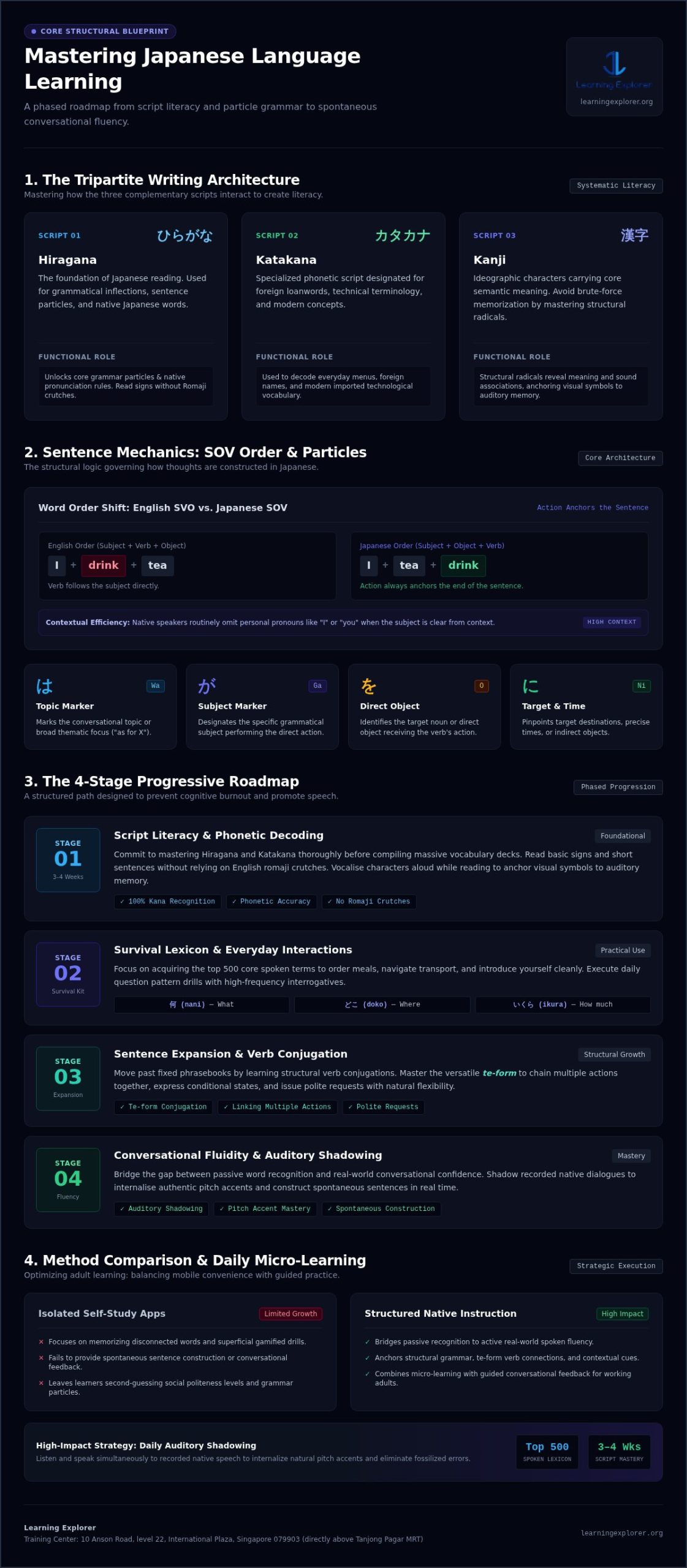
Approaching Japanese language learning systematically removes early intimidation and creates a clear, predictable path forward. Many beginners feel overwhelmed by unfamiliar scripts, yet the core architecture of the Japanese language is logical and structured once broken down into its functional components. Japanese incorporates Hiragana for grammar, Katakana for loanwords, and Kanji for semantic meaning. Mastering these three complementary scripts alongside spoken phonetics gives you a dependable framework for long-term fluency.
To accelerate your initial progress with reading and pronunciation, watch this structured walkthrough:
Navigating the Three Writing Systems: Hiragana, Katakana, and Kanji
Start with Hiragana to unlock core grammar particles and native pronunciation rules. Next, tackle Katakana to decode menus, modern technical terminology, and foreign loanwords with ease. Rather than using brute-force memorisation for Kanji, learn to recognise structural radicals that reveal meaning and sound associations. Vocalising characters aloud while reading anchors visual symbols to auditory memory, preventing fossilised pronunciation errors from taking root.
Japanese Grammar Mechanics: SOV Order and Particles Explained
Japanese follows a Subject-Object-Verb (SOV) sentence order. In practice, this means the action always anchors the end of your sentence, turning English phrasing like “I drink tea” into “I tea drink.”
- Wa (は): Marks the conversational topic or broad theme (“as for X”).
- Ga (が): Designates the specific grammatical subject performing the action.
- O (を): Identifies the direct object receiving the verb’s action.
- Ni (に): Pinpoints target destinations, precise times, or indirect objects.
Context carries significant weight in everyday dialogue. Native speakers routinely omit personal pronouns like “I” or “you” when the subject is obvious. Embracing this streamlined dynamic lets you communicate naturally without overthinking complex syntax, turning your Japanese language learning journey into an intuitive daily practice.
The 4 Core Stages of Japanese Language Learning for Beginners
Most working adults quit learning Japanese because conventional courses swing between two extremes: superficial gamified apps that teach disconnected words, or rigid academic degrees that demand years of historical linguistics. A sequential, phased roadmap prevents cognitive burnout by targeting practical communicative milestones. Global standards maintained by The Japan Foundation show that adult learners advance fastest when functional literacy and spoken application develop hand in hand, rather than treating speech as an afterthought.
Stages 1 and 2: Script Literacy and Everyday Interactions
The opening phase builds phonetic accuracy and script reading within three to four weeks. Commit to mastering Hiragana and Katakana thoroughly before compiling massive vocabulary decks. Once you can decode kana comfortably, Stage 2 shifts toward high-utility survival communication. Focus on acquiring the top 500 core spoken terms that allow you to order meals, navigate transport, and introduce yourself cleanly.
- Phonetic Decoding: Read basic signs and short sentences without relying on English romaji crutches.
- Survival Lexicon: Memorise high-frequency terms for daily routines, directions, and transactional exchanges.
- Pattern Drills: Practice question structures using nani (what), doko (where), and ikura (how much) daily.
Stages 3 and 4: Sentence Expansion and Conversational Fluidity
Moving past phrasebook memorisation requires structural flexibility. Stage 3 introduces verb conjugations, particularly the versatile te-form, which allows you to link multiple actions, state conditions, and make polite requests. You will also begin shadowing recorded dialogues to internalise natural pitch accents.
Stage 4 marks the leap into unscripted, spontaneous conversation. Here, you transition from translating thoughts in your head to reacting fluidly in real-time scenarios. You learn cultural pragmatics, such as reading situational cues and shifting smoothly between informal banter and workplace politeness (keigo).
Navigating these progressive milestones becomes significantly easier with expert feedback. If you want structured momentum outside your work commitments, exploring an interactive Conversational Japanese Course can provide the guided speaking practice needed to turn isolated grammar rules into fluent everyday conversation.
Comparing Study Methods: Self-Study Apps vs. Structured Live Instruction
Measuring true Japanese language learning success requires looking past gamified streaks and matching games. An app notifying you of a 100-day streak doesn’t guarantee you can comfortably order at an izakaya or clarify a workplace request. Real conversational readiness demands spontaneous verbal output. While independent study tools build foundational awareness, relying exclusively on digital software often traps learners in passive recognition mode.
The Inherent Limitations of Gamified Language Apps
Gamification keeps users hooked, but it rarely produces spontaneous speakers. Tapping multiple-choice prompts trains passive recognition rather than active vocal formulation. When studying intricate rules of Japanese grammar and syntax, software algorithms can’t detect subtle pitch-accent slips or explain why a particular response sounds unintentionally blunt. Without targeted feedback, beginners unknowingly reinforce pronunciation errors that become difficult to break later.
The Measurable Value of Native-Instructor Classrooms
Live instruction with certified bilingual native teachers transforms static textbook theory into practical muscle memory. Instead of pausing to mentally translate English thoughts into Japanese, guided classroom exchanges train your brain to react naturally in the moment.
- Immediate Feedback: Instructors gently correct pronunciation and clarify cultural politeness levels that apps overlook.
- Dynamic Speaking Drills: Partner interactions and unscripted dialogues force you to adapt your vocabulary to unpredictable replies.
- Built-In Accountability: Fixed weekly sessions establish a consistent routine, dramatically lowering the high dropout rates common with solitary study.
For working adults, a blended learning model offers the highest return on investment. Use mobile tools during short commutes to review character sets and vocabulary decks, then bring those newly acquired terms into structured classroom sessions to practice live communication. This balanced approach turns independent study into genuine conversational capability, making your Japanese language learning both time-efficient and sustainable.
Essential Strategies to Accelerate Japanese Fluency as a Working Adult
Balancing a demanding career with Japanese language learning requires deliberate efficiency rather than weekend marathon sessions. Passive habits, like playing background audio while checking emails, rarely produce spoken fluency. Instead, replace passive listening with fifteen minutes of active auditory shadowing each day, repeating recorded phrases aloud to calibrate your vocal mechanics. Pair this with a digital spaced repetition system (SRS) focused on vocabulary relevant to your daily routine. Treat early mistakes as useful diagnostic feedback points; stumbling through unscripted sentences is the fastest way to build linguistic resilience.
Integrating Active Language Habits into a Hectic Workday
Transform routine pockets of downtime into focused micro-sessions. Reviewing twenty Kanji cards during your morning MRT commute reinforces visual recall without eating into your personal evening schedule. At your desk, narrate simple physical actions silently in Japanese, such as opening a spreadsheet or stepping into an elevator. This simple internal monologue habit strengthens syntax recall, eliminating the lag time between forming a thought and saying it aloud.
Mastering Japanese Etiquette and Situational Nuance
Professional communication requires navigating social hierarchies and cultural expectations with confidence. Beginners should anchor themselves in standard polite forms (desu and masu) before experimenting with informal plain forms or layered honorific speech (keigo).
- Meeting Protocol: Understand the ceremonial two-handed presentation of business cards (meishi koukan) and respectful seating arrangements.
- Physical Nuance: Match your verbal greeting with appropriate bow angles, reserving deeper bows for clients and senior management.
- Indirect Refusals: Soften disagreements using phrases like chotto muzukashii (it is a bit difficult) rather than blunt negative statements.
To master these situational nuances and accelerate your Japanese language learning with structured native feedback, register for our Conversational Japanese Course designed specifically around the busy schedules of working adults.
Taking the Next Step: Structured Japanese Language Learning at Learning Explorer
Transitioning from basic recognition to fluent speech requires more than solo app drills. Founded in 2015 with over a decade of language training expertise, Learning Explorer provides adult-focused courses designed to build practical conversational readiness quickly. Our curricula align directly with recognized global proficiency standards, giving you measurable milestones without academic overload. Certified native-speaker instructors who are fully bilingual guide every class, making it easy to clarify subtle grammar nuances in English before putting them straight into spoken practice.
The Conversational Japanese Course Curriculum
Our curriculum takes adult learners from zero initial background to confident, everyday communicators. Instead of bogging you down with archaic grammar theory, lessons focus on high-yield speaking drills, interactive partner role-plays, and real-world conversational themes. You will practice ordering meals, asking for complex transit directions, and holding social banter with immediate pronunciation feedback. Check out our detailed learn Japanese language guide to explore how our foundational teaching framework helps adult beginners build rapid speaking momentum.
Why Professionals in Singapore Choose Learning Explorer
Navigating a demanding corporate schedule shouldn’t force you to put your linguistic goals on hold. Professionals across the city partner with Learning Explorer for several practical reasons:
- Prime CBD Location: Our modern training centre is at 10 Anson Road, level 22, International Plaza, Singapore 079903, directly above Tanjong Pagar MRT. Attending evening classes after office hours is seamless.
- Small, Focused Group Sizes: Capped class sizes ensure you spend less time listening quietly and more time actively producing spoken Japanese with your peers.
- Curated Learning Resources: We provide structured, vetted course materials that save you the frustration of sifting through fragmented internet tutorials.
- Flexible Training Options: Choose between interactive small-group evening sessions or private coaching tailored specifically to your individual pace.
Building real-world speaking confidence doesn’t require years of trial and error. Explore our full range of Learn Japanese Language Course options today to find a class schedule that matches your professional routine, and start your Japanese language learning journey with expert guidance.
Transform Your Japanese Fluency in 2026
Achieving practical speaking confidence doesn’t require endless flashcard drills or years of isolated study. Sustainable Japanese language learning happens when you combine foundational script literacy with active, real-time conversation. By adopting focused daily shadowing habits and embracing mistakes as stepping stones, you can turn complex grammar into natural verbal agility.
Learning Explorer provides the structure and accountability needed to bridge the gap between textbook theory and spontaneous dialogue. Led by certified native-speaker instructors who are fully bilingual, our interactive curriculum is designed specifically for adult professionals aiming for rapid conversational fluency. Centrally situated at International Plaza directly above Tanjong Pagar MRT, our evening and weekend classes fit effortlessly into your busy career routine.
Step beyond passive memorization and discover how rewarding fluent communication can be. Begin Your Conversational Japanese Journey with Learning Explorer and unlock authentic conversational mastery today.
Frequently Asked Questions
Is Japanese difficult for absolute beginners who only speak English?
Japanese feels unfamiliar initially due to its distinct writing systems and Subject-Object-Verb syntax, but its phonetic consistency makes speaking remarkably straightforward. Japanese features only five basic vowel sounds and follows strict pronunciation rules with virtually no silent letters. While memorizing characters requires early discipline, the grammar relies on logical building blocks rather than unpredictable exceptions, making foundational Japanese language learning accessible with structured study.
How long does it typically take to become conversationally fluent in Japanese?
Most dedicated adult learners reach practical conversational fluency within six to nine months of consistent study. Reaching this milestone involves mastering basic transactional speech, asking everyday questions, and understanding routine social responses. Fluency timelines accelerate significantly when you combine weekly live lessons with fifteen minutes of daily review, focusing your initial energy on high-frequency vocabulary rather than attempting to memorize rare literary kanji characters right away.
Do I need to learn Kanji immediately when starting Japanese language learning?
No, you don’t need to tackle Kanji on day one. Beginners should first master the phonetic Hiragana and Katakana syllabaries, which takes roughly three to four weeks. Once you read kana smoothly and grasp essential sentence patterns, you can introduce high-utility Kanji gradually using radical components. This phased sequence prevents cognitive fatigue and ensures your Japanese language learning focuses on practical communication before written complexity.
Can I learn Japanese effectively using only mobile smartphone apps?
Mobile apps are fantastic tools for memorizing vocabulary and reviewing character flashcards during short commutes, but they rarely build spontaneous speaking ability. Relying solely on software traps you in passive recognition patterns without training your mouth and vocal cords. To develop genuine conversational confidence, you need real-time verbal drills and authentic conversational exchanges where an instructor can correct subtle pronunciation and grammatical missteps immediately.
What is the main difference between polite Japanese and casual Japanese?
The primary difference lies in verb endings and social distance. Polite Japanese relies on standard desu and masu sentence endings, signaling mutual respect between colleagues, strangers, and service staff. Casual Japanese uses plain verb forms and dropped particles, reserved strictly for close friends and family. Adult learners should prioritize polite forms first, as they are universally accepted and prevent inadvertent social friction across Singapore’s corporate environments.
How many hours per week should a working professional dedicate to Japanese study?
Setting aside three to four hours each week delivers steady, noticeable progress without overwhelming your work-life balance. An ideal schedule pairs one two-hour structured classroom session with fifteen to twenty minutes of daily micro-practice, such as shadowing audio dialogues or reviewing spaced repetition flashcards. Consistency matters far more than irregular weekend cramming, as daily exposure prevents forgetting curves from eroding your hard-earned vocabulary.
What are the benefits of learning Japanese with a certified bilingual native instructor?
Certified bilingual native teachers bridge the cultural and linguistic gap that self-study materials simply can’t address. They provide immediate, precise feedback on pitch accent, model natural conversational pacing, and explain complex Japanese particles clearly in English. This targeted human guidance eliminates confusion quickly, reinforces proper conversational etiquette, and keeps you accountable so you stay motivated through every stage of your educational journey.