The course with the most finance jargon may not be the one that helps you communicate best at work. If you’re searching for an english for finance professionals course sg, start with the conversations and writing your role actually demands, from explaining figures to answering client questions. Then check whether the course lets you practise those tasks instead of assuming a general syllabus will cover them.
It’s understandable to want relevant training without adding pressure to an already demanding schedule. A general Business English course may help with workplace communication, but the right fit depends on your priorities, current level and opportunities to practise. Private, group and intensive formats each offer a different learning experience, so compare them with the time you can realistically set aside.
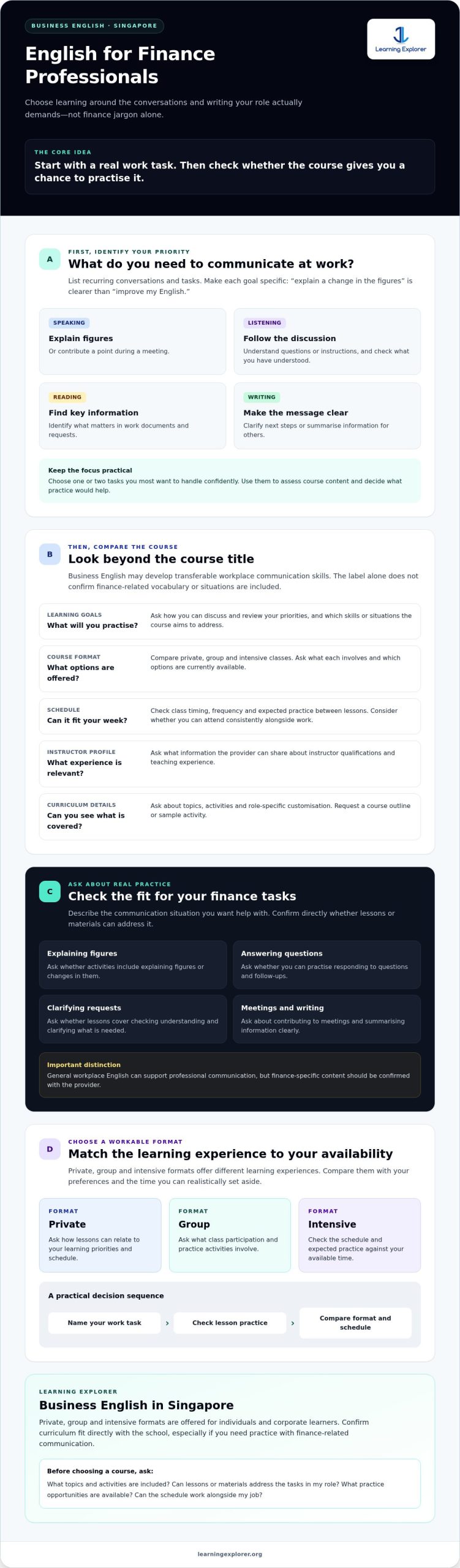
This guide will help you identify communication priorities for your finance role, compare course formats and build a practical learning plan. You’ll also find questions to ask providers about lesson focus, practice opportunities, scheduling and materials. Learning Explorer offers a Business English Course in Singapore, with private, group and intensive formats to explore. Before enrolling, ask whether lessons or materials can address your specific finance communication needs.
Key Takeaways
- Choose an english for finance professionals course sg based on the communication tasks you want to practise, not finance terminology alone.
- Compare private, group and intensive formats with your learning preferences and realistic availability.
- Check what the Business English curriculum covers. The course label alone doesn’t confirm finance-specific content.
- Before enrolling, ask about lesson materials, practice opportunities and whether the course can address the communication needs of your role.
- Learning Explorer offers Business English in private, group and intensive formats for individuals and corporate learners. Confirm curriculum fit directly with the school.
English for Finance Professionals in Singapore
A busy finance role can leave little time to search for the right words. You may need to explain figures, clarify a request or contribute to a meeting while keeping your message accurate and easy to follow. Consider an english for finance professionals course sg in light of these real communication demands, not just the terminology it appears to cover.
Needs vary by role. An analyst might focus on describing data and answering questions about a report, while someone in client-facing work may need to explain information clearly and respond to follow-up questions. General workplace English can support communication in both situations, but check with each provider about specialist finance vocabulary or curriculum. The English for Specific Purposes (ESP) approach offers a useful lens: connect language learning to the learner’s discipline and practical context.
Which communication tasks matter in your finance role?
Start with a simple inventory. List recurring conversations with colleagues, clients and other stakeholders, then note what you need to do in each one. Be specific: “explain a change in the figures” is a clearer learning target than “improve my English.”
- Speaking: Explain figures or contribute a point during a meeting.
- Listening: Follow questions, instructions or discussion, and check that you’ve understood.
- Reading: Identify key information in work documents and requests.
- Writing: Clarify next steps or summarise information for others.
These are prompts, not a checklist every finance professional must follow. Choose one or two tasks you most want to handle confidently. That focus can help you assess course content and decide what practice would be useful.
Is general Business English enough for finance professionals?
A Business English course may help develop transferable workplace communication skills, such as expressing ideas clearly, asking follow-up questions and taking part in professional discussions. These skills can be relevant across finance roles. However, a course title alone doesn’t confirm that lessons include finance-specific vocabulary or situations.
Ask each provider for sample topics, learning activities and curriculum details. You might ask whether learners practise explaining figures, clarifying requests or contributing to meetings, and whether finance-related material is included. If you need help with a particular task, describe it and ask whether lessons or materials can address it. Confirm the answer directly rather than assuming the course covers your requirements.
Once you’ve listed your priorities, you can assess whether a course fits your role before comparing its format and schedule.
How to Compare English Courses for Finance Professionals in Singapore
Compare courses against the priorities you identified, not just their titles. For a useful english for finance professionals course sg, look for clear information about learning goals, teaching format, schedule and content. The Monetary Authority of Singapore’s Skills Framework for Financial Services can also help you reflect on the skills relevant to your role and identify communication areas to discuss with providers.
| What to compare | What to look for | What to ask |
|---|---|---|
| Learning goals | Skills and situations the course aims to address | How can I discuss and review my learning priorities? |
| Format | Private, group or intensive classes | What does each format involve, and which options are currently available? |
| Schedule | Class timing, frequency and expected practice between lessons | Can I attend consistently alongside my work calendar? |
| Instructor profile | Qualifications and relevant teaching experience | What information can you share about the instructors? |
| Curriculum transparency | Topics, activities and any role-specific customisation | Can I review a course outline or sample activity? |
Private, group or intensive English classes: which format fits?
Private classes may suit you if you prefer individual attention and want to focus discussions on your learning priorities. Group classes offer interaction with other learners, while an intensive format may appeal if you prefer a more concentrated pace. These describe different learning experiences, not particular results. Check each provider’s current format details, then weigh them against your calendar, preferred learning environment and time for practice.
What should you check about instructors and course content?
Ask about instructors’ qualifications and relevant teaching experience, and request a clear outline of course topics and activities. If finance-related scenarios or other role-specific customisation matter to you, confirm whether they can be included. Don’t infer specialist content from a course name. Ask what is covered and how learning priorities and progress are discussed.
Learning Explorer offers a Business English Course for individuals and corporate learners, with private, group and intensive formats. The school describes its instructors as certified native speakers who are bilingual. Ask the team about current format details and whether lessons or materials can address your finance communication needs. You can explore the Business English course in Singapore as one option to assess against your checklist.
Will a Business English Course Address Finance-Specific Communication?
Not necessarily. A Business English label tells you the broad learning area, not whether the course includes finance subject matter. A course may offer practice with transferable workplace communication, but don’t assume it covers specialist terminology or finance-related scenarios without checking.
Business English develops how you communicate at work; finance subject knowledge concerns what you communicate about. The two can overlap in a lesson, but one doesn’t automatically include the other. Clear communication also matters in Singapore’s financial sector: the Monetary Authority of Singapore’s hiring criteria identifies communication skills among qualities sought for graduate officer positions. That supports the value of clear communication, but it doesn’t confirm what any particular course teaches.
If you’re considering an english for finance professionals course sg, the practical question is whether the provider’s actual lessons fit the situations you need to handle. Check the learning activities and materials, not only the course name or a general promise of workplace relevance.
Which finance-related situations should you ask about?
Bring examples from your own work. You might want to explain information clearly, ask a precise clarifying question or join a discussion with colleagues or stakeholders. Ask whether these situations can be discussed or practised in the course, and what that practice would involve. Don’t assume specific finance topics are included unless the provider confirms them.
A useful answer should make the scope clear: what learners will work on, how the activities relate to your communication goals and what remains outside the course. If a scenario is important to you, describe it plainly and ask whether it can be addressed.
How to verify specialist fit before enrolling
Request the course outline and compare it with your communication goals. Ask whether you can discuss your priorities before lessons begin, and whether the listed activities give you a chance to practise situations that matter to you. If the outline is broad, ask for sample materials or a clearer explanation of what learners do in class.
- Which topics and communication activities are included?
- Can I discuss my learning priorities before the course begins?
- Can the lessons or materials address the situations I’ve described?
- How are priorities and progress discussed during the course?
Treat customisation, finance-related materials and specific outcomes as open questions until the provider confirms them. A clear explanation helps you judge whether general workplace practice is enough or whether you should look for a closer curriculum fit.
How to Choose a Singapore English Course Around Your Work Schedule
A course fits your working life only if you can attend consistently and make time to practise. Before comparing options, look at your real calendar: recurring meetings, reporting periods, client commitments and the time you can protect for learning. This makes it easier to choose an english for finance professionals course sg around a workable plan, rather than an ideal week that rarely happens.
A four-step course-selection checklist for working professionals
- Set a goal. Write down two communication tasks you want to handle more confidently, such as explaining information or contributing to a discussion.
- Review formats. Compare the available class settings with your preferred way to learn and the time you can commit.
- Check schedules. Ask about current class timings and frequency. Consider attendance alongside the time needed to review or practise between lessons.
- Ask about content. Request course details and confirm whether finance-related situations can be discussed or practised. Don’t assume a specialist focus without confirmation.
In Singapore, a school’s Central Business District location may be convenient if you work nearby, but proximity doesn’t tell you whether class timings fit. Check both commute practicality and schedule details before deciding. Keep your plan realistic: a format that fits your calendar is more useful than one you may struggle to attend.
Questions for individuals and corporate decision-makers
If you’re choosing as an individual, ask which formats are currently available, what the course covers and how its content relates to your goals. Be ready to describe the situations you want to practise. You can also use this guide to English courses for adults in Singapore to consider broader course-selection factors.
For employer-sponsored learning, first identify the communication needs of the people who would take part. Different roles may call for different priorities, so clarify whether learners share goals or need different areas of focus. Then ask providers about corporate course arrangements, available formats, scheduling and how learning priorities can be discussed. Confirm any finance-specific content directly rather than treating it as included by default.
Learning Explorer offers a Business English Course for individual and corporate learners, with private, group and intensive formats. Compare those options with your needs by reviewing Learning Explorer’s Business English course options and asking the school about current schedules and course content.
Explore Business English Training in Singapore with Learning Explorer
Learning Explorer offers a Business English Course in Singapore for individual and corporate learners. If you’re considering an english for finance professionals course sg, assess it against the communication goals you’ve identified. The school offers private, group and intensive formats, giving you different learning settings to ask about as you compare course fit and availability.
What Learning Explorer confirms about its Business English Course
Learning Explorer describes its instructors as certified native speakers who are bilingual. The available course details establish the training focus and formats, but don’t confirm a dedicated finance syllabus, specific class schedules, durations or class sizes. Check those details directly with the school, especially if you need practice with a particular finance-related communication task.
The training centre is at 10 Anson Road, level 22, International Plaza, Singapore 079903, directly above Tanjong Pagar MRT. Its Central Business District location may be useful when planning your commute, but you’ll still need to confirm current class timings and format availability.
What to ask before taking the next step
Start with a couple of clear goals. Describe the work situations you want to handle more confidently, then ask whether the course can address them. Request relevant course details and ask how you can discuss your learning priorities. Treat finance-specific lessons, tailored materials or customisation as questions to confirm, not features to assume.
- Which private, group or intensive options are currently available?
- What topics and activities does the course cover?
- Can lessons or materials address the finance communication situations I’ve described?
- How can individual or corporate learners discuss their goals and course suitability?
These questions help you make a considered choice without expecting a general Business English course to include specialist finance content automatically. For more context on choosing a provider, read this English language school guide for Singapore.
Share your goals with the school and confirm course suitability before enrolling. Explore Business English courses with Learning Explorer and ask about the format and content that may fit your needs.
Choose Training That Fits Your Role and Routine
The strongest course choice starts with your real communication priorities. Identify the work situations you want to handle with more confidence, then check whether the course content addresses them. A Business English label alone doesn’t confirm finance-specific lessons, so ask providers about topics, activities and learning priorities before enrolling.
For an english for finance professionals course sg, compare formats and schedules with the time you can realistically commit. Learning Explorer offers a Business English Course for individual and corporate learners, with private, group and intensive formats. Its training centre is in Singapore’s Central Business District. Confirm current availability and ask the school directly whether the course suits your finance communication goals.
Ready to check whether the course fits your goals? Explore Business English courses with Learning Explorer and discuss the format and content that may suit your needs.
Frequently Asked Questions
Is there an English course in Singapore specifically for finance professionals?
Learning Explorer offers a Business English Course in Singapore, but its available course information doesn’t confirm a dedicated finance syllabus. If you’re comparing an english for finance professionals course sg, ask providers whether finance vocabulary or work scenarios are included. Share the tasks you want to practise, such as explaining figures or joining stakeholder discussions, and request an outline or sample activity to assess whether the course matches your needs.
What should finance professionals look for in a Business English course?
Look for clear course goals, a useful format and a schedule you can attend consistently. Review the outline for practical communication activities, and ask how you can discuss your learning priorities. Check the instructor profile and ask whether lessons can address your work situations. A Business English label alone doesn’t confirm finance-specific content, so request details rather than relying on the course name to indicate specialist coverage.
Can I take private English lessons for finance work in Singapore?
Private classes are one format to explore. Learning Explorer offers private formats for its courses, but you should confirm current availability and details directly with the school. Explain which finance-related tasks you want to handle more confidently, then ask whether the course can address them. Don’t assume lessons include tailored finance content. First check the outline, learning activities and whether your priorities can be discussed.
How do I know if a course will help with finance meetings?
Ask the provider what meeting-related activities the course includes and whether you can practise situations relevant to your role. For example, you might want to contribute a point, ask a clarifying question or respond to a follow-up. Request a course outline or sample activity, and explain your goals before enrolling. This helps you check the actual content instead of assuming that a Business English course covers finance meetings.
Are group English classes suitable for finance professionals?
They may suit learners who value interaction with other students and a shared class setting. Whether a group course fits depends on your goals, preferred learning environment and schedule. Ask about current format availability, how class activities work and whether your priorities can be discussed. If you need practice with a particular finance-related situation, confirm whether it can be included rather than assuming the group curriculum covers it.
Where can I take Business English classes in Singapore’s CBD?
Learning Explorer’s training centre is in Singapore’s Central Business District at International Plaza, directly above Tanjong Pagar MRT. The school offers a Business English Course in private, group and intensive formats. Check directly with Learning Explorer for current format availability and class details. Its CBD location may be convenient if you work nearby, but confirm the schedule too so you can plan around your work commitments.
Can employers arrange English training for finance teams in Singapore?
Employers can enquire about Business English training for corporate learners. Learning Explorer offers its Business English Course to corporate clients, but employers should discuss arrangements directly with the school. Outline the team’s communication needs, preferred learning format and scheduling considerations. Ask whether the course content can address the team’s finance-related situations, and confirm the details before making a decision. Don’t assume customisation is included without checking.