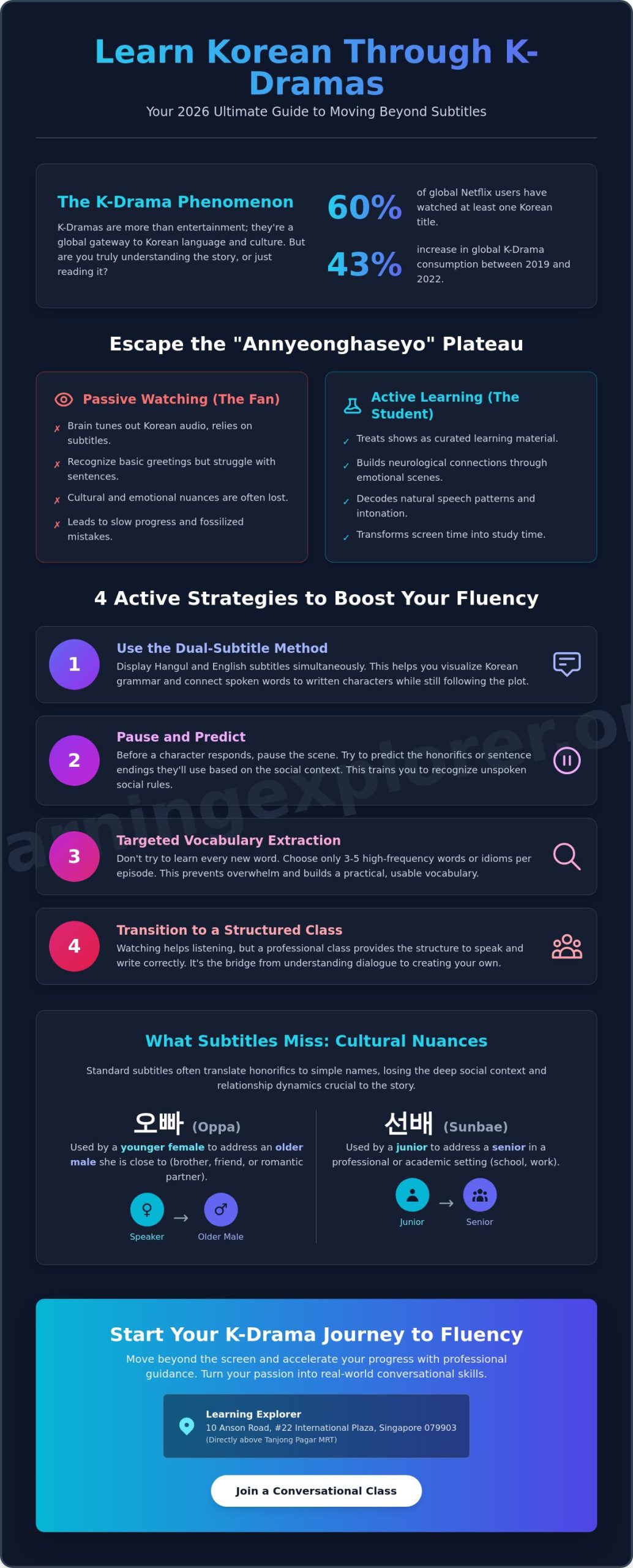
Did you know that 60% of Netflix users globally have watched at least one Korean title according to February 2026 data? If you’re part of that majority, you’ve likely felt the frustration of missing a clever pun or a subtle emotional shift because you were racing to keep up with fast-moving subtitles. It’s difficult to fully immerse yourself in a story when you’re constantly translating in your head. You want to understand the “why” behind a character’s choice of honorifics and feel the genuine impact of every scene without a language barrier standing in the way.
The good news is that you can learn korean to understand k-drama while turning your favorite hobby into a bridge to real-world fluency. At Learning Explorer, located at 10 Anson Road, level 22, International Plaza, Singapore 079903, right above Tanjong Pagar MRT, we believe your passion is the perfect spark for educational success. This 2026 ultimate guide will empower you to simplify complex grammar and use active learning strategies to move past the subtitles for good. We’ll outline a clear path to help you decode cultural nuances and gain the confidence you need to join a conversational class.
Key Takeaways
- Transform passive binge-watching into an intentional study session by treating your favorite shows as curated learning objects for natural speech.
- Discover how to learn korean to understand k-drama through the dual-subtitle method, which helps you visualize Hangul while following the plot.
- Uncover the cultural nuances behind honorifics like “Oppa” and “Sunbae” to grasp the deep social hierarchies that standard subtitles often miss.
- Streamline your learning path by transitioning from isolated phrases to a structured conversational curriculum that prevents fossilized mistakes.
- Gain the confidence to join a professional conversational class and eventually enjoy your favorite series without the need for English translations.
Can You Really Learn Korean by Watching K-Dramas?
Many fans wonder if they can truly learn korean to understand k-drama simply by hitting “play” on their favorite streaming service. The short answer is yes, but it requires a shift from passive consumption to active engagement. While global consumption of K-dramas rose by 43% between 2019 and 2022 according to WifiTalents, simply watching doesn’t guarantee fluency. You need a bridge between being a spectator and becoming a speaker. Real progress happens when you move beyond the “Annyeonghaseyo” phase and start analyzing the dialogue as a functional system.
K-dramas act as a high-quality “learning object” because they showcase the Korean language in its most natural, conversational form. Unlike textbook dialogues that often feel stiff or outdated, dramas provide a seamless look at how people actually talk, argue, and express love. This emotional resonance is a powerful tool for memory retention. When you hear a new word during a heart-wrenching scene, your brain creates a stronger neurological connection to that vocabulary than it would through a generic flashcard. You aren’t just memorizing sounds; you’re attaching them to human experiences.
However, you must set realistic expectations. You won’t become fluent by osmosis alone. Watching TV helps you recognize patterns and improves your listening comprehension, but it won’t teach you how to conjugate irregular verbs or write complex sentences from scratch. It provides the “spark” of inspiration, while a structured curriculum provides the foundation. Think of K-dramas as your laboratory where you test what you’ve learned in a professional setting.
The “Spark” of Inspiration
Character-driven stories provide the necessary motivation to help you push through the “grit” of daily practice. You stay engaged because you’re emotionally invested in the protagonist’s journey. These shows offer authentic native speaker intonation, which is vastly superior to the robotic, monotone voices often found in basic language apps. In the context of modern media consumption, immersion is the intentional act of replacing your native language environment with authentic target-language media to stimulate natural acquisition. This constant exposure helps your brain map out the rhythm of the language without it feeling like a chore.
The Limits of Passive Watching
Passive watching has its boundaries because your brain naturally tunes out the audio when you rely heavily on English subtitles. This creates the “Annyeonghaseyo” Plateau, where you recognize basic greetings but struggle with anything more complex. To learn korean to understand k-drama effectively, you must eventually stop reading and start listening. You don’t have to lose the fun to make progress. You just need to transition from a fan to a student by incorporating active strategies that force you to process the Korean audio before your eyes jump to the translation.
4 Active Watching Strategies to Boost Your Fluency
Transitioning from a casual viewer to an active learner requires a structured approach. To effectively learn korean to understand k-drama, you must move beyond the “play” button and engage with the script as a living textbook. This shift transforms your screen time into a powerful laboratory for language acquisition. By implementing specific cognitive habits, you can streamline your progress and turn random phrases into a functional vocabulary. These strategies ensure you learn korean to understand k-drama in a way that sticks long after the credits roll.
One of the most effective methods is the “Pause and Predict” technique. Stop the scene right before a character responds to a question. Based on the social hierarchy and the emotional tone, try to predict the specific honorifics or ending particles they might use. This forces your brain to process the “unspoken rules” of Korean social dynamics. Additionally, practice vocabulary extraction by choosing only three to five high-frequency words per episode. Focus on “learning objects” like common idioms or verbs that appear in multiple contexts. This prevents overwhelm and ensures you are building a foundation based on official guidance on the Korean language and natural usage.
Mastering the Subtitle Strategy
The “Dual Subtitle” method is your bridge to fluency. Displaying both Hangul and English text simultaneously allows you to visualize the grammar while following the plot. Start with both, then transition to Korean-only subtitles as your recognition improves. To avoid burnout, use the “10-minute rule.” Dedicate only the first ten minutes of an episode to intensive study, then watch the rest for pure enjoyment. You can also use digital browser extensions to hover over unfamiliar words for instant definitions, making the transition from searching to finding completely seamless.
The Art of Shadowing
Shadowing involves repeating an actor’s lines immediately after they speak them. This isn’t just about the words; it’s about mimicking the “melody” and emotional weight of the sentence. Mimicking a native speaker improves your mouth muscles and builds immense confidence. Building this muscle memory through shadowing helps you overcome the fear of speaking english or any new language by normalizing the act of vocalizing foreign sounds. If you want to refine these skills further, consider joining a Conversational Korean Course at our center located at 10 Anson Road, level 22, International Plaza, Singapore 079903, right above Tanjong Pagar MRT.
Deciphering Honorifics and Slang: What Subtitles Often Miss
English subtitles often flatten the rich, multi-layered texture of Korean dialogue. While they help you follow the plot, they frequently strip away the social markers that define character relationships. To truly learn korean to understand k-drama, you must look beyond the translated text and listen for the specific ending particles that signal respect or intimacy. A single sentence can change meaning entirely based on whether it ends in “-yo” or a blunt verb stem. This isn’t just grammar; it’s the heartbeat of Korean culture.
Korean society operates on a clear hierarchy based on age and professional status. This is why characters often ask, “How old are you?” within minutes of meeting. They aren’t being rude; they’re searching for the correct linguistic lane. You’ll notice that “Oppa” (older brother to a female) or “Sunbae” (senior) are used as functional titles rather than just nicknames. Understanding these “unspoken rules” allows you to catch the subtle tension when a junior character accidentally uses a term that’s too familiar. It’s these moments that make the drama come alive. This level of detail is exactly why many students find that a textbook from the University of Hawai’i Press can be a vital resource for bridging the gap between media and formal study.
Navigating Social Hierarchy
Age and status dictate every syllable spoken on screen. Physical etiquette, like two-handed pouring of drinks or specific bowing angles, mirrors the linguistic shifts you hear. A major plot point in many series involves a character getting angry about “Banmal” (informal speech). When a younger person uses Banmal with an elder without permission, it signals a breakdown in social order or a deliberate act of rebellion. Recognizing these shifts helps you learn korean to understand k-drama at a much deeper level than a casual viewer ever could.
Slang and Emotional Nuance
Textbooks often ignore the “Konglish” and modern slang that define Seoul’s youth culture. Terms like “Heol” (Gasp/No way) or “Daebak” (Amazing) appear in almost every episode but rarely in a formal curriculum. You also need to identify the emotional weight of words like “Han” (unresolved grief) and “Jeong” (deep social bond), which subtitles usually simplify into “sadness” or “love.” Learning these nuances helps you identify sarcasm and humor that would otherwise be lost in translation. These subtle cues provide the “spark” that makes your learning journey feel personal and rewarding.
Moving Beyond the Screen: Why Professional Guidance Accelerates Your Progress
While independent study is a fantastic starting point, it often leads to the “grit” of hitting a plateau. You might pick up catchy phrases from your favorite shows, but without feedback, you risk fossilizing errors in pronunciation and grammar. A native-speaker instructor acts as your knowledgeable guide, helping you streamline your progress by correcting mistakes in real-time. This professional intervention ensures that your attempt to learn korean to understand k-drama doesn’t result in bad habits that are difficult to break later. Teachers provide the spark for better comprehension by explaining the logic behind the language, not just the definitions.
A structured curriculum transforms random phrases into a cohesive, functional system. Instead of searching through the noise of the internet for fragmented tips, a professional course offers curated excellence. This standards-aligned approach ensures long-term retention of vocabulary and sentence structures. Joining a reputable language school also provides the community support needed to stay motivated when the initial excitement of a new drama series fades. You’ll find that the most efficient way to learn korean to understand k-drama is through a blend of personal passion and professional structure.
The Role of the Reliable Educational Ally
Teachers answer the “why” questions that subtitles ignore. They help you understand why a character chose a specific word, a detail that subtitles often flatten or ignore entirely. By customizing your learning path, they help you focus on conversational fluency rather than just academic theory. Our language courses in Singapore provide the roadmap you need to transition from a passive viewer to a confident speaker who can navigate real-world interactions.
Curated Excellence vs. The Noise of the Internet
Curated materials save you hours of searching for the right lesson or explanation. Instead of falling into the “Annyeonghaseyo” plateau mentioned earlier, you’ll engage with learning objects designed for adult learners. Enrolling in the best language school Singapore simplifies the journey by replacing the chaos of self-study with a clear, step-by-step roadmap to fluency. This organized approach respects your time and ensures every hour of study delivers a measurable benefit to your listening skills.
Ready to take your skills to the next level? Discover our Conversational Korean Course and start your journey toward subtitle-free viewing today. Visit us at 10 Anson Road, level 22, International Plaza, Singapore 079903, right above Tanjong Pagar MRT, to see our curated classroom environment firsthand.
Start Your K-Drama Journey at Learning Explorer Singapore
Take the first step toward subtitle-free viewing by joining a community that understands your passion. At Learning Explorer, we’ve designed our Conversational Korean Course specifically for busy adults who want to bridge the gap between being a fan and a fluent speaker. Our native-speaker instructors don’t just teach grammar; they bring the vibrant culture of Seoul into the classroom, providing the context you need to truly learn korean to understand k-drama. Located at 10 Anson Road, level 22, International Plaza, Singapore 079903, our center is conveniently situated right above Tanjong Pagar MRT, making it easy to fit lessons into your professional schedule.
Finding your “K-drama tribe” is a vital part of the learning process. When you learn korean to understand k-drama at our center, you aren’t just a student; you’re part of a visionary community of learners who share your goals. Our instructors are more than just teachers; they are reliable educational allies who understand the specific challenges of learning a new script and tonal system. They provide the “spark” for better classroom experiences by tailoring lessons to the themes you already love. Whether you’re curious about the latest thriller or a classic romance, our curriculum management ensures that the vocabulary you learn is relevant, high-quality, and immediately useful.
What to Expect in Our Classes
Expect a learning environment that prioritizes active engagement over rote memorization. Our small group settings empower you to engage in “fearless” speaking practice from day one. We utilize interactive learning objects and real-world scenarios to ensure your new skills are applicable outside the classroom. If you’ve struggled with the “grit” of self-study or found that social media tips lack depth, our instructors streamline the process. They turn complex sentence structures into manageable milestones. We offer flexible scheduling because we respect the limited time of Singapore’s working professionals, ensuring your journey is both effective and sustainable.
Join the Learning Explorer Family
Our “Lessons your students will love” philosophy ensures that every session provides the inspiration needed to keep your motivation high. We believe in curated excellence, moving you away from the noise of the open internet and toward a standards-aligned path to mastery. By choosing a professional school, you empower your hobby and transform it into a lifelong skill that opens doors to new cultural experiences. Don’t settle for just reading translations when you can experience the story exactly as the writers intended. Discover our Korean courses and start your journey today!
Step Into Your Subtitle-Free Future
Your journey from a curious fan to a confident speaker starts with a single episode, but it’s completed with the right professional support. You’ve discovered how active watching strategies and a deep understanding of social hierarchy can transform your viewing experience. By choosing to learn korean to understand k-drama through a structured path, you move past the frustration of fast subtitles and into a world of genuine cultural connection. It’s about moving from searching for meanings to finding the heart of the story.
At Learning Explorer, our native-speaker bilingual instructors provide the spark needed to turn your hobby into a functional life skill. Our interactive and standards-aligned curriculum is designed to respect your time while delivering measurable results. We invite you to visit our CBD location at International Plaza, right above Tanjong Pagar MRT, to see how we simplify the learning process. Our mission is to streamline your progress so that every drama you watch becomes a lesson you’ll love. Empower your K-drama obsession; Book your Conversational Korean trial at Tanjong Pagar today!
It’s time to stop just watching and start truly understanding every nuance, joke, and emotional beat. We’re ready to help you turn that passion into fluency with a community that supports your growth every step of the way.
Frequently Asked Questions
Is it possible to learn Korean just by watching K-dramas with subtitles?
Passive watching alone isn’t enough to reach fluency. To truly learn korean to understand k-drama, you must combine media consumption with structured study. While 60% of Netflix users watch Korean titles, only those who use active strategies like shadowing or note-taking bridge the gap to real-world speaking. Subtitles often act as a crutch that prevents your brain from processing the actual audio patterns.
How long does it take to understand a K-drama without subtitles?
Reaching a level where you can follow 80% of a modern drama usually takes 600 to 750 hours of intentional study. If you commit to five hours a week, you’ll see significant results within 18 to 24 months. Historical dramas take longer because they use archaic vocabulary. Modern rom-coms are faster to master because they use everyday conversational patterns and modern slang.
What are the best K-dramas for Korean language beginners?
Choose “slice-of-life” shows like “Weightlifting Fairy Kim Bok-joo” or “Hometown Cha-Cha-Cha” for the best results. These dramas feature modern, daily language and clear pronunciation. Avoid medical or legal thrillers early on. At least 30% of their dialogue consists of specialized jargon that you won’t use in real-life conversations. Start with stories centered on family and friendship to build a usable foundation.
Can I learn the Korean alphabet (Hangul) from watching dramas?
You can’t effectively learn Hangul just by watching shows because it’s a phonetic script that requires visual study. While you might recognize the sound of certain words, you won’t know how to read or write them without formal instruction. Spend your first two weeks focusing on the alphabet through a structured course. This foundation allows you to use Korean subtitles, which significantly accelerates your progress.
Why do characters in K-dramas speak differently to different people?
Speech levels change based on the social hierarchy and the relationship between characters. You’ll hear formal Jondetmal used with bosses and informal Banmal used with close friends. This reflects deep-rooted cultural values of respect and seniority. Understanding these shifts helps you catch the emotional subtext and tension that English translations often miss entirely. It’s the key to knowing why a character is suddenly offended.
How can a language school in Singapore help me understand dramas better?
A professional center like Learning Explorer, located at 10 Anson Road, level 22, International Plaza, Singapore 079903, provides the roadmap you need. Our instructors explain the cultural “why” behind the dialogue you hear on screen. Being right above Tanjong Pagar MRT makes it easy to attend lessons after work. We turn random phrases into a functional system that empowers you to learn korean to understand k-drama effectively.
What is the most effective way to memorize vocabulary from a show?
The most effective method is “Contextual Extraction.” Instead of trying to learn every word, pick five high-frequency phrases per episode. Write them down with the timestamp and the emotional context of the scene. Use these in your next conversational class to move them from your short-term memory into your permanent vocabulary. This focus on specific learning objects ensures you don’t get overwhelmed by the noise of the script.
Do I need to take a TOPIK preparation course to enjoy dramas?
You don’t need a TOPIK course if your primary goal is to enjoy media and speak with others. TOPIK focuses heavily on academic writing and formal grammar. A Conversational Korean Course is a better fit because it prioritizes the natural speech patterns found in dramas. This approach streamlines your progress and keeps the learning process fun and relevant to your daily interests.