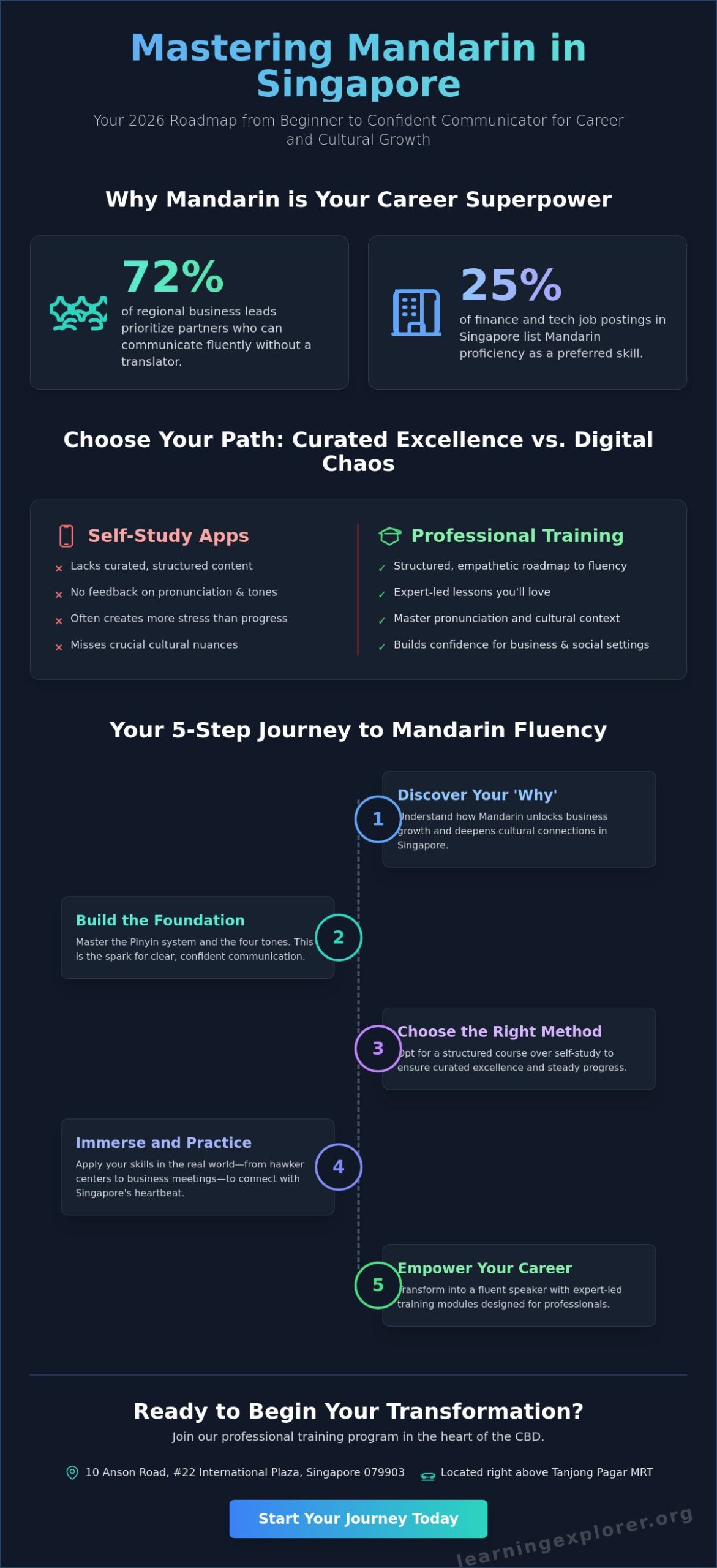
Did you know that 72% of regional business leads in Singapore prioritize partners who can communicate fluently without a translator? While the professional benefits are clear, many beginners feel paralyzed by the complexity of tones and the daunting task of memorizing characters. You’ve likely tried self-study apps only to find they lack the curated excellence you need to truly learn Chinese in a meaningful way. We understand that your time is precious and the noise of ineffective tools often creates more stress than progress.
We believe that mastering a new language should feel like an empowering transformation rather than an administrative burden. This 2026 guide offers a structured, empathetic roadmap designed to take you from searching for answers to finding true fluency. You’ll discover how to communicate confidently in social and business settings through lessons you’ll love. You’ll also learn to understand the unique cultural nuances of the local landscape. We’ll preview the essential steps to streamline your journey at our professional training center located at 10 Anson Road, level 22, International Plaza, Singapore 079903, conveniently situated right above Tanjong Pagar MRT.
Key Takeaways
- Learn how Mandarin serves as a vital bridge to regional business growth and provides the grit needed to succeed in the Asian market.
- Simplify your start by mastering the Pinyin system and the four tones, which provide the spark for clear communication.
- Discover why curated excellence in a structured course is more effective than the chaos of self-study apps for those who want to learn Chinese.
- Plan your progress using a practical 5-step action roadmap designed to transform you from a searching beginner into a fluent speaker.
- Empower your career with expert-led training modules located in the heart of the CBD, right above Tanjong Pagar MRT.
Why Learning Chinese is Your Best Career and Cultural Move in Singapore
Choosing to learn ; chinese in Singapore isn’t just about picking up a new hobby. It’s about unlocking a new dimension of life in the Lion City. While many residents navigate daily life using English, Mandarin stands as one of the official languages of Singapore, acting as the primary medium for local news, television, and the national education system. Mastering this language transforms you from a spectator into an active participant in the nation’s cultural narrative. It allows you to connect deeper with heritage and understand the subtle “grit” that drives the Asian market.
To better understand how the local version of the language compares to other regions, watch this helpful video:
The Professional Advantage in the CBD
Empower your resume with a skill that opens doors across the region. Data from 2025 shows that 25% of job postings in Singapore’s finance and technology sectors list Mandarin proficiency as a preferred skill. For professionals working near Tanjong Pagar, the ability to lead a meeting in Business Mandarin is a strategic career move. It streamlines cross-border communication and demonstrates a level of cultural intelligence that regional partners value. Industry surveys from 2025 indicate that 72% of regional business leads prioritize partners who can communicate fluently without a translator. By choosing professional language training, you move beyond the noise and start finding real opportunities in the heart of the CBD.
Connecting with the Singaporean Heartbeat
There’s a unique joy in finding the “spark” of a language through local interaction. While formal Mandarin is essential for business, understanding the nuances of local “Singdarin” expressions simplifies your daily life. It makes a world of difference when ordering at a heartland hawker center or chatting with neighbors. We focus on delivering lessons your students will love by blending high-quality curriculum with practical, real-world application. This approach ensures you aren’t just memorizing characters; you’re learning to navigate the emotional and social heartbeat of the city. Our training center at 10 Anson Road, level 22, International Plaza, Singapore 079903, puts you right in the center of this cultural discovery, located conveniently right above Tanjong Pagar MRT.
Understanding the Foundations: Mandarin, Pinyin, and Chinese Characters
Beginning your journey to learn ; chinese often feels like staring at a mountain of complexity. You face four distinct tones that change meanings and thousands of intricate characters. These elements aren’t barriers; they’re the spark that gives the language its unique depth and character. In Singapore, we utilize the Simplified Chinese script. This system was adopted to streamline literacy and align with modern communication standards used in media and education. By understanding how these foundations work together, you move from searching for individual definitions to finding the underlying logic that makes Mandarin accessible.
Pinyin: Your Phonetic Roadmap
Pinyin acts as your essential phonetic roadmap. It uses the Roman alphabet to represent Mandarin sounds, allowing you to speak fluently before you’ve mastered a single brush stroke. This system makes starting out feel seamless and simple.
- Master the four tones: These pitch variations are crucial. They distinguish between common words that might otherwise sound identical to an untrained ear.
- Reduce administrative stress: Focus on listening and repeating sounds rather than memorizing abstract rules or phonetic charts.
- Prioritize pronunciation: Working with native-speaker instructors helps correct your “accent” early on. This prevents the development of hard-to-break habits.
Pinyin simplifies the initial hurdle of spoken Mandarin, ensuring your first few weeks of study are productive and encouraging.
The Logic of Chinese Characters
Think of characters as learning objects rather than random drawings. Each character contains radicals, which are smaller components that hint at the word’s meaning or sound. For example, characters related to “people” or “water” often share specific visual markers. Identifying these patterns allows you to decode new words with ease.
- Start with the basics: Focus on the 100 most common characters to build immediate functional literacy for signs and menus.
- Find the story: Many characters have an internal logic or historical story that makes them easier to remember.
- Achieve curated excellence: Avoid the chaos of the open internet by following a structured curriculum. Focus on high-frequency professional vocabulary that you can use in the office tomorrow.
By identifying these patterns, you’ll find that reading becomes a logical puzzle rather than a daunting memory test. If you’re ready to see how these foundations fit together in a supportive classroom setting, you can explore our structured modules designed specifically for busy professionals who value their time.
Effective Learning Strategies: Self-Study vs. Professional Language Schools
Choosing the right path to learn ; chinese is a decision that defines your progress. Many beginners start with the “chaos” of the open internet, jumping between free videos and scattered resources. While this might feel productive initially, it often leads to a cycle of endless searching without finding real fluency. A professional language school offers curated excellence that streamlines your journey. It replaces the noise with a structured roadmap designed by experts who understand the grit required to master a new language.
Language apps are excellent tools for building a basic vocabulary, but they frequently fail at teaching conversational context. An app can tell you if you’ve typed a word correctly, but it cannot hear the subtle pitch of your tones. It can’t guide you through the cultural nuances of a business lunch in Tanjong Pagar. Professional instruction provides the spark of human connection. It creates a supportive environment where making mistakes is part of the growth process rather than a source of stress. You need real-time feedback to ensure your foundations are solid from day one.
The Role of Immersion in Singapore
Singapore provides a unique advantage for learners. You live in a bilingual environment where you can practice daily. Choosing language courses singapore professionals trust allows you to join a community of like-minded individuals. These group settings foster a shared sense of momentum. You’ll find peers who share your professional goals and personal challenges. This social element transforms study from a solitary chore into an engaging experience. Flexible schedules ensure that even the busiest managers can find time to invest in their growth.
Why Native-Speaker Teachers Matter
Expert native speakers do more than just deliver content. They inspire confidence. A bilingual instructor understands the specific hurdles an English speaker faces when navigating Mandarin grammar. They simplify complex concepts and provide real-world scenarios that go beyond the textbook. This empathetic approach helps you move past the administrative stress of lesson planning. Instead, you focus on delivering results in your personal and professional life. These instructors ensure you are learning the version of the language actually spoken in modern boardrooms and local neighborhoods.
How to Start Your Mandarin Journey: A 5-Step Action Plan for Beginners
Starting a new language requires more than just enthusiasm; it requires a clear roadmap. To truly learn ; chinese, you need to transition from a passive spectator to an active practitioner. This five-step plan simplifies the process, ensuring you don’t get lost in the noise of ineffective methods. By following a structured path, you move from the grit of initial effort to the spark of real conversation. When you learn ; chinese through a curated plan, you avoid the chaos of the open internet and start seeing measurable results.
- Step 1: Identify your “Why.” Determine if your motivation is for regional business growth, connecting with family, or travel. Having a clear purpose helps you stay focused when the learning gets challenging.
- Step 2: Master Pinyin. Build a solid phonetic foundation early. This system allows you to speak before you can read, making your initial progress feel seamless and simple.
- Step 3: Commit to a daily rhythm. Consistency is the key to retention. Even 15 minutes of daily practice is more effective than one long session every two weeks.
- Step 4: Join a structured class. This is where you transition from searching for answers to finding fluency. A professional environment provides the curated excellence you need to succeed.
- Step 5: Practice in the real world. Start with simple greetings in your neighborhood. Singapore’s heartland hawker centers and community spaces are your best classrooms for real-world application.
Setting Realistic Proficiency Goals
Plan your learning milestones with precision. Instead of aiming for vague “fluency,” set specific targets like being able to introduce yourself and order a meal by the end of month one. Celebrating these small wins is essential to maintain your momentum. Align your goals with global standards to ensure your progress is measurable and recognized in professional settings. This structured approach reduces administrative stress and keeps you focused on the emotional reward of genuine communication.
Creating a Consistent Study Schedule
Busy adults often struggle to find time, but you can integrate Mandarin into your existing routine. Use your commute to engage with learning objects like podcasts or digital flashcards. These bite-sized interactions keep the language fresh in your mind throughout the day. However, a weekly two-hour professional session serves as the necessary anchor for long-term success. It provides the deep focus and expert guidance that self-study apps lack. If you’re ready to commit to a plan that works, enroll in our structured Mandarin courses to begin your transformation today.
Mastering Mandarin at Learning Explorer: Professional Training in the CBD
Choosing where to learn ; chinese is just as important as the decision to start. You need a partner that understands the daily grit of a busy professional and provides the spark needed to stay motivated. At Learning Explorer, we’ve moved past the cold approach of traditional software. Instead, we act as a reliable educational ally. We’ve built a supportive environment where expert native speakers simplify complex grammar and inspire engagement through curated excellence. Our goal is to ensure you spend less time searching for resources and more time finding your voice in a new language.
Convenience is the key to consistency for adults working in the city. Our training center is located at 10 Anson Road, level 22, International Plaza, Singapore 079903. Because we’re situated right above Tanjong Pagar MRT, you can transition from your office to your classroom in minutes. This seamless access reduces the administrative stress of commuting, allowing you to focus entirely on your learning journey. Whether you’re coming from a high-stakes meeting or ending your workday, our center provides a calm, professional space to master new skills.
Conversational and Business Mandarin Courses
Our curriculum isn’t a one-size-fits-all model. We deliver conversational mandarin singapore modules that focus on the emotional and practical outcomes you actually need. We specialize in “Lessons your students will love,” ensuring that every session feels relevant to your life in Singapore. For corporate teams, we empower staff with customized language solutions that streamline cross-border communication. Our curated library of learning objects saves you hours of effort by providing high-quality, standards-aligned materials that cut through the noise of the open internet.
Flexible Learning Formats for Busy Adults
We understand that your schedule can change in an instant. To accommodate this, we offer a variety of formats to suit your specific needs:
- Private Classes: One-on-one attention to fast-track your specific professional goals.
- Group Sessions: Join a community of peers who share your drive and ambition.
- Intensive Courses: Deep-dive modules designed for rapid transformation.
Our interactive atmosphere is designed to deliver results quickly. You’ll move beyond rote memorization to real-world conversational scenarios that build immediate confidence. If you’re ready to feel the spark of professional language learning, sign up for a trial session today. It’s the first step toward transforming your career and connecting more deeply with the world around you.
Empower Your Future with Confident Communication
Mastering a new language is a transformation that opens doors across the regional business market. You’ve discovered how a structured roadmap replaces the chaos of self-study apps with curated excellence. By focusing on the foundations of Pinyin and tones, you simplify the path to fluency. You don’t have to navigate the grit of learning alone when you have an ally that understands your professional challenges. Choosing to learn ; chinese in a supportive environment ensures you build the confidence needed for real-world interactions.
Our native-speaker, bilingual certified instructors deliver lessons your students will love, using a curriculum aligned with global proficiency standards. We’re strategically located at 10 Anson Road, level 22, International Plaza, Singapore 079903, situated right above Tanjong Pagar MRT for your convenience. Stop searching for the right time and start finding your voice. Start your Mandarin journey with a trial class at Learning Explorer today! We’re excited to partner with you on this rewarding mission.
Frequently Asked Questions
How long does it take for a beginner to become fluent in Chinese?
Achieving fluency typically takes between 1,000 and 2,200 hours of study according to major language frameworks. For most beginners in a part-time course, reaching an intermediate conversational level takes about 12 to 18 months of consistent effort. Your progress depends on your daily rhythm and the quality of your learning objects. We focus on streamlining this process so you can start finding your voice in social settings within the first few months.
Is Mandarin the hardest language for English speakers to learn?
Mandarin is often ranked as a Category IV language by the Foreign Service Institute, meaning it requires more time than Spanish or French. However, the grammar is actually quite simple with no verb conjugations or gendered nouns. The spark of the language lies in its tones and characters, which feel much easier when you use a structured, empathetic roadmap. With the right guidance, it’s a manageable and rewarding transformation that inspires confidence.
Should I learn Simplified or Traditional Chinese characters in Singapore?
You should prioritize Simplified characters because they are the standard for media, education, and government in Singapore. This script was designed to streamline literacy and is used by the majority of the local population for daily communication. Learning Simplified characters ensures your skills are standards-aligned with the local environment. It’s the most practical choice for those who want to learn ; chinese for professional growth in the CBD and beyond.
Can I learn Chinese as an adult without any prior background?
Yes, you can absolutely learn as an adult without any prior experience. Adults often have a better grasp of logical patterns and disciplined study habits compared to children. Our curriculum is built for busy professionals who need to move from searching for meanings to finding real-world context. We use empathetic teaching styles to reduce the administrative stress of starting a new skill from scratch, making the entire process feel seamless and simple.
What is the difference between Mandarin and Chinese?
Chinese refers to the broad family of languages and dialects, while Mandarin is the official standard dialect used in Singapore. Mandarin is the language of instruction in schools and the primary medium for regional business. When you learn ; chinese here, you are almost always focusing on Mandarin. This distinction is important for ensuring your learning journey is aligned with local cultural nuances and the professional opportunities found in the Singaporean market.
What are the best ways to practice speaking Mandarin in Singapore?
Practice speaking daily in Singapore’s heartland hawker centers or during professional interactions in the Tanjong Pagar area. Engaging with local community events or joining a structured group class provides the necessary grit and social support for improvement. Our center at 10 Anson Road, level 22, International Plaza, Singapore 079903, makes it easy to practice in a professional setting. Being right above Tanjong Pagar MRT simplifies your daily transition from work to study.
How many Chinese characters do I need to know for basic daily conversation?
You need to know roughly 500 to 600 high-frequency characters for basic daily conversations. For general literacy in newspapers or menus, a goal of 2,500 characters is standard. We focus on delivering curated excellence by teaching the most relevant characters first. This approach empowers you to understand 80% of daily text without the administrative burden of memorizing rare vocabulary. It’s about finding the most efficient path to functional communication.
Are native-speaker teachers better for learning Mandarin?
Native-speaker instructors are highly beneficial because they provide accurate pronunciation and deep cultural context. Bilingual native speakers are especially helpful for beginners as they understand the English-speaking perspective and can simplify complex grammar rules. They offer the real-time feedback needed to master tones, which most apps often miss. Their professional guidance helps you move beyond the noise and find true confidence in your speaking abilities through lessons your students will love.