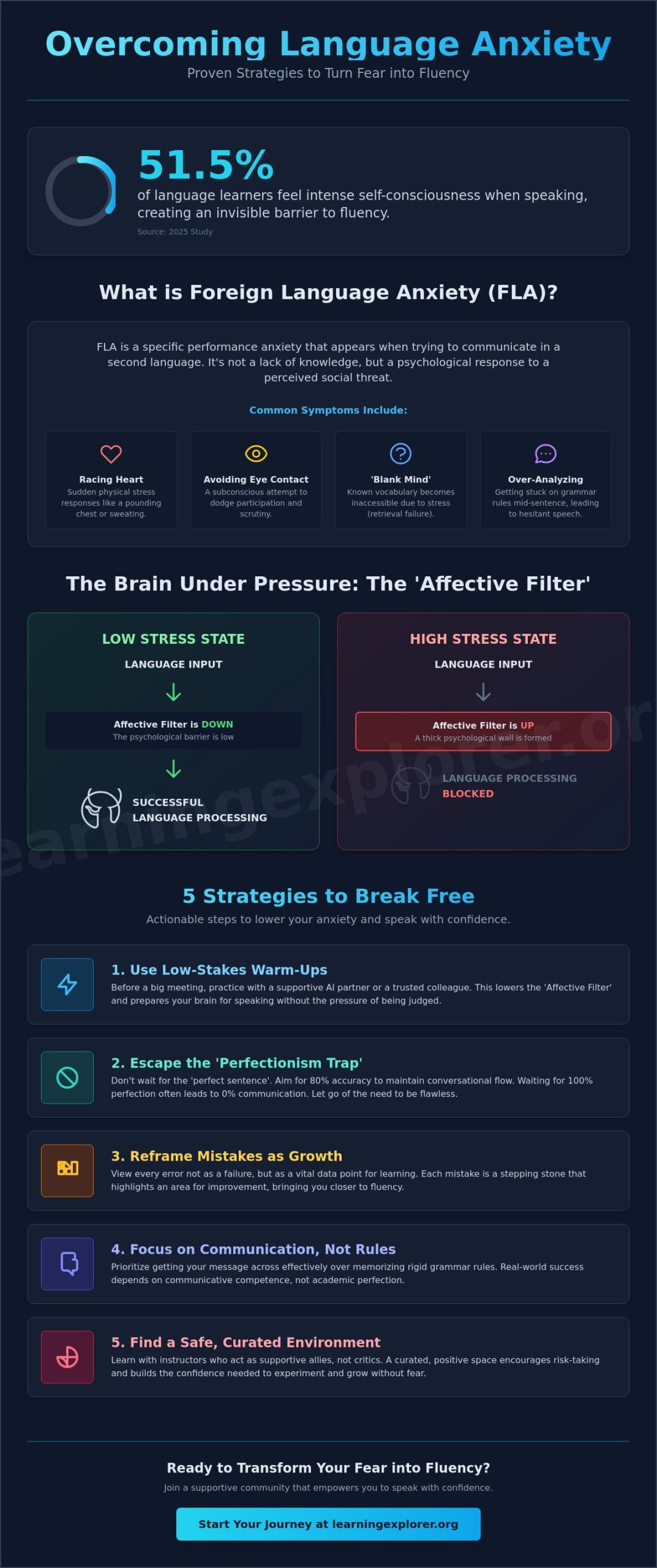
A 2025 study revealed that 51.5% of language learners feel intense self-consciousness when speaking in front of others. If you’ve ever felt your mind go blank during a business meeting or feared being judged for a grammar mistake, you’re not alone. It’s incredibly frustrating when the vocabulary you practiced disappears the moment you need it most. We believe you can overcome language learning anxiety by silencing your inner critic and lowering your stress levels.
At our center at 10 Anson Road, level 22, International Plaza, located right above Tanjong Pagar MRT, we help students transform their fear into fluency. This guide will empower you with proven psychological strategies and practical steps to speak any language with confidence. You’ll discover how to use AI practice partners and curated techniques to turn mistakes into learning moments, helping you finally feel at home in a new language.
Key Takeaways
- Understand how the ‘Affective Filter’ acts as an invisible wall that blocks your fluency during high-stress moments.
- Discover practical scripts and low-stakes warm-up techniques to overcome language learning anxiety before important business presentations.
- Break free from the ‘Perfectionism Trap’ by reframing mistakes as vital growth markers rather than embarrassing failures.
- Learn why focusing on communicative effectiveness is more valuable than memorizing rigid grammar rules for real-world success.
- Identify the benefits of a curated learning environment led by native-speaker instructors who act as your reliable educational allies.
What is Foreign Language Anxiety and Why Does it Happen?
Imagine sitting in a boardroom at Raffles Place, ready to present your quarterly findings. You know your data inside out, but the moment you open your mouth to speak, your chest tightens and the words vanish. This experience is known as Foreign language anxiety (FLA). It’s a specific type of performance anxiety that only appears when you try to communicate in a second language. This phenomenon creates an invisible wall that blocks your ability to process and produce speech, making it nearly impossible to overcome language learning anxiety without the right psychological tools.
Common symptoms of FLA include:
- A racing heart or sudden sweating when called upon.
- Avoiding eye contact with colleagues or instructors to dodge participation.
- The ‘blank mind’ phenomenon where even simple vocabulary feels out of reach.
- Over-analyzing grammar rules mid-sentence, which leads to stuttering.
It’s vital to understand that FLA doesn’t discriminate based on intelligence or professional success. Even high-achieving managers and educators with high IQs struggle with these feelings. Recent data from 2024 shows that 43% of adults feel more anxious than they did in previous years, and this general stress often manifests as a fear of speaking. Your ‘frozen’ state isn’t a sign that you’re bad at languages; it’s a sign that your brain is trying to protect you from a perceived social threat.
To better understand this concept, watch this helpful video:
The Science of the ‘Frozen’ Brain
When you feel stressed, your amygdala triggers a ‘fight or flight’ response. This biological system was designed to help humans escape physical danger, but in a modern meeting, it sees a grammar mistake as a predator. Your brain prioritizes survival over correct verb conjugation, effectively shutting down the parts responsible for language. The Affective Filter is the psychological barrier that prevents linguistic input from reaching the brain’s processing centre. When your stress levels are high, this filter stays up, and no matter how much you’ve studied, the information simply won’t flow.
Common Triggers in the Singaporean Workplace
In Singapore’s competitive environment, the pressure to be precise is immense. High-stakes meetings in the CBD often demand ‘perfect’ English or Mandarin, which can trigger a massive spike in anxiety. Many professionals fear ‘losing face’ or appearing less competent because of a slight accent. Social situations, like quick-fire banter during a team lunch at Amoy Street, can also feel impossible to follow. These moments make you feel like you’re falling behind, but recognizing these triggers is the first step to help you overcome language learning anxiety and regain your voice.
The Psychology of the ‘Blank Mind’ in Language Learning
Many professionals in Singapore’s busy CBD believe they’ve simply forgotten their vocabulary. However, there’s a vital distinction between a ‘lack of knowledge’ and ‘retrieval failure’. When you’re sitting in a high-pressure meeting at Tanjong Pagar, your brain might know the word, but the stress of the moment locks it away. This mental block is a core reason why people struggle to overcome foreign language speaking anxiety. It’s often fueled by the ‘Perfectionism Trap’, where the intense need to be 100% correct results in 0% actual speaking.
Adult learners often carry hidden baggage from their school days. Perhaps a strict teacher once corrected your pronunciation in front of the whole class, or you were penalised for a minor grammar slip. These negative experiences haunt you, making you feel like an ‘outsider’ in group discussions. You aren’t just fighting a new language; you’re fighting years of internalised fear. This fear can make you feel disconnected from your peers, even when you have valuable insights to share during a strategy session.
The Perfectionism Trap
Waiting for the ‘perfect sentence’ is the fastest way to kill a conversation. If you wait until you’re sure of every tense and preposition, the moment passes. This is why we advocate for the ‘80% Rule’. Aim for 80% accuracy instead of perfection. This shift allows you to maintain conversational flow and actually practice. To overcome language learning anxiety, you must reframe mistakes as ‘data points’. Each error is just a piece of information that helps you refine your skills, not a personal failure.
Overcoming the Fear of Judgment
Most of us suffer from the ‘Spotlight Effect’. This is the psychological bias where we think people notice our mistakes much more than they actually do. In reality, your colleagues are likely focused on your message, not your syntax. They want to understand your ideas and move the project forward. A practical way to manage this is to identify your ‘inner critic’. Give it a silly name. When it tells you that you’re going to sound foolish, acknowledge it and move on. This simple mental shift is a powerful way to overcome language learning anxiety and regain your confidence.
Building this confidence is easier when you’re in a supportive environment. If you want to practice in a space designed for growth, consider a Business English Course tailored for professionals.
5 Actionable Strategies to Overcome Speaking Anxiety Today
Understanding the science of the ‘frozen brain’ is the first step, but you need practical tools to handle the heat of a real-time conversation. In Singapore’s fast-paced corporate world, you don’t have the luxury of time to pause and reflect on every verb tense. You need strategies that work in the moment. These techniques help you overcome language learning anxiety by moving the focus away from your internal fear and back onto the task at hand.
Developing Your ‘Safety Scripts’
Preparation is your strongest shield. Professional athletes use pre-game routines to settle their nerves; you can do the same with language. Identify the most common interactions you face at work, such as introducing yourself or asking for clarification. Prepare three to five ‘filler phrases’ like, “That’s a great question, let me consider that for a moment,” or “If I understand you correctly, you mean…” These give you vital seconds to breathe and retrieve the words you need. Scripts act as a cognitive safety net for the brain. By automating the opening of a sentence, you free up mental energy to focus on the complex ideas that follow.
Physical Grounding Techniques
Anxiety isn’t just in your head; it’s a physical state. Before you enter a meeting, use the ‘Box Breathing’ method: inhale for four seconds, hold for four, exhale for four, and hold for four. This simple exercise signals your nervous system to exit the ‘fight or flight’ mode. During the conversation, use a tactile anchor like a pen or a ring to keep yourself grounded in the present. If you feel your heart racing, adjust your posture. Sitting tall and using ‘power posing’ can subconsciously boost your linguistic confidence, making you feel more like a leader and less like a student. These physical shifts are essential to overcome language learning anxiety during high-pressure moments.
Beyond physical prep, find a ‘Language Parent’. This is a supportive colleague or friend who listens to your ideas without correcting every minor slip. Their goal is to understand your meaning, not grade your grammar. When you talk to them, practice ‘Communication over Conjugation’. If you can’t remember the perfect past participle, use a simpler word and keep the dialogue moving. Finally, try a ‘low-stakes’ warm-up. Talk to yourself or your pet in your target language for five minutes before your first big meeting of the day. It primes your brain for the shift and reduces the shock of that first professional interaction.
Reframing Mistakes: From Embarrassment to Growth
Mistakes aren’t just inevitable; they’re the only way your brain actually learns. When you stumble over a word in a Tanjong Pagar office, it’s easy to feel a sudden flush of shame. However, adopting a growth mindset means seeing every “um” and “ah” as a necessary repetition for mastery. To overcome language learning anxiety, you must stop treating a misplaced verb as a character flaw. Instead, treat it as a sign that you’re pushing your boundaries and expanding your comfort zone.
The Native Speaker Perspective
Many learners assume native speakers are waiting to pounce on every error. In reality, most people find your effort to speak their language deeply endearing and impressive. Communication is always a two-way street. The listener shares the responsibility for understanding the message, so you aren’t carrying the burden alone. When you work with a professional, native speaker teacher benefits extend far beyond grammar corrections. They provide a cultural safety net where you can fail without consequences. If you get stuck, don’t panic. Simply ask gracefully, “Could you say that another way?” or “Did I use the correct term there?”
The Power of ‘Yet’
Small linguistic shifts can change your entire outlook. Stop telling yourself “I can’t speak English” and start saying “I can’t speak English fluently *yet*.” This tiny addition acknowledges your current path and your future potential. Set micro-goals for your workday to build momentum. Perhaps today you will ask exactly one question during the team huddle. When you achieve it, celebrate that win. This creates a positive feedback loop in your brain, making it easier to overcome language learning anxiety over time.
Use self-correction sparingly during live conversations. If you realize you made a mistake but the other person clearly understood you, keep moving. Interrupting your own flow to fix a minor tense issue often causes more anxiety than the mistake itself. Consider keeping a “Mistake Log” during your private study time. Write down three common errors you made this week. As you practice at our center at 10 Anson Road, level 22, International Plaza, you’ll eventually see those errors disappear from your log. This visual proof of progress is a powerful motivator for any professional.
Ready to turn your mistakes into mastery? Join our Business English Course and start speaking with confidence in the workplace today.
Finding a Safe Space: How Learning Explorer Empowers Fluency
Choosing the right environment is just as vital as the psychological strategies we’ve discussed. To truly overcome language learning anxiety, you need a space that values progress over perfection. Stop searching for random tutorials and start finding real progress. We provide curated excellence that replaces the noise of the internet with structured, high-quality learning objects. Our certified native-speaker instructors act as your Reliable Educational Allies. They don’t just teach grammar; they guide you through the grit of daily communication as a Knowledgeable Guide.
Our facility is situated right above Tanjong Pagar MRT, offering a visionary ‘third space’ for professionals in the heart of the CBD. You’ll find yourself in small group classes where everyone is in the same boat. Being in a room with peers who are also working to overcome language learning anxiety creates a sense of community that you simply can’t find through a screen. Our standards-aligned curriculum management ensures that every session we deliver is relevant to your professional needs.
Interactive and Fun Learning Experiences
We believe that learning should be a spark that inspires you, not a chore that drains you. Our Business English Course utilizes immersive role-play to simulate real-world workplace stress in a safe, controlled zone. You’ll practice handling difficult client calls or leading a presentation before you ever have to do it for real. This approach follows our ‘Lessons your students will love’ philosophy, adapted specifically for the needs of adult learners. We simplify complex linguistic concepts, ensuring you leave every session feeling more capable than when you arrived. It’s a seamless transition from theory to practice that increases student engagement and builds lasting confidence.
Flexible Formats for Busy Professionals
Every learner’s journey is unique, which is why we offer flexible options to suit your schedule and comfort level. We aim to reduce the administrative stress of your learning journey by providing clear, punchy, and action-oriented paths to success. You might choose private coaching if you’re dealing with intense anxiety and want a completely personalized pace. Alternatively, our group classes are perfect for those who want social practice and peer feedback. These language courses in Singapore focus heavily on conversational confidence rather than rote memorization. Sign up for a trial today and discover how we can help you streamline your path to fluency.
Take the Next Step Toward Fearless Fluency
You’ve discovered that the ‘frozen brain’ is a biological response, not a lack of talent. By implementing safety scripts and reframing mistakes as vital data points, you can reclaim your voice in any high-stakes meeting. These psychological shifts are the essential first steps to help you overcome language learning anxiety for good. Fluency isn’t about being perfect; it’s about being present and communicative in your professional life.
At Learning Explorer, we provide the curated excellence you need to move from theory to real-world application. Our certified native-speaker instructors act as your reliable educational allies in our convenient CBD center, located right above Tanjong Pagar MRT. Through interactive, small-group sessions designed specifically for adult learners, we help you find the spark for better communication. Discover how our supportive environment can help you overcome your fear-book a trial class at Learning Explorer today! We’re here to help you deliver results that empower your professional future and inspire your confidence.
Frequently Asked Questions
Is it normal to feel like I’ve forgotten everything when I start speaking?
Yes, it’s completely normal and is known as retrieval failure. When you’re stressed, your brain prioritizes survival over complex language processing. This is why your vocabulary seems to vanish during a high-stakes meeting in a boardroom. Understanding that this is a physical response rather than a lack of knowledge helps you stay calm. You can use deep breathing to signal your nervous system to relax and allow the words to flow again.
How long does it take to overcome language learning anxiety?
Most learners see a significant reduction in stress within 12 to 24 weeks of consistent, low-stakes practice. A 2025 study found that students using structured support felt 40% more confident after just one semester. To overcome language learning anxiety effectively, you need regular exposure in a safe environment. It isn’t a race to the finish line; it’s about building a sustainable habit that makes speaking feel like a natural part of your daily routine.
Can I learn a language if I’m an introvert?
Absolutely, introverts often excel at language learning because they tend to be highly observant listeners. While extroverts might jump into conversations quickly, introverts often process information more deeply before speaking. You don’t need to be the loudest person in the room to be fluent. Focus on one-on-one interactions or small group sessions at our center to build your confidence in a setting that respects your personality.
What should I do if someone laughs at my mistake?
If someone laughs, the best approach is to smile and treat it as a lighthearted moment of connection. Most people aren’t being malicious; they’re reacting to the surprise of a linguistic slip. Acknowledge the error, perhaps ask for the correct phrasing, and continue your point. Remember that communication is about the message, not perfection. Native speakers usually respect the grit it takes to learn their language, especially in Singapore’s diverse professional landscape.
Does learning in a group make anxiety worse or better?
Learning in a small group usually reduces anxiety because it shows you that you’re not alone in your struggle. When you see others making mistakes and recovering, it normalizes the process. At Learning Explorer, our interactive sessions are designed to foster a supportive community. This environment acts as a buffer against the fear of judgment, helping you overcome language learning anxiety through shared experiences and collaborative learning tasks.
How can I practice speaking if I don’t have any native speaker friends?
You can use AI-powered conversation tools or join a professional course led by native speakers. AI tutors provide a 24/7, zero-pressure environment to practice basic dialogue. For more nuanced professional skills, our Business English Course offers direct access to Reliable Educational Allies. These instructors provide the curated excellence you need to master cultural subtext and professional jargon without the noise of the open internet.
What is the best way to handle a ‘mind blank’ during a presentation?
Use a pre-prepared safety script or filler phrase to give your brain a few seconds to reset. Saying something like, “Let me find the best way to explain this,” buys you time without creating awkward silence. Take a slow breath and look at your notes. Most audiences won’t even realize you’ve had a blank moment if you remain composed. These small pauses are a natural part of professional communication, even for native speakers.
Is it better to focus on grammar or fluency first?
Focus on fluency and being understood before worrying about perfect grammar. If you spend too much time over-analyzing every tense, your speech becomes robotic and slow. Aim for communicative effectiveness, which means getting your point across clearly. As your confidence grows, your grammar will naturally improve through consistent practice and feedback. This strategy helps reduce the pressure of the ‘Perfectionism Trap’ that stops many learners from speaking at all.