Professional fluency isn’t about perfect grammar; it’s about the strategic mastery of workplace communication frameworks. You’ve likely felt that sudden freeze during a high-stakes meeting when the right word just won’t come. If you’re searching for how to improve spoken english fluency for work, you already know that the fear of being judged by colleagues can be paralyzing. It’s exhausting to feel like your career growth is held back by a language barrier when you have valuable expertise to share.
We promise to help you master the specific habits needed to speak English confidently in any professional setting. This guide explores how to transition from hesitant searching to the satisfaction of clear discovery. We’ll cover everything from contributing to fast-paced discussions to leading presentations with total ease. Whether you visit our training center at 10 Anson Road, level 22, International Plaza, Singapore 079903, or study independently, these insights will help you build better rapport with international clients and elevate your professional impact immediately.
Key Takeaways
- Shift your focus from linguistic perfection to clarity and professional impact to command authority in executive roles.
- Discover practical techniques like shadowing and business collocations to master how to improve spoken english fluency for work through daily habits.
- Learn to navigate high-pressure meetings by utilizing executive summaries and signposting phrases that guide your audience through complex ideas.
- Reframe communication mistakes as valuable learning data to overcome the fear of being judged and speak with a “communication-first” mindset.
- Identify when self-study plateaus and how seeking expert guidance in a professional environment can accelerate your transition to mastery.
Redefining Fluency: What Workplace English Mastery Really Means
Mastery in a professional setting requires a unique toolkit. Many professionals mistakenly believe that talking fast equals being fluent. In reality, workplace mastery is defined by clarity and impact. If you’re researching how to improve spoken english fluency for work, start by accepting that being understood is more valuable than being perfect. True fluency includes the ability to navigate cultural nuances in global business, ensuring your message lands as intended across different regions. You must identify your specific communication gaps. Are you struggling with a limited vocabulary range, or do you find it hard to use technical jargon during high-pressure negotiations? Pinpointing these weaknesses is the first step toward professional discovery.
The Difference Between Social and Business English
Setting Realistic Fluency Goals for Your Career
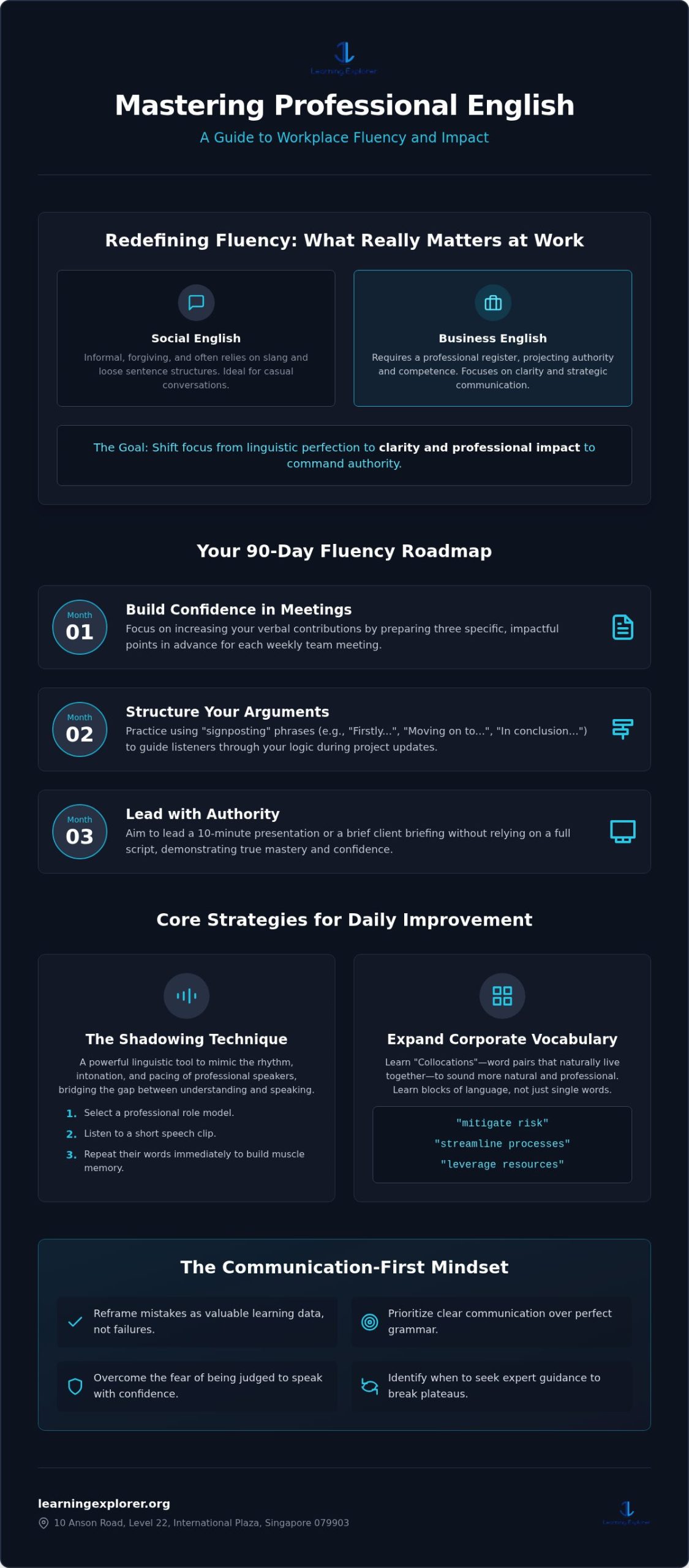
Success looks different for a project manager than it does for a sales executive. Define what “success” looks like for your specific industry. Don’t get bogged down in obscure grammatical rules that native speakers rarely use in a professional context. Instead, prioritize high-frequency professional phrases that appear in your daily tasks. Create a 90-day roadmap to track your progress and understand how to improve spoken english fluency for work in a practical, measurable way:
- Month 1: Focus on increasing your verbal contributions in weekly team meetings by preparing three specific points in advance.
- Month 2: Practice “signposting” phrases to guide listeners through your logic during project updates.
- Month 3: Aim to lead a 10-minute presentation or a brief client briefing without relying on a full script.
This structured approach ensures you focus on skills that actually drive career growth and increase engagement with your team. By setting clear benchmarks, you move away from the frustration of feeling “stuck” and toward the confidence of an expert communicator.
Core Strategies for Improving Daily Spoken Fluency
Developing a natural rhythm requires active participation rather than just passive observation. If you’re wondering how to improve spoken english fluency for work, the answer lies in deliberate, technical practice. While many general guides suggest simply “talking more,” professional mastery requires specific exercises that target muscle memory and cognitive recall. By integrating these strategies into your daily routine, you can reduce the mental effort required to form complex sentences during high-pressure moments.
The Shadowing Technique for Professional Speech
Shadowing is a powerful linguistic tool that bridges the gap between understanding English and speaking it. Select a professional role model, perhaps a CEO or a specialized industry expert, whose speaking style matches your career goals. Listen to a short clip of their speech and repeat their words immediately after they speak. Don’t wait for the end of the sentence; aim for a delay of only a fraction of a second. This forces your brain to mimic their specific rhythm, intonation, and sentence pacing. Focus on word stress, as placing emphasis on the correct syllable can instantly make you sound more like a native speaker and increase the clarity of your message.
Expanding Your Corporate Vocabulary and Phrasal Verbs
Professional English relies heavily on “Collocations”—word pairs that naturally live together in a business context. Instead of learning isolated words, learn blocks of language like “mitigate risk,” “streamline processes,” or “leverage resources.” Identifying 10 industry-specific phrasal verbs used frequently in your Singapore office will also help you sound more natural. Use a digital vocabulary log to track new terms encountered in emails. Before using these in a board meeting, practice them in low-stakes social settings to ensure you’ve mastered the nuances of their usage. If you find self-study reaching a plateau, a structured Business English Course can provide the expert feedback needed to refine these skills.
Utilize “Record and Review” cycles to refine your delivery. Record yourself explaining a project for two minutes, then listen back specifically to identify repetitive vocal fillers like “um,” “ah,” or “you know.” These fillers often creep in when we’re searching for words, but they can undermine your authority. Over time, you’ll learn to replace these sounds with comfortable silences. Finally, integrate English into your digital environment. Change your phone and computer settings to English and follow industry news outlets like the Financial Times or Harvard Business Review. This constant linguistic engagement ensures your brain remains in “work mode” even during your commute to our center at 10 Anson Road, level 22, International Plaza, Singapore 079903, located right above Tanjong Pagar MRT. If your current app-based learning isn’t delivering results, exploring the best alternative to Duolingo in Singapore for professionals can help you find a more effective path to workplace fluency.
Navigating High-Stakes Workplace Interactions in English
High-stakes interactions are the ultimate test of your linguistic progress. It’s one thing to practice in private. It’s another to hold your own when a director asks a pointed question during a board briefing. Understanding how to improve spoken english fluency for work means moving beyond basic vocabulary. You need a specific strategy for real-time verbal reporting and high-pressure dialogue. Mastering the art of the executive summary allows you to deliver complex information concisely. This skill is vital for verbal reporting where stakeholders value brevity and impact over long-winded explanations. By focusing on the “bottom line” first, you command attention and project executive presence.
Mastering Professional Presentations and Pitches
Effective presentations rely on simple, powerful sentence structures rather than complex jargon. Draft your script to focus on one key idea per slide. Use signposting phrases to guide your audience through your logic. Phrases like “Let’s look at the data” or “This leads to my next point” create a clear roadmap for listeners. This reduces the cognitive load on your audience and makes you appear more organized. Prepare for Q&A sessions by pre-empting objections in English. Write down the three hardest questions you might face and practice your responses until they feel natural and instinctive.
Active Participation in Fast-Paced Meetings
Fast-moving discussions often leave professionals feeling left behind. To stay engaged, use active listening techniques. If a question is difficult, buy time by saying, “That’s an interesting perspective. Let me make sure I’ve understood you correctly.” This demonstrates competence while giving your brain a few extra seconds to process. Practice polite interruption strategies to ensure your voice is heard. A firm “If I could just add a point here” or “I’d like to weigh in on that” allows you to enter the conversation without appearing rude or aggressive.
Focus on functional language for agreeing, disagreeing, and proposing new ideas. Instead of a simple “I disagree,” try “I see your point, but I have some concerns regarding the timeline.” This nuanced approach builds rapport and shows you are a collaborative partner. In contrast to social settings, professional disagreements should always be backed by logic. Conclude your contributions by summarizing key takeaways. This proves you have full command of the discussion and ensures everyone is aligned before the meeting ends. This level of engagement turns a taxing professional task into a moment of career-defining discovery.
Overcoming Psychological Barriers and the Fear of Speaking
Fear is the invisible wall that prevents many professionals from reaching their full potential. You might know the grammar rules perfectly, but when the spotlight hits you in a meeting, your mind goes blank. Learning how to improve spoken english fluency for work isn’t just about memorizing words; it’s about managing your nervous system. Reframe every verbal slip-up as “learning data” rather than a professional failure. Each mistake tells you exactly which sounds or structures need more attention. This shift from a perfectionist mindset to a “Communication-First” mindset reduces anxiety and allows your natural expertise to shine through.
Practice visualization techniques before important speaking engagements to reduce cortisol. Spend five minutes picturing yourself speaking calmly, maintaining eye contact, and answering questions clearly. This mental rehearsal prepares your brain for the actual event, making the transition to the real discussion feel like a familiar task rather than a frightening hurdle.
Managing the ‘Fear of Judgement’ in Professional Settings
Most colleagues and superiors value the substance of your ideas far more than the precision of your syntax. They are looking for solutions, not a grammar lesson. If you can convey a complex strategy clearly, a minor tense error won’t diminish your professional standing. Building a resilient identity involves using positive affirmations and realizing that everyone, including native speakers, makes mistakes. For more specific local context, read our guide on overcoming your fear of speaking English in Singapore to gain confidence in your specific environment.
Pronunciation and Enunciation for Global Clarity
Building confidence often starts with the knowledge that you are being heard and understood the first time you speak. Identify your common pronunciation pitfalls. For many professionals in Singapore, this means focusing on ending sounds and vowel clarity. Dropping the final “t” or “d” in a word can change the meaning of a sentence entirely in a global business context. Accent neutralization isn’t about losing your identity; it’s about ensuring your message isn’t lost when speaking with international stakeholders. Practice ending every word sharply and giving vowels their full space.
If you feel your progress has stalled despite your best efforts, professional intervention can provide the breakthrough you need. Our Conversational English Course at 10 Anson Road, level 22, International Plaza, Singapore 079903 offers a supportive environment where you can practice these psychological shifts with expert guidance. Transitioning from the labor of seeking the right words to the satisfaction of discovery is much easier when you have a reliable ally by your side.
Accelerating Fluency with Structured Professional Training
Self-study apps and podcasts provide a solid foundation for language development. However, most learners eventually reach a plateau where progress feels stagnant. You might know the theory, but applying it in real-time during a high-pressure board meeting remains a struggle. This is when professional intervention becomes necessary. Understanding how to improve spoken english fluency for work requires more than just passive listening; it demands active, guided practice. A structured environment forces you out of your comfort zone and provides the catalyst for true professional transformation. Many Singapore professionals who have relied on language apps discover that seeking the best alternative to Duolingo in Singapore is the turning point that finally bridges the gap between digital learning and real-world boardroom confidence.
Personalized Feedback from Expert Instructors
Immediate correction is vital for breaking ingrained linguistic habits that you might not even notice. If you’ve been mispronouncing a specific industry term for years, an automated app won’t catch the nuance. Our native-speaker instructors provide the real-time feedback needed to refine your delivery. Because they are bilingual and understand the local context, they can bridge the gap between your native language and professional English efficiently. Unlike a solo study session, a structured course offers the accountability required to maintain momentum. You’ll engage in simulations that mirror actual corporate needs, ensuring your learning is directly applicable to your next big project or negotiation.
Learning at Learning Explorer in the Singapore CBD
Convenience is key for busy professionals who need to balance career growth with a demanding schedule. Our training center is strategically located at 10 Anson Road, level 22, International Plaza, Singapore 079903, situated directly above Tanjong Pagar MRT. This CBD location makes it easy to transition from your office to the classroom without a taxing commute. You’ll join a community of ambitious peers, allowing you to network with other professionals while you refine your communication skills.
Our curriculum aligns with global standards for professional development, focusing on the high-impact skills like signposting and active listening discussed earlier in this guide. Check out our spoken english classes near me to find a schedule that fits your 2026 career goals. By choosing a partner that understands the daily challenges of the Singapore workplace, you turn the labor of seeking mastery into the satisfaction of discovery. Don’t let a language barrier limit your potential; take the final step toward becoming a confident, fluent leader in your field.
Elevate Your Professional Voice in 2026
Mastering how to improve spoken english fluency for work is a transformative journey that moves you from hesitation to leadership. By shifting your focus from linguistic perfection to strategic impact, you’ll command attention in any boardroom. Whether you’re implementing the shadowing technique or navigating high-stakes negotiations, your goal remains clear: being understood and respected by your global peers. You’ve already identified the barriers, now it’s time to dismantle them with consistent, deliberate practice.
Self-study has its limits. Structured guidance provides the professional breakthrough you need to reach the next level. Our certified native-speaker instructors offer the personalized feedback necessary to break old habits and build a true executive presence. With evening and intensive formats designed for busy professionals, you can easily integrate your development into your work week without adding to your administrative burden. Complementing your spoken skills with a business email writing course in Singapore ensures your written communication projects the same authority and clarity as your spoken word.
Visit us at our center at 10 Anson Road, International Plaza, conveniently located directly above Tanjong Pagar MRT. Book Your Business English Diagnostic at Learning Explorer today. Your transition from the labor of seeking the right words to the satisfaction of discovery starts here. You have the expertise; it’s time to ensure your voice reflects your talent.
Frequently Asked Questions
How long does it take to become fluent in English for work?
Achieving professional fluency typically takes three to six months of consistent, focused practice. This timeline depends on your starting level and the intensity of your training. If you’re researching how to improve spoken english fluency for work, dedicate five hours a week to targeted exercises like shadowing. Prioritizing high-frequency corporate phrases over general vocabulary accelerates this process, helping you reach your career goals faster and with greater confidence.
Can I improve my speaking fluency without a partner?
You can absolutely make progress alone by using techniques like shadowing and “Record and Review” cycles. Shadowing involves repeating professional speech from podcasts immediately after hearing it to mimic rhythm. Recording your own project updates allows you to identify vocal fillers and refine your pacing. While a partner provides live feedback, these independent habits build the necessary muscle memory and cognitive recall required for high-stakes workplace interactions.
What is the fastest way to learn business vocabulary?
The most efficient method is focusing on “Collocations,” which are word pairs that naturally live together in a corporate setting. Instead of memorizing single words, learn blocks like “mitigate risk” or “streamline operations.” This approach mirrors how native speakers actually communicate. You should also maintain a digital vocabulary log of terms encountered in daily emails and meetings to ensure your learning is directly relevant to your specific job role.
Is it better to focus on grammar or speaking first?
Prioritize speaking and clarity over perfect grammar. In a professional environment, colleagues value the impact of your ideas more than your ability to use the perfect tense. Adopting a “Communication-First” mindset allows you to contribute to meetings without the paralyzing fear of making a minor error. Once you’re comfortable expressing complex concepts, you can gradually refine your grammatical precision through structured feedback from expert instructors.
How can I reduce my accent to be better understood?
Focus on accent neutralization rather than total elimination. You can improve clarity by emphasizing ending sounds and ensuring vowel clarity, which prevents your message from being lost during international calls. Identifying common pronunciation pitfalls for your specific linguistic background is the first step. Sharp enunciation helps you sound more authoritative and ensures that stakeholders focus on your expertise rather than struggling to decode your speech.
What should I do if I forget a word during a presentation?
Don’t panic if a word escapes you. Use a placeholder phrase like “Let me rephrase that” or “To put it another way” to buy your brain time. You can also describe the concept using simpler terms. Maintaining eye contact and a steady pace projects confidence even during a temporary lapse. Most audiences won’t notice a brief pause if you continue with a signposting phrase that guides them back to your main point.
Are online English courses as effective as in-person classes?
Aim for at least 15 to 30 minutes of deliberate practice every day. Consistency is more important than long, infrequent sessions. Understanding how to improve spoken english fluency for work requires daily engagement with the language. Integrating English into your digital environment and practicing during your commute ensures constant engagement. Regular exposure helps transition the language from short-term memory to long-term fluency, making professional communication feel like a natural habit.