A Japanese lesson that prepares you for life in Japan should do more than teach vocabulary. The right Japanese lessons for adults in Singapore should match your current level and the situations you want to handle, whether everyday conversations, workplace interactions or preparing for a move. Your goals can guide what you focus on and the feedback that helps you progress.
It’s understandable to want a clear study plan before committing time, especially when balancing lessons with work and other responsibilities. A course should build useful skills without assuming every adult learner starts at the same level or has the same plans for Japan.
Here, you’ll learn how to approach beginner, intermediate and advanced study, choose a focus that fits your goals, and understand how lesson formats and feedback can support your learning. Conversational Japanese can be a practical starting point for adults who want to communicate with greater confidence.
Key Takeaways
- Choose a starting level that reflects your prior Japanese study, and follow the course’s placement process rather than relying on assumptions.
- Match your lessons to your goal: conversational practice, workplace communication or JLPT preparation each calls for a different learning focus.
- Remember that JLPT results cover language knowledge, reading and listening, not direct tests of speaking or writing.
- If you’re preparing to study or relocate to Japan, focus on the everyday and practical tasks you’ll need to handle there.
- Consider how lesson format and personalized feedback can fit your schedule, current level and learning priorities.
Beginner, intermediate, and advanced course progression
In Singapore, Japanese lessons may be offered in group or private formats, in person or online. A format’s name alone doesn’t determine its pace or suitability. Compare entry requirements, lesson activities, timetable and terms. For example, someone who wants individual speaking practice may prefer a different structure from a learner who enjoys group discussion.
Beginners can start without assuming they need an examination first. Review the entry requirements for a beginner course, since not every starting class requires an exam. Early lessons might cover introductions, greetings and everyday requests, giving you a practical base for longer exchanges. If you already know basic expressions, a placement process can help identify a suitable starting point.
Progress is clearest when each stage develops distinct skills. Beginners can practise recognising common words, forming basic sentences and responding to familiar questions. Intermediate learners might work on longer exchanges, explaining preferences and following conversations with less repetition. Advanced study can focus on expressing nuance, understanding more complex speech and adapting language to formal or casual situations.
Use real tasks to judge whether a level fits. Can you introduce yourself, ask for directions and understand a simple reply? If these exchanges still feel difficult, a beginner course may provide the right foundation. If you can manage them but struggle to explain plans, intermediate practice may be more useful. If you have studied Japanese before, follow the school’s placement process rather than treating an informal chat as an official level assessment.
Course hours and timetables help you plan, but they don’t establish when you’ll handle every conversation or workplace task. A published beginner syllabus elsewhere in Singapore comprises three 16-hour modules, totalling 48 hours. Treat that as one course structure, not a universal measure of progress. Your pace depends on the skills covered, practice opportunities and how well each lesson matches your current ability.
Class policies matter alongside progression. For Japanese course classes in Singapore, students must give at least 24 hours’ notice to reschedule; cancellations made less than 24 hours before class are counted as attended. Refund and make-up arrangements depend on the course terms, so understand those terms before committing. This distinction helps you plan around work and avoid confusing a rescheduled lesson with a cancelled one.
Choose Japanese lessons for adults in Singapore by matching the starting level to what you can already do, then connecting the next stage to a practical goal. Someone preparing for daily life in Japan may prioritise everyday exchanges, while a learner focused on reading may need different activities. This task-based approach makes progress more meaningful than choosing a level by its label alone.
Group classes and private lessons don’t guarantee faster learning or a better fit. Compare entry requirements, activities, timetables and terms.
Choosing conversational, business or JLPT study
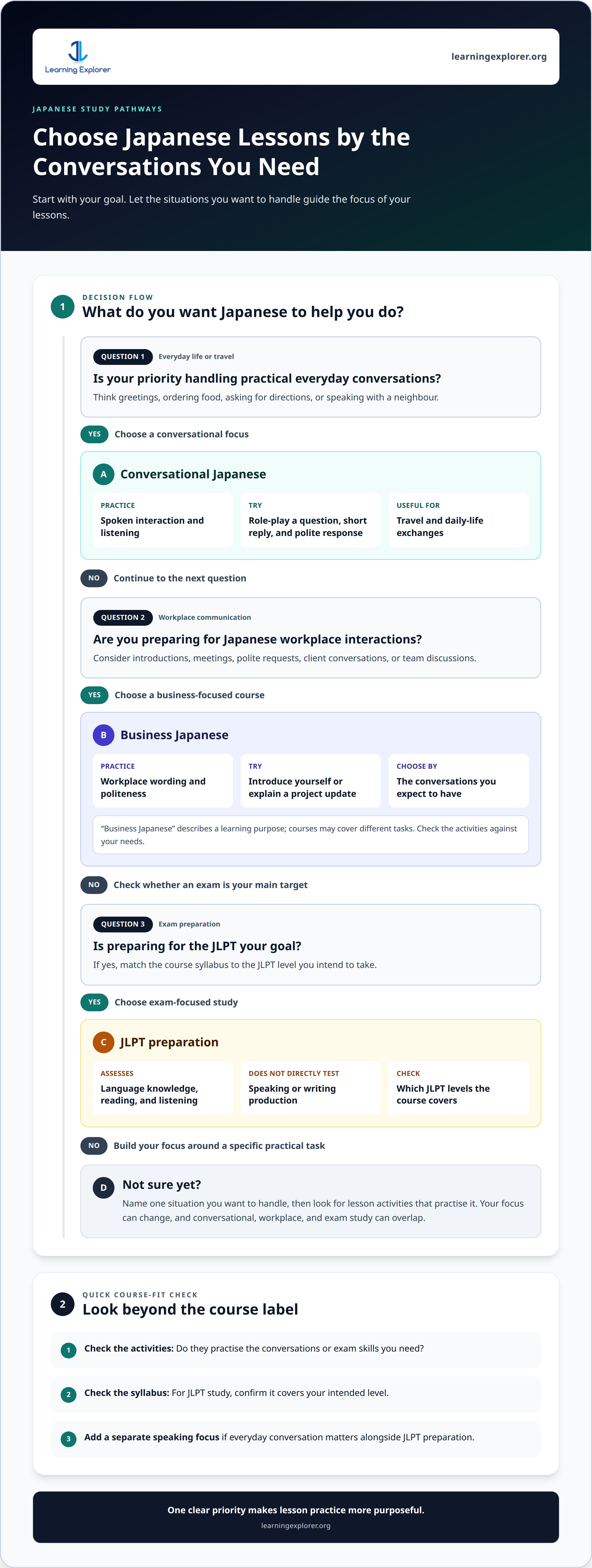
Start with the situations you want Japanese to help you handle. Conversational study suits practical exchanges, such as greeting a neighbour, ordering food or asking for directions. Business-focused study centres on workplace communication, such as introducing yourself in a meeting or making a polite request. JLPT preparation follows an exam goal. These paths can overlap, but each gives lesson time a different focus. A clear priority helps shape useful practice rather than leaving every skill equally broad.
For travel or daily life, conversational practice puts spoken interaction first. A lesson might rehearse asking where a train platform is, understanding a short answer and responding politely. Role-play lets learners practise the exchange instead of only memorising isolated vocabulary. Listening matters too: recognising a familiar question can help you respond without translating every word first. This focus is useful when real conversations matter more than a certificate or formal workplace language.
Workplace goals call for different examples. Someone preparing for Japanese business interactions may want to practise introductions, meeting language, requests and appropriate levels of politeness. Explaining a project update, for instance, requires different wording from asking a shop assistant for help. “Business Japanese” describes a learning purpose, not a guarantee that every course covers the same tasks. Choose lessons around the conversations you expect to have, such as client introductions or team discussions.
Some Japanese courses in Singapore prepare learners for JLPT study, but the levels covered depend on the course. Match the syllabus to your intended JLPT level instead of assuming every school teaches every level. The JLPT assesses language knowledge, reading and listening; it doesn’t directly test speaking or writing production. An exam-focused plan may therefore build reading and listening skills while leaving spoken practice to separate activities. This distinction matters if you need both an exam result and everyday fluency.
Use each lesson’s purpose to decide what belongs in your plan. If you want to speak comfortably during a trip to Japan, prioritise listening and spoken scenarios. If a work assignment is approaching, practise the specific workplace exchanges you expect. If the JLPT is your target, focus on the relevant exam skills, then add conversation practice if speaking matters too. A timetable shows when lessons run, but not when every real-world task will feel manageable. Choose a course by its activities, not its label alone.
Your goals can change, too. Someone starting with travel conversations might later add workplace language or JLPT preparation. Keep the main priority clear, then decide which secondary skill deserves lesson time. This helps adults make a focused choice without treating conversation, business communication and exam preparation as interchangeable.
Some Japanese courses offer JLPT preparation, but the levels available vary. Check that the syllabus covers your intended level, and add separate speaking practice if you also want to build conversational skills.
Japanese Lessons for Adults Relocating to Japan
Preparing for Japan is easier when lessons reflect the situations you’ll face. Focus on practical language tasks, from daily errands to study-related conversations.
Choosing a Japanese Language School
“Best” depends on your destination, goals and starting level. Compare what lessons practise, not just their labels. Someone planning to relocate may need to describe an address, ask about transport or speak with a landlord. A learner planning to study in Japan may need classroom phrases and practice asking for clarification. Choose lessons with activities connected to those real tasks.
Use your move as a planning tool. Write down situations you expect, such as buying groceries, asking for directions or discussing a timetable. Then connect each situation to a language skill: listening for key details, asking follow-up questions or giving a clear response. The Japan Foundation frames learning objectives around language tasks, a useful way to think about practical progress.
Lesson Locations in Singapore
For CBD learners, an in-person training centre is at 10 Anson Road, level 22, International Plaza, Singapore 079903, directly above Tanjong Pagar MRT. Online lessons are another format to consider when commuting is difficult. A Japanese study and relocation course in Singapore provides 16 hours of private, live online instruction. This gives relocating learners a defined block of lessons before departure.
Registration typically gathers a learner’s contact details, Japanese experience, study purpose and preferred schedule. Sharing a specific goal, such as handling a university orientation or asking for help at a station, can help identify a relevant starting point. Trial-class arrangements differ between schools, so don’t assume a trial is part of registration. Ask what the session covers before treating it as a placement assessment.
Registration and Trial Classes
If you attend a trial, focus on the lesson itself: the teacher’s explanations, speaking practice and feedback. A short sample can show whether the activities match your needs, but it doesn’t automatically establish an official course level. Registration may also involve choosing a format and confirming course terms. Keep your relocation date and priority situations clear so planning starts with useful context.
Adults often ask which Singapore school is best. There’s no single best fit for every relocation plan. Look for one aligned with your destination tasks, learning level and preferred lesson format. Compare how schools handle speaking practice, feedback and the situations you need to manage. Someone moving to Osaka for study, for example, may prioritise campus directions and classroom questions.
Preparation also means deciding which situations matter first. List a few, such as introducing yourself to a neighbour, asking a clinic about an appointment or understanding a train announcement. Lessons can then prioritise the vocabulary and responses each situation calls for. This makes study more relevant than trying to cover every possible exchange before leaving Singapore.
For adults balancing work and a move, online lessons can remove travel from the routine. In-person classes at Learning Explorer’s CBD location suit learners who prefer attending a centre. Whichever setting you choose, connect the schedule and lesson activities to a real relocation goal, such as settling into a neighbourhood or starting a course in Japan.
Personalized instruction and feedback
Personalised Japanese instruction starts with your communication goals. One adult may want to follow a train announcement; another may need workplace conversations. A teacher can use those situations to shape practice, keeping lesson activities relevant to your priorities rather than relying only on generic examples.
A useful starting point is a short learning profile covering prior study, speaking confidence, reading comfort and intended use. Someone who recognises common phrases but hesitates when speaking needs different practice from a complete beginner. Clear goals help the teacher choose an appropriate pace and focus.
Feedback works best when it points to a specific next step. If you give a greeting clearly but miss a question, the teacher can identify what to listen for. If sentence order causes confusion, a focused correction can show you how to rebuild your response. This turns mistakes into practical guidance.
Speaking practice can use situations you expect to face. A role-play might involve asking for directions, introducing yourself or ordering a meal. The teacher can listen for pronunciation, word choice and whether your message is understandable. Then you can try the exchange again with that feedback in mind.
Personalisation also means choosing material that fits your purpose. Someone preparing for life in Japan may practise asking a landlord about a repair. A learner focused on conversation might rehearse weekend plans with a classmate. These examples connect vocabulary with real communication needs.
Review progress through concrete tasks, not broad impressions. For example, compare how comfortably you handle a self-introduction before and after practice. The teacher can note which phrases come easily and where you still pause. That record helps guide upcoming lessons without assuming every skill improves equally.
Feedback should distinguish between communication priorities. A conversation partner may understand you despite a small grammar error, while a formal message may need more careful wording. The teacher can explain which correction matters most for the task, helping you focus instead of trying to fix every detail at once.
For useful Japanese lessons for adults in Singapore, share your goal, preferred practice situations and areas of uncertainty. You might say, “I want to ask for help at a station,” or “I need to introduce myself at work.” These examples give instruction a clear direction and make feedback easier to apply.
Where can adults take Japanese lessons in Singapore?
Adults in Singapore can study Japanese in a classroom or online. Group classes create opportunities to practise exchanges with classmates, while private lessons give a teacher more scope to focus on one learner’s goals. The right setting depends on your schedule, preferred interaction and where you need Japanese. A CBD worker, for example, might prefer a central classroom after work, while someone with a changing schedule may choose live online lessons.
For CBD learners, a training centre is at 10 Anson Road, level 22, International Plaza, Singapore 079903, directly above Tanjong Pagar MRT. A central location can make it easier to fit an in-person class around work or a commute. Think about the journey from your office, home or regular MRT stop. A convenient route may make attending scheduled lessons simpler.
Online learning removes the commute, but the format still matters. Live lessons let learners practise speaking and receive responses during class. A Japanese study and relocation course in Singapore provides 16 hours of private, live online instruction. Consider whether that focused format suits your preparation, especially if you want lessons tied to practical situations before moving to Japan.
Compare settings by the learning experience they provide:
- Group classes: Practise conversations with classmates and hear different responses.
- Private lessons: Focus class activities on one learner’s level and goals.
- Online lessons: Join live instruction without travelling to a classroom.
- In-person lessons: Attend a physical class at a location that fits your routine.
These formats describe how lessons happen, not how quickly someone learns. A private class isn’t automatically faster, and an online lesson isn’t automatically more convenient. Consider the timetable, activities and course terms together. If you want regular speaking turns, look at how much live interaction the format includes.
Location also affects the practical rhythm of study. A CBD class may suit someone already working near Tanjong Pagar, while an online session may better fit a learner commuting from elsewhere in Singapore. Consider what will help you attend consistently, then connect that choice to your goal. Someone preparing for daily life in Japan might prioritise live conversation practice.
If you’re weighing lesson formats, explore Japanese lesson options and consider which setting fits your schedule and learning goals. Japanese lessons for adults in Singapore are easier to plan when the location, live interaction and course activities all support the same purpose.
The right choice depends on your schedule, preferred interaction and learning goals. Adults who work near Tanjong Pagar may find a central classroom convenient, while those needing flexibility can consider live online lessons, including private instruction focused on practical situations before moving to Japan.
Learning Explorer: Conversational Japanese Course
Learning Explorer’s Conversational Japanese Course is a practical next step for adults who want to build confidence in everyday Japanese. It can suit learners preparing for travel, daily interactions or a move to Japan. Lessons are interactive and taught by native-speaker instructors who are also bilingual, offering clear guidance as you practise communication.
Bring a goal such as introducing yourself, asking for directions or handling a simple exchange. It gives your learning a useful focus from the start. Ready to explore conversational Japanese study? Contact Learning Explorer to discuss your learning goals.
Make Your Next Learning Step Count
Your next step can be small and specific: decide which real-life conversation you want to handle more confidently. That priority gives your Japanese study direction and helps you explain what support would be useful. Japanese lessons for adults in Singapore become more relevant when your goals guide the learning plan.
If you’re building broader communication skills too, Learning Explorer also offers a Conversational English Course, a Business English Course and a Conversational Mandarin Course. Each supports a different language goal, from everyday conversations to professional interactions.
Share what you hope to do in Japanese and what you’d like lessons to help you practise. Contact Learning Explorer to discuss your learning goals. A clear first step can make it easier to move forward with confidence.
Frequently Asked Questions
What Japanese proficiency levels and class schedules do Singapore schools offer?
Japanese courses commonly progress from beginner through intermediate to advanced study, while schedules depend on the course and format. Learning Explorer provides private, group and intensive classes, with in-person and online options. Adults balancing work and study can consider which format fits their routine, then choose a timetable that supports regular attendance. Lesson activities and placement processes help identify a suitable level.
Are there Japanese lessons in Singapore for beginners with no prior experience?
Yes, adults with no previous Japanese study can look for beginner-level lessons. Entry requirements vary, so complete beginners should review what the starting course expects rather than assume an exam is necessary. A useful first goal could be introducing yourself or understanding a simple greeting. Sharing that goal during registration helps the school understand your starting point and direct you towards an appropriate learning pathway.