A Level 1 Mandarin course doesn’t follow one fixed calendar. For expats taking Mandarin lessons in Singapore, basic conversation is estimated to take 350 to 700 study hours, depending on the learner’s goal and study method. Your pace also depends on your starting level, lesson frequency and practice between classes.
It’s natural to wonder when you’ll be able to use Mandarin with confidence, especially in everyday conversations or at work. This guide explains how course length relates to your goals, what progress milestones can look like, and why focused pronunciation practice matters from the start. You’ll also learn how lessons can build practical communication skills for workplace situations, so you can plan your learning around your schedule.
Key Takeaways
- Set a course timeline around your starting point, learning goals and opportunities to practise, rather than expecting one pace to suit everyone.
- Use progress milestones to see how your Mandarin is developing and what to focus on next.
- Build pronunciation from the start by connecting Pinyin with accurate tones and clear speech.
- Make guided practice between lessons part of your routine to reinforce what you learn in class.
- Choose beginner lessons that support the situations you want to handle, from everyday conversations to communication at work.
How long does it take to complete a Level 1 Conversational Mandarin course?
There’s no single completion time for a Level 1 Conversational Mandarin course. A broad estimate for developing basic Mandarin conversation is 350 to 700 study hours, depending on your goal and study method. This estimate concerns basic conversation, not a particular school’s timetable. For expats, mandarin lessons for expats in singapore should be matched to practical goals, such as introducing yourself, ordering food, or asking for directions.
Mandarin courses in Singapore vary in format, schedule, and teaching approach. Group lessons give learners opportunities to practise with others, while private lessons can focus on individual learning needs. Learning Explorer offers in-person and online classes, as well as group and private formats. Compare these options with your work commitments and consider how much guided speaking practice you want.
Yes, lessons can focus on expat life, workplace communication, or everyday conversation. Beginners might practise greeting a colleague, ordering lunch, or making small talk at a social gathering. Workplace scenarios could include introducing yourself at a meeting or asking someone to repeat a detail. When considering mandarin lessons for expats in singapore, identify the situations you want to handle so your learning has a clear purpose.
When choosing a course, consider whether it suits beginners and offers clear speaking goals, opportunities to practise, and useful instructor feedback. Location matters if you plan to attend in person, since travel time from work can affect how easily lessons fit your routine. For online classes, consider whether the format supports live conversation and correction. Focus on practical fit rather than a single feature.
Lesson costs vary by provider and format, so there isn’t one reliable price for private and group classes. The price depends on the case and is given after a quote request; relevant factors include class format, course length, and lesson frequency. Compare what the lessons cover and how they support speaking practice, rather than choosing by fee alone.
To enrol, choose a course format and a schedule that works with your commitments, then follow the provider’s registration process. Trial classes vary by provider, so don’t assume one is included. Before signing up, consider whether the course’s beginner content and teaching approach suit your goals. A clear fit can help you build a consistent learning routine around work and daily life.
Peer interaction can be part of a speaking routine: 72% of language learners find peer interaction vital for mastering a new language. When choosing a class, look for opportunities to speak with classmates as well as receive instructor feedback. CEFR and HSK are internationally aligned standards that can help learners track Mandarin progress, offering a way to review development alongside practical conversation goals.
Ten focused minutes of Mandarin practice most days can reinforce lesson material. In Singapore, 85% of adult learners give up on their language goals before they can hold a five-minute conversation. In September, Beijing announced plans to greatly expand language-school places for overseas students to boost international fluency.
Progress milestones and CEFR and HSK frameworks
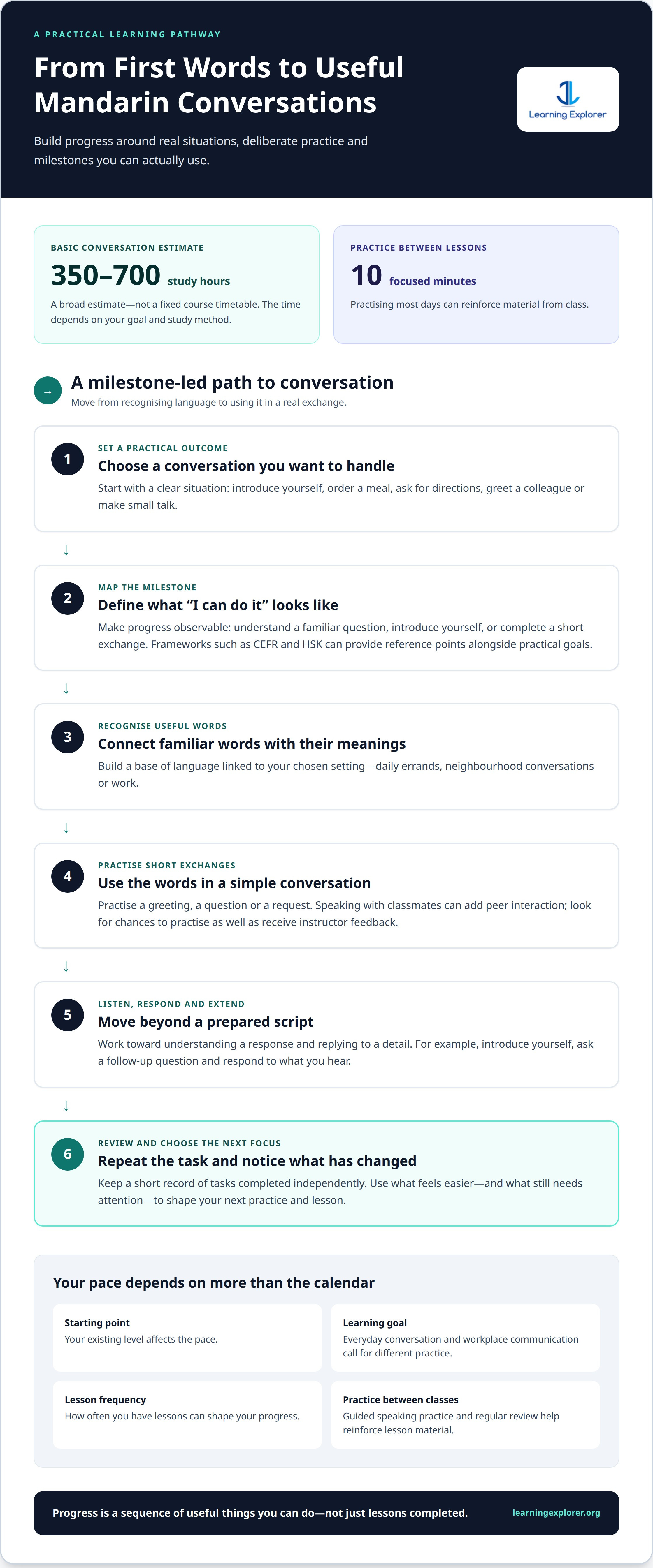
Progress is easier to measure when milestones describe what you can do, not simply what you have covered. The Common European Framework of Reference for Languages (CEFR) and the Hanyu Shuiping Kaoshi (HSK) framework can help learners track Mandarin development. For a beginner, useful milestones might include introducing yourself, understanding a familiar question, or handling a short exchange. Connect each milestone to a real situation, such as greeting a colleague or asking for directions.
These frameworks provide reference points, but a course plan should also reflect your purpose. Someone preparing for office conversations needs different practice from a learner focused on daily errands. One milestone might be asking a colleague to clarify a meeting time; another could be ordering a meal. Discussing your goals at the start gives an instructor practical criteria for choosing vocabulary, listening tasks, and speaking activities.
Professional working proficiency is a much longer-term goal than basic conversation. An English speaker may need about 2,200 class hours to reach professional working proficiency in Mandarin, according to the U.S. Department of State’s Foreign Service Institute. At 10 class hours per week, the stated estimate would take more than four years. This benchmark describes a demanding proficiency target, not the time required to finish a beginner course.
A beginner pathway can move from recognising words to using them independently. First, learners connect familiar words with their meanings. Next, they practise short exchanges using those words. Then they work on understanding a response and replying without relying entirely on a prepared script. A progress review can use a simple task, such as introducing yourself, asking a follow-up question, and responding to a detail.
A structured Mandarin course can organise lessons around a learner’s level, purpose, and preferred situations. An expat working with Singapore-based colleagues might prioritise meeting introductions and polite requests. Someone settling into a neighbourhood might focus on everyday exchanges. In either case, a useful milestone structure is to set a practical outcome, practise the language, then revisit the task to identify what is becoming easier and what still needs attention.
Keep a short record of completed tasks, such as understanding a greeting or asking a basic question independently. That record makes progress visible between formal assessments and helps guide the next lesson. A structured Mandarin learning pathway can help connect course milestones with the conversations you want to manage at work and in daily life.
Pronunciation, pinyin and tones
Pinyin represents Mandarin sounds with Latin letters and tone marks. Beginner instruction starts with Pinyin and the four basic tones, giving learners a pronunciation guide before they rely on Chinese characters. In an early lesson, an instructor can model a syllable, demonstrate its tone, and invite the learner to repeat it. The goal is to connect what learners see with what they hear and say, rather than memorising sounds in isolation.
Tones change the pitch movement used when saying a syllable. A familiar teaching example is ma: the marks in mā, má, mǎ, and mà show four different tones. Practising the same syllable this way helps learners notice how pitch distinguishes spoken forms. An instructor can model each version, then listen for whether the learner’s voice follows the intended contour. Clear feedback is more useful than simply repeating a syllable quickly.
Pinyin marks also help learners practise pronunciation while building useful phrases. For example, the greeting nǐ hǎo shows tone marks above the vowels. Learners can first say each syllable slowly, then join them into the complete greeting. An instructor can correct the vowel sound, consonant, or tone separately. This step-by-step approach helps identify what needs attention before using the phrase in conversation.
Listening practice should connect directly to speaking. An instructor might say a greeting or short question, then ask the learner to identify the tones before responding. The learner can repeat the phrase, receive a correction, and try it again in a short exchange. Comparing similar-sounding syllables also trains the ear to notice pitch differences. These focused activities keep pronunciation practice from becoming a list of disconnected sounds.
For work and social situations, practise pronunciation in realistic exchanges. A learner might rehearse greeting a colleague, saying their name, or asking someone to repeat a point. The instructor can model the phrase, guide a slower attempt, then prompt a more natural conversational pace. If a tone affects understanding, the instructor can isolate that syllable and rebuild the phrase. This sequence helps learners use Pinyin to practise speech beyond pronunciation exercises.
How instructors guide practice between Mandarin lessons
Practice between classes works best when each task reinforces a lesson goal. A useful routine is ten focused minutes most days. An instructor can connect that practice to class material, such as recalling key phrases, listening for a familiar expression, or preparing a short response. Keeping tasks specific helps busy learners fit Mandarin into a workday without turning practice into an open-ended chore.
After a lesson on ordering food, for example, learners might review a short exchange and practise saying each line aloud. The next class can begin with a role-play: one person orders while the other responds. This creates a clear cycle: revisit lesson language, use it in context, then identify what still feels difficult. A focused task also offers a practical way to prepare for the next session.
Listening tasks can support speaking practice. An instructor might choose a short dialogue using familiar words and ask learners to note the main idea before replaying it. Learners can then repeat a useful phrase and explain its meaning. In the following lesson, the instructor can revisit the phrase in a new situation, such as a conversation with a colleague. This links listening, recall, and speaking without requiring advanced vocabulary.
Between-class practice can also prepare learners for real interactions in Singapore. If a learner wants to greet a neighbour, an instructor can set a brief rehearsal task using expressions already taught. For a workplace goal, practice might involve preparing a simple self-introduction or polite request. Keeping tasks within the learner’s current level helps build on known language without adding too much at once.
- Recall: Revisit a small set of phrases from the latest lesson.
- Rehearse: Say a short dialogue aloud, then repeat it without reading.
- Apply: Use one familiar phrase in a realistic work or social scenario.
- Review: Bring a difficult word or response back to the next class.
Review gives the instructor useful information for planning. If a learner remembers a phrase but struggles to respond naturally, the next lesson can add a follow-up question. If listening is difficult, the instructor can replay a short exchange and focus on a few key words. This targeted adjustment makes practice purposeful and helps learners see which skills are developing and where guided support can make the next conversation easier.
Which Singapore Mandarin schools offer beginner lessons for adults?
Adult beginners in Singapore can look for structured Mandarin instruction that matches their goals. A useful starting point is the course focus: everyday conversation, workplace communication, or both? Someone who wants to greet neighbours needs different practice from a learner preparing for short exchanges with colleagues. Choose a beginner pathway with practical outcomes, not just a broad language level.
Compare the teaching approach before you decide. A course may use guided speaking, listening exercises, reading, or a mix of activities. For a first lesson, check whether learners practise useful exchanges, such as introducing themselves or asking someone to repeat a detail. Ask how instructors support beginners who have never studied Mandarin. Clear explanations and structured speaking practice can make lessons easier to follow.
Class format and schedule also affect the learning experience. In a group, learners can practise responding to different people; private lessons allow more individual attention. Consider how classes fit around a Singapore workweek and commute. An adult working in the CBD may prefer a regular class near the office, while another learner may choose online sessions. Match the format to a routine you can sustain.
Use these practical checks when comparing adult beginner options:
- Course focus: Look for examples tied to your goals, such as daily errands or workplace introductions.
- Lesson structure: Check whether classes include time to listen, speak, and receive instructor feedback.
- Starting point: Confirm that the course is designed for learners with little or no Mandarin experience.
- Practical fit: Compare location, class timing, and format with your work and travel commitments.
Be specific about the situations you want to handle. An expat in Singapore might prioritise ordering lunch, making small talk, or asking a colleague a simple question. Choose beginner lessons that connect classroom activities to those goals. Look for a progression from modelled phrases to short exchanges, so you practise responding rather than only repeating vocabulary.
Before enrolling, review the course description and registration steps. Trial classes vary by provider, so don’t assume one is included. Focus on the learning format, schedule, and speaking goals that fit your needs. To explore a structured option for adult beginners, view beginner Mandarin course options.
Adults can explore Singapore language schools and tutors, and check which providers offer online sessions.
Learning Explorer has been teaching languages to adults in Singapore’s CBD since 2015. Adults considering it can ask whether its current Mandarin provision includes a beginner course and what learners practise in class. Confirm the schedule, format, and starting level directly with the school, then compare those details with your goals and routine before deciding whether it is a suitable option.
Learning Explorer
Learning Explorer helps adult learners connect Mandarin study with conversations they want to manage in Singapore. For everyday exchanges, the Conversational Mandarin Course offers a relevant learning path; learners focused on workplace communication can consider the Business Mandarin Course. Your goals, current level, and available study time can guide which direction fits best.
When discussing a course, explain where you want to make progress, such as greeting colleagues, following simple workplace conversations, or handling daily interactions. This context helps establish a practical starting point and keeps learning focused on communication that matters to you.
Contact Learning Explorer to discuss which Mandarin course fits your goals and take the next step.
Make your next conversation the goal
Let real conversations guide your next step. Before starting, decide where you most want Mandarin to be useful: speaking with colleagues, joining social conversations, or handling everyday interactions in Singapore. That priority gives your learning a clear purpose and helps you focus on language you can use beyond the classroom.
For expats considering Mandarin lessons in Singapore, the right starting point fits both your current level and your reason for learning. Learning Explorer offers a Conversational Mandarin Course for learners building practical speaking skills. Share the situations you want to manage and discuss how lessons can support that goal.
You don’t need to have every milestone mapped out before you begin. Start with one meaningful communication goal and build from there. Contact Learning Explorer to discuss lessons and take your next step toward communicating with greater confidence.
Frequently Asked Questions
What is the maximum number of students in a small group class?
Group sizes depend on the specific class, so there isn’t one maximum for every Singapore course. Learning Explorer offers group and private formats, giving learners a choice between peer practice and more individual attention. Consider how much speaking time you want and whether you’re comfortable taking turns with classmates when choosing a format.
What Mandarin classes are available for expats in Singapore?
Expats can choose Mandarin learning focused on conversation or workplace communication. Learning Explorer offers a Conversational Mandarin Course and a Business Mandarin Course. If you’re starting from scratch, consider whether you mainly want to manage everyday exchanges or communicate in professional settings. That purpose helps identify the course direction that best matches your needs and the situations you want to handle.
Where can expats find Mandarin tutors for in-person lessons in Singapore?
For in-person Mandarin lessons in Singapore, Learning Explorer’s training centre is at 10 Anson Road, level 22, International Plaza, Singapore 079903, directly above Tanjong Pagar MRT. This CBD location can suit learners who work nearby or travel through Tanjong Pagar. Consider your commute and how easily the class location fits into your regular workday when planning lessons.
What are the best areas in Singapore for finding Mandarin classes?
The most practical location depends on where you work, live, and travel regularly. For CBD-based learners, Learning Explorer is located at International Plaza in Tanjong Pagar. When planning in-person classes, consider whether the journey makes a regular schedule manageable. Choose an option that fits your routine rather than adding a difficult trip to an already busy day.
What levels and proficiency tests do Singapore Mandarin courses cover?
CEFR and HSK can serve as frameworks for tracking Mandarin progress, but a course’s level structure and exam preparation depend on its curriculum. CEFR means the Common European Framework of Reference for Languages; HSK is the Hanyu Shuiping Kaoshi. For practical learning, distinguish general course milestones from formal test preparation, and look for level descriptions connected to clear communication tasks.
Are there discounts, subsidies, or employer funding for Mandarin courses in Singapore?
NTUC union members can claim up to 50% of their unfunded course fees through UTAP. They must maintain at least 75% attendance and submit the claim within six months after finishing the course.