A busy workweek doesn’t have to rule out Korean study. In Singapore, beginner Korean classes include weekday-evening and weekend batches, so adults looking for Korean lessons in Jurong East can consider options beyond daytime schedules. The right fit also depends on whether you prefer learning with a group, one-to-one guidance or online lessons.
It’s understandable to want clear answers before committing time to learning Korean. This guide explains how class formats differ and what to consider when matching Korean lessons for adults in Jurong East to your routine and learning preferences.
You’ll also find details on the Jurong East campus, age eligibility and the schedule questions that matter to working adults, so you can make a more confident choice.
Key Takeaways
- Beginner Korean classes include weekday-evening and weekend batches, offering working adults more scheduling flexibility.
- Jurong East MRT Exit D is about 360 m from the centre, roughly a six-minute walk.
- Compare group, private and online formats to find a lesson setup that suits your routine and learning preferences.
- Consider your Korean level and age eligibility when deciding which class pathway may fit.
- Explore how the Conversational Korean Course can support practical language learning.
Are there evening or weekend Korean classes for working adults?
Yes. Beginner Korean group classes in Singapore include weekday-evening and weekend batches, giving working adults schedule options outside standard office hours. Korean lessons for adults in Jurong East can suit learners starting with the basics, while the right level and class format depend on prior study and learning goals.
Class Dates and Schedules
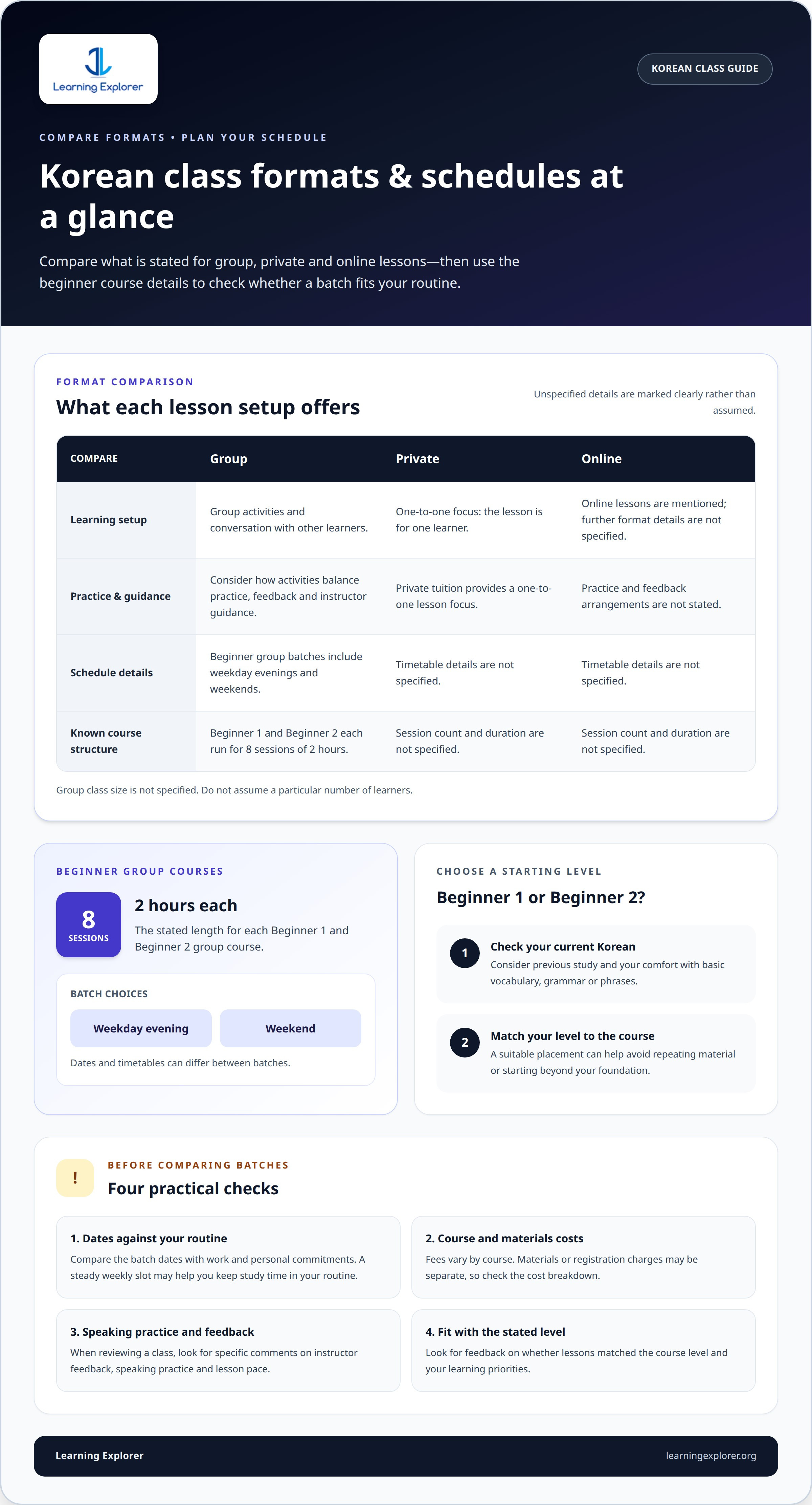
Beginner 1 and Beginner 2 group courses each run for eight sessions of two hours. Choose between a weekday-evening or weekend batch, then compare the session dates with your work and personal commitments. Dates and timetables can differ between batches, so the schedule is a practical first filter. A steady weekly slot can also make it easier to keep study time in your routine.
Course levels matter as much as timing. Beginner 1 and Beginner 2 provide named starting points for learners at the beginning of their Korean study. If you already know basic vocabulary or grammar, consider how your current ability matches the course level before enrolling. A suitable placement helps keep lessons relevant, rather than repeating material you already understand or starting beyond your current foundation.
Learning Explorer’s beginner group courses run for eight sessions of two hours each. Class size is not specified, so don’t assume a particular number of learners. The number of participants can affect individual speaking time. When comparing formats, consider how group activities balance practice, feedback and instructor guidance.
Include course fees and materials in your budget. Fees vary according to the course, and materials or registration charges may be separate. Ask for a breakdown of course and materials costs before enrolling. This gives you a clearer picture of the overall commitment before choosing a class.
Enrolling in Adult Korean Classes
Start by identifying your level, preferred format and available weekday evenings or weekends. Then select a suitable batch and review its dates, eight-session duration and materials arrangements before completing the provider’s enrollment process. If you’re unsure whether Beginner 1 or Beginner 2 fits, share your previous Korean study and current comfort with basic phrases to support a more appropriate placement.
Reviews and ratings can help you assess a Jurong East class, but a single score won’t explain the learning experience. Look for comments about instructor feedback, speaking practice, lesson pace and whether the course matched its stated level. Specific examples are more useful than general praise. Compare feedback that reflects your priorities, such as conversation practice or a schedule you can maintain.
Jurong campus location near Jurong East MRT
Jurong East MRT Exit D is about 360 m from the area, roughly a six-minute walk for adult students living in the western region. That gives commuters a clear transit reference when planning how to connect to central classes. Allow for the travel time between the station exit and your final destination when fitting korean lessons for adults jurong east around work or other appointments. The distance is a useful planning point for residents commuting from the neighbourhood.
Bus stops offer alternatives for people travelling through the district. The J Gateway stop, number 28061, is about 240 m from the main thoroughfare. Buses 49, 98, 98M, 99 and 990 serve it. The Blk 203 stop, number 28069, is also about 240 m away, with buses 49 and 99. Choose the stop that best matches your route if you live in the west.
Other bus options sit farther away in the precinct. Opposite Jem, stop 28199, is about 360 m away and is served by bus 333. Use the stop name and number to distinguish it from nearby boarding points. If you are travelling by bus from Jurong, compare the route and stop location with your planned arrival time to ensure a smooth journey to our central campus.
- By MRT: Use Jurong East MRT Exit D, about 360 m from the local hub.
- By bus: J Gateway and Blk 203 are each about 240 m away.
- By car: Car park J91 at Blk 287e Jurong East Street 21 is about 200 m away.
- For another bus route: Opposite Jem is about 360 m away.
Drivers living nearby can use local parking references when planning a visit. Car park J91 at Blk 287e Jurong East Street 21 is about 200 m from the neighbourhood reference point. The IMM Building car park is about 260 m away, while the Westgate car park is about 270 m away. These distances help compare local parking options before heading out for your weekend or evening schedule.
For a first visit, choose your transport mode before setting off from the west. MRT users can start from Exit D; bus users can identify J Gateway, Blk 203 or Opposite Jem by stop number. Drivers can compare J91, IMM Building and Westgate by distance. To explore Korean learning options with Learning Explorer, visit Korean course information.
Where are the Korean classes held?
In-person lessons are held at 10 Anson Road, level 22, International Plaza, Singapore 079903, directly above Tanjong Pagar MRT. This is the stated training-centre address, not a Jurong East campus. If you live or work in Jurong East, include the journey to Tanjong Pagar when assessing whether an on-campus class fits your routine.
Regular, express, intensive and private describe different ways to organise language learning. A regular course follows a paced schedule across lessons. An express course generally moves through material in a more concentrated format. Intensive classes group learning into a faster sequence, while private lessons focus on one learner. These labels describe formats, not a confirmed timetable or course specification.
For an adult learner, the useful comparison is how each format supports practice. A regular schedule can spread learning across time. An intensive structure concentrates study, which may suit someone with a defined learning window. Private tuition gives the lesson a one-to-one focus. Group learning brings peers into activities and conversation. Match the format to your availability, preferred pace and comfort speaking Korean aloud.
In-person and online classes also differ in how learners take part. In-person lessons mean travelling to the training centre and joining the session there. Online learning removes that commute but requires a suitable device and a quiet place to participate. Consider where you concentrate best, and whether face-to-face interaction or remote access better fits your weekly routine.
A trial class can help you experience a teaching approach before choosing a longer course. Its fee and duration are separate details from the full course schedule. Use the session, if offered, to observe lesson pacing, instructor explanations and opportunities to practise the Korean language. Don’t treat a trial as evidence of a particular regular, express or intensive timetable.
Schedule notifications are useful when dates or class arrangements change. Look for clear information covering the lesson date, start time, location or online access, and any change affecting attendance. Keep those details alongside work commitments, especially if you travel from Jurong East to International Plaza. A consistent calendar entry can help you protect study time and arrive prepared.
Before selecting a format, compare its pace, participation style, location and scheduling needs. For example, a learner with limited travel time may value remote access, while someone who prefers in-person practice may plan around the Tanjong Pagar MRT location. These are format considerations, not promises about a particular class option or trial arrangement.
Age eligibility
Adult Korean classes are intended for adult learners, while children may have a different learning pathway. Age eligibility is therefore a useful first filter, separate from Korean ability. An adult beginner and a child beginner may share a language level, but they don’t necessarily belong in the same class. Choose a class designed for the learner’s age group before comparing lesson pace or format.
You don’t need to focus on a specific age to decide whether adult learning suits you. Instead, consider the learner’s stage of life and preferred setting. An adult balancing work commitments may value a class organised for adult learners, while a younger learner may need a programme designed around children. Match the learning environment to the person, rather than relying on Korean proficiency alone.
Age and level answer different questions. Age eligibility identifies the intended learner group; level indicates the learner’s starting point in Korean. An adult with no previous study can still be a beginner. Someone who has studied Korean before may need a different level assessment. Keep those decisions separate when reviewing class information.
- Identify the learner group: adult learner or child.
- Note prior study: none, introductory exposure or previous classes.
- Consider the setting: group, private or online learning.
- Match the level: beginner or a level suited to existing knowledge.
For adults returning to study after a long break, previous experience may not reflect current confidence. Someone who learned basic phrases years ago might still prefer a beginner foundation. Another learner may remember enough vocabulary to benefit from a higher starting point. Consider current comfort with listening, speaking, reading and writing when discussing placement, not age alone.
Class format can also shape the experience for different adult learners. Group lessons include other learners, while private instruction gives one learner focused attention. Online study changes the learning environment but not the need to select an appropriate level. Consider how you prefer to practise and participate before settling on a format.
Before enrolling, note your age category, Korean experience and preferred class setting. An adult beginner seeking online lessons, for example, has different needs from a child with prior classroom study. This short profile helps frame the placement conversation and keeps age, level and format clear. If enrolment involves a younger learner, use the children’s pathway rather than assuming adult-class eligibility.
Group, private and online lesson formats
For adults choosing Korean lessons in Jurong East, the right format depends on how you prefer to participate, the guidance you want and your travel needs. Group classes, private lessons and online study each shape learning differently. If you enjoy practising with peers, a group may suit you; if you prefer individual attention, consider private lessons. Online lessons can suit learners who want to avoid travelling to class.
Group lessons bring learners together for shared instruction and practice. They create opportunities to hear different voices and take part in partner activities. Class time is shared, so individual speaking turns depend on the group’s pace and participation. If practising with peers helps you stay motivated, consider whether you’ll feel comfortable contributing and speaking aloud.
Private lessons centre on one learner’s questions and progress. They can suit an adult who wants to focus on a particular priority, such as pronunciation, reading or everyday conversation. The format also calls for active participation, since there are no classmates to share practice with. Think about whether individual feedback or learning alongside peers is more likely to keep you engaged.
Online lessons replace the commute with a remote setup. That can help adults in Jurong East fit study around work and other commitments. A quiet space, reliable internet connection and suitable device support participation. Consider whether you can concentrate at home or prefer the classroom setting, and whether remote lessons make it easier to study consistently.
Use these factors to compare formats before choosing:
- Participation: Do you prefer peer practice or individual guidance?
- Routine: Does travelling to class fit your week?
- Focus: Can you study online without interruptions?
- Learning priority: Are you focused on conversation, pronunciation or building a foundation?
For example, an adult who enjoys discussion may find group activities energising. Someone focused on pronunciation may value individual attention, while a busy commuter may prioritise remote access. These examples can clarify what matters most to you. They describe differences between formats, not a promise about a specific class arrangement.
Before settling on korean lessons for adults in Jurong East, consider how each format supports speaking practice, feedback and continuity. A good personal fit brings together your schedule, preferred participation style and language goals. If you’re ready to explore Korean learning options, review the available course information.
One concrete option to compare with your preferred format is Learning Explorer’s Beginner 1 and Beginner 2 group courses in Singapore. If a group setting matches your preference for peer practice, compare that commitment with the time you can reliably set aside and the kind of feedback you want. The session length can also help you judge whether two-hour classes fit your attention and routine. If you are weighing group study against private or online lessons, use the course information as a point of comparison, then confirm that the format and schedule suit your priorities before enrolling. Consider not just the price, but whether the way you learn feels sustainable.
Learning Explorer: Conversational Korean Course
Learning Explorer’s Conversational Korean Course is a natural next step for adults ready to build practical Korean skills. Choose it if your goal is more confident everyday conversation, whether you’re beginning or continuing your language study. The earlier sections can help you weigh schedules, location and learning formats before deciding what suits your routine.
As you consider the course, think about situations where you want to use Korean, such as introducing yourself or taking part in a simple conversation. Clear goals can help focus your learning and make your next steps easier to plan.
If Korean conversation is your priority, contact Learning Explorer to discuss the Conversational Korean Course.
Make Korean Study Part of Your Next Chapter
Choosing a class format is only the starting point. Connect your Korean study with a real goal, such as speaking more comfortably in everyday situations or building confidence for travel. A clear purpose can help you stay focused as you begin learning and decide what you want to practise first.
If you’re considering Korean lessons for adults in Jurong East, use your preferred learning style and personal goals to guide your choice. Learning Explorer offers a Conversational Korean Course, alongside Conversational English, Business English and Conversational Mandarin courses for other learning needs.
There’s no need to have every detail mapped out before taking that step. Share what you hope to learn and discuss whether the Conversational Korean Course fits your direction. Contact Learning Explorer about Korean classes and take a confident first step towards your language-learning goals.
Frequently Asked Questions
How much does a beginner Korean course cost, and how long does it take?
Learning Explorer’s beginner group courses run for eight sessions of two hours each. Fees vary according to the course, and materials or registration charges may be separate. Ask Learning Explorer for a breakdown of course and materials costs before enrolling, so you can plan the full commitment. Compare the lesson format and what the course includes, not fees alone.
Should I choose group, private or online Korean lessons?
Choose based on how you learn best and how lessons will fit into your week. Group classes provide shared practice, private lessons focus on one learner, and online study avoids travelling to a classroom. A group may suit you if peer conversation is motivating, while private tuition can provide focused attention. Online lessons require a quiet study space and reliable internet.
Which course should I choose for TOPIK or intermediate Korean?
Start by defining whether your priority is exam preparation or practical conversation. Learning Explorer’s Conversational Korean Course is suited to learners focused on speaking in everyday situations. If you’re working toward TOPIK or have intermediate Korean goals, explain your current level and target skills when discussing course fit. Listening, reading, writing and speaking may call for different kinds of practice.
Korean class reviews and ratings in Jurong East Singapore
Reviews and ratings can help you assess a Jurong East class. Look for specific comments about instructor feedback, speaking practice, lesson pace and whether the course matched its stated level.