Imagine standing at a patient’s bedside during a hectic night shift, trying to explain a critical medication change, only to be met with a look of pure confusion from a Mandarin-speaking grandmother. It’s a stressful moment every practitioner in our city-state eventually faces. You want to provide the highest standard of care, yet the language barrier creates a wall that feels impossible to scale between rounds. The anxiety of being misunderstood or missing a vital symptom is a heavy burden to carry in an already demanding environment.
Key Takeaways
- Understand why bridging the language gap with the Pioneer and Merdeka generations is critical for accurate diagnosis and patient safety.
- Discover how learning mandarin for healthcare professionals singapore helps you conduct smooth patient intakes and explain medication instructions with total clarity.
- Learn to navigate local “Singdarin” and manage dialect interference to build deeper rapport with patients who mix Mandarin with Hokkien or Cantonese.
- Explore micro-learning strategies and specialized coaching designed to fit into the demanding schedules of hospital shifts and clinical rounds.
- Transition from basic conversational skills to professional clinical use through a supportive curriculum tailored to the unique Singaporean healthcare context.
Why Mandarin Proficiency is Essential for Healthcare Professionals in Singapore
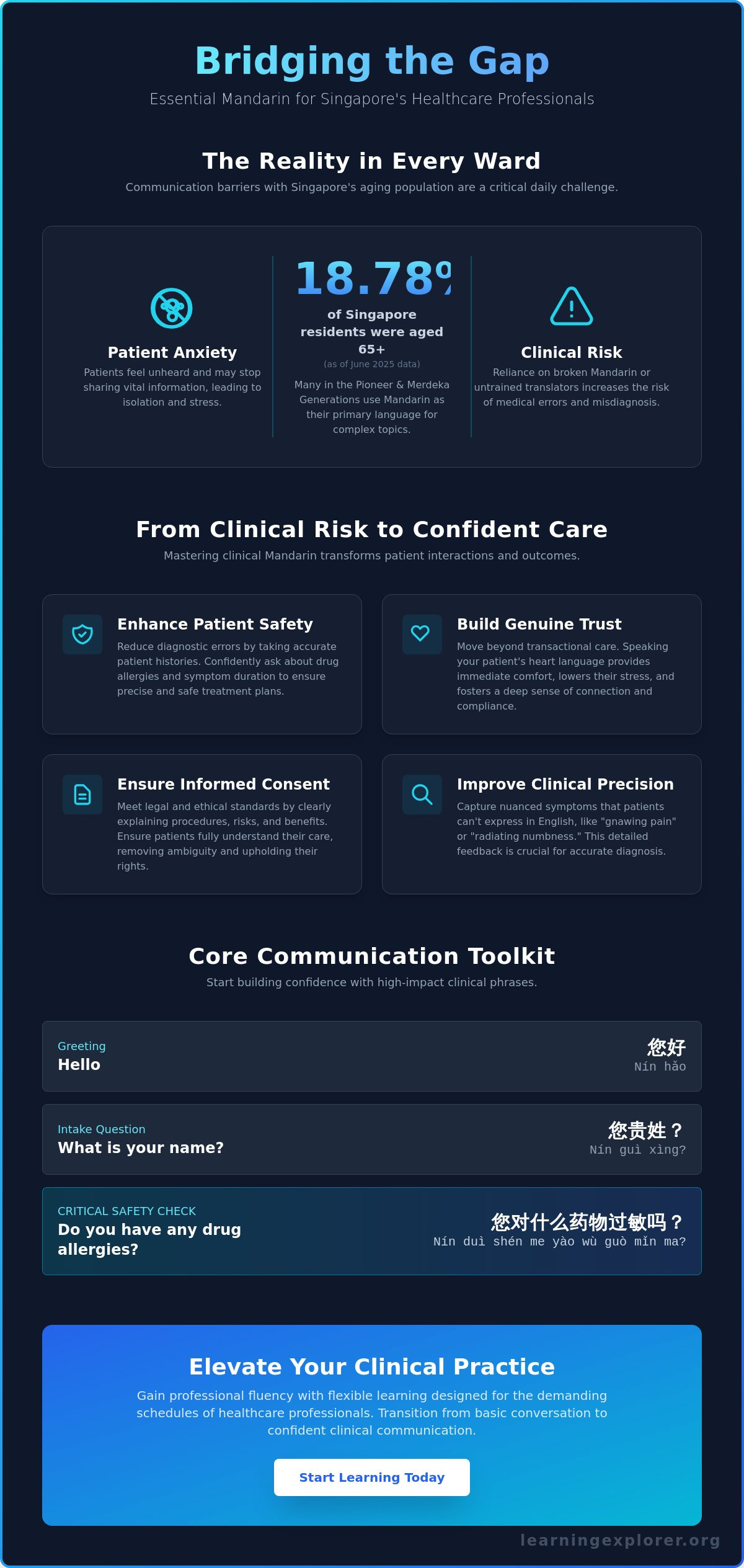
Singapore is aging fast. By June 2025, official data showed that 18.78% of our residents were aged 65 and over. For you, this isn’t just a dry statistic; it’s the daily reality of every ward round and clinic consultation. In our multilingual society, English serves as the administrative bridge, yet Mandarin remains the heart language for nearly 30% of the population. When you can’t communicate fluently, the emotional labor of your shift increases. You aren’t just managing a medical condition. You’re also managing the exhaustion that comes from trying to guess a patient’s needs through a wall of silence.
Mastering mandarin for healthcare professionals singapore is a transformative step for your career in 2026. It moves you from the labor of seeking clarity to the satisfaction of providing immediate comfort. Beyond the clinical benefits, it positions you as a visionary practitioner who values empathy as much as technical skill.
To see how specific medical terminology translates into practice, watch this helpful demonstration:
Bridging the Generational Communication Gap
Many members of the Pioneer and Merdeka Generations grew up in a linguistic environment where English was secondary. While they might follow simple instructions, they often lack the English vocabulary to describe complex internal sensations like “gnawing hunger” or “radiating numbness.” This gap triggers significant patient anxiety. When a patient feels unheard, they often stop sharing vital information. They might nod politely while feeling deeply isolated. By speaking their native tongue, you lower their stress levels and improve compliance. You also learn to navigate the role of family members, ensuring that the patient’s own voice isn’t lost when relatives step in to translate.
Mandarin as a Tool for Clinical Precision
Relying on “broken” Mandarin or an untrained staff member to translate is a major clinical risk. Inaccurate history taking remains a primary cause of medical errors globally. If you can’t confidently ask about specific drug allergies or the exact duration of a fever, your diagnostic accuracy drops. There are also legal and ethical layers to consider. Informed consent requires that a patient fully understands a procedure before they agree to it. If you’re relying on hand gestures and simple “yes” or “no” questions, you’re on shaky ground. Developing your skills in mandarin for healthcare professionals singapore ensures you can explain the “why” behind every treatment, which is the true foundation of professional trust.
Core Medical Mandarin Vocabulary: From Patient Intake to Diagnosis
The first thirty seconds of a patient encounter often set the tone for the entire hospital stay. When you greet an elderly patient with a polite “Nin hao” (Hello) and introduce yourself clearly as their healthcare provider, you immediately signal respect. Mastering mandarin for healthcare professionals singapore isn’t just about memorizing a list; it’s about building a functional toolkit for the ward. Effective care relies on clear communication, a sentiment echoed by the Ministry of Health on language needs in healthcare, which highlights the ongoing effort to eliminate these barriers in our clinics.
During patient intake, you need to move quickly but accurately. Start by asking for their name (Nin gui xing?) and checking for allergies (Nin you dui shen me yao wu guo min ma?). Understanding the basic anatomy of the cardiovascular (xin zang), respiratory (hu xi), and digestive (xiao hua) systems allows you to guide the patient through a physical exam with simple instructions like “Deep breath” (Shen hu xi) or “Please lie down” (Qing tang xia).
Pain assessment is where precision matters most. Don’t just ask if it hurts; ask how it hurts. Use these specific descriptors to narrow down a diagnosis:
- Sharp pain (Ci tong): Often associated with acute injury or nerve issues.
- Dull pain (Yin tong): Common in chronic conditions or internal organ discomfort.
- Throbbing pain (Tiao tong): Frequently used to describe migraines or inflammatory responses.
- Radiating pain (Fang she tong): Essential for identifying spinal or cardiac concerns.
Symptom Description and Patient History
Listen closely to the specific localized terms patients use. An elderly patient might describe numbness as “ma” or a feeling of bloating and pressure as “zhang.” These aren’t just descriptions; they’re clinical clues. You’ll also need to identify chronic conditions that are prevalent in our community. Learn to recognize “tang niao bing” (diabetes) and “gao xue ya” (hypertension) during the history-taking phase. Always clarify the onset by asking when the discomfort started (Shen me shi hou kai shi de?) and how often it occurs.
Medication and Treatment Instructions
Clear instructions prevent medication errors. Explain dosages using the “times per day” (Yi tian ji ci) and “how many pills” (Ji li) structure. Be explicit about timing, such as before meals (fan qian) or after meals (fan hou). It’s also your responsibility to warn them about side effects like dizziness (tou yun) or drowsiness (shui yi). Always conclude with reassurance phrases like “Don’t worry” (Bu yong dan xin) to help them feel safe. If you’re ready to refine these skills, exploring a Conversational Mandarin Course can help you practice these scenarios in a supportive environment.
Navigating Clinical Nuance: Addressing the Needs of Mandarin-Speaking Patients
Textbook fluency is a great start, but it often hits a wall in the reality of a busy Singaporean ward. Our seniors rarely speak the standardized Mandarin found in language apps. Instead, they communicate through a rich, localized tapestry of “Singdarin” and dialect loanwords. To truly master mandarin for healthcare professionals singapore, you must learn to listen for the subtle shifts between standard terms and the Hokkien or Cantonese phrases that often slip into their descriptions of pain. This isn’t just about translation; it’s about cultural recognition.
Communication is more than just words. It’s about recognizing that a patient might use the Malay loanword “tahan” when describing their ability to endure a procedure, or they might refer to their “ang mo lo kun” (Western doctor) while secretly consulting a TCM practitioner. Understanding these nuances reduces the administrative burden of repeating questions and increases your engagement with the patient’s actual lived experience. It transforms you from a clinician who just follows a script into a trusted ally who truly understands the community’s heartbeat.
Understanding Localized Medical Terms
Patients often simplify complex medical jargon into “market Mandarin.” For example, instead of using the technical term for “myocardial infarction,” a patient might simply say their heart is “bo lat” (has no strength) or feels “kiat” (tight or clogged). Don’t correct them. Instead, adopt their vocabulary to ensure they feel heard. You’ll frequently encounter loanwords from Hokkien, such as “sim-pau” for chest or “kha” for leg. Being able to identify these dialect interferences ensures you don’t misinterpret a symptom location during a fast-paced intake session. It’s about meeting them where they are.
Integrating Cultural Context into Care
Cultural sensitivity is a clinical tool, not just a soft skill. Many Chinese patients in Singapore view health through the lens of balance, often categorizing illnesses as “heaty” (re qi) or “cooling” (liang). If you dismiss their concerns about eating certain foods while on medication, you risk losing their trust. Respectfully acknowledging their use of Traditional Chinese Medicine (TCM) allows for a safer, more integrated treatment plan. Additionally, be mindful of “face” (mian zi). Avoid discussing sensitive diagnoses or end-of-life care in crowded areas where the patient might feel embarrassed or exposed. The same principles of hierarchy and “face” that govern patient interactions also apply in professional settings — understanding business Mandarin etiquette can deepen your appreciation of these cultural dynamics across all contexts. Practicing these delicate conversations at our training center at 10 Anson Road, level 22, International Plaza, Singapore 079903, empowers you to handle real-world scenarios with grace and professional confidence.
Flexible Learning Solutions for Busy Healthcare Schedules
Healthcare shifts are grueling. Between back-to-back rounds and emergency calls, your schedule leaves little room for traditional classroom settings. We understand that the labor of seeking out resources shouldn’t add to your administrative burden. Instead of forcing your life to fit a course, choose a learning model that adapts to your professional reality. Mastering mandarin for healthcare professionals singapore requires an approach that respects your time and targets your specific clinical needs. It’s about finding the creative catalyst for better patient outcomes without burning out.
Micro-learning is a powerful ally for practitioners. Use your commute or brief meal breaks to reinforce high-frequency vocabulary. Mobile apps and digital flashcards allow you to review terms like “shortness of breath” or “numbness” in thirty-second bursts. These small, consistent efforts build a momentum that transforms your confidence over time. By focusing on bite-sized, scannable chunks of information, you can integrate language practice into your daily workflow without feeling overwhelmed.
Customizing Your Learning Path
Generic language courses often fail healthcare professionals because they focus on tourist scenarios rather than clinical ones. You don’t need to know how to book a hotel; you need to know how to explain a lumbar puncture or a discharge plan. Private one-on-one coaching allows you to dive deep into your specific specialty. A pediatrician needs different phrases than a geriatrician. Start by building a personalized “cheat sheet” of the 50 most common phrases you use in your ward. Practice these through role-playing with bilingual instructors who understand the Singaporean context. This targeted method ensures every minute you spend studying translates directly into professional impact.
Maximizing Efficiency in the CBD
Logistics shouldn’t be a barrier to your growth. Our training center is located at 10 Anson Road, level 22, International Plaza, Singapore 079903. Being situated directly above Tanjong Pagar MRT makes it incredibly easy to attend a session before or after your shift. This central location is particularly convenient for staff at major hubs like SGH. We offer flexible scheduling options, including lunchtime intensives and post-shift evening classes, to accommodate the unpredictable nature of medical work. You can transition from the labor of seeking to the satisfaction of discovery in a space designed for busy professionals.
Ready to start your journey? Sign up for a Business Mandarin Course today to gain the professional edge you need in the ward.
Elevate Your Clinical Practice with Learning Explorer’s Mandarin Courses
Choosing the right training partner matters. Our instructors aren’t just language teachers; they’re expert bilingual guides who understand the unique Singaporean medical context. They recognize the difference between a textbook phrase and the localized terms actually used in a busy ward. This professional insight is the foundation of our mandarin for healthcare professionals singapore program. We help you move from the labor of seeking the right words to the satisfaction of providing immediate, high-quality care. By reducing the stress of communication, you can focus entirely on your clinical expertise.
Our curriculum is designed for a smooth and logical progression. You’ll transition from basic conversational Mandarin to professional clinical use through interactive, hospital-based scenarios. Instead of abstract grammar, you’ll practice explaining a biopsy, conducting a mental state exam, or reassuring a family in the ER. This immersive approach builds immediate speaking confidence, ensuring you can apply your skills during your very next shift. You’ll join a dedicated community of practitioners who are committed to excellence in patient communication and clinical safety.
A Partner in Your Professional Journey
Our Chinese language course in Singapore is built specifically for adult professionals. We respect your expertise and your time. For those moving into leadership or healthcare administration, we offer a clear path toward advanced business Chinese. This ensures you can lead multilingual teams and manage complex organizational systems with ease. Every resource we provide is vetted and high-quality. Our curated library of materials is designed to save you from the overwhelming nature of unorganized external sources, providing a creative catalyst for better professional results.
Take the Next Step Toward Better Patient Care
Visit us at our central location at International Plaza, situated directly above Tanjong Pagar MRT. This convenient hub makes it easy to integrate learning into your professional life. Our team is visionary and expert, yet remains accessible and humble, acting as a reliable ally in your growth. Reach out to us today for a consultation on customized corporate training for your clinic or hospital department. We can tailor a program that meets the specific linguistic demands of your medical specialty. Experience the confidence and satisfaction that come from being a truly multilingual healthcare provider, enhancing your professional impact and the lives of your patients every single day.
Transform Your Patient Care with Clinical Mandarin Mastery
Mastering these specialized communication skills ensures you can navigate the complex needs of Singapore’s aging population with confidence and grace. By integrating localized “Singdarin” and clinical vocabulary into your daily rounds, you effectively reduce the risk of diagnostic errors while building deeper trust with the Pioneer and Merdeka generations. This 2026 guide to mandarin for healthcare professionals singapore provides the roadmap for your professional growth, moving you from the stress of language barriers to the satisfaction of clear communication.
Our mission is to support your journey with a tailored curriculum designed by native-speaking bilingual instructors who understand the specific demands of the ward. We’ve positioned our center in a convenient CBD location right at Tanjong Pagar MRT to ensure your training fits seamlessly into a busy hospital schedule. You don’t have to navigate these daily challenges alone; we’re here as your visionary ally in achieving better patient outcomes and professional excellence.
Empower your clinical practice—Enroll in our Mandarin for Healthcare Professionals course today!
Take the step toward becoming a more empathetic and effective practitioner. Your patients deserve the clarity that comes from your commitment to mastery, and you deserve the confidence that comes with it.
Frequently Asked Questions
Do I need prior Mandarin knowledge to take a healthcare-specific course?
No, you don’t need any prior knowledge to begin your journey. Our foundational modules are designed for absolute beginners, focusing first on Pinyin phonetics and basic sentence structures. We guide you through a step by step transition from zero experience to functional clinical use. This supportive approach ensures you build a solid base before moving into complex medical terminology, allowing you to gain confidence at your own pace.
How long does it take to become proficient in basic medical Mandarin?
Most practitioners achieve functional proficiency for basic patient interactions within 30 to 40 hours of structured learning. This timeframe allows you to master patient intake questions, common symptom descriptions, and simple medication instructions. While total mastery takes longer, our high impact curriculum focuses on the phrases you use most frequently in the ward. Consistent practice during your commute can significantly accelerate your ability to connect with patients.
Can these courses help me communicate with patients who only speak dialects?
Yes, our curriculum includes specific training on recognizing common dialect loanwords and “Singdarin” terms used by Singaporean seniors. While we teach standardized Mandarin, we empower you to identify Hokkien or Cantonese phrases that often slip into clinical descriptions. Understanding these linguistic overlaps helps you bridge the gap with older generations who may mix languages. This nuanced approach ensures you aren’t left confused when a patient uses localized terminology.
Are there private classes available for doctors with unpredictable shift patterns?
Absolutely, we offer flexible one on one coaching specifically designed for healthcare professionals with irregular rosters. You can coordinate your sessions to match your weekly shift changes, ensuring your learning never becomes an additional administrative burden. This personalized format allows you to focus exclusively on the scenarios relevant to your specialty. It’s an efficient way to make progress without the constraints of a fixed group class schedule.
Will I learn how to write Chinese characters, or is the focus on speaking?
The primary focus of our program is on oral communication and listening comprehension for the clinical environment. We prioritize the verbal skills you need at the bedside to ensure patient safety and build rapport. You’ll utilize Pinyin, the romanized system of Mandarin, to help you master pronunciation quickly. This allows you to spend your limited study time on speaking rather than the labor of memorizing complex written characters.
How does medical Mandarin differ from standard conversational Mandarin?
Medical Mandarin prioritizes clinical precision, anatomy, and diagnostic phrasing over general social topics. While standard courses might teach you to navigate a restaurant, mandarin for healthcare professionals singapore focuses on asking about pain intensity, explaining side effects, and conducting physical exams. We strip away irrelevant vocabulary to provide a creative catalyst for better patient outcomes. This targeted approach ensures every word you learn has direct professional utility in the hospital.
Is the curriculum updated for the 2026 Singapore healthcare landscape?
Yes, our curriculum is fully updated to reflect the 2026 Singaporean healthcare environment and demographic shifts. We’ve integrated the latest clinical scenarios and professional terminology used in local hospitals and polyclinics. Our expert instructors continuously refine the materials to ensure they address the current needs of the Pioneer and Merdeka generations. You’ll be learning vetted, high quality content that is immediately applicable to your daily professional tasks in today’s wards.
Where are the classes held in Singapore?
Our training center is situated in the heart of the CBD at International Plaza, located directly above Tanjong Pagar MRT. This central hub is easily accessible for staff traveling from major healthcare clusters across the city. The facility is designed to be a supportive environment where you can transition from the stress of work to the satisfaction of discovery. Our visionary space provides the perfect professional setting for your language journey as you grow into a more confident practitioner.