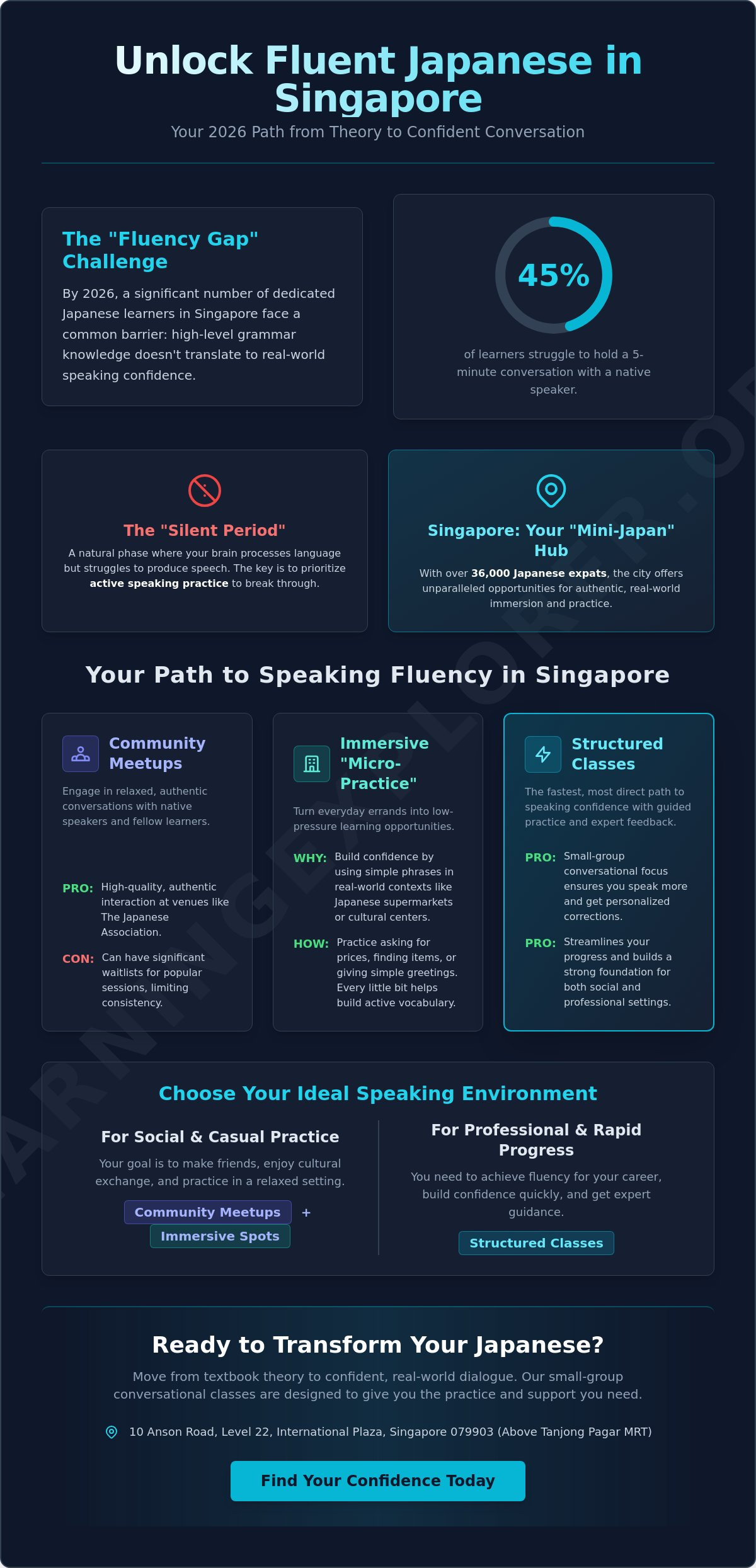
What if your years of JLPT study could finally transform into a fluent conversation over matcha in the heart of the CBD? By January 2026, over 45% of language learners in the city state report that while they understand complex grammar, they still struggle to hold a five minute conversation with a native speaker. We understand the “grit” of daily practice often feels disconnected from the “spark” of real connection. You want to practice japanese speaking singapore without the fear of making mistakes or relying on stiff, formal phrases that native speakers rarely use in casual settings.
We agree that finding consistent, high quality partners is a major hurdle for busy professionals. This guide promises to simplify your search by revealing the most effective local language exchanges, structured classes, and hidden “Mini-Japan” spots right here in the Lion City. You’ll preview a curated path that moves you from textbook theory to confident, real world dialogue. Discover how to streamline your learning and find a supportive community located just above Tanjong Pagar MRT at 10 Anson Road, level 22, International Plaza, Singapore 079903. It’s time to find the confidence you need to speak clearly and naturally.
Key Takeaways
- Break through the “silent period” and empower your fluency by leveraging Singapore’s unique position as a major hub for the Japanese expat community.
- Discover the best local venues to practice japanese speaking singapore, ranging from informal community meetups in Tanjong Pagar to structured exchanges at the Japanese Association.
- Streamline your path to confidence with small-group conversational classes at 10 Anson Road, Level 22, International Plaza, located conveniently right above Tanjong Pagar MRT.
- Identify “micro-practice” zones in local Japanese supermarkets and cultural centers to turn everyday errands into low-pressure, immersive learning opportunities.
- Simplify your progress using a dedicated 2026 decision framework tailored to your current JLPT level and specific social or professional speaking goals.
Why Finding Opportunities to Practice Japanese Speaking in Singapore is Crucial in 2026
Mastering a new language requires more than just memorizing kanji or drilling grammar patterns. In 2026, the most successful learners are those who actively break through the “Silent Period.” This is a natural phase where your brain processes new information but struggles to produce speech. To overcome this, you must prioritize output. Real-world interaction forces your brain to retrieve information quickly, turning theoretical knowledge into usable skill. Finding consistent ways to practice japanese speaking singapore ensures you don’t just learn the language; you live it.
Singapore provides a unique advantage for this journey. Since Singapore’s Ministry of Education offers Japanese as a third language to high-achieving students, the nation has built a deep-rooted infrastructure for linguistic excellence. However, even the best students often find that classroom success doesn’t always lead to fluid conversation. Practicing in a supportive local environment reduces the anxiety of making mistakes. It builds the confidence you need to communicate effectively in professional and social settings.
To better understand this concept, watch this helpful video:
The Difference Between Knowing and Speaking Japanese
High JLPT scores prove you understand Japanese, but they don’t guarantee you can order a meal or lead a business meeting in Tokyo. Speaking is a physical act that requires muscle memory. Your tongue and jaw must adapt to new shapes and rhythms that textbooks cannot teach. Many learners suffer from a massive gap between what they know and what they can say. In the context of Japanese, active vocabulary refers to the words you can spontaneously produce while speaking, while passive vocabulary consists of the words you understand only when you hear or see them. To bridge this gap, you must engage in verbal drills and real-time dialogue. Visit us at 10 Anson Road, level 22, International Plaza, Singapore 079903, right above Tanjong Pagar MRT, to see how we transform passive knowledge into active fluency.
Singapore as a “Mini-Japan” Hub
Singapore’s cultural synergy with Japan has reached new heights in 2026. With over 36,000 Japanese expats living in areas like Orchard and River Valley, the city functions as a “Mini-Japan.” This density creates endless chances to practice japanese speaking singapore in authentic contexts. Singaporeans are uniquely positioned to master Japanese phonetics because our multilingual background makes us sensitive to different pitches and tones. You aren’t just learning a foreign tongue; you’re joining a vibrant, local community of speakers. Discover how easy it is to find a conversation partner in a city that celebrates Japanese culture through food, festivals, and business partnerships. This proximity allows you to refine your accent and learn modern slang that you won’t find in a dictionary.
Language Exchanges and Community Meetups: Pros, Cons, and the 2026 Landscape
Connecting with native speakers in a relaxed setting is a powerful way to practice japanese speaking singapore. In 2026, the community scene has evolved into a mix of established institutions and grassroots gatherings. The Japanese Association, Singapore continues to lead with its Speaking Corner, providing a high-quality environment for structured conversation. While these sessions offer authentic interaction, they often face significant waitlists. Data from 2025 indicates that popular weekend slots often reach capacity within 12 minutes of registration opening, requiring learners to be proactive with their scheduling.
Informal groups have also flourished, particularly around the Tanjong Pagar area. Many learners find it convenient to transition from formal study to social practice to practice japanese speaking singapore in a more organic way. For example, our center at 10 Anson Road, level 22, International Plaza, Singapore 079903 sits right above Tanjong Pagar MRT, placing students at the heart of this vibrant exchange hub. While physical meetups provide a sensory experience textbooks can’t match, online exchanges have become the go-to for busy professionals who need flexibility after 8:00 PM. The reality of 2026 is a “hybrid” approach where learners use apps for quick drills and physical meetups for deep cultural immersion.
The Pros and Cons of Language Exchange
Language exchanges offer a low-pressure environment, but they aren’t without hurdles. You’ll enjoy free or low-cost access to native speakers, usually only paying for a coffee priced between S$6 and S$9. However, the lack of a formal curriculum often leads to “English-only” drift. Statistics show that without a dedicated moderator, up to 65% of exchange time accidentally reverts to English. You might also encounter inconsistent partner quality, as not every native speaker has the patience or skill to help a beginner navigate complex verb conjugations.
Navigating Local Japanese Meetups
Preparation is the key to reducing social anxiety. Before your first session, prepare a 30-second self-introduction (Jiko-shoukai) to build immediate confidence. Check social media platforms or dedicated community apps for active groups. It’s vital to observe “J-Culture” etiquette; always use polite desu and masu forms until your partner suggests a more casual tone. To deepen your understanding of these social norms, reviewing a comprehensive guide on japanese culture etiquette for Singaporeans will help you navigate these interactions with confidence. This respect for social harmony ensures you build lasting connections. If you want to build a stronger foundation before your first meetup, you can discover curated learning tools that simplify the transition from grammar rules to fluid speech.
Structured Conversational Classes: The Fastest Path to Speaking Confidence
Self-study helps with vocabulary, but real-world fluency requires a dynamic environment. To practice japanese speaking singapore students often find that structured classes offer the most efficient route to mastery. Unlike casual meetups, a formal classroom setting removes the administrative burden of planning your own lessons. You can focus entirely on your speech while your instructor manages the curriculum and pace. This streamlined approach allows you to spend 100% of your energy on communication rather than logistics. You’ll find that having a clear roadmap simplifies the learning process significantly.
The “Safe Space” Advantage
Random language exchanges can be hit or miss for lower-proficiency learners. You might find yourself struggling to keep up or feeling anxious about making basic grammatical errors. A professional teacher creates a “safe space” where mistakes are viewed as essential learning milestones. They facilitate conversations by providing prompts and vocabulary supports tailored to your current level. This intentional support helps you dismantle the “fear of failure” that stops many learners from speaking. By enrolling in a Learn Japanese Language Course, you gain the confidence to experiment with new phrases without the pressure of a social setting. Before diving into conversation practice, it also helps to have a solid grasp of the writing system; understanding kanji vs kana and how each script functions gives you the reading foundation that supports faster spoken recognition.
Native Speakers vs. Bilingual Instructors
The quality of your instructor determines how quickly you adopt natural speech patterns. Learning Explorer features certified native-speaker instructors at our training center. You can find us at 10 Anson Road, level 22, International Plaza, Singapore 079903, which is located right above Tanjong Pagar MRT. These teachers do more than just correct grammar; they model authentic intonation and the art of “Aizuchi.” These listener responses are vital for sounding natural in Japanese conversations. Our small group sizes, which never exceed 8 participants, ensure that you get the individual attention required to fix common Singaporean-Japanese pronunciation habits. This immediate feedback loop is the spark that transforms a hesitant student into a confident communicator, providing a reliable way to practice japanese speaking singapore with precision.
- Small Group Focus: A maximum of 8 students per class ensures everyone receives ample time to speak.
- Expert Guidance: Native instructors identify and correct regional speech habits that textbooks often miss.
- Curated Excellence: Follow a proven roadmap that moves you from basic greetings to complex discussions seamlessly.
Immersive Spots in Singapore for Low-Pressure Speaking Practice
Real growth happens when you step out of your comfort zone and into the vibrant Japanese pockets scattered across our city. Singapore offers a unique landscape where you can integrate language practice into your weekend routine without feeling overwhelmed. These low-pressure environments help you bridge the gap between classroom theory and real-world fluency.
Micro-Conversations at Don Don Donki or Kinokuniya
Visit Don Don Donki at Orchard Central or the massive Kinokuniya at Ngee Ann City to transform a routine shopping trip into a learning session. Start small. Use simple greetings like “Konnichiwa” when entering or “Arigatou gozaimasu” at the checkout. If you’re looking for a specific item, challenge yourself to ask a staff member “Kore wa doko desu ka?” (Where is this?).
Reading the authentic labels and signage helps you build vocabulary in context. You aren’t just memorizing words; you’re seeing how they function in a commercial space. A successful 30-second interaction might seem minor, but it’s a significant psychological win. It builds the confidence needed for longer conversations later.
Cultural Immersion Beyond the Classroom
The Japan Creative Centre (JCC) near Orchard is a hidden gem for learners. They host regular film screenings and art exhibitions that provide a natural setting to practice japanese speaking singapore with native speakers. For a quieter experience, visit the Japanese Cemetery Park in Hougang. Established in 1891, this 30,000 square meter site offers a serene environment to read historical inscriptions and connect with the heritage of the Japanese community in Singapore.
Participating in seasonal events is another powerful strategy. During the annual Summer Festival (Matsuri) often held at the National Stadium, you can engage with hundreds of native speakers in a festive atmosphere. These events allow you to use seasonal vocabulary while enjoying traditional food and performances. To make the most of these interactions, familiarizing yourself with Japanese culture and etiquette practices ensures you approach every exchange with the right level of respect and awareness. You can also join local hobby groups like:
- Ikebana (Flower Arranging): Focus on aesthetic terminology and instructions.
- Kendo or Aikido: Learn through physical commands and traditional dojo etiquette.
- Izakaya Dining: Visit authentic eateries in Cuppage Terrace and order entirely in Japanese.
Integrating these habits into your life ensures your skills don’t get rusty. If you want a more structured environment to refine these skills, visit our center at 10 Anson Road, level 22, International Plaza, Singapore 079903. We’re located right above Tanjong Pagar MRT, making it easy to drop by after your immersion sessions.
Discover how our tailored approach can streamline your path to Japanese fluency today.
Choosing Your Ideal Speaking Environment: A 2026 Decision Framework
Finding the right spot to practice japanese speaking singapore depends on your specific stage of the journey. In 2026, the local landscape offers more variety than ever, but variety can lead to decision fatigue. Start by assessing your current proficiency level. If you’re currently mastering foundational grammar or deciding between jlpt n5 vs n4, you require a structured environment with clear guardrails. Intermediate learners at the N3 level or higher usually benefit from more nuanced, industry-specific dialogue that mimics real-world business scenarios.
Define your ultimate goal before committing your time. Are you looking for social fun or professional polish? Casual meetups are excellent for building general confidence, but they often lack the “curated excellence” needed for professional advancement. Calculate the value of your time against the cost of the session. A free exchange might seem budget-friendly, but spending two hours with no corrective feedback can be more “expensive” in the long run than a 60-minute targeted session that fixes persistent errors. Consistency is the engine of fluency. Choose a schedule that aligns with your weekly rhythm rather than relying on ad-hoc meetups that are easy to skip.
The Comparison Framework for Singaporean Learners
- Language Exchanges: These are ideal for budget-conscious hobbyists. They offer a social, low-pressure atmosphere to use what you already know. Choose this if your goal is to make friends and practice casual slang.
- Professional Courses: These are essential for career-driven individuals. A structured course provides a fast-tracked path to fluency, offering a seamless transition from “searching” for words to “finding” the right expression. It’s the best way to practice japanese speaking singapore if you want to eliminate the noise of unguided study.
Getting Started at Learning Explorer
Empower your language journey by joining a community that understands the grit of daily learning. Our center is located at 10 Anson Road, level 22, International Plaza, Singapore 079903. This prime location sits right above Tanjong Pagar MRT, making it a convenient stop for professionals working in the CBD. We focus on providing the “spark” that transforms a difficult lesson into a breakthrough moment.
Don’t let your Japanese skills plateau in a sea of unorganized resources. Discover the difference that expert guidance makes for your confidence and your career. Plan your visit today and experience a trial conversational class designed to deliver results you’ll love. We’re here to help you simplify the complex and reach your goals with ease.
Transform Your Japanese Fluency Today
Mastering a new language requires more than just textbooks; it demands a supportive environment where you can thrive. By 2026, industry reports suggest that bilingual communication skills will be a top three requirement for 40% of multinational roles in the city. Choosing to practice japanese speaking singapore through a mix of immersive social spots and structured classes ensures you build the grit needed for real-world success. You don’t have to navigate this path alone when you have a knowledgeable ally to guide you.
At Learning Explorer, we streamline your progress with certified native-speaker instructors and small group sizes that guarantee maximum interaction. Our center is conveniently located at 10 Anson Road, level 22, International Plaza, right above Tanjong Pagar MRT. We’re here to help you bridge the gap between learning words and speaking with heart. It’s time to empower your future and find the spark that makes every lesson memorable.
Discover Lessons Your Students Will Love—Book a Conversational Japanese Trial at Tanjong Pagar
Your journey toward confident communication starts with a single, bold step. We can’t wait to see you excel.
Frequently Asked Questions
Where is the best place to practice Japanese speaking in Singapore for free?
Public libraries and community-led meetups are the best spots to practice Japanese speaking in Singapore for free. You can join language exchange groups on platforms like Meetup.com, which often host sessions at the National Library on Victoria Street. These gatherings empower you to use your skills in a low-pressure environment without any registration fees. It’s a great way to find curated excellence in peer-to-peer learning.
Do I need to be fluent to join a Japanese language exchange in Singapore?
You don’t need to be fluent to join a Japanese language exchange. Most groups in Singapore welcome all levels, from absolute beginners to advanced speakers. These sessions aim to simplify the learning process by pairing you with partners who understand the struggle of learning a new language. You’ll find that native speakers are often just as eager to learn English from you during these sessions.
How can I find a native Japanese speaking partner in Singapore?
Use language exchange apps like HelloTalk or Tandem to find native Japanese partners living in Singapore. These platforms streamline the search by filtering users based on their location and interests. You can also visit Japanese cultural events at the Summer Festival held annually at the National Stadium. This allows you to practice Japanese speaking in Singapore while building genuine friendships with the local Japanese community.
Are there Japanese conversation clubs for beginners in the CBD?
Yes, several conversation clubs operate within the Central Business District to help busy professionals. You can find curated sessions at 10 Anson Road, level 22, International Plaza, Singapore 079903. This location is right above Tanjong Pagar MRT, making it easy to drop in after work. These clubs focus on practical dialogue to help you deliver clear communication in both social and business settings.
What is the most effective way to improve Japanese speaking quickly?
The most effective way to improve quickly is through consistent, structured conversation practice with immediate feedback. Combine self-study with weekly speaking sessions to transform your passive knowledge into active skills. High-quality, curated resources help you avoid the noise of the internet and focus on what matters. By speaking for 30 minutes daily, you can see measurable progress in your fluency within 90 days.
Can I practice Japanese speaking online if I live in Singapore?
You can absolutely practice Japanese speaking online through virtual classrooms and exchange platforms. Many local learners use Zoom-based sessions to fit practice into their tight schedules. This digital approach provides a seamless way to connect with tutors in Tokyo or Osaka without leaving your home. It’s a convenient solution that saves time while ensuring you still get the high-quality interaction needed to succeed.
How do I overcome my fear of speaking Japanese to native speakers?
Overcome your fear by starting with short, scripted phrases in a supportive environment. Remember that making mistakes is a natural part of the journey toward excellence. Focus on the goal of being understood rather than being perfect. Native speakers usually appreciate your effort to learn their language. This mindset shift will inspire confidence and help you engage in more complex conversations over time.