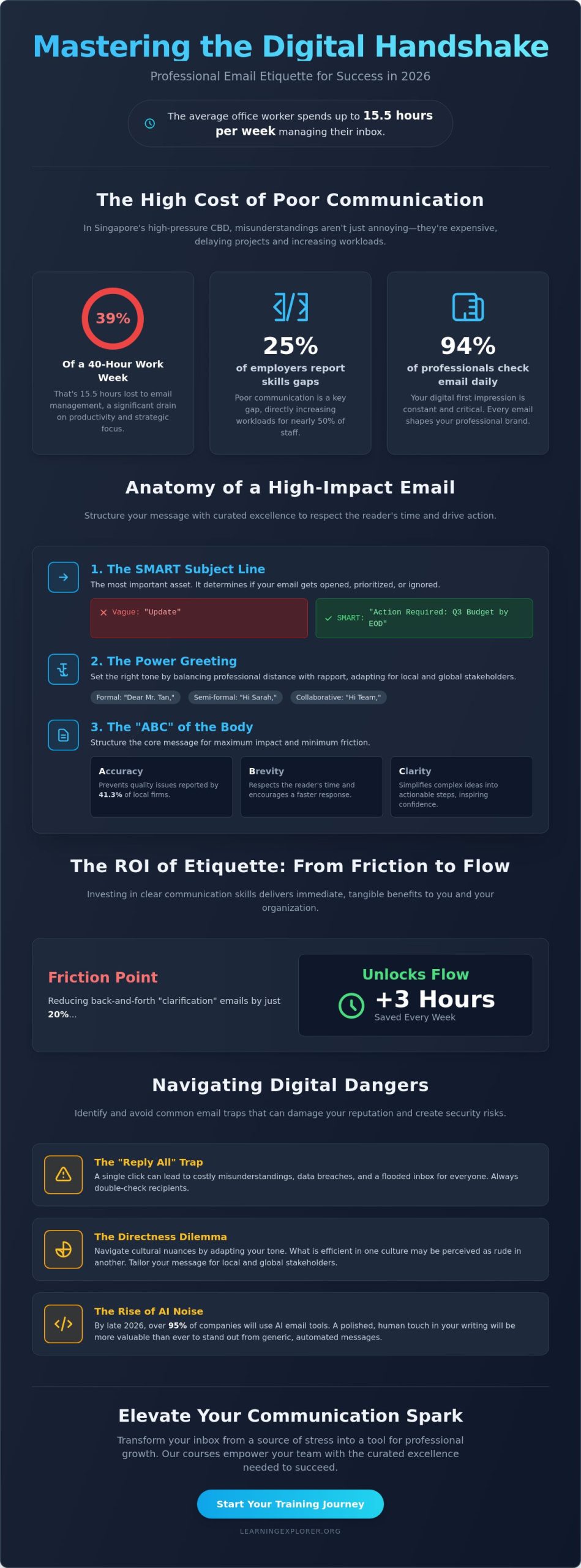
Did you know the average office worker now spends up to 15.5 hours every week managing their inbox? In a fast paced market where 94% of professionals check their emails daily, your digital communication is often your first and most frequent impression. Finding a high quality email etiquette course for business sg is no longer just a luxury; it’s a vital step to stop misunderstandings from delaying your projects. You likely feel the pressure to strike the perfect balance between local cultural nuances and global professional standards. It’s frustrating when you spend too much time drafting simple replies instead of focusing on your high level strategy.
We understand the grit it takes to manage a heavy workload while maintaining a polished reputation. We promise to help you discover how to craft impactful, professional emails that drive results and inspire confidence in your stakeholders. This article previews the best training pathways to streamline your writing, simplify your workflow, and deliver the professional spark your career deserves in 2026. Mastering these skills helps you communicate with curated excellence from our training space right above Tanjong Pagar MRT to the global stage.
Key Takeaways
- Understand how your “digital handshake” shapes your professional brand in the Singapore CBD and drives faster project approvals.
- Learn to structure high-impact emails using SMART subject lines and power greetings that capture attention without sacrificing professional distance.
- Navigate the “directness dilemma” by adapting your tone for both local and global stakeholders to build lasting rapport.
- Identify how a specialized email etiquette course for business sg helps you avoid costly misunderstandings and security risks like the “Reply All” trap.
- Empower your career with curated excellence and communication strategies that transform your daily inbox management into a professional asset.
Why Professional Email Etiquette is a Career Game-Changer in Singapore
In the high pressure environment of the Singapore CBD, your email is your digital handshake. It’s often the only interaction you have with a stakeholder before a major decision is made. Misunderstandings aren’t just annoying; they’re expensive. According to a 2026 study by the Ministry of Manpower (MOM) and NTUC, nearly 25% of employers report skills gaps that lead to increased workloads for nearly 50% of their staff. When your message is unclear, you aren’t just wasting your time; you’re slowing down the entire organization’s momentum.
To better understand this concept, watch this helpful video:
Moving from administrative grit to a communication spark requires more than just filling out templates. By late 2026, over 95% of companies will use AI email tools. This shift makes the human touch even more valuable. A specialized email etiquette course for business sg helps you stand out from the generic, AI-generated noise. It transforms your inbox from a source of stress into a tool for professional transformation, ensuring your voice remains authoritative and kind in a digital world.
The ROI of Clear Communication
Clear writing saves time and reduces administrative friction. Office workers currently spend up to 15.5 hours per week on email. Reducing back and forth “clarification” messages by just 20% can save you three hours every week. This curated excellence builds trust with senior management and empowers junior employees to lead high level conversations with confidence. It streamlines your workflow and delivers results that your team will notice immediately. When you simplify complex ideas, you inspire confidence in your leadership abilities.
First Impressions in a Digital-First World
Your subject line is your most important professional asset. It determines whether your message is prioritized or ignored by busy executives. Understanding the principles of netiquette ensures you respect the recipient’s time and digital space. Email etiquette is the bridge between your intent and your professional impact. By mastering this bridge, you can:
- Discover how to structure subject lines that get read immediately.
- Plan your tone to match the seniority and cultural background of the recipient.
- Deliver messages that simplify complex project details into actionable steps.
Choosing to refine these skills is an investment in your career resilience. It turns every sent message into a seamless building block for your professional reputation.
Mastering the Anatomy of a High-Impact Business Email
Every high impact email is built on a foundation of curated excellence. It’s not just about what you say, but how you structure it to respect the reader’s time and attention. When you join an email etiquette course for business sg, you learn that a message’s success is often decided before the recipient even clicks. It starts with a SMART subject line: Specific, Actionable, Relevant, and Time-bound. Instead of a vague “Update,” try “Action Required: Q3 Budget Approval by Wednesday.” This clarity ensures your message isn’t lost in the noise of a crowded inbox.
The “Power Greeting” sets the tone for the entire exchange. You must balance professional distance with rapport-building, a skill that requires a deep understanding of cultural etiquette in international business. In the Singapore context, knowing when to use a formal salutation versus a collaborative “Hi Team” can be the difference between building a bridge or creating a barrier. Following the greeting, apply the “ABC” of modern business writing: Accuracy, Brevity, and Clarity. Accuracy prevents the quality issues reported by 41.3% of local firms, while brevity respects the grit of a 2026 workday.
Your Call-to-Action (CTA) is the most critical component of your closing. Don’t leave your reader guessing. Tell them exactly what to do next. “Please review the attached slides and provide feedback by 4 PM” is far more effective than a passive “Let me know your thoughts.” This directness simplifies the decision making process for your stakeholders and drives immediate results.
Structuring for Scannability
Busy executives scan emails rather than reading them word for word. Empower your readers by using bullet points and bold text to highlight key deadlines or names. Adhere to the “One Screen Rule” by keeping your message concise enough for mobile viewing without scrolling. The first ten words of your email act as a second subject line and often dictate the recipient’s level of engagement. If you want to refine these skills, consider visiting our English language school Singapore located at 10 Anson Road, level 22, International Plaza, Singapore 079903, right above Tanjong Pagar MRT.
The Professional Sign-off
Your sign-off should be as intentional as your opening. A professional signature doesn’t just list your name; it streamlines follow-up actions by including your direct contact details or a scheduling link. Be mindful of confidentiality disclaimers; use them only when necessary to avoid cluttering your message. By mastering these anatomical details, you transition from searching for the right words to finding the perfect structure for every professional interaction. If you’re ready to transform your team’s communication, our Business English Course provides the spark needed for seamless collaboration.
Navigating Tone and Cultural Nuance in the Singapore CBD
Tone is the silent negotiator in every thread. In the multicultural landscape of the Singapore CBD, your choice of words can either open doors or build invisible walls. You might struggle with the “Directness Dilemma,” where you want to be clear but fear appearing blunt to a local colleague. An email etiquette course for business sg teaches you to navigate these social layers with empathy and precision. It’s about understanding that a message to a global stakeholder in New York requires a different vibe than one sent to a local vendor in Jurong.
Use active voice when you want to inspire confidence and take ownership of a task. “I will finalize the proposal by noon” sounds far more reliable than “The proposal will be finalized.” Conversely, passive voice is a helpful tool for softening requests or delivering news without pointing fingers. Saying “The invoice hasn’t been received” is often more productive for maintaining rapport than “You didn’t send the invoice.” This subtle shift helps you maintain the persona of a knowledgeable guide rather than a critic.
Adapting your style between high context and low context cultures is a vital skill for 2026. Local Singaporean business culture often values reading between the lines and preserving “face,” which is a high context approach. However, many MNCs in the city-state operate with low context communication, where every detail is explicitly stated. Mastering the transition between these styles ensures your messages are never lost in translation, regardless of who is on the other side of the screen.
Bridging the Gap Between Formal and Casual
Hierarchy remains a cornerstone of many Singaporean business environments. While tech startups might embrace a casual “Hi” from day one, traditional firms often expect a “Dear” until a relationship is established. Navigating this shift is key to your professional growth. You should also avoid using “Singlish” in formal correspondence. While local warmth is encouraged, professional emails require a curated excellence in vocabulary to ensure clarity for global partners. If you find yourself hesitating before hitting send, you might benefit from overcoming your fear of speaking English in a professional setting.
Managing Electronic Emotions
A 2025 survey by the Singapore Business Federation highlighted that communication disconnects are a top challenge for 80% of employees. When you receive a frustrating email, apply the “24-Hour Rule” before replying. Taking time to cool down prevents you from sending a message you’ll regret. Delivering a “No” or sharing difficult news requires a focus on solutions. Instead of a flat refusal, offer an alternative. “I can’t take on this project today, but I can review it on Friday” preserves the relationship while setting clear boundaries. This approach streamlines feedback and keeps the spark of collaboration alive.
Avoiding Common Email Pitfalls and Security Risks
Human error remains the weakest link in corporate security. A 2025 survey by the Singapore Business Federation revealed that cybersecurity and data privacy risks have become a top 5 business challenge, increasing in concern by 5% from the previous year. While technical firewalls are essential, your daily habits are your first line of defense. Avoiding the “Reply All” trap is a simple way to respect your colleagues’ time and prevent sensitive information from reaching the wrong eyes. Use CC to keep stakeholders informed, but reserve BCC for protecting recipient privacy or managing external vendor lists. This ethical approach prevents the “office politics” drama that often derails productive teams.
Enrolling in an email etiquette course for business sg helps you master these subtle social and security cues. Before you hit send, check your attachments. Ensure files are accessible and named professionally; “Q3_Report_Final” is much better than “Document123”. In 2026, many firms use intelligent automation for filing, so clear naming conventions streamline the entire office workflow. Identifying phishing attempts is also a vital skill. Always verify the sender’s address before clicking links or downloading files that seem out of character for your colleagues.
The Most Common Etiquette Mistakes in 2026
Overusing the “Urgent” flag is a quick way to ensure your messages are ignored. If everything is a priority, nothing is. Break up a “Wall of Text” into bite-sized chunks to empower your reader and improve scannability. When you forward an email thread, you must provide a brief context-setting intro so the recipient doesn’t have to hunt for the relevant information through dozens of previous replies. This small step shows you respect their time and mental energy.
Email vs. Instant Messaging (Slack/Teams)
Knowing when to switch platforms is a vital modern skill. Use Slack or Teams for quick, informal syncs, but keep formal decisions and project milestones in email for a searchable paper trail. In the Singapore work culture, after-hours emails can create unnecessary stress for your team. Respect these boundaries by using “Schedule Send” for non-urgent tasks so they arrive during business hours. If a thread exceeds five replies without a resolution, it’s time to move the conversation to a quick meeting to find the spark of a solution. Discover how to protect your professional brand and streamline your team’s communication by joining our Business English Course today.
Elevate Your Team with Learning Explorer’s Business English Course
Transforming your team’s communication starts with finding the right partner. At Learning Explorer, we provide the spark that turns daily administrative grit into a competitive advantage. Our Business English Course is more than just a writing workshop; it’s a journey into curated excellence. We’ve designed lessons your students and employees will love, focusing on real world impact rather than dry theory. By choosing our email etiquette course for business sg, you’re investing in a workforce that communicates with seamless confidence and authority.
Our interactive modules are led by certified native speaker instructors who deeply understand the multicultural Singapore context. They don’t just teach grammar. They mentor your staff on how to build rapport and drive results in a high stakes corporate environment. Whether you need training delivered at our CBD center or directly at your corporate office, we offer flexible solutions that fit your schedule. We believe in empowering every employee to find their professional voice and move from simply searching for words to finding the perfect message.
Convenient CBD Training Right Above Tanjong Pagar MRT
Learning shouldn’t add to your stress. Our primary training center is located at 10 Anson Road, level 22, International Plaza, Singapore 079903. Being situated right above Tanjong Pagar MRT makes it incredibly easy for your team to attend sessions without disrupting their entire workday. We’ve created an optimized learning environment designed to reduce anxiety and inspire innovation. As the best language school Singapore offers, we prioritize a supportive, teacher first atmosphere where professionals can thrive and grow.
Get Started with a Tailored Corporate Solution
We understand that HR and L&D managers have a lot on their plates. That’s why we’ve simplified the enrollment process to be as efficient as possible. Our team acts as your reliable educational ally, guiding you through every step of the training plan. The Learning Explorer promise is built on professionalism, expertise, and kind guidance. We help you identify specific communication gaps, such as the 24.3% skills gap noted by MOM in 2026, and provide the targeted training to bridge them. It’s time to empower your team with our Business English Course and watch your professional reputation soar across the globe.
Start Your Transformation Today
Mastering digital communication is about more than just avoiding errors; it’s about building a brand of curated excellence. By refining your subject lines and navigating the directness dilemma, you save hours of administrative grit every week. These skills ensure your messages inspire confidence instead of causing project delays. You’ve learned how to structure high-impact emails and avoid common security pitfalls, ensuring your professional reputation remains spotless in a digital-first world.
Choosing a specialized email etiquette course for business sg provides the spark your career needs in 2026. Our curriculum aligns with global professional standards and is delivered by certified native-speaker instructors who understand the local corporate landscape. We are conveniently located in the heart of the CBD, right above Tanjong Pagar MRT. This central location makes it simple to fit professional growth into your busy schedule without adding to your daily stress.
Discover how our Business English Course can transform your communication. Let us help you streamline your workflow and deliver results that your team will love. Your journey toward seamless professional impact and career resilience starts here.
Frequently Asked Questions
What are the golden rules of email etiquette for business in Singapore?
The golden rules of email etiquette in Singapore center on respecting hierarchy and maintaining clarity. Always use a professional salutation until invited to do otherwise, as 80% of local firms still value traditional professional distance. You must also comply with the Spam Control Act by including clear unsubscribe options in marketing messages. These practices build trust and ensure your digital handshake remains firm and respectful in a multicultural environment.
How can I improve my professional email writing skills quickly?
You can improve your professional email writing skills quickly by adopting a scannable structure and practicing active voice daily. Focus on the “One Screen Rule” to ensure your message fits on a mobile device without scrolling. Enrolling in a targeted email etiquette course for business sg provides immediate feedback from experts. This focused approach helps you transition from searching for the right words to finding them within minutes.
Is there a difference between formal and informal business email etiquette?
There is a significant difference between formal and informal business email etiquette. Formal emails use “Dear” and “Sincerely,” while informal threads between established colleagues often start with “Hi” and end with “Best.” However, even informal emails must maintain accuracy and brevity to respect the recipient’s time. A 2026 MOM study showed that 41.3% of workplace errors stem from quality standards being missed in overly casual communication.
How long should a professional business email be?
A professional business email should ideally be under 200 words to ensure it is read and understood. Busy executives in the Singapore CBD often receive 121 emails daily, so brevity is your best ally. If your message requires more detail, use bullet points to highlight key takeaways. If a topic requires more than three paragraphs, it’s usually better to schedule a quick five-minute sync instead.
Can an email etiquette course really help my career in the CBD?
An email etiquette course for business sg directly impacts your career by improving your professional reputation and saving you up to 15.5 hours per week. Clear communication reduces the administrative grit that often leads to project delays. When you write with curated excellence, senior management notices your leadership potential. It transforms your daily inbox management from a source of stress into a powerful tool for career advancement.
What should I do if I accidentally send an email with a typo or to the wrong person?
If you send an email with a typo or to the wrong person, send a brief and sincere apology immediately. Don’t over-explain the error; simply state that the previous message was sent in error or contained a mistake. If sensitive data was involved, follow your company’s security protocol immediately. A 2025 survey showed that 5% more businesses now prioritize data privacy, so taking quick responsibility demonstrates your professional integrity.
How do I manage a cluttered inbox without missing important client emails?
Manage a cluttered inbox by using behavior-based workflows and intelligent automation to filter non-urgent messages. Apply the “Touch It Once” rule: either reply, delete, or file the email as soon as you open it. This strategy helps you focus on high-priority client emails that drive results. By streamlining your digital presence, you reduce the noise and find the spark of productivity needed for a successful workday.
What are the best practices for using CC and BCC in corporate emails?
Use CC to keep essential stakeholders informed without requiring them to take action. Reserve BCC for protecting the privacy of external recipients or preventing long “Reply All” threads that clutter inboxes. This ethical approach avoids the drama of office politics and respects the digital space of your colleagues. Mastering these nuances ensures your communication remains seamless and professional across all corporate levels in Singapore.