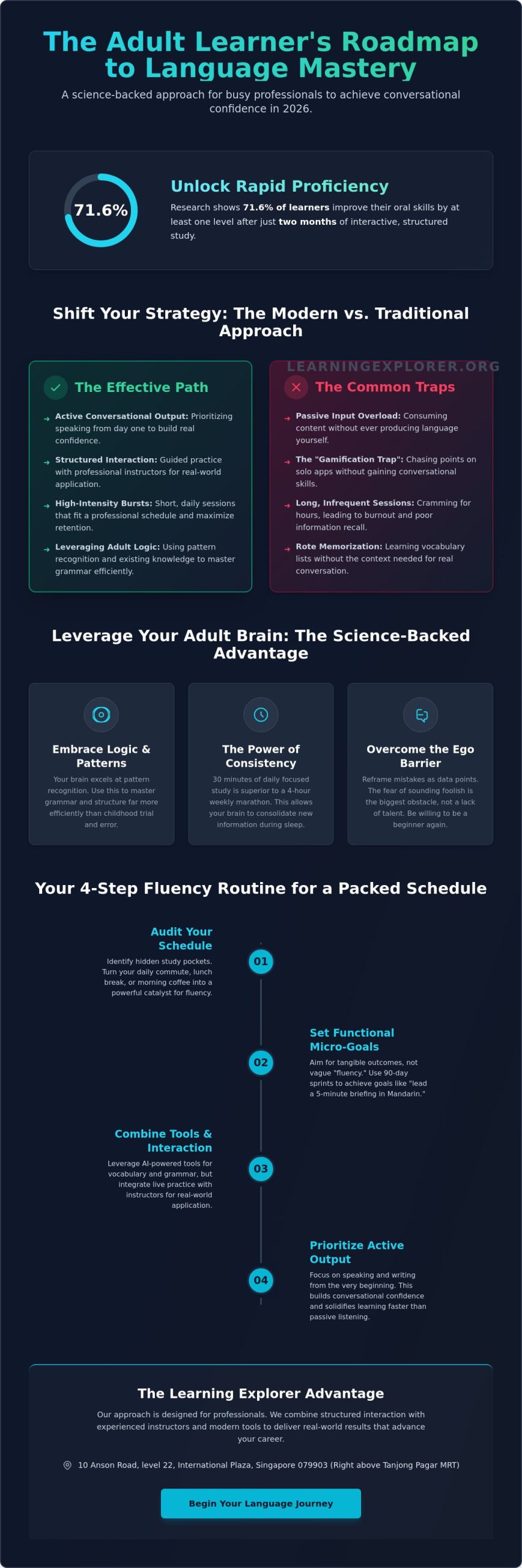
Research indicates that 71.6% of learners improved their oral proficiency by at least one level after just two months of interactive study. You might feel that your window for fluency closed years ago, but the best way to learn a new language as an adult in 2026 focuses on logic and interaction rather than childhood immersion. It’s time to stop worrying about looking foolish and start leveraging a strategy that respects your professional schedule.
We understand that your time is your most valuable asset. You’ve likely tried popular solo apps only to find yourself overwhelmed or unable to hold a real conversation. This article promises to cut through the digital noise. You’ll discover a science-backed approach that prioritizes conversational confidence and career growth. We’ll show you how to combine AI-powered tools with live practice to move beyond basic vocabulary and achieve genuine integration.
Our training center at 10 Anson Road, level 22, International Plaza, Singapore 079903, sits right above Tanjong Pagar MRT, making it easy to transition from your office to a world of new opportunities. Let’s explore the modern roadmap to mastering a second language while managing a demanding career.
Key Takeaways
- Shift your mindset from passive input to a hybrid model that prioritizes active conversational output from day one.
- Understand why short, daily bursts of high-intensity study are the best way to learn a new language as an adult compared to long, infrequent sessions.
- Avoid the “gamification trap” of solo apps by integrating structured interaction with professional instructors who focus on real-world results.
- Audit your professional schedule to identify hidden study pockets, turning your daily commute or lunch hour into a catalyst for fluency.
- Leverage adult logic and neuroplasticity to master complex grammar and vocabulary through practical, professional scenarios rather than rote memorisation.
Beyond the Classroom: Redefining the Best Way to Learn a New Language as an Adult
Adult learning isn’t a handicap; it’s an evolution. While children absorb language through osmosis, adults excel at pattern recognition and logical structures. The best way to learn a new language as an adult involves a strategic hybrid of structured input and active output. This balanced approach ensures you aren’t just collecting vocabulary like a stamp collector. You’re building a functional tool for your career. By leveraging your existing cognitive strengths, you can actually learn more efficiently than a child who lacks your focus and life experience.
Many people cite the Critical Period Hypothesis as proof that adults can’t reach fluency. However, modern research into the science of second-language acquisition shows that our brains remain remarkably plastic well into our later years. We don’t learn by simple absorption anymore; we learn by connecting new information to our existing professional knowledge. This is where “Comprehensible Input” comes in. You need to consume content that’s just slightly above your current level. This keeps the brain engaged without causing the frustration that leads many to quit.
To better understand how this process works in practice, watch this helpful video:
The Myth of the “Language Gene”
Consistency is your superpower. Most adults fail not because they lack a “language gene,” but because of “ego-permeability.” This is the psychological barrier created by the fear of making mistakes in front of others. It’s not about innate talent; it’s about showing up and being willing to sound a bit silly. Your professional expertise shouldn’t be a cage that prevents you from being a beginner. Actionable tip: Reframe every mispronounced word or grammatical slip-up as a valuable data point that refines your mental map of the language.
Setting Micro-Goals for Macro Success
Don’t aim for “fluency” right away. It’s too vague for a busy professional with a packed calendar. Instead, set functional micro-goals that provide immediate value. Can you lead a five-minute briefing in Mandarin? Can you order a coffee in Tokyo without switching to English? Schools like the Nunawading Japanese School emphasize these practical, high-impact milestones for adult students. Using 90-day learning sprints helps you maintain momentum and see tangible progress. These short, high-intensity bursts prevent the burnout that often follows long-term, low-engagement study. Finding the best way to learn a new language as an adult means aligning your study with your actual professional life. This makes the process feel less like a chore and more like a career investment.
The Science of Adult Acquisition: Leveraging Experience Over Rote Memorisation
Consistency is the engine of progress. Thirty minutes of focused study every single day is far more effective than a four-hour marathon on a Sunday. Your brain needs sleep to consolidate new neural pathways; cramming simply leads to information decay. Understanding the best way to learn a new language as an adult requires looking at how our brains process information differently than children. While kids have high plasticity, adults have superior executive function. We can use logic to accelerate what children must learn through years of trial and error.
Research highlighted in The Science of Adult Language Learning suggests that while the window for native-like mastery is easiest in childhood, adults possess the logical framework to achieve high-level fluency through structured effort. We don’t just “pick up” a language; we anchor it. This is why adults benefit from explicit grammar instruction. You need to know the “why” behind a sentence structure to make it “implicit” or automatic. If you feel a sense of “brain melt” after a session, don’t be discouraged. That cognitive fatigue is a sign that your brain is physically re-wiring itself to accommodate new data.
If you want to see how these principles apply to your career, exploring a Business Mandarin Course can provide the professional context that makes these new pathways stick.
Prioritising High-Frequency Vocabulary
Efficiency is key for a busy professional. The Pareto Principle states that the first 1,000 words of a language typically cover about 80% of daily speech. Instead of memorising lists of fruit or household objects, focus on the “Business Lexicon” relevant to your industry. Use Spaced Repetition Systems (SRS) to ensure these high-priority words move from your short-term memory into your long-term storage. This targeted approach ensures you’re learning the best way to learn a new language as an adult by focusing only on what yields the highest return on investment.
The Importance of Native-Speaker Input
Apps often fail because they lack corrective feedback. Learning from a bilingual native speaker accelerates your pronunciation and helps you avoid “fossilisation,” where incorrect habits become permanent. Professional instructors identify these errors in real-time, providing the nuanced guidance that software cannot replicate. They help you navigate the cultural etiquette that is just as important as the words themselves. This interaction transforms language from a solitary exercise into a living, professional tool.
Comparing Methods: Why Structured Interaction Trumps Solo App Learning
Choosing between a smartphone app and a professional course is the first hurdle many face. While digital tools offer convenience, the best way to learn a new language as an adult requires more than just swiping through flashcards. Many professionals fall into the ‘Gamification Trap.’ You might maintain a 300-day streak on a popular app, yet still freeze when asked a basic question in a real-world meeting. This happens because apps focus on recognition rather than production. You’re learning to play a game; you aren’t learning to communicate with a human being.
Contrast this with a structured, interactive environment. Some critics argue that classrooms are inefficient, but they’re often referencing outdated, lecture-style formats from their school days. Modern language training focuses on a vetted content library that removes decision fatigue. Instead of wasting hours searching for the right podcast or YouTube video, you follow a proven roadmap designed for high-impact results. It’s about efficiency. You don’t have time to waste on unorganized internet resources. A professional curriculum ensures every minute spent translates directly to conversational skill.
The App Trap: Why Gamification Isn’t Enough
Apps are excellent for building a foundational vocabulary, but they often fail at syntax and conversational confidence. A multiple-choice quiz doesn’t prepare you for the unpredictable nature of a live conversation. Use these tools as a supplement. They’re great for a five-minute commute, but they shouldn’t be your primary source of instruction if you want to reach professional-level fluency. The false sense of mastery they provide can actually delay your progress by keeping you in a comfort zone where you never have to speak out loud.
The Conversation Catalyst: Why Professional Feedback Matters
A professional instructor provides a safe environment to fail. Unlike a random language exchange with a stranger, a teacher knows how to bridge cultural nuances and correct your errors without denting your confidence. This is why our training center is strategically located at 10 Anson Road, level 22, International Plaza, Singapore 079903, right above Tanjong Pagar MRT. It’s designed for busy people who need expert guidance in a convenient setting. Group classes also offer diverse listening opportunities, exposing you to different accents and speaking styles. This variety is essential for developing the ‘ear’ needed for international business. Ultimately, the best way to learn a new language as an adult is through guided, real-time interaction that mimics the challenges of your professional life.
Building Your Fluency Routine: A Practical Roadmap for Busy Professionals
You’ve understood the cognitive science; now you need a system that survives a sixty-hour work week. The best way to learn a new language as an adult is to integrate it into your existing routine rather than trying to build a new life around it. Start by auditing your schedule to find “hidden” study pockets. These are the fifteen-minute gaps during your commute on the East-West Line or the time spent waiting for a client to join a call. Use these moments for high-intensity review. Consistency in these small windows prevents the information decay that happens when you only study on weekends.
Next, select a core course that offers native-speaker interaction. Self-study apps are useful supplements, but they can’t replace the real-time feedback of a professional instructor. Once you have your core instruction, replace your passive media habits. Swap your usual English podcasts for target-language media that interests you professionally. Finally, engage in “Self-Talk.” Narrate your daily tasks in your head. Describing your morning routine or preparing a mental meeting agenda in a new language builds the internal narrative structures needed for spontaneous speech.
Immersion in the Lion City: Practice Opportunities in Singapore
Living in Singapore provides a unique advantage for language learners. You don’t need to travel abroad to find immersion. Use your daily interactions at hawker centres or during taxi rides as low-stakes practice sessions. These brief, functional exchanges build conversational muscle without the pressure of a formal setting. Choosing a school located right above Tanjong Pagar MRT makes it easy to transition from the office to a dedicated learning environment. This central location allows you to fit in a session during your lunch hour or immediately after work, ensuring your learning stays on track despite a demanding CBD schedule.
Overcoming the Mid-Level Plateau
Many professionals find that their progress stalls after the initial beginner phase. This plateau happens because your brain has become comfortable with basic survival language. To jumpstart your growth, you must introduce “Desirable Difficulty.” This means tackling content that feels slightly uncomfortable or complex. Switching to a specialized Business English or Mandarin course provides the industry-specific challenges you need to reach the next level. These programs focus on professional nuances that generic apps ignore, helping you move from basic communication to true bilingual influence.
Ready to transform your communication skills? Explore our Business Mandarin Course to start your journey toward professional fluency today.
The Learning Explorer Advantage: Professional Language Mastery in the CBD
Finding the best way to learn a new language as an adult often leads back to one core truth: the environment must match the ambition. At Learning Explorer, we’ve moved away from the dry, academic models of the past to embrace a philosophy of high-impact, interactive learning. We understand that as a professional, you don’t just want to pass a test. You want to negotiate a contract, build rapport with international colleagues, and navigate new markets with confidence. Our approach reduces the administrative burden of self-study by providing a curated, vetted content library that allows you to focus entirely on the satisfaction of discovery.
Our instructors are more than just teachers; they’re certified native speakers who understand the unique psychological barriers adults face. They act as visionary guides, helping you overcome the fear of looking foolish while providing the creative catalyst needed for better professional outcomes. Whether you prefer the focus of private tuition, the networking opportunities of group classes, or the rapid progress of intensive sessions, our flexible formats adapt to your specific schedule. We’ve designed our programs to be a reliable ally in your career progression, ensuring that every hour spent in our center translates into a tangible professional asset.
Tailored Courses for Every Professional Need
We provide specialized tracks that go beyond basic greetings. Our Conversational Mandarin Course and Japanese offerings are built on curriculum standards that ensure your skills remain portable across global markets. Learning in an adult-only environment removes the social friction often found in community classes, allowing you to practice in a room full of peers who share your drive and challenges. This supportive atmosphere is the best way to learn a new language as an adult because it prioritizes the emotional and professional needs of the learner, making the transition from a monolingual to a bilingual professional feel both achievable and inspiring.
Convenience Meets Quality in Tanjong Pagar
Efficiency is at the heart of our mission. Our training center is located at 10 Anson Road, level 22, International Plaza, Singapore 079903. Positioned right above Tanjong Pagar MRT, we offer a level of convenience that respects the limited time of our target audience. Being in the heart of the International Plaza means your learning happens in a hub of professional activity, providing immediate opportunities for networking and real-world application. Don’t let another year pass with a half-finished app streak. Book a trial today to experience the best language school Singapore has to offer and start seeing the results your career deserves.
Master Your Next Language with Confidence
Achieving fluency in 2026 isn’t about finding more hours in the day; it’s about making the hours you already have work harder for you. By leveraging your logical strengths and prioritizing high-intensity interaction over passive app usage, you’ve already identified the best way to learn a new language as an adult. You’ve seen how modern science supports your ability to reach professional-level proficiency through consistency and expert feedback.
Now, it’s time to take the final step toward your global career goals. Our native-speaker certified instructors provide the interactive, adult-centric curriculum you need to succeed. Our center is conveniently located in International Plaza, right above Tanjong Pagar MRT. This makes it easier than ever to fit high-quality learning into your busy CBD schedule without sacrificing your personal time.
Start your journey to fluency—explore our adult language courses at International Plaza today!
Your professional advancement is within reach. We’re here to guide you from the labor of seeking to the satisfaction of discovery. Let’s build your conversational confidence together and unlock the doors to new cultural and professional opportunities that a second language provides.
Frequently Asked Questions
Is it really possible to learn a new language after age 30 or 40?
Yes, it is absolutely possible. Adults often learn faster than children in structured environments because they can apply logical frameworks to grammar and syntax. While children absorb through immersion, the best way to learn a new language as an adult involves leveraging your existing cognitive skills to map out the language’s structure. Your brain remains plastic; it just requires more intentional stimulation than a child’s brain.
How many hours a week should a busy professional dedicate to language learning?
Aim for at least three to five hours per week, ideally spread across daily thirty-minute sessions. Short, high-intensity bursts are more effective for memory retention than a single five-hour marathon on the weekend. This “little and often” approach prevents cognitive overload and keeps the language fresh in your mind between professional tasks. Consistency is the most important factor in seeing tangible progress.
Which is better for an adult: private 1-on-1 classes or group sessions?
Private classes offer a tailored experience for specific business goals, while group sessions provide diverse listening opportunities. If you need to master industry-specific jargon quickly for a promotion, one-on-one instruction is superior. However, group classes at a professional center offer a supportive social environment where you can practice with peers who share your challenges. Both formats work well depending on your specific timeline.
How long does it take to become conversationally fluent as an adult?
Reaching basic conversational fluency typically takes between 150 to 300 hours of structured study. According to research from the Foreign Service Institute, more complex languages may take longer, but you can achieve functional results for business meetings much sooner. A 90-day high-intensity sprint often yields enough confidence to handle routine professional interactions and basic social networking with ease.
What is the most useful language for professionals to learn in Singapore?
Mandarin and English remain the most critical languages for professional advancement in Singapore’s corporate landscape. Mastering a Business Mandarin Course or a Business English Course can significantly enhance your networking capabilities in the CBD. These languages serve as the primary bridges for regional trade and corporate communication across Southeast Asia, making them high-value assets for any career path.
Can I learn a language just by using apps like Duolingo or Babbel?
Apps are useful supplementary tools for vocabulary, but they rarely lead to conversational fluency on their own. They lack the real-time corrective feedback and cultural nuance that a professional instructor provides. To truly speak with confidence, you must transition from multiple-choice games to live, structured interaction. Apps don’t prepare you for the unpredictable nature of a real-world business conversation.
Why do I struggle to understand native speakers even if I know the vocabulary?
Native speakers use contractions, regional slang, and a rhythm that solo apps don’t replicate. You might know the words, but your brain hasn’t practiced decoding them at natural speeds. Engaging in a Conversational English Course or Mandarin program helps you adjust your “ear” to these natural patterns through guided exposure. Live interaction is the only way to bridge the gap between “textbook” knowledge and real-world hearing.
How do I maintain my language skills if I don’t have anyone to speak with daily?
Use “self-talk” to narrate your daily routine and consume active media like business podcasts in your target language. Regular sessions at a centrally located school ensure you have a dedicated space for high-quality practice with expert feedback. This keeps your skills sharp even when your daily work environment is monolingual. Active engagement with vetted materials prevents the “forgetting curve” from setting in during busy weeks.