What if the only barrier between you and a multi-million dollar commission was a single conversation? In 2026, the massive influx of international capital makes bilingualism a baseline requirement for success in the Core Central Region. You’ve likely felt the frustration of watching a high-net-worth lead slip away because a competitor could explain complex tax structures with greater ease. Mastering mandarin for real estate agents singapore is no longer just a bonus skill; it’s a critical tool for anyone serious about dominating the luxury property market.
We understand the daily pressure of balancing property viewings with the urgent need to upskill. It’s taxing to feel like an expert in English but a novice in Mandarin when discussing high-stakes investments with savvy investors. This guide provides the essential phrases and cultural nuances you need to build immediate trust and navigate the entire sales process. We’ll explore stage-by-stage vocabulary and the intricacies of cultural etiquette to help you transform every interaction into a successful closing.
Key Takeaways
- Capture the high-value market by understanding the shifting demographics of property investors in the Core Central Region.
- Gain confidence using stage-by-stage vocabulary and “Power Verbs” designed to influence and inspire international investors.
- Explain the specific value propositions of Singapore’s unique property classes using precise Chinese terminology.
- Navigate the cultural art of “Mianzi” and “Guanxi” to build the deep trust required for high-stakes referrals.
- Discover how our Business Mandarin Course delivers the specific mandarin for real estate agents singapore needs to secure long-term professional success.
Why Mandarin is the Competitive Edge for Singapore Agents in 2026
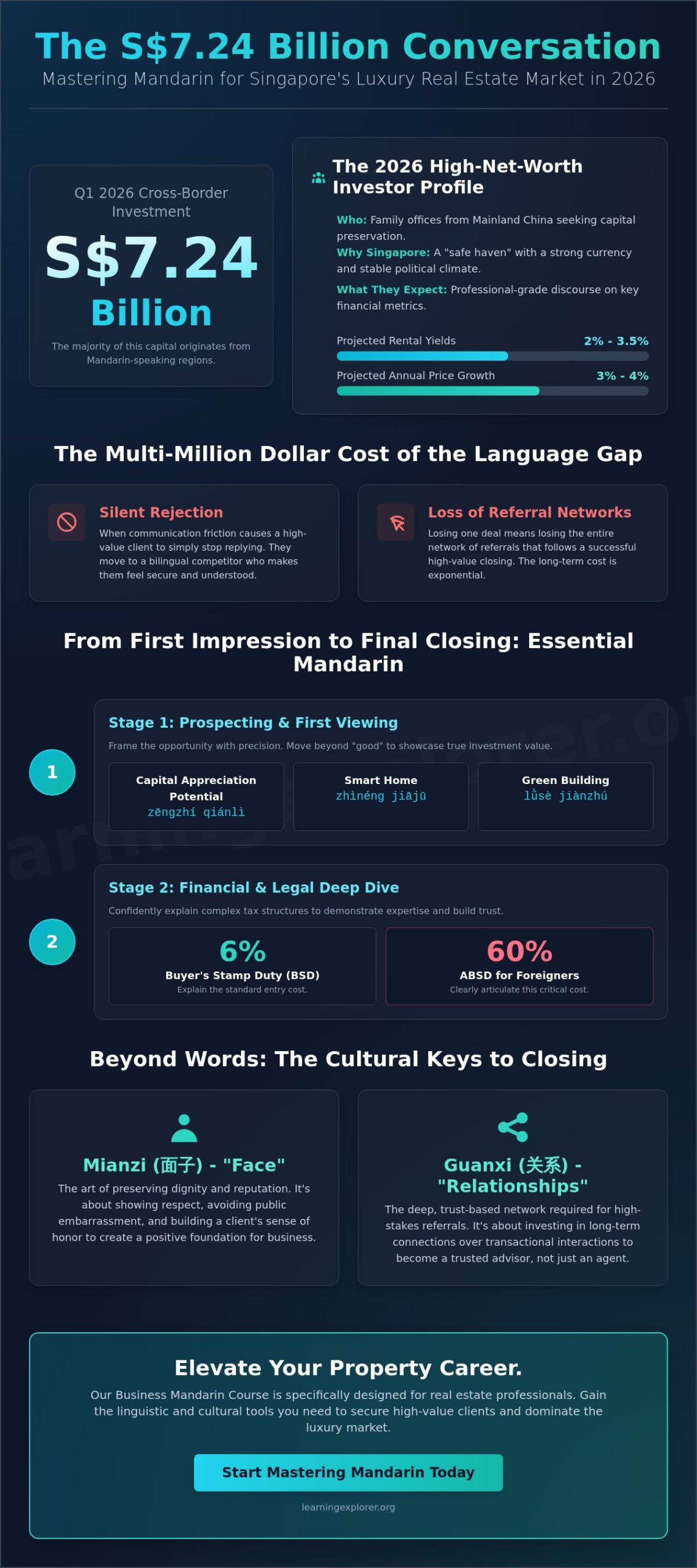
The Singapore property market reached a pivotal moment in early 2026. With cross-border real estate investment hitting S$7.24 billion in the first quarter, the demand for high-tier service has never been higher. Most of this capital flows from regions where Mandarin is the primary medium of business. While there are four official languages in Singapore, Mandarin has become the essential currency of the luxury property sector. Mastering mandarin for real estate agents singapore isn’t about being “helpful” anymore; it’s about being competent in a market that moves at lightning speed.
When you speak a client’s native tongue, you bypass the initial layers of skepticism. It’s a psychological bridge. High-net-worth individuals aren’t just buying a condo; they’re looking for a partner who understands their heritage and financial nuances. If you can’t explain the 6% Buyer’s Stamp Duty or the 60% ABSD for foreigners without stuttering, you risk looking unprepared. Developing this fluency allows you to act as a visionary guide who reduces the friction of complex cross-border transactions.
To better understand how language impacts the daily hustle of a realtor, watch this helpful video:
The 2026 Investor Profile: Who are you selling to?
The face of the Core Central Region (CCR) has changed significantly. We’re seeing a massive influx of family offices seeking capital preservation. These investors from Mainland China and surrounding regions choose Singapore because it’s a “safe haven” with a strong currency and stable political climate. They don’t just want a “hello” and “thank you.” They expect professional-grade discourse regarding rental yields, which currently hover between 2% and 3.5%, and projected annual price growth of 3-4%. If your vocabulary is stuck at a basic level, you won’t survive the scrutiny of a family office representative who manages billions in assets.
The Cost of the Language Gap
The price of staying monolingual is steep. Think about the “silent rejection.” This happens when a client feels the friction in your communication and simply stops replying. They’ll move to a bilingual competitor who makes them feel secure and understood. You aren’t just losing one deal; you’re losing the entire referral network that follows a successful high-value closing. In a market where prime residential prices often exceed S$2,000 per square foot, a single misunderstanding is a multi-million dollar mistake you can’t afford to make. Investing in your language skills is the most direct way to protect your commission and build a resilient career.
Essential Real Estate Mandarin: A Stage-by-Stage Vocabulary
Stop relying on direct translations. They often sound clunky and unprofessional to a sophisticated investor who expects a high level of industry expertise. To build real authority, you need a structured approach to your lexicon. Categorizing your learning into transaction stages ensures you have the right “Power Verbs” ready when the pressure is on. Mastering professional mandarin for real estate agents singapore means moving past basic greetings and into the mechanics of wealth preservation and asset management.
Your ability to articulate value determines your commission. When you speak the language of investment, you aren’t just an agent; you’re a consultant who reduces administrative friction. This clarity builds the high-level engagement necessary for the luxury segment. It’s about shifting from the labor of explaining basic concepts to the satisfaction of closing complex deals.
Stage 1: Prospecting and the First Viewing
Your first impression depends on how you frame the opportunity. Instead of just saying a property is “good,” discuss its zengzhi qianli (capital appreciation potential). In 2026, investors prioritize sustainability and tech. Use terms like zhineng jiaju (smart home) and luse jianzhu (green building) to highlight modern features. If a client hesitates on the price, use tactful phrases to explain why a strategic entry point in the current market is essential for long-term gains. This professional framing positions you as a visionary guide rather than a salesperson.
Stage 2: The Financial and Legal Deep Dive
This is where deals often stall. You must explain complex taxes clearly to maintain momentum. For example, explain that the Additional Buyer’s Stamp Duty (ABSD) is 60% for foreigners but significantly lower for Permanent Residents on their first purchase. Differentiate between yongjiu diqi (Freehold) and zulin di (Leasehold) with absolute confidence. When discussing numbers, refer to Singapore property transaction records to provide evidence-based projections. If these technical terms feel daunting, a Business Mandarin Course can provide the specific drills you need to speak fluently.
Stage 3: Closing and After-Sales Support
The final push requires a balance of firmness and etiquette. Use professional phrasing for the “final offer” to avoid sounding desperate. You must also be clear about the “Option to Purchase” (OTP). In Mandarin, the Option to Purchase is referred to as goumai xuanze quan, a legal agreement where the seller grants the buyer the exclusive right to buy the property at a fixed price within a set period. Once the deal is done, use congratulatory language that emphasizes a long-term partnership. This builds the Guanxi (relationships) necessary for future referrals within the client’s network.
Navigating Singapore Property Types in Mandarin
Understanding the nuances of the local market is your biggest asset. You can’t just call every residence a “house” and expect to maintain a professional image. In Singapore, the distinction between public and private housing carries heavy legal and financial weight. Mastering mandarin for real estate agents singapore involves learning the specific labels that define our skyline. Whether you’re standing in a high-floor unit in the CBD or showing a sprawling bungalow, your terminology must be precise to inspire client confidence.
Your ability to categorize assets correctly helps manage investor expectations. It simplifies the discovery process and reduces the time spent on unsuitable leads. We’ve seen that agents who use precise industry terms often secure higher engagement rates because they sound like seasoned practitioners rather than casual observers.
HDB vs Private Condominiums
Foreign investors usually focus on private condominiums, known as Gongyu. You’ll need to explain why these command a premium compared to public housing. Use the term quan tao sheshi to describe full condo facilities like 24-hour security, gyms, and swimming pools. For your Permanent Resident (PR) clients, explaining Executive Condominiums (EC) is vital. Describe them as a hybrid asset class that offers the lifestyle of a condo with the subsidized entry price of public housing. Don’t forget to remind PRs that they face a 5% ABSD on their first residential property, a detail that requires clear and empathetic communication.
Landed Property and GCBs
Landed property represents the pinnacle of Singapore real estate. Good Class Bungalows (GCB) are the crown jewels of the market, often described as you di hao zhai. You must be prepared to explain the strict Singapore Land Authority (SLA) restrictions with absolute clarity. Foreigners are generally restricted from buying landed homes unless they look toward Sentosa Cove. Be ready with terms for different styles: pai wu for terrace houses, shuang pin for semi-detached, and du li shi for detached homes. Using these specific terms proves you’re an expert advisor who understands the prestige associated with landed assets.
The commercial sector also offers significant opportunities since it doesn’t attract ABSD. Many international investors are currently targeting shophouses or Grade A offices in the Tanjong Pagar area. Use shang ye di chan for commercial real estate and gong ye di chan for industrial properties. If you’re ready to practice these property-specific dialogues, visit us at 10 Anson Road, level 22, International Plaza, Singapore 079903. We’re located right above Tanjong Pagar MRT, making it easy to drop by after your viewings in the CBD.
Cultural Etiquette: Closing the Deal with Chinese Investors
In the luxury property segment, the final signature on a contract is rarely the result of a cold transaction. It’s the culmination of a relationship built on trust and mutual respect. If you want to master mandarin for real estate agents singapore, you must look beyond the vocabulary and dive into the cultural mechanics of the deal. High-net-worth investors aren’t just looking for a square foot price; they’re evaluating your character and your ability to respect their status.
Two concepts dominate these interactions: Mianzi (Face) and Guanxi (Relationships). Giving “face” means acknowledging your client’s prestige and avoiding any public corrections or confrontations. Meanwhile, Guanxi is the deep, reciprocal network of trust you build over time. Don’t be surprised if the most critical negotiations happen over a meal rather than at the showflat. The “Dinner Table” negotiation is where the formal barriers drop, and you transition from a salesperson to a trusted ally. Pay attention to non-verbal cues; a slight hesitation in a client’s tone can be more telling than their words.
Building “Guanxi” with High-Net-Worth Individuals
Position yourself as a consultant rather than a typical agent. Your value increases when you provide insights into Singapore’s lifestyle, such as elite schooling options or private banking landscapes. Use WeChat to maintain a presence without being intrusive. Share high-quality market reports or updates on the 0.9% private residential price increase seen in early 2026. This consistent, low-pressure engagement proves you’re invested in their long-term success. If you’re ready to refine these high-stakes communication skills, enroll in our Business Mandarin Course to practice real-world negotiation scenarios.
The Role of Feng Shui in Modern Real Estate
Even in a modern city like Singapore, Feng Shui remains a decisive factor for many Mandarin-speaking investors. You need to be familiar with terms for chaoxiang (facing) and shui (water elements). Respect the presence of a client’s Feng Shui master during viewings; your role is to provide the technical data they need to make their assessment. To highlight a property’s orientation, describe it as a north-south facing unit that maximizes natural light while capturing the cooling cross-ventilation of the prevailing winds. Understanding these preferences shows you respect their worldview, which is often the final nudge needed to secure a closing.
Elevate Your Property Career with Learning Explorer
Success in the 2026 property market requires more than just a real estate license. It demands the ability to build immediate rapport with international investors. We understand that your schedule is demanding, filled with back-to-back viewings and late-night negotiations. That’s why we’ve built a program specifically designed to reduce your administrative burden while increasing your professional impact. Our approach to mandarin for real estate agents singapore focuses on the high-quality, vetted content you need to close deals faster and with greater precision.
You don’t have time for generic vocabulary. You need to speak the language of the CBD. Our instructors are bilingual native speakers who act as your visionary guides. They understand the nuances of the Singapore property sector, from the latest cooling measures to the subtle art of Guanxi. They focus on transformative verbs and adjectives that emphasize your efficiency and inspiration during client presentations. We ensure every word you learn highlights the transition from the labor of seeking terms to the satisfaction of discovery, allowing you to focus on the human connection behind the deal.
Practical, Scenario-Based Learning
We believe in learning by doing. Our sessions prioritize role-playing real-world property viewings and high-stakes price negotiations. You’ll practice handling objections about the 60% ABSD or explaining the benefits of a GCB in a supportive, expert environment. We keep our group sizes small to ensure you get maximum speaking practice. You’ll receive customized materials that you can take straight to your next viewing, turning your classroom discovery into a creative catalyst for better sales outcomes and stronger client trust.
Join the Learning Explorer Community in the CBD
Location matters for a busy professional. Visit our training center at 10 Anson Road, level 22, International Plaza, Singapore 079903. We’re located right above Tanjong Pagar MRT, making it easy to swing by between client meetings or after a showflat duty. Beyond the lessons, you’ll find networking opportunities with other ambitious professionals in our Business Mandarin Course. Take the next step toward becoming a top-tier bilingual property consultant today. We provide the tools you need to increase your efficiency while simultaneously enhancing your professional impact in Singapore’s most competitive market segments.
Secure Your Future in Singapore’s Luxury Property Market
The real estate landscape in 2026 demands more than just market knowledge; it requires a deep linguistic and cultural connection with your clients. By mastering professional terminology and understanding the subtle art of Guanxi, you position yourself as a trusted advisor. Mastering mandarin for real estate agents singapore is the catalyst that transforms your career. It allows you to bridge the gap between a simple viewing and a multi-million dollar closing with absolute confidence. You’ve worked hard to build your reputation; don’t let a language barrier limit your growth.
It’s time to stop feeling awkward during property tours and start leading with authority. Our tailored curriculum and certified native-speaker instructors ensure you succeed in every high-stakes negotiation. Visit us right above Tanjong Pagar MRT to see how we help you reduce administrative friction and increase your commission potential. Book Your Trial Business Mandarin Class at Tanjong Pagar Today and join a community of top-tier property consultants. Your journey toward becoming a bilingual expert starts here. We’re ready to be your partner in every step of that professional discovery.
Frequently Asked Questions
Is it difficult for an English-speaking agent to learn real estate Mandarin?
It isn’t difficult when you focus on the specific vocabulary you use every day. Our approach centers on high-frequency phrases needed for property viewings rather than abstract academic grammar. You’ll find that many technical terms have logical structures that are easy to memorize once you understand the underlying property concepts. We provide the tools to help you bridge the gap quickly and professionally.
How long does it take to become fluent enough to conduct a property viewing?
Most agents achieve professional proficiency within three to six months of consistent practice. This timeframe allows you to handle initial inquiries and lead a standard property tour with confidence. Your progress accelerates when you apply what you’ve learned in our Business Mandarin Course directly to your weekend viewings. Consistent engagement with the language transforms your communication from a struggle into a competitive advantage.
Do I need to learn how to write Chinese characters for real estate?
You don’t need to master writing thousands of characters by hand to be successful. Focus your energy on speaking and reading instead. In 2026, most transaction documents are digital; therefore, being able to recognize key terms in a sales agreement is far more valuable than knowing how to write them from memory. This focus increases your efficiency and reduces unnecessary study burdens.
What are the most common Mandarin terms for Singapore property taxes?
The most critical terms are Ewai Maijia Yinhuashui for Additional Buyer’s Stamp Duty (ABSD) and Maijia Yinhuashui for Buyer’s Stamp Duty (BSD). You should also know Maijia Yinhuashui for Seller’s Stamp Duty (SSD) when assisting clients with divestments. Using these precise terms for mandarin for real estate agents singapore builds immediate trust with high-net-worth investors who value accuracy in financial discussions.
Can I take a trial class to see if the Business Mandarin course fits me?
Yes, we encourage you to book a trial session to experience our teaching style firsthand. It is the best way to see how our scenario-based learning fits your professional needs and schedule. You’ll meet our native-speaker instructors and get a feel for the supportive community we’ve built for realtors. This trial serves as the creative catalyst for your professional growth.
How does Learning Explorer differ from other language schools in Singapore?
We specialize in professional outcomes rather than general conversation. Our curriculum for mandarin for real estate agents singapore is built by practitioners who understand the specific stresses of the luxury market. We don’t just teach a language; we provide a visionary guide to help you close high-value deals. Our focus is consistently on the emotional and financial success of the agent and their clients.
Are the classes held online or in-person at International Plaza?
We offer high-impact in-person classes at our center at 10 Anson Road, level 22, International Plaza, Singapore 079903. Being located right above Tanjong Pagar MRT makes it incredibly convenient for you to attend sessions between your CBD appointments. We also provide flexible hybrid options for agents who need to balance learning with a heavy viewing schedule across the island.
What is the best way to practice Mandarin between property appointments?
Use your commute time to listen to Mandarin property news or market analysis. Practice describing your latest listing out loud while driving to your next appointment to build muscle memory. Engaging with high-quality, vetted materials consistently will help you transition from the labor of seeking words to the satisfaction of natural discovery. This habit ensures you maintain momentum and improve your professional impact daily.