What if the reason you feel stuck at the intermediate level isn’t a lack of effort, but a curriculum that prioritizes rote memorization over real world application? Many learners in Singapore find the jump from N4 to N3 feels like hitting a wall. If you’re searching for a JLPT N3 course sg that actually prepares you for the professional workplace, you’re likely looking for more than just a passing grade. You want the confidence to speak without hesitation and the ability to handle complex social interactions with ease.
We understand that facing 650 Kanji and intricate grammar patterns can feel overwhelming, especially when you’re balancing studies with a busy career. This article outlines the most effective path to mastering the intermediate level in 2026. You’ll discover how to secure one of the 400 limited exam slots, the specific structure of the July and December tests, and how our training center at 10 Anson Road, level 22, International Plaza, Singapore 079903, right above Tanjong Pagar MRT, provides the supportive environment you need. We’ll break down the syllabus so you can stop worrying about administrative burdens and start enjoying your journey toward professional fluency.
Key Takeaways
- Learn how to bridge the gap between basic Japanese and professional fluency by targeting the specific skills Japanese firms in Singapore value most.
- Demystify the N3 syllabus by breaking down the 650 Kanji and 3,700 vocabulary words you need to master for semi-formal communication.
- Identify the most efficient path to success by comparing the discipline of self-study against the benefits of an interactive JLPT N3 course sg.
- Implement a strategic four-month preparation timeline that moves you from grammar foundations to real-world immersion through news and podcasts.
- Explore why learning with native-speaker instructors who understand the Singaporean context is the creative catalyst for your linguistic growth.
Mastering the Intermediate Bridge: Why JLPT N3 is Your Career Catalyst
Passing the N5 and N4 levels feels like a series of quick wins. You learn how to order sushi, ask for directions, and introduce yourself. However, the Japanese-Language Proficiency Test (JLPT) N3 represents a significant shift. It’s the threshold where you move from “survival” Japanese to “functional” Japanese. At this level, you begin to grasp the nuances of social interactions and understand abstract ideas. If you’ve been searching for a JLPT N3 course sg, you’re likely ready to stop translating word-for-word and start thinking in Japanese.
To better understand the level of comprehension required, watch this helpful video:
The Professional Advantage of N3 in Singapore
In the competitive landscape of Singapore’s Central Business District (CBD), N3 is the most sought-after certification by Japanese MNCs. While N4 shows interest, N3 demonstrates capability. It proves you can follow business reports, participate in meetings, and understand the subtle etiquette of a Japanese office. For many, choosing to learn japanese language at this intermediate stage is a strategic move to enhance their CV. It signals to employers that you possess the grit to push through the “Intermediate Plateau,” where many learners quit due to the sudden increase in complexity. By enrolling in a structured JLPT N3 course sg, you gain the tools to decode these nuances systematically.
Bridging the Gap from N4 to N3
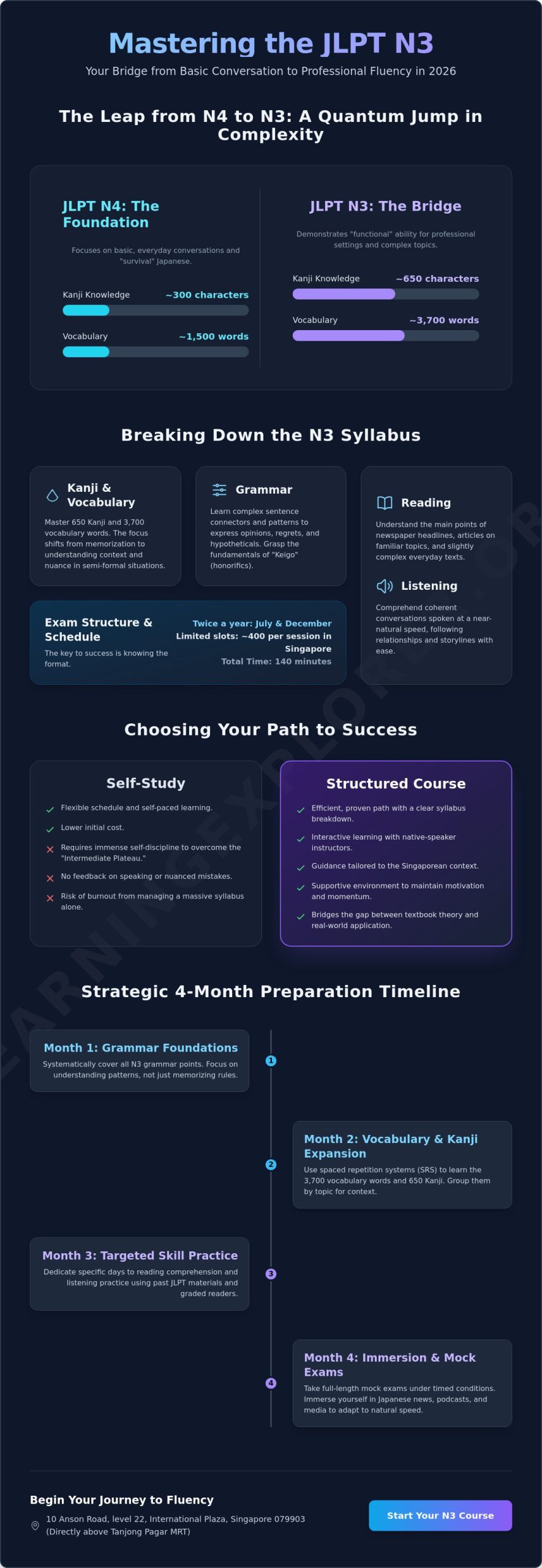
The transition from N4 to N3 is often described as a “jump” rather than a step. You’ll move from roughly 300 Kanji characters to nearly 650. The grammar becomes less about literal meaning and more about intent and context. This is where many students feel stuck. They understand the words but miss the “vibe” of the conversation. Navigating this shift requires a psychological change. You must stop relying on English anchors and embrace the ambiguity of natural Japanese. This is where a supportive language school makes all the difference. Having a guide who understands the specific hurdles Singaporean learners face can turn a frustrating plateau into a period of discovery. Our center at 10 Anson Road, level 22, International Plaza, Singapore 079903, located right above Tanjong Pagar MRT, is designed to be that creative catalyst for your success. Don’t let the complexity stop your momentum.
Breaking Down the JLPT N3 Syllabus: What You Need to Know
Mastering the N3 requires a tactical approach to a massive volume of new information. You’re moving from basic literacy to a level where you can navigate semi-formal Japanese society with relative ease. A high-quality JLPT N3 course sg provides the necessary structure to manage this expansion without feeling buried under a mountain of flashcards. It’s about shifting your focus from simple memorization to understanding how the language functions in a professional ecosystem.
According to the Official JLPT Website, you’ll need to recognize approximately 650 Kanji and 3,700 vocabulary words. This isn’t just a numbers game; it’s about context. At this stage, you’ll start using “Keigo” (honorifics) to navigate social hierarchies. You’ll also encounter complex sentence connectors that allow you to express subtle opinions, regrets, and hypothetical scenarios. If you want to see how these patterns work in practice, exploring a Conversational Japanese Course can help you bridge the gap between textbook theory and real-world speech.
The Three Pillars of the N3 Exam
The exam tests your agility across three core areas. Language Knowledge focuses on your ability to recall Kanji and choose the correct grammar pattern for specific social settings. Reading Comprehension marks a major shift; you’ll move from short, predictable passages to multi-paragraph essays and informational brochures. Finally, the Listening section challenges you with near-natural speech speeds. You’ll need to filter out environmental noise and identify the speaker’s true intent, which is often left unsaid in Japanese communication.
Common N3 Pitfalls for Singaporean Learners
Many learners in Singapore struggle with “Kanji traps.” It’s easy to confuse similar-looking characters like 持 (to hold) and 待 (to wait) when you’re rushing through the exam. Another common hurdle is the over-reliance on English sentence structures. Because Japanese grammar often places the verb at the end, literal translation leads to confusion. You might also find it difficult to grasp the “intent” behind indirect speech. In Japanese, a “maybe” often means “no,” and N3 expects you to understand these cultural nuances. Focusing on these specific challenges early in your JLPT N3 course sg will save you time and frustration during your final review.
Structured Course vs. Self-Study: Choosing Your Path to Success
Deciding between self-study and a structured JLPT N3 course sg often comes down to how much you value your time and clarity. The internet offers an endless supply of free resources, yet this abundance frequently leads to information overload. Without a clear roadmap, you might spend hours researching a grammar point that rarely appears in real conversations. A professional course replaces the labor of seeking with the satisfaction of discovery. It filters out the noise and provides a vetted curriculum that targets the exact skills you need for both the exam and the workplace.
Self-study requires an incredible amount of discipline at the intermediate level. Many learners find that while they can memorize vocabulary on their own, they struggle to apply N3 grammar in real-time. Peer interaction provides the conversational practice that solo study lacks. Engaging with other students allows you to test your understanding in a safe, supportive environment. This community aspect transforms the taxing nature of language learning into a creative catalyst for better results.
Why Native Bilingual Teachers are Essential for N3
At the intermediate level, understanding the “why” is just as important as the “how.” While an app can tell you a sentence is wrong, it can’t explain the social nuance behind your choice. Native bilingual teachers bridge the cultural gaps that textbooks often miss. They provide the nuanced corrections that AI tools simply cannot replicate. This is especially vital when preparing for the exam through the official JLPT administrator in Singapore, where contextual understanding is tested as much as vocabulary. By enrolling in a Conversational Japanese Course, you ensure your learning isn’t just academic; it’s functional.
The Power of a Structured Learning Environment
Discipline is the hardest part of self-study. It’s easy to fall into the “I will study tomorrow” trap when your professional life gets busy. A structured environment provides fixed schedules that keep you accountable and maintain your momentum. You gain access to high-quality materials that have been curated by experts, saving you from the unorganized chaos of online forums. Regular mock tests are another critical benefit. They build the exam stamina needed to handle the rigorous test format without burning out. Our training center at 10 Anson Road, level 22, International Plaza, Singapore 079903, right above Tanjong Pagar MRT, offers the perfect hub for this focused growth. You aren’t just studying in a vacuum; you’re joining a community of like-minded professionals striving for the same goal.
Strategic Preparation: A Timeline for Singaporean Learners
Map out your path to success with a clear six month roadmap. Most professionals in Singapore juggle demanding careers with their language goals, so efficiency is your best ally. A dedicated JLPT N3 course sg provides the structure to turn a short window of time into a successful certification. Instead of guessing what to study next, follow a logical progression that builds your confidence alongside your skills.
Months 1 and 2 focus on building your foundations. Commit to mastering the 350 new Kanji characters and core grammar patterns that distinguish N3 from basic levels. By Months 3 and 4, shift your attention toward immersion. Start reading semi-formal news articles and listening to intermediate podcasts to train your ear for natural speech speeds. This transition from textbook Japanese to real world application is the creative catalyst for true fluency.
Month 5 is for refinement. Tackle your weak areas, specifically the complex honorifics that often trip up learners during the listening section. Finally, Month 6 is the final push. Spend this time on mock exams and time management strategies. Remember that registration for the July 5, 2026 test opens on March 13, 2026. With only 400 slots available per session in Singapore, you must be prepared to act quickly. Securing your spot early reduces administrative stress and lets you focus entirely on your performance.
Daily Habits for N3 Mastery
Consistency beats intensity every time. Use digital flashcards for spaced repetition to ensure your Kanji retention stays high. Leverage your daily commute for passive listening; even twenty minutes on the MRT can sharpen your comprehension over time. Set realistic weekly goals to maintain your momentum without burning out. If you find yourself needing more interactive practice to solidify these habits, consider enrolling in a Conversational Japanese Course to apply your knowledge in real time.
Utilizing Local Resources in Singapore
Singapore offers a wealth of resources for the dedicated learner. Visit specialized Japanese bookstores in the city to find supplemental reading materials that match your interests. Joining local language exchange groups can also provide a low pressure setting to practice speaking with others. The convenience of our training center at 10 Anson Road, level 22, International Plaza, Singapore 079903, located right above Tanjong Pagar MRT, makes it easy to fit high quality study sessions into your professional life. Discovery becomes much easier when your resources are right at your doorstep.
Why Learning Explorer is the Preferred JLPT N3 Course in Singapore
Choosing a language school is about finding a reliable ally that understands your specific professional goals. At Learning Explorer, we provide a JLPT N3 course sg that treats the exam as a gateway to conversational fluency rather than a mere academic hurdle. Our mission is to reduce your administrative burdens while increasing your engagement with the language. We offer a vetted content library and a curriculum designed by practitioners for practitioners. This ensures that every hour you spend with us translates into tangible progress in your career and daily life.
Our certified native-speaker instructors are the heart of our program. They understand the local Singaporean context and the unique challenges faced by busy professionals. Whether you prefer the focused attention of private lessons or the dynamic energy of group classes, our flexible formats cater to your schedule. We align our teaching with global standards while tailoring the material for adult learners who need to use Japanese in high-stakes environments. You won’t just learn to pass a test; you’ll learn to navigate the complexities of a Japanese workplace with ease.
The Learning Explorer Experience
We keep our class sizes small to ensure you get ample speaking time. This isn’t just about learning grammar patterns; it’s about the emotional outcome of feeling truly capable. We aim to turn the labor of seeking the right words into the satisfaction of discovery. In our supportive environment, you’ll find a community of like-minded learners who motivate each other. This atmosphere builds the confidence you need for both the exam hall and the boardroom. Our Conversational Japanese Course serves as a creative catalyst, helping you apply N3 concepts to real-world scenarios immediately.
Convenient CBD Location for Busy Professionals
Time is your most valuable resource. Our training center is easily accessible for those working in the city, located at 10 Anson Road, level 22, International Plaza, Singapore 079903. Being situated right above Tanjong Pagar MRT allows for a seamless transition from your office to the classroom. You can leave work and be immersed in your studies within minutes. This convenience helps you maintain momentum without the stress of a long commute. We’ve organized our systems to be as efficient as possible, respecting your limited time while maximizing your learning outcomes.
Ready to bridge the gap? Join our JLPT N3 Course today!
Transform Your Career with Functional Japanese Fluency
Mastering the intermediate level is about more than just passing a test; it’s about unlocking doors to Japanese MNCs and gaining the confidence to lead professional conversations. You’ve seen how a structured six month timeline and a deep dive into the N3 syllabus can turn an overwhelming challenge into a series of achievable wins. By choosing a JLPT N3 course sg that prioritizes interactive discovery over rote memorization, you ensure your progress is both efficient and sustainable.
Our native bilingual instructors are ready to guide you through the nuances of Keigo and complex social patterns in our small group sessions. Located at 10 Anson Road, level 22, International Plaza, right above Tanjong Pagar MRT, we make it easy to transition from your professional workday to your personal growth. You don’t have to face the intermediate plateau alone. Let us be your creative catalyst for better outcomes.
Begin Your Journey to N3 Mastery at Learning Explorer
Take the first step today and watch how your dedication transforms your professional impact. You’ve got the drive, and we’ve got the roadmap to help you succeed.
Frequently Asked Questions
How long does it take to prepare for the JLPT N3 in Singapore?
Most professionals find that four to six months of consistent study is the ideal timeframe. This assumes you already possess a solid N4 foundation and can commit to weekly sessions in a structured JLPT N3 course sg. Managing the jump to 650 Kanji characters requires a steady pace to ensure long-term retention and conversational confidence.
Is the JLPT N3 exam difficult compared to N4?
N3 is significantly more challenging because it moves from basic survival Japanese into abstract and social nuances. While N4 focuses on daily routines, N3 tests your ability to understand semi-formal news, business scenarios, and faster speech. You’ll need to master approximately 3,750 vocabulary words, which is nearly double the requirement of the N4 level.
Can I take an N3 course if I haven’t passed the N4 exam yet?
You can certainly join an N3 program if your current proficiency is at an intermediate level. Passing the formal N4 exam isn’t a strict requirement for enrollment. However, we recommend a placement assessment to ensure you’re comfortable with basic grammar and the first 300 Kanji characters so you don’t feel overwhelmed by the faster pace of intermediate learning.
What is the passing score for the JLPT N3?
To pass the N3, you must achieve a total score of at least 95 out of 180 points. It’s also vital to meet the minimum “sectional pass marks” of 19 out of 60 in each of the three categories: Language Knowledge, Reading, and Listening. If you fail to hit the minimum in any single section, you won’t pass the overall exam.
Are trial classes available for the Japanese N3 course?
We often host preview sessions where you can experience our interactive teaching style firsthand. These sessions let you meet our native bilingual instructors and see how we transform complex grammar into functional skills. It’s an excellent opportunity to discover if our supportive, small-group environment fits your professional learning schedule before you commit to the full term.
How often is the JLPT held in Singapore?
The exam takes place twice a year, specifically on the first Sunday of July and December. For 2026, the test dates are July 5 and December 6. Because the N3 level is limited to 400 candidates per session in Singapore, we encourage students to register as soon as the online portal opens in March and August.
What materials are used in the Learning Explorer N3 course?
Our JLPT N3 course sg utilizes a curated mix of industry-standard textbooks and proprietary materials designed for adult professionals. We focus on vetted content that bridges the gap between exam theory and real-world application. You’ll work with mock papers, listening audio recorded at natural speeds, and reading passages that reflect actual Japanese business culture.
Is N3 enough to work in a Japanese company in Singapore?
N3 is generally recognized as the minimum threshold for functional communication within Japanese firms. While N2 or N1 are required for translation-heavy roles, N3 proves you can follow instructions, understand office reports, and participate in social gatherings. It’s a significant career catalyst that demonstrates your commitment to mastering the language in a professional context.