Imagine a busy Friday night at a bustling restaurant right above Tanjong Pagar MRT. You’re taking a complex order for a table of international tourists, and suddenly, the pressure of the kitchen and their unfamiliar accents make you freeze. You hesitate, worried you’ll misinterpret a guest’s request or struggle to switch between local lingo and the professional tone they expect. It’s a stressful moment that many in the industry face daily, often leading to anxiety when handling difficult customers.
We understand that these communication gaps can be draining. You want to provide world-class service, but language barriers shouldn’t hold you back from the higher tips and glowing reviews you deserve. Mastering english for f&b service staff singapore is the most effective way to unlock your full potential in this fast-paced sector. This guide provides the practical communication skills needed to process orders faster and handle complaints with absolute poise. We’ll explore how refined language skills help you transition into high-end dining and build a career you’re proud of. If you’re ready to grow, our training center at 10 Anson Road, level 22, International Plaza, Singapore 079903, is here to support your journey toward professional excellence.
Key Takeaways
- Learn to describe menu items with precision to increase order accuracy and provide a more engaging dining experience for your guests.
- Discover how to adapt your communication style using english for f&b service staff singapore to meet the expectations of both local regulars and international tourists.
- Use the LEAP framework to handle guest complaints with poise, helping you secure better reviews and higher tips even in high-pressure situations.
- Find out how professional language training can reduce your daily stress and open doors to leadership roles in Singapore’s fine dining sector.
Why English Proficiency is the Secret Ingredient for F&B Success
English in the hospitality sector isn’t just about grammar; it’s a specialized tool for safety, warmth, and precision. In a city where 60% of residents eat out at least three times a week and millions of international tourists visit annually, clear communication is the foundation of every transaction. Understanding Singapore’s linguistic landscape helps you realize that while local dialects build rapport with regulars, professional English ensures clarity for a global audience. It’s the difference between a guest feeling merely fed and feeling truly cared for.
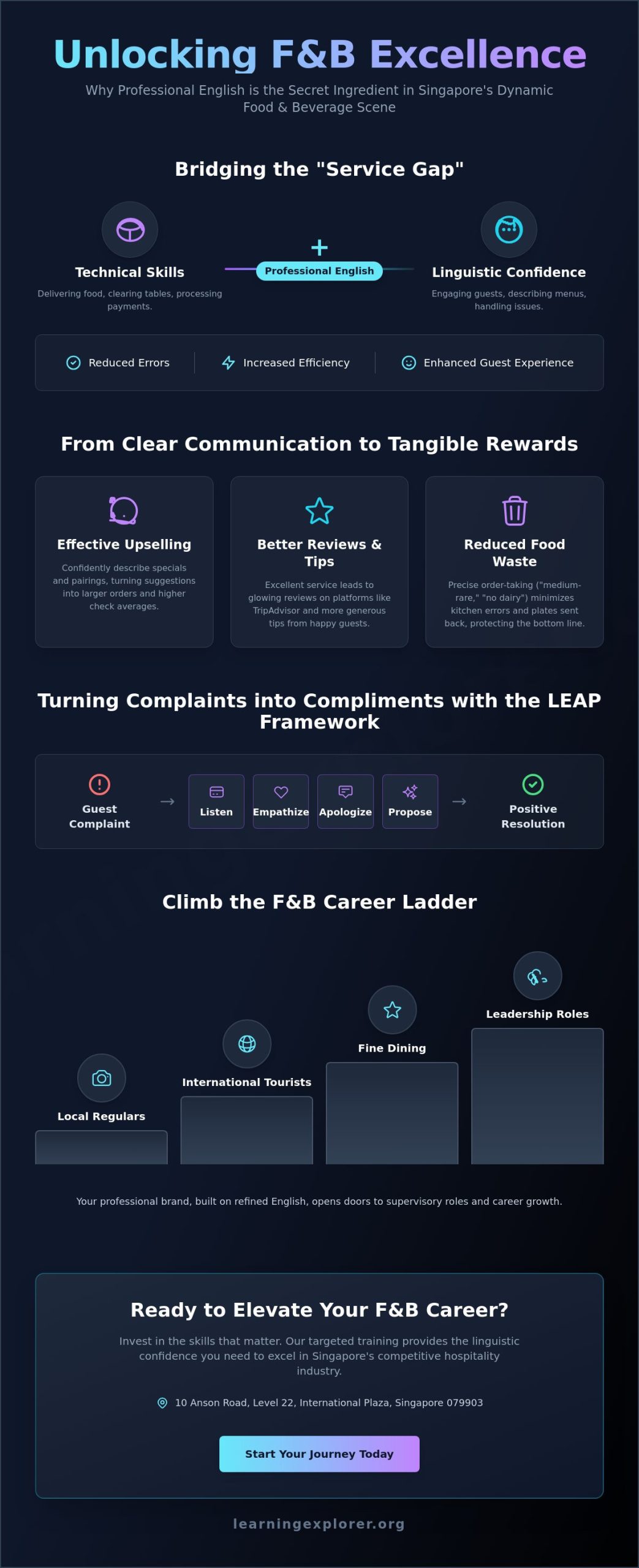
Mastering english for f&b service staff singapore allows you to bridge the “Service Gap.” This gap occurs when a server has the technical skills to deliver food but lacks the linguistic confidence to engage deeply with the person sitting at the table. When you speak clearly, you aren’t just taking an order; you’re creating an atmosphere of trust. This confidence directly impacts operational efficiency by reducing the time spent clarifying simple requests. It means less time running back to the kitchen to fix mistakes and more time focusing on the guest’s comfort.
To better understand this concept, watch this helpful video:
The Economic Impact of Better Communication
Clear communication translates directly into dollars and cents for both you and your employer. When you can describe a dish’s texture or a wine’s origin with flair, you create upselling opportunities that feel like helpful suggestions rather than a pushy sales pitch. This leads to higher guest ratings on platforms like TripAdvisor, which is vital in an industry with over 220,000 workers. Additionally, precise language reduces food waste. Misinterpreted orders lead to sent-back plates, which hurts the restaurant’s bottom line and disrupts the kitchen’s flow. Every correctly heard “medium-rare” or “no-dairy” request protects the business.
Career Mobility in Singapore’s Hospitality Scene
Your language skills are the ladder to your next big promotion. Moving from a casual café to a Michelin-starred establishment requires a shift in how you present yourself. High-end hospitality demands a level of polish that only comes with practice. By refining your English, you build a professional personal brand that stands out to hiring managers. It’s the key to reaching supervisory roles where you’ll lead teams and manage complex guest relations. If you’re ready to make this leap, our training center at 10 Anson Road, level 22, International Plaza, Singapore 079903, located right above Tanjong Pagar MRT, provides the perfect environment to sharpen these skills. Your journey to the top starts with the confidence to speak up.
Core English Modules for High-Impact Food and Beverage Service
The first thirty seconds of a guest’s arrival define their entire meal. Professional greetings and seamless seating etiquette create an immediate sense of belonging. Instead of a simple “How many?”, try “Good evening, a table for four?” This subtle shift demonstrates attentiveness and sets the stage for a high-quality service culture in the hospitality industry. It’s about being present and proactive from the moment they step through the door.
Modern service also requires you to be a tech guide. With many restaurants adopting AI-powered POS systems and digital ordering, you’ll often need to assist guests with new tools. Clear instructions like “Simply scan this QR code to view our seasonal specials” help guests feel in control. If a digital payment fails, your ability to explain the issue calmly prevents a minor glitch from becoming a major frustration. Mastering english for f&b service staff singapore means being just as comfortable with a tablet as you are with a menu.
The Art of Recommendation and Upselling
Effective upselling feels like a curated suggestion rather than a sales pitch. Use sensory adjectives like “crispy,” “zesty,” or “velvety” to bring the menu to life. Replace closed questions like “Do you want a drink?” with open, persuasive phrases such as “May I recommend our house-made ginger ale to complement the spice of your main course?” These linguistic nuances turn a standard transaction into a memorable culinary journey. If you want to refine these specific phrasing techniques, a conversational English course can provide the targeted practice you need.
Dietary Nuance and Guest Safety
Guest safety is a non-negotiable part of modern hospitality. You must confidently identify and communicate common allergens like gluten, nuts, and shellfish. When a guest mentions a restriction, don’t just nod; confirm with the kitchen using specific, standardized language. This ensures nothing is lost in translation during the peak dinner rush. You might say, “I will check with our chef to ensure this dish is entirely nut-free,” to provide immediate reassurance.
Providing peace of mind is a hallmark of a professional. Cross-contamination occurs when allergens are unintentionally transferred from one food item or surface to another during the preparation process. Explaining this clearly to a concerned guest shows that you take their health seriously and understand the technical side of food safety. This level of detail builds immense trust with your diners.
Navigating Singapore’s Unique Language Landscape
Singapore’s dining culture is a fascinating spectrum. You might start your morning serving a “Kopi O” at a local coffee shop and end your shift presenting a vintage wine in a high-end CBD bistro. This diversity requires more than just a basic vocabulary; it demands the ability to code-switch effectively. When you master english for f&b service staff singapore, you gain the agility to move between these cultural worlds without losing your professional edge. It’s about matching the guest’s energy while maintaining a high standard of clarity that works for everyone.
Knowing when to use local lingo versus international standard English is a career-defining superpower. For a local regular, a warm “Coming right up!” feels like home. For an international tourist, a more formal “I’ll have that ready for you shortly” provides the professional polish they expect. With foreign workers making up 30% of the F&B workforce, your ability to lead this linguistic transition sets you apart as a reliable expert. It ensures that no matter who walks through the door, they feel understood, respected, and valued.
Bridging the Gap Between Local and International Guests
Tourists often find Singaporean menus exciting but confusing. Instead of just listing names, describe the experience to them. Tell them Laksa is a “rich, spicy coconut noodle soup with prawns,” or explain that Hainanese Chicken Rice is “poached, tender chicken served with fragrant ginger-infused rice.” Slow your pace and soften your accent to ensure clarity for those unfamiliar with the local rhythm. You can maintain your local warmth without over-using sentence particles like “lah” or “leh,” which might confuse someone visiting for the first time. This balance creates a welcoming atmosphere that resonates globally.
Professionalism in the Heart of the CBD
If you work in Tanjong Pagar, you’re dealing with high-stakes corporate clients who value efficiency and precision. These guests expect a level of service that matches their fast-paced environment. Our center is located right above Tanjong Pagar MRT, making it a convenient hub for F&B professionals to sharpen their skills between shifts. For a deeper look at excelling in this specific area, check out our English Language School Singapore: Your 2026 Guide to Mastery in the CBD. Mastering professional English here isn’t just a requirement; it’s your ticket to the city’s most prestigious and high-paying dining establishments.
Handling Service Recovery and Guest Complaints with Confidence
Complaints are often the most stressful part of the job. However, they are also your biggest opportunity to build lasting loyalty. When a guest is unhappy, they aren’t necessarily attacking you personally. They are reacting to a gap between their expectations and their actual experience. Mastering english for f&b service staff singapore gives you the tools to close that gap with grace. Instead of feeling defensive, you can use structured language to regain control of the situation and protect the restaurant’s reputation.
Using the LEAP framework helps guide your response during high-pressure moments. First, Listen without interrupting to show respect and let the guest feel heard. Second, Empathize by acknowledging their feelings with a calm tone. Third, Apologize sincerely for the inconvenience, regardless of who is at fault. Finally, Propose a specific, actionable solution. This logical flow prevents emotional escalations and proves you’re a professional problem-solver. It transforms a negative moment into a showcase of world-class service.
The Language of Empathy
The words you choose can either escalate a conflict or settle it instantly. Avoid using “I can’t” because it sounds like a dead end to a frustrated diner. Instead, try “What I can do is…” to show you’re actively looking for a way to help. Soften your language with phrases like “I understand why that’s frustrating” or “I appreciate your patience while I resolve this.” If you find yourself freezing up when a guest raises their voice, you aren’t alone. Many professionals struggle with this, but you can find strategies for overcoming your fear of speaking English in Singapore: the 2026 guide. Building this linguistic resilience is essential for your long-term career growth.
Practical Scenarios for Service Recovery
Effective recovery happens in four clear steps. Start by acknowledging the issue immediately without making excuses. Use specific vocabulary to validate their concern, such as “You’re right, the temperature of this dish should be perfect.” Next, offer a clear, timed resolution. Phrases like “I’ll check with the chef right now and have a fresh plate for you in five minutes” provide the certainty guests crave. Finally, follow up after the solution is delivered. A simple “Is everything to your satisfaction now?” shows you care about the final outcome. If a situation becomes too complex, use professional hand-over language to involve your supervisor. Say, “I want to ensure you get the best assistance, so I’m bringing my manager over to help us resolve this immediately.”
Ready to handle any guest interaction with total poise and professionalism? Sign up for our Business English Course to practice these de-escalation techniques in a supportive environment.
Elevate Your F&B Career with Training at Learning Explorer
Transforming your daily interactions into moments of professional excellence requires more than just a list of vocabulary. Our native-speaker instructors focus on the subtle emotional nuances that define world-class hospitality, helping you move from basic communication to genuine guest engagement. By perfecting your english for f&b service staff singapore in a supportive environment, you gain the poise needed to represent prestigious brands with confidence.
We understand the taxing nature of the industry’s rotating shifts. Our training is designed to be highly flexible, offering scheduling that respects your limited time. Classes take place in an interactive setting that mirrors real-world dining environments, allowing you to role-play scenarios before you ever step back onto the floor. Conveniently located at International Plaza right above Tanjong Pagar MRT, our center serves as a creative catalyst for your professional growth.
Customized Corporate Solutions for F&B Groups
Every restaurant concept has its own language, whether you’re serving high-end fusion or authentic Italian cuisine. We provide tailored curricula that focus on your specific menu and service standards, ensuring your entire team speaks with a unified, expert voice. You can choose between on-site training at your establishment or sessions at our CBD center. This targeted approach leads to measurable improvements in guest feedback and staff retention, reducing the administrative burden of constant retraining.
Start Your Journey to Professional Fluency
Don’t waste time with unorganized and overwhelming online resources that lack the necessary hospitality context. High-quality, vetted materials are the foundation of rapid improvement and lasting impact. Discover why we are the preferred partner for industry practitioners by reading about Language School Singapore: Why Learning Explorer is Your Best Choice in 2026. Visit us at International Plaza to see our facilities and meet the team dedicated to your discovery of professional satisfaction. Your path to a more rewarding career in Singapore’s vibrant food scene begins with a single, confident conversation.
Master the Language of World-Class Hospitality
Professional communication is the bridge between a standard job and a rewarding career. By mastering the nuances of high-impact greetings and the LEAP framework for service recovery, you position yourself as an indispensable asset to any dining team. These skills don’t just improve guest ratings; they build the personal confidence needed to thrive in Singapore’s competitive culinary scene. You’ve learned how to navigate dietary requirements and code-switch between different guest demographics, which are the hallmarks of a true hospitality expert.
Investing in english for f&b service staff singapore is a commitment to your own professional excellence. Our certified native-speaker instructors provide a curriculum aligned with global hospitality standards, ensuring you’re prepared for the high expectations of modern diners. Located right above Tanjong Pagar MRT, we offer the convenience and expertise you need to succeed without the burden of unorganized resources.
Empower your F&B team with professional English training at Learning Explorer today.
Your journey toward world-class service starts with the right words. Let’s make every interaction count and turn your professional goals into reality.
Frequently Asked Questions
How long does it take for F&B staff to see improvement in their English?
Most professionals notice a significant boost in their confidence after completing a 16-hour training package. While achieving total fluency is a long-term journey, most staff can master essential greetings and order-taking scripts within a few weeks of consistent study. The speed of your progress depends on how often you apply these new phrases during your daily shifts. Regular use in the actual dining room is the key to seeing rapid, measurable results.
Can these courses be customized for a specific type of cuisine or restaurant?
Yes, we can tailor the curriculum to match the specific menu and service style of your restaurant. Whether you serve traditional Italian dishes or modern Asian fusion, we focus on the vocabulary needed to describe your unique flavors and textures. This customization ensures that every lesson is directly applicable to your staff’s daily tasks. It makes the training feel relevant and immediately useful for your specific concept and guest profile.
Is the training suitable for staff with very basic English levels?
Absolutely, our training is designed to be accessible for learners who are starting with very limited English skills. We use a supportive, step-by-step approach that focuses on high-frequency phrases used in the hospitality industry. Our instructors are experts at building confidence in beginners through interactive role-play. You’ll start with basic greetings and gradually move toward more complex guest interactions at a comfortable pace that never feels overwhelming.
How does professional English training help with service recovery?
Training gives you a clear linguistic framework to handle stressful complaints without losing your professional poise. You’ll learn specific phrases for de-escalation that validate a guest’s concerns while you work toward a solution. This prevents minor issues from turning into major conflicts that could hurt your restaurant’s reputation. Having the right words ready allows you to stay calm and empathetic even when a guest is frustrated or demanding.
What is the benefit of having native-speaker teachers for F&B English?
Native-speaker instructors help you master the subtle nuances of tone and politeness that are essential in world-class service. They provide expert guidance on using persuasive adjectives and “softeners” that make your speech sound natural and welcoming. This level of polish is a core part of english for f&b service staff singapore training. It helps you meet the high linguistic standards expected in the city’s prestigious international dining establishments.
How do language classes accommodate the busy shift schedules of F&B workers?
We offer flexible scheduling options that are specifically designed to fit around the rotating shifts of the F&B industry. Classes can be held during off-peak hours or split-shift breaks to ensure minimal disruption to your restaurant’s daily operations. This flexibility allows busy professionals to prioritize their growth without sacrificing their work duties. It’s a convenient way to integrate professional development into a demanding hospitality schedule without added stress.
Do the courses cover digital menu and payment system communication?
Yes, our modules cover communication for modern tools like QR code menus and digital payment systems. You will learn how to guide guests through digital ordering processes and explain technical glitches with professional clarity. This ensures that technology enhances the guest experience rather than creating a barrier to good service. Being able to troubleshoot digital systems using clear English is a vital skill for any modern server in 2026.
What is the best way to practice F&B English outside of the classroom?
The best way to practice is to use at least one new phrase or vocabulary word during every single shift. Try practicing a new menu description with a colleague during a pre-service briefing before using it with a guest. Listening to how experienced coworkers handle complex interactions can also provide great inspiration. Small, daily efforts in the real-world environment of your restaurant will lead to the most lasting and impactful improvements.