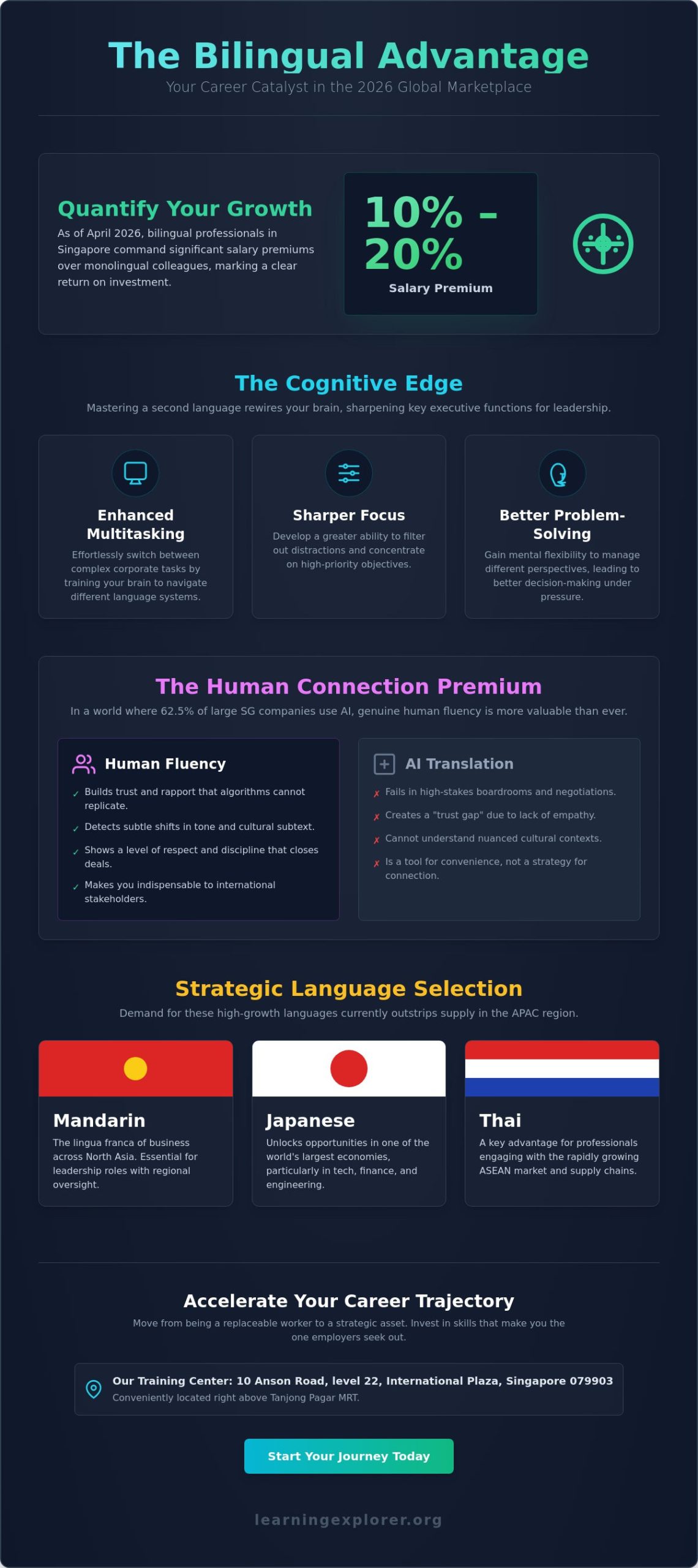
Did you know that as of April 2026, bilingual professionals in Singapore command salary premiums between 10% and 20% over their monolingual colleagues? It’s common to feel replaceable in a competitive market, especially when you see international regional roles pass you by because of a language gap. Understanding the benefits of bilingualism for career advancement is the first step toward connecting more authentically with diverse stakeholders and securing your place in a globalized workforce.
The 77,700 job vacancies recorded at the end of 2025 prove that while the market is active, the competition for the best roles is fierce. Don’t let a lack of language skills be the bottleneck in your career. Investing in a second language provides a compounding return that lasts for decades, ensuring you remain relevant in an increasingly interconnected global economy. For professionals ready to make this investment, LETS GO ACADEMY offers the comprehensive training needed to turn linguistic ability into a powerful career asset.
We understand that the daily professional grind is taxing, and you want a partner who can help you bridge that gap. Discover how mastering a second language goes beyond simple communication; it actually transforms your cognitive abilities and unlocks high-stakes leadership opportunities. This article explores how a new language increases your earning potential and provides the mental flexibility needed for the 2026 global marketplace. Visit us at our training center located at 10 Anson Road, level 22, International Plaza, Singapore 079903, right above Tanjong Pagar MRT, to see how professionals achieve these breakthroughs and find the satisfaction of discovery every day.
Key Takeaways
- Enhance your executive function by learning to switch between language systems, which directly improves your corporate multitasking and focus.
- Discover how the benefits of bilingualism for career advancement translate into a 10% to 20% salary premium in the 2026 Singaporean job market.
- Learn why native-level conversation creates a “human connection” premium that AI cannot replicate, making you indispensable to international stakeholders.
- Identify which high-growth languages like Mandarin, Japanese, or Thai offer the highest return on investment for professionals in the APAC region.
Beyond the Resume: Why Bilingualism is the Ultimate Career Catalyst in 2026
Bilingualism used to be a simple line item on a CV. In 2026, it’s a strategic “operating system” for your professional life. While technical skills get you in the door, the ability to switch between languages acts as a force multiplier for that expertise. It’s no longer just a personal hobby or a “nice-to-have” skill. Instead, the benefits of bilingualism for career advancement are now central to how high-performing professionals differentiate themselves in a crowded marketplace. You aren’t just adding a skill; you’re upgrading your ability to process information and lead teams.
To better understand how this skill transforms your professional potential, watch this helpful video:
AI has changed the game, but it hasn’t won it. While 62.5% of large Singaporean companies have integrated AI into their operations, human nuance has become more valuable than ever. Genuine connection requires more than a digital translation; it requires empathy and cultural awareness that an algorithm simply cannot replicate. This is where the human connection premium comes into play, rewarding those who can communicate without a screen between them and their stakeholders.
The Post-AI Reality: Why Human Fluency Still Wins
Translation apps are great for reading menus, but they often fail in high-stakes boardrooms. They can’t detect a subtle shift in a client’s tone or the cultural subtext of a negotiation. This creates a “trust gap” that only a human can bridge. When you speak a partner’s native language, you show a level of discipline and respect that no device can mimic. Research into the Cognitive Effects of Bilingualism shows that this mental agility also makes you a better problem solver. You’re not just translating words; you’re managing different perspectives to close deals and build lasting rapport. Employers in 2026 value this cognitive flexibility because it translates directly to better decision-making under pressure.
The Singapore Advantage: Bilingualism as a Regional Requirement
Singapore remains the primary gateway to ASEAN and North Asia. For professionals working in the dense business hubs around Tanjong Pagar, standing out is a constant challenge. If you aim for regional mobility, your choice of language school matters. Mastering a language like Business Mandarin, Japanese, or Thai allows you to lead teams across borders rather than just managing them from a distance. It’s about being the person who can fly to a regional office and connect with the local team without an interpreter.
The demand for Japanese, Mandarin, and Thai speakers in Singapore currently outstrips supply, creating a unique window of opportunity. By investing in these skills, you move from being a replaceable worker to a strategic asset. Our training center is conveniently located at 10 Anson Road, level 22, International Plaza, Singapore 079903, right above Tanjong Pagar MRT. We help you transition from the labor of seeking for opportunities to the satisfaction of being the one employers seek out. Start your journey today and see how a second language becomes your ultimate career catalyst.
The Cognitive Edge: How Multilingualism Sharpens Executive Function and Leadership
Your brain is your most valuable asset in the workplace. When you master a second language, you aren’t just memorizing vocabulary; you’re fundamentally re-wiring how your mind processes information. This cognitive “operating system” upgrade is one of the most powerful benefits of bilingualism for career advancement in 2026. It gives you a mental sharpness that helps you filter out distractions and switch between complex tasks with ease. It’s about working smarter by using your brain’s natural capacity for growth.
Mastering the ‘Mental Switch’: Multitasking in the Boardroom
Bilingual individuals possess a highly developed mechanism called “inhibitory control.” This is the brain’s ability to suppress one language while using another. In a corporate environment, this translates to superior focus. Think about a high-stakes meeting where you’re managing conflicting stakeholder interests while tracking project milestones. Your brain is already trained to filter out irrelevant noise and stay locked on the priority. Neuroplasticity is the brain’s ability to reorganize itself for peak professional performance. This constant mental exercise means you’re better equipped to handle the chaos of modern leadership. It reduces the mental fatigue associated with heavy administrative burdens and keeps you engaged during long workdays.
Empathy and Negotiation: The ‘Theory of Mind’ Benefit
Effective leadership requires more than just logic; it requires deep empathy. Research suggests that bilinguals often have a more developed “Theory of Mind.” This is the capacity to understand that others have beliefs, desires, and perspectives different from your own. Because you’ve navigated different linguistic structures, you naturally become better at perspective-taking. This makes you a formidable negotiator in cross-cultural deals. You don’t just hear the words; you understand the cultural logic behind them. If you want to develop these high-level negotiation skills, consider how a Business Mandarin Course or other language programs can provide that edge. It’s the difference between a simple transaction and a true partnership.
Thinking Outside the Box in a Crisis
Cognitive flexibility is another hallmark of the multilingual mind. When a crisis hits, bilinguals are often better at thinking outside the box because their brains are accustomed to navigating multiple sets of rules. They don’t get stuck in a single way of solving a problem. This mental agility is a key trait of visionary leaders who can pivot quickly when market conditions change. Beyond immediate promotions, there’s also the issue of career longevity. Studies show that bilingualism can delay the onset of cognitive decline by several years. This means your professional peak lasts longer, allowing you to contribute at a high level well into your later career. It’s a long-term investment in your most important tool, ensuring you remain a relevant and expert guide in your field.
Quantifying the ROI: Salary Premiums and Global Marketability
By 2026, the financial case for multilingualism has become undeniable. Data from April 2026 indicates that bilingual professionals in Singapore enjoy a salary premium typically ranging from 10% to 20%. When you look at specialized sectors like finance, manufacturing, and high-level customer relations, the premium for specific languages like Japanese can soar as high as 30%. This significantly outpaces the average 4.0% salary increment forecast for the general Singaporean workforce in 2026. Understanding the benefits of bilingualism for career advancement means recognizing that your paycheck can grow at a much faster trajectory than that of your monolingual peers.
It’s not just about the base salary; it’s about access to the “Hidden Job Market.” Many executive roles that require regional oversight or specific linguistic competence are never posted on public job boards. Instead, companies headhunt for these positions through exclusive networks. When you break the language barrier, you effectively double your professional circle. You gain the ability to build trust with stakeholders who prefer to conduct high-stakes business in their native tongue, turning you into a strategic asset that companies fight to retain.
Industry-Specific Gains: Where Fluency Pays Most
Singapore’s status as a global financial hub means that banking and fintech sectors are constantly seeking an edge. For professionals in these MNCs who aren’t native speakers, enrolling in a Business English Course is often the catalyst for moving into senior leadership roles. In the world of regional supply chain management, fluency in Mandarin or Japanese is frequently the deciding factor for top-tier appointments. These industries value the precision that comes with direct communication, as it reduces the risk of expensive misunderstandings in contracts and logistics.
The Mobility Factor: Becoming a Global Citizen
If you’ve ever felt stuck in a local role while seeing others take on exciting international assignments, language is likely the missing piece. Companies view bilingual employees as “low-risk” expat candidates because they can navigate new environments with minimal cultural friction. This mobility is the primary differentiator between a “Local Manager” and a “Regional Head.” By choosing the right language courses in Singapore, you prepare yourself for a career that isn’t confined by geography. You stop being a replaceable part of a local team and start becoming a visionary leader who can bridge the gap between headquarters and regional offices across the APAC region.
The 77,700 job vacancies recorded at the end of 2025 prove that while the market is active, the competition for the best roles is fierce. Don’t let a lack of language skills be the bottleneck in your career. Investing in a second language provides a compounding return that lasts for decades, ensuring you remain relevant in an increasingly interconnected global economy.
Strategic Selection: Which Languages Offer the Highest ROI in Singapore?
Choosing a second language shouldn’t be a random decision based on personal interest alone. In a regional hub like Singapore, certain languages act as high-octane fuel for specific industries. To maximize the benefits of bilingualism for career advancement, you must align your learning with the economic engines of the APAC region. While English remains the primary medium of business, the “English-plus” framework is the new standard for those aiming for the C-suite. Employers are actively seeking professionals who can bridge the gap between global headquarters and local markets.
The Power of North Asian Languages
Mandarin, Japanese, and Korean dominate the corporate landscape in East Asia. Mastering conversational mandarin singapore is often the fastest way to unlock trade opportunities with the world’s second-largest economy. It’s about more than just words; it’s about understanding the “guanxi” or relationship-based business culture. Similarly, learning Japanese language serves as a significant prestige signal in the tech and manufacturing sectors. As of November 2025, Japanese-speaking professionals remain in short supply, allowing those with the skill to negotiate better terms. Meanwhile, the rising influence of Korean “K-Business” has created a surge in demand for bilingual marketing experts who can navigate the nuanced consumer trends of the region.
Business English: The Foundation for Global Leadership
For many non-native speakers, high-level English mastery is the final hurdle to global leadership. In Singapore-based MNCs, the ability to move beyond basic grammar into “Persuasive English” is vital. You need to be able to command a boardroom and deliver presentations that inspire confidence. Training in the heart of the CBD, right above Tanjong Pagar MRT, provides the perfect setting for this growth. It allows you to step out of your office and immediately into an environment focused on your professional evolution without the stress of a long commute.
Don’t overlook the “Niche Advantage” either. While the big three dominate, languages like Thai or Spanish can open doors to untapped markets. Spanish connects you to over 500 million people globally, while Thai is essential for the growing trade corridors within ASEAN. To ensure you gain “Business Fluency” rather than just “Travel Fluency,” work with native-speaker instructors who understand the professional context of their home countries. They provide the cultural intelligence that AI simply cannot replicate. Explore our Business Language Courses today to find the specific catalyst your career needs.
Accelerating Your Career with Learning Explorer’s Professional Programs
Transforming your professional potential requires a partner who understands the high-stakes nature of the 2026 global marketplace. At Learning Explorer, our philosophy centers on providing a creative catalyst for your growth. We believe that learning a new language should be interactive, engaging, and strategically aligned with international standards. We’ve moved away from the coldness of traditional instruction to offer a supportive, user-centric experience that respects your time and ambition. Our goal is to help you transition from the labor of seeking opportunities to the satisfaction of discovering them through your new skills.
One of the primary benefits of bilingualism for career advancement is the cultural intelligence you gain along the way. To ensure you master this nuance, we utilize native-speaker instructors who are also bilingual themselves. They act as expert guides, helping you understand the subtle social cues and business etiquette that AI cannot capture. Whether you’re interested in a Conversational Japanese Course or a Business Mandarin program, you’ll receive the cultural context necessary to build genuine trust with international partners. We offer flexible learning formats, including private sessions, small groups, and intensive tracks, designed specifically for the busy professional.
Vetted Curriculum for Adult Learners
Our courses are built by practitioners for practitioners. We’ve stripped away the “academic fluff” to focus purely on professional application and real-world results. You won’t spend hours on irrelevant theory; instead, you’ll practice the specific communication skills needed for your industry. Our training center is conveniently located right above Tanjong Pagar MRT, making it easy to step into a supportive learning environment immediately after your workday. If you’re unsure which path is right for you, we offer trial classes so you can find the perfect fit before committing to a full roadmap.
Corporate Solutions for Organizational Growth
We also partner with visionary businesses to provide customized training solutions for entire teams. These programs are designed to reduce administrative burdens while significantly increasing employee engagement and regional mobility. By upskilling your workforce, you ensure your organization stays competitive in a market where 90% of employers now rely on multilingual talent. We work with you to build a personalized language roadmap that aligns with your specific corporate goals and the broader benefits of bilingualism for career advancement. Don’t let language barriers limit your team’s impact or your own trajectory. Start your journey to professional bilingualism today and unlock the leadership opportunities you deserve.
Secure Your Future in the Global Marketplace
The shift toward a multilingual workforce is more than a trend; it’s a fundamental change in how we define professional excellence in 2026. You’ve seen how a second language acts as a cognitive operating system, sharpening your focus and negotiation skills. It’s also clear that the financial rewards are significant, with salary premiums reaching up to 30% in specialized sectors. By choosing a language that aligns with regional economic powerhouses, you position yourself as a visionary leader who can bridge cultural gaps that technology alone cannot reach.
We are here to support your transition from the labor of seeking to the satisfaction of discovery. Our native-speaker instructors provide the essential cultural context needed for high-stakes business environments. Whether you need customized corporate training solutions or individual growth, our center located right above Tanjong Pagar MRT makes learning accessible and efficient. Maximizing the benefits of bilingualism for career advancement is the most reliable way to stay relevant in an evolving economy. Unlock your global potential with a professional language course at Learning Explorer. Your journey toward becoming an indispensable global asset starts with a single, strategic step. We look forward to helping you reach your goals.
Frequently Asked Questions
Is it too late to become bilingual as an adult for career purposes?
It’s never too late to start learning a new language. Adults often learn more strategically than children by connecting new vocabulary directly to existing professional concepts and business scenarios. This targeted approach allows you to focus on the specific terminology needed for your industry, making the process efficient and results-oriented. Your professional experience actually gives you an advantage in understanding the complex social and business structures behind a new language.
Which language is most in-demand for jobs in Singapore in 2026?
As of November 2025, Japanese, Mandarin, and Thai are the most in-demand languages in the Singaporean labor market. These languages align perfectly with regional trade corridors and manufacturing hubs across the APAC region. Mastering one of these provides a distinct edge, especially in finance and supply chain roles. Native-level communication is vital for building trust with international stakeholders who prefer doing business in their own tongue.
How long does it take to reach professional working proficiency in a new language?
Reaching professional working proficiency typically takes between 600 to 1,100 hours of study, depending on the complexity of the language you choose. For a busy professional, this often translates to 6 to 12 months of consistent, structured learning. Focusing on a Business Language Course helps you reach your goals faster by prioritizing the vocabulary you actually use in meetings and negotiations rather than general travel phrases.
Can bilingualism really increase my salary in a corporate role?
Bilingualism significantly increases your earning potential and long-term marketability. In Singapore, data from April 2026 shows that bilingual professionals command a salary premium of 10% to 20% over their monolingual peers. Understanding the benefits of bilingualism for career advancement helps you negotiate better packages, especially in regional roles. This financial return compounds over time, leading to significantly higher lifetime earnings and more frequent promotion opportunities.
Do I need to take a formal exam like HSK or JLPT to prove my skills to employers?
While certificates like the JLPT or HSK are excellent benchmarks, many employers prioritize your actual ability to communicate in a professional setting. Demonstrating your fluency during an interview or a trial project is often more persuasive than a piece of paper. You should focus on conversational and business-specific tracks to ensure you can handle real-world tasks effectively. Practical application is what truly reduces administrative burdens and increases engagement in global teams.
How can I practice speaking a second language if I work in a monolingual office?
You can maintain your skills by seeking out language exchange groups or digital immersion tools during your daily commute. Another effective method is to join professional associations that cater to your target language’s community. If you work near the CBD, consider joining after-work sessions at a professional center to keep your skills sharp. This helps you stay engaged with the language without adding significant stress to your daily schedule.
Why is learning with a native speaker better than using a language app?
Learning with a native speaker is superior because it provides real-time feedback on pronunciation and essential cultural nuance. Apps are helpful for basic vocabulary, but they can’t teach you how to read a room or handle a sensitive negotiation. A human instructor offers the empathy and specific business context that helps you transition from a student to a confident leader. This personal connection is what builds the trust necessary for high-stakes international deals.
What are the cognitive benefits of bilingualism for older professionals?
For older professionals, learning a second language is a powerful tool for maintaining mental sharpness and agility. It strengthens the brain’s executive function, which includes focus, task-switching, and complex problem-solving. Research also indicates that bilingualism can delay the onset of cognitive decline by several years. This ensures you remain a high-performing and visionary asset throughout your entire career, allowing you to lead with confidence well into the future.