Your language skills aren’t just a personal hobby; they’re an untapped revenue stream for your company. While it’s natural to feel a bit of anxiety when considering how to convince my boss to pay for language training, don’t let the fear of a “no” hold your career back. Most professionals struggle to quantify the value of communication skills, often feeling overwhelmed by the perceived costs of high-quality instruction. You know that being able to bridge the gap with regional partners is vital, yet finding the right words to justify the investment can feel like a job in itself.
We’re here to help you turn that hesitation into a winning pitch. This guide provides the exact strategies you need to frame language learning as a critical business asset rather than a simple perk. You’ll gain access to ROI-focused arguments and ready-to-use scripts designed to secure management’s buy-in. We’ll show you how to build a transformative professional development plan that aligns with your company’s 2026 goals. Whether you’re looking to join us at 10 Anson Road, level 22, International Plaza, Singapore 079903, right above Tanjong Pagar MRT, or seeking a specific Business English Course, your path to career advancement starts with a clear, persuasive conversation.
Key Takeaways
- Reframe your language goals as a strategic investment in human capital that unlocks new growth opportunities across the APAC region.
- Discover proven strategies for how to convince my boss to pay for language training by quantifying the ROI through increased sales conversions and improved operational efficiency.
- Learn how to identify high-impact programs that offer the flexibility and cultural nuance needed to thrive in Singapore’s modern professional landscape.
- Gain confidence with a step-by-step guide to pitching your manager, complete with ready-to-use scripts that address common administrative concerns.
- Transform your career trajectory by aligning your professional development plan with the specific communication needs of your organization.
Why Language Skills are a Strategic Asset in Singapore’s 2026 Business Landscape
In 2026, Singapore remains the definitive hub for regional trade and innovation. Success in this fast-paced environment isn’t just about logistics or technology; it’s about the people driving the deals. Viewing language training as a strategic investment in human capital allows companies to unlock new markets and build resilient teams. If you’re currently researching how to convince my boss to pay for language training, start by framing your request around business growth and regional reach. Singapore serves as the primary gateway to the Asia-Pacific (APAC) region, meaning your ability to communicate across cultures is a core business requirement.
Linguistic versatility is the grease that keeps multinational gears turning smoothly. Many professionals overlook the importance of language education in reducing operational friction. When teams speak the same language, projects move faster and employee engagement levels soar. Reducing the gap between intent and execution is the fastest way to improve a company’s bottom line.
To help you visualize a successful pitch, watch this helpful video:
The Real Cost of Miscommunication in the Workplace
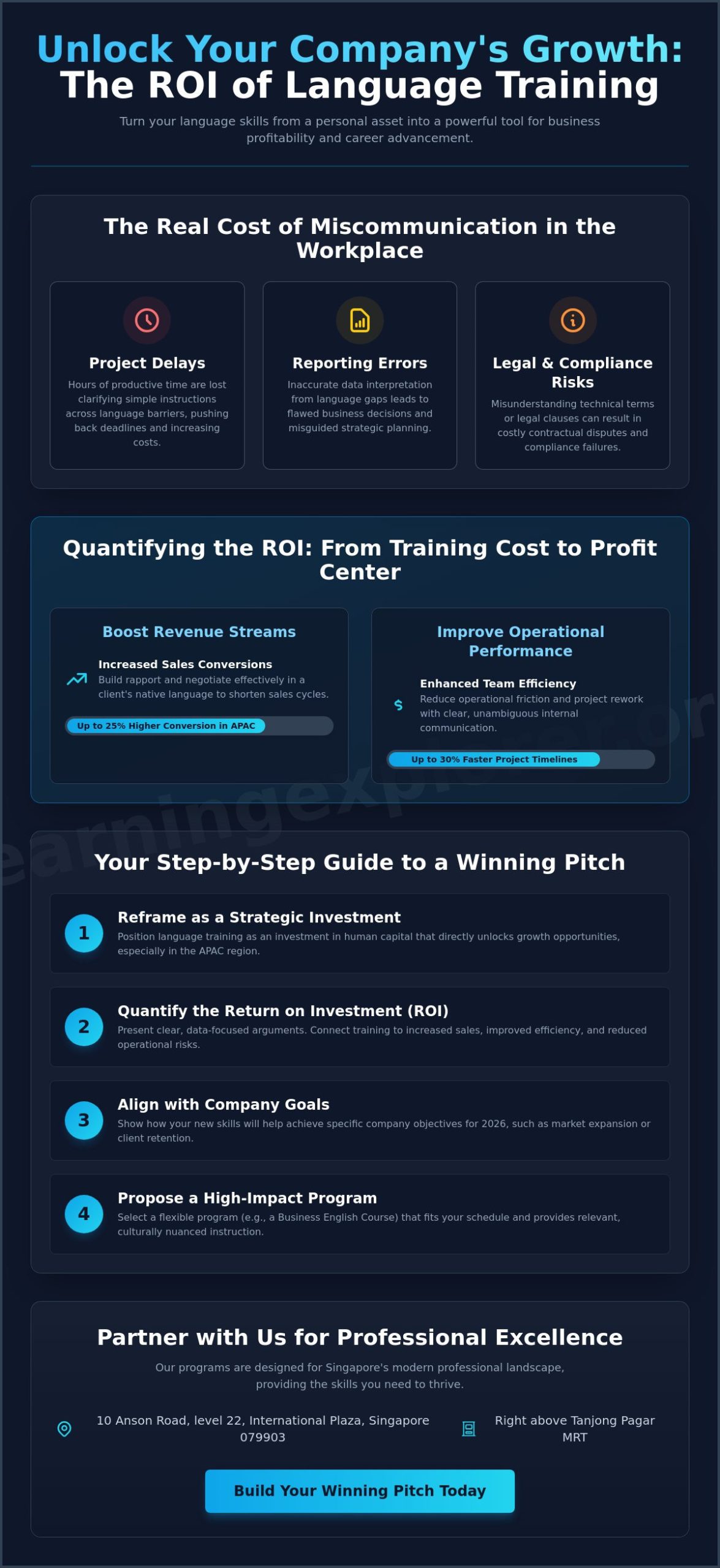
Communication debt is the cumulative cost of misunderstandings that slow down workflows and erode profit margins. In high-stakes corporate environments, a single mistranslated requirement can derail a complex project timeline. Language barriers frequently lead to errors in reporting and project management, creating a ripple effect of inefficiency that managers often struggle to diagnose. Consider these common risks:
- Project Delays: Clarifying simple instructions across language barriers wastes hours of productive time.
- Reporting Errors: Inaccurate data interpretation leads to flawed business decisions.
- Legal Risks: Misunderstanding technical terminology or legal clauses can lead to costly contractual disputes.
Bridging the Gap Between Local Teams and Global Clients
Mastering conversational mandarin singapore gives you a direct line to regional partners and stakeholders. Being able to negotiate in a client’s native tongue provides a massive competitive advantage that your rivals likely lack. It signals respect, dedication, and a long-term commitment to the partnership. While translation apps have improved, they still lack the cultural nuance required to build deep trust in professional settings. Understanding the subtle shift in tone or etiquette ensures you don’t just communicate data; you build the lasting rapport necessary to secure the next major contract.
Quantifying the ROI: How Language Training Boosts the Bottom Line
When you start thinking about how to convince my boss to pay for language training, remember that managers care about outcomes, not just activities. To secure funding, you must move the conversation from “training” to “profitability.” Language proficiency is a core pillar of developing a globally competent workforce, directly influencing how effectively your company competes. High-level fluency in English or Mandarin doesn’t just improve emails; it shortens sales cycles. When you speak the customer’s language, you remove the friction that often kills a deal before it’s even signed. Your proposal on how to convince my boss to pay for language training should highlight these efficiency gains as a way to reclaim lost time.
Beyond sales, consider the immediate savings on external services. Relying on outside vendors for every document or meeting is expensive and slow. By bringing those skills in-house, you reduce overhead and increase your team’s agility. Internal communication also becomes a precision tool. Clearer instructions mean fewer mistakes, faster project turnarounds, and a significant reduction in wasted work hours. If your company is eyeing the Chinese market, suggesting a Business Mandarin Course can be the catalyst for that expansion.
Expanding Market Reach in the Asia-Pacific Region
Singapore’s proximity to North Asia is a goldmine for companies ready to engage. Tapping into Japanese or Korean-speaking markets requires more than just a website; it requires real connection. Research shows that as of 2023, 65% of multinational firms in Tanjong Pagar prioritized candidates with bilingual proficiency in Asian languages. Enrolling in a Learn Japanese Language Course can open doors to Tokyo-based stakeholders that were previously locked. Localizing your business relationships through language shows a level of respect that automated tools simply cannot replicate.
Improving Employee Retention and Workplace Engagement
Talent is expensive to replace. Employees stay longer when they see a clear path for growth and feel their company is invested in their future. This “engagement bonus” pays off in every meeting. Staff who feel confident in their communication skills contribute more ideas and take on more responsibility. As of April 2026, bilingual professionals in Singapore can command a salary premium of 10% to 20%, proving the market value of these skills. Attending a reputable language school can even serve as a unique team-building experience. Our center at 10 Anson Road, level 22, International Plaza, Singapore 079903, located right above Tanjong Pagar MRT, provides the perfect environment for this growth. It fosters a culture of continuous learning and mutual support, which are essential for long-term organizational stability.
Strategic Considerations: Selecting a High-Impact Language Program
Your pitch is only as strong as the program you recommend. When you’re figuring out how to convince my boss to pay for language training, you must prove that the chosen course won’t interfere with your daily deliverables. Look for language courses singapore that prioritize flexible scheduling. Managers are far more likely to approve a request that fits into your lunch hour or follows a hybrid model. This flexibility reduces administrative friction and ensures you stay engaged without burning out. A well-structured program feels like a supportive partner in your growth, not an additional burden on your calendar.
Quality matters just as much as timing. Native-speaker instructors are essential for mastering professional accents and the subtle nuances of business etiquette. You don’t want to learn from a generic textbook; you want to learn how a real partner in Tokyo or Seoul actually speaks. This level of authenticity builds the confidence needed to lead high-stakes meetings and negotiate complex contracts. When you present your case, emphasize that you’ve done the heavy lifting by vetting the best options. This proactive approach is a key part of how to convince my boss to pay for language training successfully.
Group Classes vs. Private Intensive Coaching
Cost-effectiveness often drives management decisions. Group classes are an excellent choice for department-wide upskilling. They offer a lower price point per head while doubling as a powerful team-building exercise. These sessions allow colleagues to practice together, creating a supportive learning environment that persists back in the office. Conversely, private intensive coaching is often necessary for C-suite executives who require a tailored curriculum and absolute schedule control. Private sessions allow for rapid progress on specific, high-priority goals, making them a visionary choice for leadership development.
Aligning Curriculum with Specific Job Functions
Ensure the curriculum focuses on business-specific vocabulary. A generic course won’t help you write a technical financial report or deliver a persuasive sales pitch. Match your chosen module to your daily tasks, whether that’s a Business English Course for Finance or a Business Mandarin Course for Client Relations. Choosing a school located right above Tanjong Pagar MRT adds a layer of logistical ease that bosses appreciate. It minimizes travel time and keeps you close to the office, making the transition from the classroom to the boardroom seamless. This strategic alignment ensures every hour spent learning translates directly to better professional outcomes.
Your Step-by-Step Guide to Pitching Your Manager (With Scripts)
If you’re wondering how to convince my boss to pay for language training, the secret lies in meticulous preparation. You aren’t just asking for a course; you’re offering a solution to a business bottleneck. Start by pinpointing a specific friction point in your current workflow. Does a lack of fluency delay project sign-offs by three days? Does it cause recurring misunderstandings with your regional team? Identifying these gaps turns your request into a strategic necessity rather than a personal favor.
Once you’ve identified the problem, your next move is vetting the solution. Research the best English course for adults and gather all the logistical details, including the fee structure and duration. Draft a concise one-page “Training Impact Proposal” that outlines how the training will solve the problems you’ve identified. Timing is everything, so schedule a formal meeting after a successful project delivery or during your annual performance review when your value is most visible. Walk into that meeting with confidence, ready to present your solution and handle any administrative pushback.
Preparing Your Data and Timing Your Request
Managers respond best to data, not just enthusiasm. Your proposal should clearly list the course duration, the specific outcomes you expect, and how these outcomes benefit the department. Mastering how to convince my boss to pay for language training requires a shift from asking for a favor to offering a solution. Use this script for your initial meeting request email:
“Hi [Manager Name], I’ve identified a way to improve our team’s communication efficiency with our regional partners. I’d like to discuss a brief professional development proposal for a Business English Course that addresses our recent reporting delays. Do you have 15 minutes on Thursday to review the impact this could have?”
Handling Common Objections About Cost and Time
Expect some resistance regarding the budget or your availability. If your manager mentions a lack of funds, reframe the training as a risk mitigation tool. You might say: “I understand the budget is tight. However, the cost of miscommunication on the last regional project was significant. This training prevents those errors and acts as a high-yield investment.”
For the “too busy” objection, highlight the flexibility of the program. Suggest lunch-hour sessions or after-work classes that don’t interfere with your core hours. You can also frame the training as a “pilot program.” Propose completing one module first to demonstrate the immediate value before committing to a longer track. This reduces the perceived risk and makes it much easier for your boss to say “yes.” To find the right fit for your proposal, browse our professional language programs and start building your case today.
Partnering with Learning Explorer for Professional Excellence
Choosing the right partner is the final step in your journey of how to convince my boss to pay for language training. You need a training provider that understands the high-stakes nature of Singapore’s business environment. Learning Explorer acts as your reliable ally, offering more than just vocabulary lists. We provide the creative catalyst for better professional outcomes through immersive and mission-driven instruction. Our approach focuses on the emotional outcome for you, the learner, ensuring you feel confident and inspired after every session. We aim to reduce your administrative burden by providing a clear, structured path to fluency.
Our center is strategically placed at 10 Anson Road, level 22, International Plaza, Singapore 079903. Being located right above Tanjong Pagar MRT means you won’t waste precious billable hours on a long commute. This central location makes it easy to transition from a morning strategy meeting to an intensive language session without missing a beat. We designed this space to feel like a tool for practitioners, avoiding the coldness of typical software-driven learning. It is a visionary space where professionals gather to transform their communication skills into a competitive advantage.
Professional Instructors in the Heart of the CBD
Our instructors are bilingual, native speakers who bring real-world cultural nuance to every lesson. They understand that adult learners need a balance of structured progress and engaging, interactive experiences. You won’t find dry, academic lectures here. Instead, you’ll enter a professional atmosphere designed specifically for practitioners who need immediate, actionable results. We focus on high-quality, vetted materials that distinguish our curriculum from the unorganized and overwhelming nature of external sources. This ensures every hour spent in our center translates to increased engagement in your workplace.
Flexible Corporate Solutions for Every Team
We understand that every organization has unique needs. That’s why we offer customizable corporate training contracts that fit your specific department goals. Whether your team requires a Conversational Japanese Course for a new regional project or a Business Mandarin Course for long-term growth, we have a format to match. Choose from private coaching, group sessions, or intensive workshops. We encourage your manager to schedule a trial class. This allows them to see the Learning Explorer difference firsthand, making your pitch on how to convince my boss to pay for language training even more persuasive. By partnering with us, you aren’t just taking a class; you’re investing in a professional development plan that yields measurable results.
Take the Next Step Toward Your Professional Breakthrough
Mastering the nuances of business communication is no longer a luxury in Singapore’s regional hub; it is a necessity for anyone aiming for leadership roles. You now have the strategies and scripts needed for how to convince my boss to pay for language training by focusing on tangible ROI and reduced operational friction. By framing your request as a solution to specific business bottlenecks, you position yourself as a proactive leader ready to drive growth. Success depends on choosing a partner that aligns with your company’s high standards and provides the creative catalyst for better results.
We offer customizable corporate programs led by native-speaker instructors who ensure you gain the cultural mastery required for global success. Our convenient CBD location right above Tanjong Pagar MRT makes it easy to balance your workload with your professional development. Don’t let another quarter pass without the skills you need to excel. Download our Corporate Training Proposal Template and book a trial class today at Learning Explorer to start your journey. Your career advancement is within reach, and we are here to support every step of your professional evolution.
Frequently Asked Questions
How do I explain the ROI of language training to my boss?
Explain ROI by linking language skills to specific financial outcomes. Higher proficiency in regional languages directly impacts sales conversion rates and reduces the need for expensive external translation services. You can also highlight how clearer communication prevents project delays and errors. This shifts the focus from a personal perk to a tool for increasing the company’s bottom line and operational speed.
What should I include in a training request proposal?
Your training request proposal should include a clear identification of the business problem, the proposed course details, and expected outcomes. Be specific about the course fees and duration. Include a section on how the training will improve your daily deliverables, such as faster email responses or better client negotiations. Providing a structured one-page document shows your manager that you’ve done the research and are serious about professional growth.
Is it better to ask for group classes or private language tuition?
Choose group classes for cost-effectiveness and team-building or private tuition for rapid, customized progress. Group sessions are ideal for departments working toward a common goal, while private coaching suits executives with tight schedules and specific needs. When researching how to convince my boss to pay for language training, suggest group classes as a lower-risk pilot program for the whole team to demonstrate immediate value.
How do I handle my boss saying there is no budget for training?
Handle a “no budget” response by reframing the training as a risk mitigation strategy. Explain that the cost of miscommunication on a single regional project often exceeds the price of a high-quality course. You can also propose a shorter pilot module or suggest using remaining professional development funds from the current fiscal year. This approach demonstrates your commitment to finding a solution that respects the company’s financial constraints.
Can language training count as part of my annual performance goals?
Language training should definitely be integrated into your annual performance goals. Link your learning milestones to specific KPIs, such as expanding into a new market or improving client retention in North Asia. This makes your progress measurable and ensures your manager sees the training as a core part of your professional evolution. It also provides a natural framework for reviewing the impact of the investment during your year-end appraisal.
How much time should I expect to commit to a professional language course?
Expect to commit approximately two to four hours per week for a professional language course. Most high-impact programs for adults are designed to fit into a busy work schedule, offering sessions during lunch hours or after work. Consistency is more important than intensity, so choose a program that allows you to maintain your daily deliverables while making steady progress toward fluency. This balance ensures you stay engaged without feeling overwhelmed.
What are the most in-demand business languages in Singapore for 2026?
Mandarin, Japanese, Korean, and Vietnamese are the most in-demand business languages in Singapore for 2026. These languages are critical for professionals navigating the expanding consumer markets and supply chains across the APAC region. Mandarin remains a powerhouse for regional business, while the rise in Vietnamese trade has made it a high-priority skill for marketing and logistics roles. Mastering these languages provides a significant competitive edge in the local job market.
How do I find a language school that caters specifically to working adults?
Look for a school located in the CBD that features native-speaker instructors and a business-focused curriculum. A center situated right above Tanjong Pagar MRT, like our facility at 10 Anson Road, level 22, International Plaza, ensures you don’t waste time commuting. This logistical ease is a huge factor in how to convince my boss to pay for language training because it proves the classes won’t disrupt your core working hours or productivity.