What if the reason you still sound like a foreigner has nothing to do with your vocabulary and everything to do with muscle memory? You’ve likely spent months memorizing phrases or using apps, yet you still feel a pang of embarrassment when speaking in social or professional settings. It’s a common struggle. Korean sounds are physically different from English, and relying on inaccurate romanization often leads to confusion rather than clarity.
We understand that mastering “Batchim” and complex sound-change rules feels like an uphill battle. By joining a korean pronunciation class singapore, you’ll stop guessing and start speaking with precision. This guide outlines how a structured Conversational Korean Course can help you gain the confidence to speak without hesitation. We’ll show you how our training center at 10 Anson Road, level 22, International Plaza, Singapore 079903, right above Tanjong Pagar MRT, provides the expert guidance you need to sound natural and fluent.
Key Takeaways
- Escape the “Romanization Trap” by shifting your focus from English subtitles to the specific phonetics and speech rhythms of native speakers.
- Master the physical mechanics of Hangul, including precise tongue placement for tense consonants and the logic behind complex “Batchim” sound changes.
- Overcome the “Echo Effect” by enrolling in a korean pronunciation class singapore, where professional feedback catches subtle errors that apps and AI often miss.
- Implement a structured five-step improvement plan that begins with diagnostic recordings to isolate and refine your specific pronunciation challenges.
- Experience the benefits of small, interactive group sessions led by native instructors who specialize in helping Singaporean learners sound natural and authentic.
What is a Korean Pronunciation Class and Why Do You Need One?
Enrolling in a korean pronunciation class singapore is about more than just correcting an accent; it’s a specialized training module that focuses on the physical mechanics of speech. While a standard course might teach you what to say, this training focuses on how to say it by mastering phonetics, intonation, and the natural rhythm of the language. Many learners fall into the “Romanization Trap,” where they rely heavily on English subtitles or phonetic spellings. This habit creates a significant barrier to sounding authentic because English letters cannot accurately represent the unique nuances found in Korean phonology.
To better understand this concept, watch this helpful video:
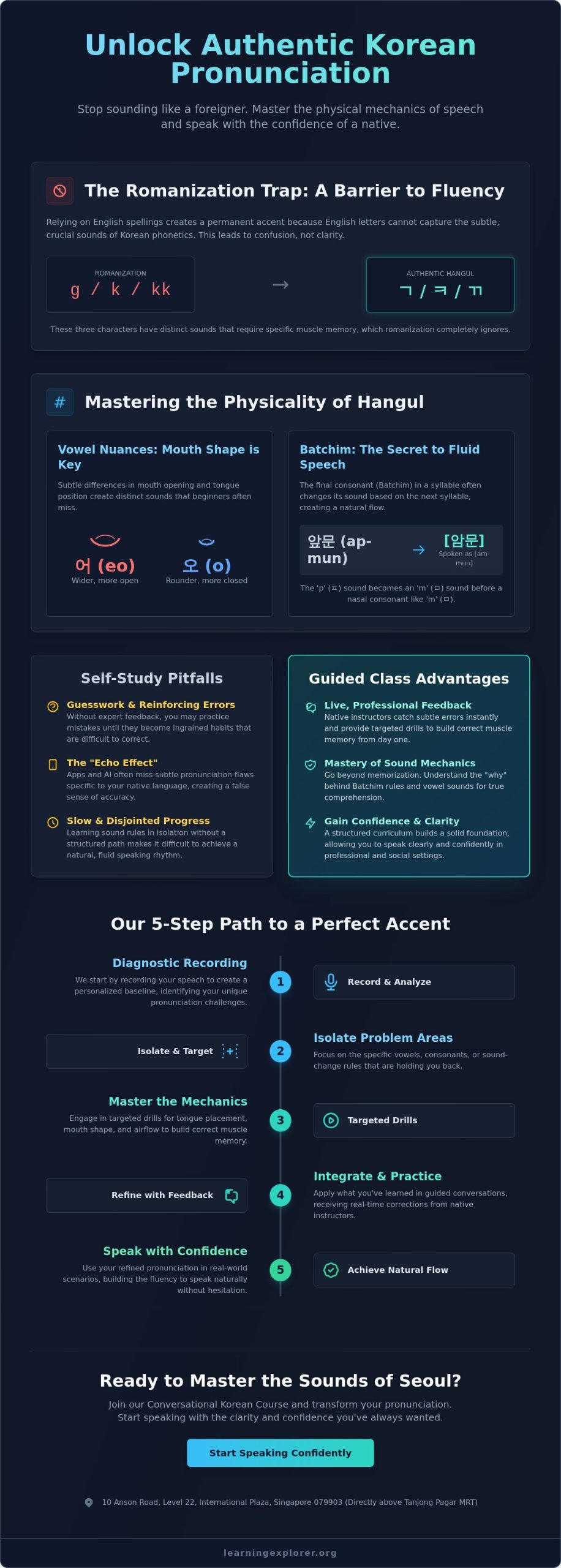
Developing a “Korean Ear” is the first step toward genuine fluency. It involves training your brain to distinguish between subtle sounds that often seem identical to beginners, such as the difference between plain ‘g’, aspirated ‘k’, and tense ‘kk’. Mastering these phonetic foundations is essential for anyone taking language courses in Singapore. Without this grounding, even the most advanced grammar can be lost in translation during real-world conversations.
The Difference Between Knowing Vocabulary and Speaking Naturally
Vocabulary gives you the building blocks of a sentence, but pronunciation provides the soul of the communication. A common misconception is that a vast vocabulary will eventually mask a poor accent. In reality, inconsistent pronunciation leads to cognitive fatigue for the listener. If a colleague has to work hard to decipher your sounds, your message loses its impact. Auditory discrimination is a skill we prioritize in our korean pronunciation class singapore. It moves you from simply “knowing” words to “feeling” the language, ensuring your speech flows with natural ease.
How Pronunciation Impacts Your Professional Reputation in Singapore
In a fast-paced business environment, clarity is a form of professional respect. Mispronouncing key industry terms or over-relying on “Konglish” can lead to awkward pauses and unnecessary repetitions during high-stakes meetings. By refining your speech, you demonstrate deep cultural sensitivity and commitment to your Korean counterparts. Gaining these skills at our center at 10 Anson Road, level 22, International Plaza, Singapore 079903, right above Tanjong Pagar MRT, positions you as a professional who values precision. Whether you’re presenting a proposal or networking, sounding natural builds immediate rapport and trust.
The Mechanics of Hangul: Mastering Complex Sound Rules
Mastering Korean speech requires more than just memorizing a new alphabet; it demands a fundamental shift in how you use your vocal muscles. English is a stress-timed language where we emphasize specific syllables, but Korean is syllable-timed. This means each block receives roughly the same amount of time, creating a steady, rhythmic flow. Beginners often struggle with vowel nuances, particularly distinguishing between ‘o’ (오) and ‘eo’ (어). While they might sound identical initially, the difference lies in the vertical opening of the mouth and the position of the tongue. For a detailed breakdown of every character, you can explore this comprehensive guide to Hangul pronunciation.
Batchim: The Secret to Fluid Speech
Batchim refers to the final consonants in a syllable block. These letters are the primary reason Korean sounds so fluid when spoken by natives. The sound of a Batchim often changes based on the letter that follows it, a process known as assimilation. Many learners in a korean pronunciation class singapore find these rules challenging because they don’t exist in English. For instance, nasalization rules might turn a ‘p’ sound into an ‘m’ sound if the next syllable starts with ‘n’. Without practicing these transitions through targeted drills, your speech will likely sound choppy or disjointed. Learning these rules helps you stop treating words as isolated blocks and start seeing them as part of a continuous stream of sound.
Tense and Aspirated Consonants
Understanding airflow is the quickest way to differentiate between plain, aspirated, and tense consonants. Plain consonants are soft, while aspirated sounds like ‘ph’ or ‘kh’ require a noticeable burst of air. Tense consonants are sounds produced with a constricted glottis. These require you to build up pressure behind the tongue before releasing the sound with no air at all. It’s a physical skill that takes time to develop. If you find yourself struggling to produce these sounds accurately, joining a Conversational Korean Course can provide the professional feedback necessary to correct your technique before bad habits set in.
Intonation and Pitch: Moving Beyond Monotone
Korean isn’t a tonal language like Mandarin, yet it isn’t entirely flat. It relies on pitch contour to signal the end of a thought or a question. Sentence-level rhythm is crucial; pausing in the wrong place can change the meaning of your sentence or confuse your listener. Honorifics also influence your delivery. Formal speech typically requires a more deliberate pace and specific pitch drops to convey respect. Mastering these subtle shifts ensures you sound engaged and culturally aware rather than monotone. By focusing on these mechanics, you’ll gain the confidence to speak naturally in any setting.
Self-Study vs. Enrolling in a Korean Pronunciation Class in Singapore
Many learners start their journey with apps, thinking they can master the sounds of Seoul in isolation. But there’s a physiological hurdle called the “Echo Effect.” When you speak, you hear your own voice through bone conduction, which creates a distorted version of your actual output. You might think you’re perfectly mimicking a native speaker, but your brain is filling in the gaps. Without a professional listener, you’re essentially practicing your mistakes until they become permanent habits. This is why a korean pronunciation class singapore is essential for those who want to sound truly authentic.
While technical resources like the Defense Language Institute’s Korean Basic Course offer incredible depth, they cannot provide the real-time correction found in a live classroom. Voice recognition software in most apps is built for basic comprehension, not phonetic perfection. It often fails to catch the subtle shifts in mouth tension or air release that distinguish a beginner from a fluent speaker. Enrolling in a reputable language school ensures that these nuances are addressed from day one.
Why Your Ear Needs a Professional Guide
Professional instructors excel at identifying “fossilized” errors, which are mistakes that have become so ingrained they feel natural to the speaker. For Singaporean learners, this often involves correcting the staccato rhythm common in local speech patterns or the tendency to shorten specific vowel sounds. An expert guide understands the specific phonetic hurdles you face and provides tailored drills to overcome them. This supportive, expert-led environment builds a level of confidence that solo study simply cannot replicate.
The K-Drama Myth: Can Passive Listening Fix Your Accent?
It’s a common belief that binge-watching dramas will naturally fix your accent. While this improves listening comprehension, it rarely translates to accurate production. Dramas often feature highly stylized, emotional, or informal speech that may not be appropriate for a professional setting. Passive listening is a great supplement, but it lacks the structured phonetic training required to master the language. To speak with clarity in a business meeting, you need to move beyond the screen and engage in active, guided practice.
5 Steps to Perfecting Your Korean Accent
Perfecting an accent is similar to training for a sport; it requires targeted muscle memory rather than just intellectual understanding. If you’ve already mastered the basics of Hangul, these five steps will help you bridge the gap between “textbook speech” and sounding like a native. By focusing on physical execution, you’ll find that your confidence in a korean pronunciation class singapore grows with every session.
- Step 1: Record and Analyze. Use your phone to record yourself reading a short paragraph. Listen to a native speaker read the same text and identify where your pitch or vowel length differs. This diagnostic recording serves as your baseline.
- Step 2: Isolate the Sounds. Don’t try to fix everything at once. Focus on one specific group, such as the tense consonants (kk, tt, pp) or the distinction between ‘o’ and ‘eo’, for an entire week.
- Step 3: Mouth Positioning. Stand in front of a mirror and watch your lip shape. Korean requires different jaw tension and lip rounding than English. Mimic the facial movements of native speakers to produce cleaner sounds.
- Step 4: Slow Down. Speed is the enemy of accuracy in the early stages. Prioritize the correct placement of your tongue and the control of your breath. Speed will come naturally once the muscle memory is locked in.
- Step 5: Seek Expert Feedback. Real-time correction is the fastest way to improve. Attend a session at our center at 10 Anson Road, level 22, International Plaza, Singapore 079903, to have a professional identify errors you might be missing.
The Shadowing Technique Explained
Shadowing is a powerful tool where you repeat a native speaker’s phrases almost immediately after they say them. Instead of waiting for the sentence to finish, you aim for a delay of just one or two seconds. This forces you to focus on the “melody” and flow of the sentence rather than getting hung up on individual words. Shadowing requires mimicking the speaker’s speed and emotion simultaneously. It’s an active way to internalize natural speech patterns and reduce the influence of your native tongue.
Daily Phonetic Drills for Busy Professionals
You don’t need hours of free time to see progress. Consistent, five-minute “tongue twister” exercises can significantly improve your vocal agility. Use your daily commute to Tanjong Pagar MRT to practice subtle vowel distinctions or silent “Batchim” transitions. Consistency matters far more than intensity when it comes to speech training. Small, daily efforts ensure that your vocal muscles remain primed for the nuances of the language. To accelerate your progress with professional guidance, consider enrolling in our Conversational Korean Course today.
Master the Sounds of Seoul at Learning Explorer Singapore
Finding the right environment to practice is the final, most crucial step in your journey to fluency. Choosing a korean pronunciation class singapore at Learning Explorer means you aren’t just learning from a book; you’re training with native-speaker instructors who are also bilingual experts. These teachers possess a deep understanding of the Singaporean linguistic context, allowing them to pinpoint exactly why certain Korean sounds might feel unnatural to an English or Mandarin speaker. They bridge the gap between your current speech patterns and the authentic rhythm of Seoul, ensuring your transition is smooth and efficient.
We prioritize small, interactive group sizes to maximize your growth. In a large lecture setting, it’s easy to hide or repeat errors without being noticed. Here, every session is designed to give you ample speaking time. This high-engagement model allows our instructors to provide immediate, personalized feedback on your mouth positioning and breath control. Our curriculum aligns with global standards, which means the progress you make in our classrooms is both measurable and recognized internationally. You’ll move through a structured pathway that transforms technical phonetic knowledge into effortless, natural conversation.
Why Our Tanjong Pagar Center is the Ideal Learning Hub
Efficiency is vital for busy professionals working in the city. Our center at International Plaza is situated directly above Tanjong Pagar MRT, making it an incredibly convenient stop for those looking to upskill during a lunch break or immediately after work. We’ve designed our modern facilities to foster an atmosphere that is both professional and encouraging. You won’t just find a classroom; you’ll find a supportive community of like-minded adult learners who share your goals. This environment acts as a creative catalyst, reducing the administrative burden of travel and allowing you to focus entirely on your professional impact.
Flexible Formats to Suit Your Schedule
Every learner has unique needs, which is why we offer various ways to master the language. If you require rapid progress for an upcoming relocation or high-stakes project, our private intensive sessions provide one-on-one focus. For those who prefer a more social and collaborative experience, our group Conversational Korean Course offers a dynamic way to practice with peers. We also provide customized corporate training solutions for organizations looking to expand their presence in South Korea. By choosing a partner that values your time and understands your professional aspirations, you gain the tools to speak with absolute clarity and confidence in any setting.
Start Speaking Korean with Absolute Clarity Today
Mastering the physical mechanics of speech is the definitive way to move beyond the limitations of apps and self-study. You’ve learned that authentic sounds come from precise mouth positioning and understanding the logic of Batchim rules. By choosing a korean pronunciation class singapore, you ensure that every syllable you speak is refined by expert ears. This focused approach saves you time and prevents the frustration of being misunderstood in professional or social settings. Our training center at 10 Anson Road, level 22, International Plaza, provides the creative catalyst you need to achieve your goals.
With certified native-speaker instructors and interactive small-group learning formats, you’ll gain the confidence to engage with Korean counterparts naturally. Our convenient CBD location makes it easier than ever to integrate high-quality language training into your professional life. We’re here to act as your knowledgeable guide, turning the labor of seeking into the satisfaction of discovery. Take the first step toward sounding like a native today.
Book Your Korean Trial Class at Learning Explorer Today!
You have the potential to sound natural and fluent. Let us provide the guidance and support to help you get there.
Frequently Asked Questions
Is Korean pronunciation difficult for English speakers in Singapore?
Korean pronunciation presents unique challenges because many sounds don’t exist in English or Mandarin. The difficulty often lies in distinguishing between plain, aspirated, and tense consonants. While it’s a hurdle, focused training helps you overcome these phonetic gaps. Most learners find that once they understand the physical placement of the tongue, the sounds become much easier to replicate.
How long does it take to see improvement in my Korean accent?
You’ll likely notice a significant difference in your clarity within 4 to 8 weeks of consistent, guided practice. Since pronunciation is a physical skill, your vocal muscles need time to adapt to new patterns. Attending a weekly korean pronunciation class singapore provides the structure needed for steady progress. Daily five-minute drills between sessions will further accelerate your journey toward sounding natural.
Do I need to be able to read Hangul before joining a pronunciation class?
It’s best to have a basic understanding of Hangul because relying on English romanization creates bad habits. Romanization is often inaccurate and fails to capture the nuances of Korean phonology. Most structured courses will briefly review the alphabet to ensure you’re connecting sounds directly to Korean characters. This foundation prevents you from mentally translating sounds back into English letters.
Are native Korean teachers better for learning pronunciation?
Native teachers are essential because they provide an authentic phonetic model that apps simply can’t match. Bilingual native instructors are particularly effective for Singaporean learners. They understand the specific speech habits of local students and can explain the physical differences in sound production. This expert guidance ensures you don’t just learn the language but also the cultural nuances of speech.
Can I learn Korean pronunciation online or is in-person better?
In-person learning is generally more effective for mastering pronunciation and speech rhythm. Being physically present allows your instructor to observe your mouth movements and jaw tension more clearly than through a screen. Our center at 10 Anson Road, level 22, International Plaza, Singapore 079903, offers the ideal environment for this direct interaction. You’ll receive immediate corrections that are vital for building correct muscle memory.
What is the most common mistake Singaporeans make with Korean sounds?
The most frequent error is applying the staccato rhythm of local speech to the more fluid Korean language. Many learners also struggle with “Batchim” transitions, often pronouncing final consonants too harshly. A korean pronunciation class singapore helps you smooth out these transitions. By focusing on the natural flow and pitch contours of the language, you’ll move away from choppy sentences and toward a more authentic accent.
Where is the best place to take a Korean pronunciation class in the CBD?
Learning Explorer is the premier choice for professionals looking to master the language in the heart of the city. We are conveniently located at 10 Anson Road, level 22, International Plaza, Singapore 079903, which is right above Tanjong Pagar MRT. Our location makes it easy to attend sessions during your lunch break or after work without adding to your daily administrative burden.
Will improving my pronunciation help me with the TOPIK exam?
Improving your pronunciation directly enhances your performance in the listening section of the TOPIK exam. There’s a strong neurological link between speech production and auditory perception. If you can’t produce a specific sound accurately, your brain often struggles to recognize it when spoken at native speeds. Mastering these sounds ensures you can distinguish between similar-sounding words, leading to higher scores and better overall comprehension.