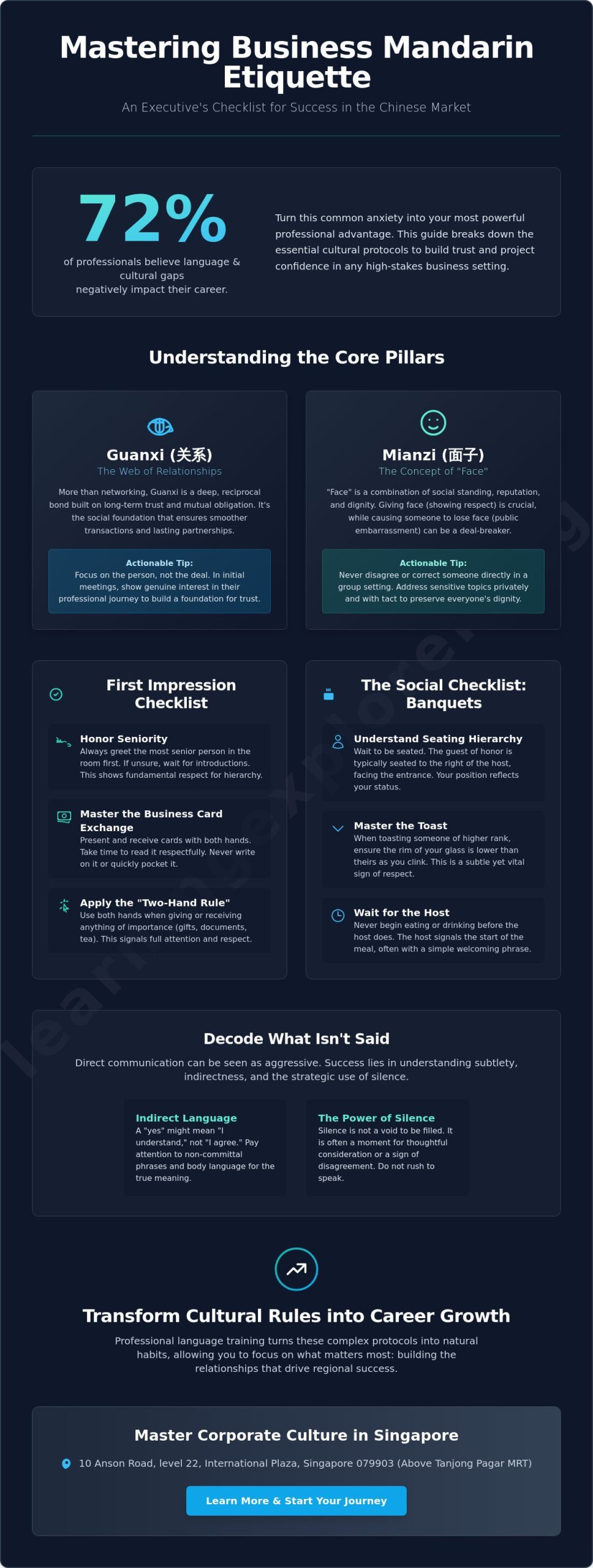
Research shows that 72% of professionals believe language barriers and cultural gaps negatively impact their career trajectory. You’ve likely felt that same knot of anxiety before a high-stakes meeting with Chinese partners. It’s difficult to focus on the deal when you’re worried about misreading a subtle gesture or causing a loss of “face” during a formal dinner. Refining your business mandarin etiquette is the most effective way to turn that anxiety into a powerful professional advantage.
We know that building trust in this environment requires more than just vocabulary; it requires a deep understanding of corporate hierarchy and social harmony. Master the subtle art of Chinese corporate culture with this comprehensive checklist designed for executives. This guide breaks down the complexities of building Guanxi, explains how to decode indirect communication, and outlines the specific dining protocols you need to project professionalism. Prepare to step into your next meeting at 10 Anson Road, level 22, International Plaza, located directly above Tanjong Pagar MRT, with the confidence that only deep cultural insight provides.
Key Takeaways
- Understand how Guanxi and Mianzi form the bedrock of successful partnerships. Prioritize long-term trust and mutual respect over simple transactions.
- Learn the precise order of greetings to honor seniority. This ensures your first impression is both polished and culturally resonant.
- Decode the subtle nuances of indirect communication and silence. Navigate complex negotiations with ease by understanding what isn’t being said.
- Master the essential business mandarin etiquette of the formal banquet, from seating hierarchy to the strategic lowering of your glass during a toast.
- Discover how professional language training transforms these complex cultural rules into natural habits that accelerate your regional career growth.
Understanding the Pillars of Business Mandarin Etiquette
Success in the Chinese market isn’t just about the numbers on a spreadsheet. It’s about understanding the invisible forces that govern every interaction. These forces, rooted in the foundations of Chinese culture, dictate how deals are made and why some partnerships flourish while others fail. In 2026, even as digital transformation accelerates, the core principles of seniority and ritual remain the standard for professional credibility.
To better understand how these concepts apply in a real-world setting, watch this helpful video:
Beyond the language, business mandarin etiquette relies on ‘Li’, the concept of ritual and politeness. It’s the framework that establishes you as a serious professional. While tech startups in Singapore might feel casual, the 2026 corporate environment still prioritizes rank. A 2024 study of Singapore-based MNCs found that 65% of hiring managers consider linguistic and cultural precision non-negotiable for leadership. This precision starts with acknowledging the senior leader in the room before anyone else; ignoring this hierarchy can stall a deal before it begins.
The Concept of Guanxi: More Than Networking
- Actionable Tip: In your first meeting, focus entirely on the person rather than the deal. Ask about their professional journey and background to lay the groundwork for a long-term bond.
The Psychology of Mianzi (Face)
Understanding Mianzi is essential for anyone practicing business mandarin etiquette. ‘Giving face’ involves showing public respect, while ‘losing face’ happens when someone is embarrassed or criticized in front of others. This is why a direct “no” or public correction is a significant deal-breaker. If you need to disagree, do it privately and with extreme tact. Preserving a partner’s dignity is always more important than being right in a meeting. Mianzi is the social currency of the Chinese professional world.
The First Impression Checklist: Greetings and Business Cards
In a high-stakes meeting, the first 60 seconds often dictate the next 60 months of a partnership. While Western business culture often prizes a firm, bone-crushing handshake, business mandarin etiquette calls for a gentler approach. A light handshake shows respect and restraint. When you enter the room, your first priority is identifying hierarchy. Always acknowledge and greet the most senior person first. If you’re unsure who holds the highest rank, wait for your host to facilitate the introductions. This order isn’t just about politeness; it’s a fundamental recognition of authority that facilitates smoother negotiations later on.
Apply the ‘Two-Hand Rule’ relentlessly. Use both hands when presenting or receiving business cards, gifts, or even a cup of tea. It signals that you’re giving the interaction your full attention. Once you receive a card, treat it as an extension of the person. Never write on it, fidget with it during the meeting, or slide it into your pocket immediately. These small lapses in business mandarin etiquette can be interpreted as a lack of respect for the individual’s professional standing.
For those looking for a deep dive into Chinese negotiation styles, understanding these initial social markers is crucial. They signal that you’ve done your homework and respect the local corporate structure. These actions demonstrate that you’re a partner who values tradition and detail.
Mastering the Business Card Exchange (Meishi)
Always ensure one side of your card is translated into Simplified Chinese. When presenting, hold the card by the top corners with the Chinese side facing the recipient so they can read it instantly. After receiving their card, observe the ‘Study Period’. Spend at least 5 to 10 seconds reading their name and title. This brief pause shows you value their role. Place the card on the table in front of you for the duration of the meeting to help you remember names and titles.
Titles and Formalities
Address your counterparts by their surname and professional title, such as ‘Director Wang’ or ‘Manager Chen’. Avoid first names unless explicitly invited to use them. In modern corporate settings, gender-neutral titles are becoming more common, so follow the lead of your host. If you’re in specialized sectors like healthcare or engineering, pay close attention to ‘Xueshu’ (Academic) titles, as these carry significant weight. If you’re looking to polish these interactions, consider enrolling in a Business Mandarin Course to practice these formalities in a supportive environment.
Navigating Communication: Subtlety, Silence, and Indirectness
Successful communication in a Mandarin-speaking boardroom requires a high level of emotional intelligence and a shift in pace. While Western business culture often prizes brevity and directness, business mandarin etiquette favors a more nuanced approach. Before diving into contract figures or project timelines, prioritize ‘Keqi’ (small talk). Devote at least 15 minutes to building rapport through neutral topics like travel, food, or general industry trends. This isn’t a distraction; it’s a critical phase where your partners assess your character and patience. If you rush this process, you risk appearing aggressive or untrustworthy. In a 2026 corporate environment, where digital speed is the norm, this deliberate slowing down signals that you value the person over the transaction.
During the dialogue, pay close attention to the power of silence. In many Western settings, a pause in conversation feels like an awkward gap that needs filling. In Chinese corporate culture, silence is a sign of respect and deep contemplation. It indicates that your counterpart is giving your words the weight they deserve. Avoid the urge to interrupt or reiterate your point during these pauses. Similarly, maintain composed body language. Expansive gestures and loud voices are often viewed as a lack of self-control or professional maturity. For more on these physical cues, refer to this practical guide to Chinese business etiquette. By mirroring the calm and deliberate pace of your partners, you project a sense of stability and reliability.
Decoding Indirect Language
The most challenging aspect of business mandarin etiquette for many Singaporean professionals is the ‘Indirect No’. Because preserving ‘Face’ is paramount, a direct refusal is rare. If a partner says “It is inconvenient” or “We will consider it”, they are often politely declining your request. To clarify their position without being confrontational, ask open-ended questions about their timeline or potential challenges they foresee. This allows them to elaborate on their hesitation without being forced into a corner. Understand that a ‘Yes’ in this context often signals ‘I hear you’ rather than ‘I agree with your proposal’.
The Role of the Interpreter
Even if you possess intermediate language skills, utilizing an interpreter can be a strategic masterstroke. It provides you with extra time to process information and formulate your response while the translation occurs. When working with one, always maintain eye contact with the principal partner, not the interpreter. Address your comments directly to the decision-maker to show you value their authority. Our Chinese language course Singapore is specifically designed to help you navigate these subtle linguistic shifts. We focus on the high-level workplace Chinese communication needed for complex negotiations and leadership roles in 2026. This training ensures you can lead with confidence while letting the interpreter handle the heavy linguistic lifting.
The Social Checklist: Dining Etiquette and Banquets
While the boardroom is for formal proposals, the dinner table is where the real bond is forged. In business mandarin etiquette, the social banquet, or ‘Yingchou’, serves as the ultimate test of your cultural fluency. Mastering these protocols ensures you don’t just participate in a meal, but actively build Guanxi. Start by observing the seating hierarchy. The seat facing the door is the place of honor, reserved for the host or the most senior guest. Wait for the host to indicate your seat before sitting down. This simple act of patience signals your respect for their leadership and the established order.
Once the meal begins, the ‘Lazy Susan’ or rotating tray becomes the center of attention. Never take the last piece of food from a shared platter; doing so implies the host didn’t provide enough. Instead, leave a small amount of food on your plate at the end of the night to signal that you are satisfied and the host was generous. If someone pours your tea, use the ‘Finger Tap’ method: gently tap two fingers on the table to express silent gratitude without interrupting the flow of conversation. These small gestures show you’re a partner who pays attention to the finer details of the relationship.
The Art of the Toast
Toasting is a strategic tool for building rapport and showing humility. When clinking glasses, always ensure the rim of your glass is physically lower than that of the senior person. This physical gesture is a powerful non-verbal cue that you acknowledge their standing. While ‘Ganbei’ (bottoms up) is common, you can politely decline by explaining a health reason or a preference for tea. As long as you participate in the spirit of the toast, your sincerity will be respected. If you want to handle these high-pressure social scenarios with poise, consider joining our Business Mandarin Course to practice these interactions before your next big deal.
Gift Giving Do’s and Don’ts
In 2026, gift-giving remains a vital part of relationship management, but it requires careful navigation. Avoid items like clocks, sharp objects, or white flowers, as these carry negative associations with death or bad luck. Presentation is everything; always wrap gifts in red or gold paper to symbolize prosperity and joy. Be prepared for the ‘Refusal Ritual’. It’s customary for a recipient to decline a gift two or three times before finally accepting it. Persist politely, as this dance is a standard part of showing humility and respect for the giver. Once accepted, the gift usually won’t be opened in front of you, which is a sign of politeness to avoid any potential embarrassment regarding the gift’s value.
Mastering Corporate Culture at Learning Explorer Singapore
Investing time in a dedicated language program is the ultimate sign of respect in business mandarin etiquette. It proves to your partners that you’re committed to the long-term growth of the relationship. Our curriculum goes beyond rote memorization. We focus on the high-pressure scenarios you face daily, from leading a board meeting to managing a delicate negotiation. Our bilingual, native-speaker instructors bridge the gap between textbook theory and the fast-paced reality of the 2026 Singaporean business landscape.
We’ve designed our courses to reduce your administrative burden. You don’t have to search for unorganized resources; we provide a vetted library of high-quality materials. Whether you’re starting with basic greetings or looking for an advanced business Chinese course Singapore, we tailor the experience to your specific career goals. Our trainers simulate real-world interactions, giving you a safe space to practice your tone and delivery before you step into a live meeting with regional stakeholders.
Our Business Mandarin Modules
Our modules are built for immediate impact. We use interactive role-playing to help you master business card exchanges and formal introductions until they become second nature. We also offer specialized vocabulary tracks for high-growth sectors. If you work in medicine, our mandarin for healthcare professionals singapore module provides the precise terminology needed for patient care and administrative leadership. Small group sizes ensure you receive personalized feedback on the nuances of ‘Face’ and hierarchy that we’ve discussed throughout this checklist.
Visit Us at International Plaza
Efficiency is key for busy professionals. Our training center is situated in International Plaza, directly above Tanjong Pagar MRT. This central location makes it easy to attend sessions during lunch hours or immediately after work. We offer flexible schedules that respect your limited time while ensuring you maintain the momentum needed for mastery. Stop by our office in the heart of the CBD to see how we can help you enhance your professional impact. Join our next Business Mandarin intake at Learning Explorer and start building the trust your career deserves.
Unlock Your Competitive Edge in 2026
Mastering business mandarin etiquette is a strategic investment in your professional future. By prioritizing relationship-building and respecting cultural hierarchies, you transform potential misunderstandings into long-term partnerships. You now have the essential framework to handle greetings, business card exchanges, and complex dining protocols with ease. You don’t have to tackle these complexities alone. Our team of native-speaker instructors at International Plaza provides the expert guidance you need to navigate every boardroom and banquet with poise. We offer an interactive, scenario-based curriculum that fits perfectly into your busy CBD schedule. This approach ensures you’re ready for real-world scenarios, from formal negotiations to casual networking. Take the first step toward career-defining confidence and increased engagement. Enroll in our Business Mandarin Course at Tanjong Pagar today and see the difference that cultural fluency makes in your professional results. We’re here to support your journey toward becoming a visionary leader in the Mandarin-speaking business world.
Frequently Asked Questions
What is the most important rule of Business Mandarin etiquette?
Respecting hierarchy is the single most important rule you must follow. This manifests in every interaction, from greeting the most senior person first to waiting for the host to begin a meal. Acknowledging rank demonstrates that you understand the traditional values of authority and order, which are essential for building professional credibility.
How should I address my Chinese business partner if I don’t know their title?
Use their surname followed by “Xiansheng” (Mr.) or “Nüshi” (Ms.) as a respectful default. In 2026, many professionals also use “Manager” as a safe, honorific title for anyone in a leadership position. It’s always better to be overly formal than to appear too casual by using a first name without an explicit invitation.
Is it necessary to bring a gift to a first business meeting?
Yes, bringing a modest gift is a standard part of business mandarin etiquette during an initial encounter. It serves as a physical gesture of your intention to build a long-term relationship. Focus on high-quality tea or premium food items from Singapore, ensuring they are wrapped in red or gold paper to symbolize prosperity.
What should I do if I accidentally cause someone to ‘lose face’?
Immediately pivot the conversation to a neutral topic to deflect attention from the mistake. Later in the meeting, find a genuine opportunity to praise that person’s expertise or contribution to restore their standing. Never apologize profusely in front of the group, as this only highlights the error and causes further embarrassment for everyone involved.
Why is the business card exchange so formal in Chinese culture?
The business card is viewed as a physical extension of the individual and their professional achievements. Treating the card with extreme care signifies that you value the person and the organization they represent. This formal exchange is the first tangible opportunity to demonstrate your attention to detail and your respect for the partnership.
Can I use WeChat for professional business communication in 2026?
How long does it take to learn enough Mandarin for a basic business meeting?
Most professionals can master the basics of business mandarin etiquette and essential introductory phrases within 20 to 30 training hours. This timeframe allows you to navigate greetings, handle business card exchanges, and participate in the initial phases of a social banquet with confidence and poise.
Should I accept every invitation to a business dinner?
You should accept as many invitations as possible, particularly during the early stages of a partnership. Declining a dinner invitation can be interpreted as a rejection of the relationship itself rather than just a conflict of schedule. If you absolutely cannot attend, provide a valid health or family reason to ensure you don’t cause unintended offense.