What if you could navigate the vibrant streets of Shinjuku or impress your Tokyo colleagues without spending years memorising complex scripts? Many aspiring learners in Singapore feel held back by the fear that Japanese is too difficult or that they lack the time for long commutes to class. It’s common to feel overwhelmed by traditional rote-learning methods that feel more like a chore than a creative pursuit.
You can master conversational japanese for beginners singapore through practical, interactive modules designed for your busy professional life. This guide will help you build the confidence to order food, navigate Japan, and connect with a supportive community of fellow learners. We’ll break down how expert-led classes and our convenient location at 10 Anson Road, level 22, International Plaza, Singapore 079903, right above Tanjong Pagar MRT, make achieving fluency in 2026 both efficient and inspiring.
Key Takeaways
- Understand why conversational skills offer the highest return on investment for Singaporean professionals looking to enhance their global career prospects in 2026.
- Discover how a structured approach to conversational japanese for beginners singapore simplifies the transition from basic scripts like Hiragana to real-world oral communication.
- Learn why certified native instructors and small group sizes are critical factors in ensuring you get enough speaking practice to build genuine confidence.
- Master practical “shadowing” techniques that allow you to mimic native speech patterns and accelerate your fluency outside of formal lessons.
- Find out how to integrate language learning into your daily routine with high-quality modules located conveniently at Tanjong Pagar MRT.
Why Start Conversational Japanese for Beginners in Singapore Today?
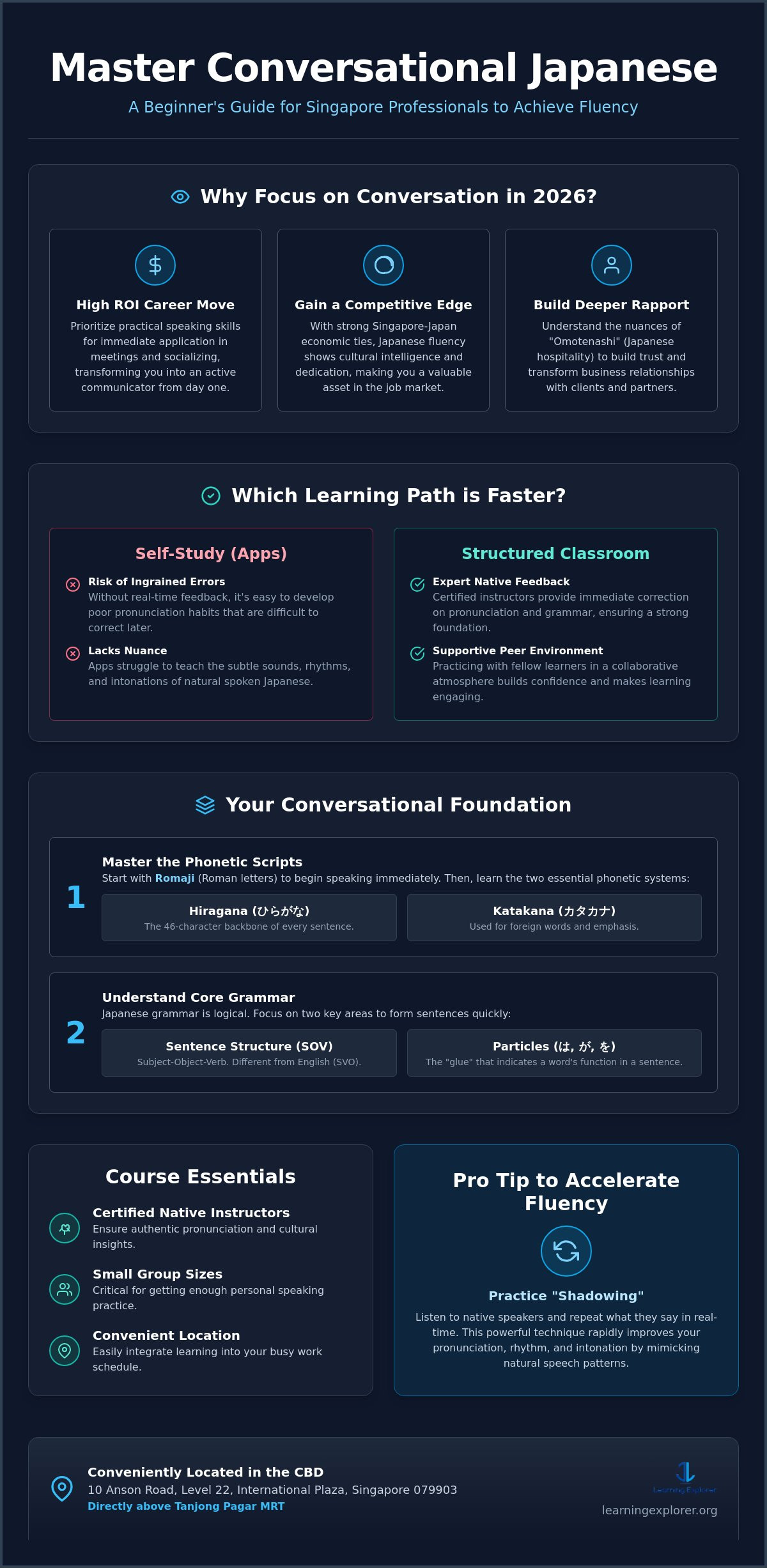
In 2026, Singapore remains a vital hub for Japanese multinational corporations, making language proficiency a high-value asset for ambitious professionals. Choosing to focus on conversational japanese for beginners singapore is a strategic move that prioritises immediate results. It’s a smart career move. Instead of getting bogged down in thousands of complex characters, you start by building the oral skills needed to participate in meetings and socialise with colleagues. This approach provides the highest return on investment because it transforms you from a silent observer into an active communicator from day one.
To better understand the foundations of speaking, watch this helpful video containing essential phrases for your first interactions:
The Growing Demand for Japanese Fluency in Singapore’s Business Landscape
Singapore’s economic ties with Japan continue to strengthen in sectors like technology, finance, and regional trade. Mastering basic Japanese allows you to navigate the nuances of “Omotenashi,” or Japanese hospitality, which is essential for building deep rapport with clients. Upskilling in this area gives you a distinct competitive advantage in the 2026 job market. It shows potential employers that you possess both the cultural intelligence and the dedication to excel in a globalised environment. By learning how to greet partners and exchange pleasantries, you bridge the gap between being a stranger and becoming a trusted partner.
Self-Study vs. Structured Classroom Learning: Which is Faster?
While digital apps offer convenience, they often fail to capture the subtleties of the Japanese sound system. Without real-time feedback from a native speaker, it’s easy to develop pronunciation habits that are difficult to break later. Learning in a structured environment at 10 Anson Road, level 22, International Plaza, Singapore 079903, right above Tanjong Pagar MRT, provides the psychological boost of peer support. You’ll find that practicing alongside others makes the process more engaging and less intimidating than staring at a screen alone. This collaborative atmosphere acts as a creative catalyst for better learning outcomes.
Many people assume Japanese is nearly impossible to learn, but the grammar is surprisingly logical. Unlike many European languages, there are no gendered nouns or complex plural forms to memorise. Once you understand the basic Sentence-Object-Verb (SOV) structure, you can start forming sentences quickly. Joining a language community in the heart of the city turns a daunting task into a rewarding social experience. We focus on reducing your administrative burdens and increasing engagement, ensuring you transition from the labor of seeking knowledge to the satisfaction of genuine discovery.
Building Your Foundation: Essential Skills for Japanese Beginners
Conversational Japanese is more than just memorising words; it’s about mastering the rhythm of oral communication and listening comprehension. By focusing on practical daily scripts, you’ll gain the ability to interact naturally rather than just translating in your head. This mental shift offers the cognitive benefits of being bilingual, which include enhanced problem-solving skills and better multitasking. For those pursuing conversational japanese for beginners singapore, the first step is understanding the architecture of the language.
The Japanese script consists of three systems. Hiragana and Katakana are phonetic, while Kanji represents concepts. While Kanji might seem daunting, beginners start with “Romaji” (the Roman alphabet) as a temporary bridge. This allows you to speak immediately while you gradually learn the characters. You also need to master particles like “wa”, “ga”, and “ni”. These small words act as the glue that holds your sentences together, indicating the subject, object, and direction of your thoughts.
Mastering the Basics: Hiragana and Katakana
Hiragana consists of 46 characters and serves as the backbone of every sentence. It’s the first thing you’ll learn to read and write. Katakana, on the other hand, is used for loan words and identifying your own name. Mastering Katakana is vital for navigating Tokyo or Osaka because it allows you to read menus, transit signs, and international brand names that are written phonetically.
The Core Vocabulary Every Singaporean Learner Needs
Building a functional vocabulary starts with “Aisatsu” or essential greetings. Knowing how to say “Ohayou gozaimasu” (Good morning) or “Otsukaresama desu” (Thank you for your hard work) builds immediate rapport with Japanese colleagues. You’ll also focus on numbers, time, and shopping phrases that make your next holiday to Hokkaido or Kyoto much smoother. Many English words like “coffee” (kōhī) and “camera” (kamera) are already part of the Japanese lexicon, giving you an easy head start.
If you’re ready to start speaking with confidence, a structured Conversational Japanese Course can help you master these foundations through interactive practice. Learning alongside peers at 10 Anson Road, level 22, International Plaza, Singapore 079903, transforms the challenge into an enjoyable social experience.
Evaluating Conversational Japanese Courses in Singapore: What to Look For
Choosing the right path to fluency requires looking beyond basic schedules and registration fees. When you search for conversational japanese for beginners singapore, your primary focus should be “air time.” You need a learning environment where you spend more time actively speaking than passively listening to a lecture. Small group sizes are non-negotiable because they ensure you aren’t just a face in the crowd. This setup allows for personalised attention and immediate feedback, which acts as a creative catalyst for building your confidence quickly.
Practicality also plays a major role in your success. For busy adults, a school situated in the CBD reduces the administrative burden of a long commute. Finding a center located near major transport hubs like Tanjong Pagar MRT respects your limited time and makes it easier to stay consistent. This convenience ensures that your learning journey remains a source of inspiration rather than another taxing professional task.
The Role of Native-Speaker Instructors in Perfecting Pronunciation
Bilingual native teachers are your most reliable allies because they bridge the gap between English and Japanese logic. They don’t just teach words; they explain the cultural context behind them. Mastering pitch accent and natural intonation early prevents the robotic speech patterns that often plague self-taught learners. Interactive modules that encourage constant dialogue are far more effective than passive styles. These expert guides help you transition from the labor of seeking knowledge to the satisfaction of genuine discovery.
Curriculum Alignment: Conversational Skills vs. JLPT Preparation
It’s vital to understand the difference between passing a proficiency test and having a real-world conversation. The Japanese Language Proficiency Test (JLPT) is a respected benchmark, but it often prioritises reading and listening over oral communication. For most beginners, the goal is to speak and be understood. A high-quality learn Japanese language course balances these needs but puts speaking at the forefront. You don’t need to memorise hundreds of Kanji characters to order a meal in Tokyo or greet a Japanese client with poise. By focusing on practical scripts, you achieve a faster professional impact and a more enjoyable learning experience.
Practical Tips to Accelerate Your Fluency Outside the Classroom
Learning a language is a marathon, not a sprint. To truly master conversational japanese for beginners singapore, you need to surround yourself with the language long after your formal lesson ends. It’s about creating a personal ecosystem where Japanese feels natural rather than foreign. This transition from the labor of seeking to the satisfaction of discovery happens when you turn passive consumption into active practice. By integrating small habits into your daily Singaporean routine, you’ll find that your confidence grows alongside your vocabulary.
Leveraging the Shadowing Technique for Natural Speech
Shadowing is a method of repeating native audio in real-time. This technique is one of the most powerful tools in your arsenal because it builds the listening-to-speaking reflex. Instead of listening and then translating in your head, you mimic the sounds, pitch, and speed of a native speaker immediately. It trains your mouth muscles to handle the nuances of the language without hesitation. It’s a physical workout for your fluency.
Don’t wait for a three-hour block on the weekend to practice. Short, daily bursts of 10 to 15 minutes are significantly more effective for long-term retention than one long weekly session. Use beginner-friendly podcasts or audio from your course materials while you’re on the MRT or waiting for a meeting. Listen to a sentence and speak it back instantly. This constant repetition bridges the gap between understanding a word and being able to use it instinctively in a live conversation.
Cultural Immersion Opportunities within Singapore
Singapore offers a unique advantage for learners due to its deep cultural ties with Japan. You don’t need a plane ticket to find immersion. Visit authentic Japanese eateries or the Japanese Association to hear the language in a natural setting. Try ordering your meal or asking for the bill in Japanese. These small, low-stakes interactions build the confidence you need for more formal professional environments. It’s about reducing the fear of making mistakes in a supportive environment.
Attend local cultural events like the annual Sakura festival or Japanese film screenings. These gatherings provide a creative catalyst for meeting others who share your passion. Joining a language school that hosts social mixers is a fantastic way to find language exchange partners. These social sessions allow you to practice what you’ve learned in a pressure-free community, helping you build lasting connections with fellow learners and native speakers alike.
Ready to turn these tips into real-world skills? Explore our conversational Japanese modules and start speaking with confidence today.
Start Your Journey with Learning Explorer: Expert Japanese Classes in the CBD
Choosing a language partner is a significant step toward your professional development. Learning Explorer stands out as a visionary guide for those seeking conversational Japanese for beginners Singapore. We understand the taxing nature of your daily professional tasks; therefore, we’ve built a system that prioritises efficiency and inspiration. Our mission is to provide the creative catalyst for better outcomes, ensuring your transition into Japanese fluency is both smooth and rewarding. We position ourselves as a partner that understands the labor of seeking and replaces it with the satisfaction of discovery.
Our team consists of certified native-speaker instructors who are also bilingual. This unique combination allows them to explain complex concepts through an English speaker’s lens while maintaining the absolute authenticity of the Japanese language. They aren’t just teachers; they’re encouraging allies who help you navigate the nuances of pitch and tone. By aligning our modules with global standards, we ensure that every hour you spend in class contributes directly to your professional impact. You’ll find our instructors to be both authoritative and kind, creating an atmosphere that inspires confidence from the very first lesson.
Our Interactive Curriculum: Focused on Real-World Communication
We move away from the coldness of traditional rote-learning methods. Our modules utilise small group settings to ensure you receive ample “air time” to practice speaking. By focusing on high-frequency vocabulary and practical sentence patterns, you’ll gain the ability to handle common professional and social scenarios quickly. We’ve created a supportive environment that actively removes the fear of making mistakes. This user-centric approach allows you to experiment with the language, building genuine confidence through active participation and real-time feedback.
Convenient Learning at International Plaza
We respect your limited time and aim to reduce administrative burdens. Our training center is located at 10 Anson Road, level 22, International Plaza, Singapore 079903. Being situated directly above Tanjong Pagar MRT means your commute is seamless, whether you’re coming from a nearby office or travelling from across the city. We offer flexible scheduling, including evening and weekend classes, to fit the demanding lives of Singapore’s busy professionals. This strategic location ensures that upskilling fits naturally into your routine without adding unnecessary stress to your day.
- Expert guidance from certified, bilingual native speakers who understand your learning journey.
- Interactive small-group sessions designed for maximum engagement and oral practice.
- Strategic CBD location at Tanjong Pagar MRT for effortless accessibility after work.
- A curriculum focused on high-frequency vocabulary for immediate real-world application.
Our integrated platform acts as the solution to your professional struggles, concluding with the benefit of improved results and broader horizons. Join a community of learners who value high-quality, vetted materials and a structured path to discovery. Start your journey today and experience the satisfaction of mastering a new language in a supportive, innovative atmosphere.
Take the Next Step Toward Japanese Fluency
Mastering a new language is about more than just vocabulary; it’s about opening doors to new cultural and professional horizons. You’ve seen how focusing on oral communication and leveraging techniques like shadowing can significantly accelerate your progress. By choosing a structured environment with certified native-speaker instructors, you ensure that every minute of practice counts toward real-world fluency. This strategic approach reduces your administrative burden and lets you focus on what matters most: genuine connection.
Embarking on conversational japanese for beginners singapore doesn’t have to be a daunting task. Our interactive small group classes provide the creative catalyst you need to overcome the fear of making mistakes. With our prime CBD location at Tanjong Pagar, fitting high-quality education into your busy schedule becomes effortless. We’re here to act as your reliable ally, helping you transition from the labor of seeking to the satisfaction of discovery.
Start your Japanese journey at Learning Explorer today! You’ve got the vision; let us provide the expertise to help you reach it. We’re excited to support your path toward greater professional impact and personal growth.
Frequently Asked Questions
How long does it take for a beginner to speak basic Japanese in Singapore?
Most learners can master basic interactions, such as ordering food and introducing themselves, within 10 to 12 weeks of consistent study. This timeframe assumes you’re attending regular sessions and engaging with the language daily. Your progress will accelerate as you move from the labor of seeking vocabulary to the satisfaction of natural discovery through practice.
Is Japanese difficult for English speakers to learn?
Japanese grammar is surprisingly logical and lacks many of the complexities found in European languages, such as gendered nouns or plural forms. While the writing systems require dedication, the phonetic sounds are consistent and easy for English speakers to mimic. You’ll find that once you understand the basic sentence structure, building your confidence becomes a rewarding creative pursuit.
Do I need to learn Kanji to attend a conversational Japanese course?
You don’t need to master Kanji characters to participate in our speaking-focused modules. We prioritise oral communication and listening comprehension, using Romaji and Hiragana as initial bridges for absolute beginners. This approach reduces your administrative burden and allows you to focus on building rapport through speech immediately.
What is the best age to start learning Japanese as an adult?
There isn’t a single “best” age to start, as adult brains are highly capable of recognising patterns and applying professional discipline to new skills. Whether you’re in your 20s or 50s, the key is finding a supportive community that inspires confidence. Learning alongside peers provides a psychological boost that makes the process feel like a shared discovery rather than a taxing task.
Can I learn Japanese for business purposes at Learning Explorer?
Yes, our conversational japanese for beginners singapore provides the essential foundation needed for professional environments. You’ll learn the cultural etiquette and polite speech patterns, known as Keigo, that are vital for building rapport with Japanese clients. This training serves as a creative catalyst for professionals looking to gain a competitive advantage in the regional market.
What materials are included in the beginner Japanese course?
Our modules typically include high-quality textbooks, audio resources for shadowing, and interactive worksheets designed for adult learners. These vetted materials ensure you’re learning practical, modern Japanese that you can use in real-world scenarios. We provide everything you need to transition from a novice to a confident communicator without the overwhelm of unorganised external sources.
Is there a trial lesson available for new Japanese students?
Prospective students should contact our team directly to enquire about the latest trial session availability and intake dates. These sessions are an excellent way to experience our interactive teaching style and meet our native-speaker instructors. It’s a risk-free opportunity to see how our expert guides can help you achieve your fluency goals.
How much are the tuition fees for a Japanese course in Singapore?
Tuition fees for a conversational japanese for beginners singapore vary based on the module’s duration and the specific curriculum focus. Factors like small group sizes and the expertise of certified native instructors influence the overall value of the programme. We recommend checking current rates for individual modules to find a schedule that fits both your budget and your professional goals.