What if the only thing standing between you and a career-defining promotion is a single proficiency certificate? Many professionals who want to learn korean singapore find themselves stuck in a loop of inconsistent self-study, relying on mobile apps that don’t provide the high-level feedback needed for advanced fluency. It’s frustrating to master basic phrases only to hit a wall when faced with the complex academic requirements and time-management traps of the official TOPIK exam.
You can master the specific strategies and linguistic nuances needed to pass the Test of Proficiency in Korean with professional guidance in the heart of the city. We understand the pressure of balancing a full-time career with intensive study, and we’re here to provide the creative catalyst for better outcomes. This guide explores the 2026 testing landscape, breaks down the intimidating TOPIK II structure, and provides a 12-week roadmap to help you secure that official certification at our training center directly above Tanjong Pagar MRT.
Key Takeaways
- Understand the critical differences between TOPIK I and TOPIK II to select the level that best aligns with your professional aspirations.
- Discover why the most effective way to learn korean singapore involves moving past casual apps and into a structured environment with native-speaker feedback.
- Follow a strategic 12-week roadmap designed to master complex grammar and intensive listening drills before the 2026 exam dates.
- Learn how to avoid “fossilized errors” and tackle the daunting TOPIK II writing section with proven, exam-specific strategies.
- Explore how professional coaching in the heart of the CBD can transform your preparation from unorganized self-study into certified success.
Understanding the TOPIK Exam and Its Value in 2026
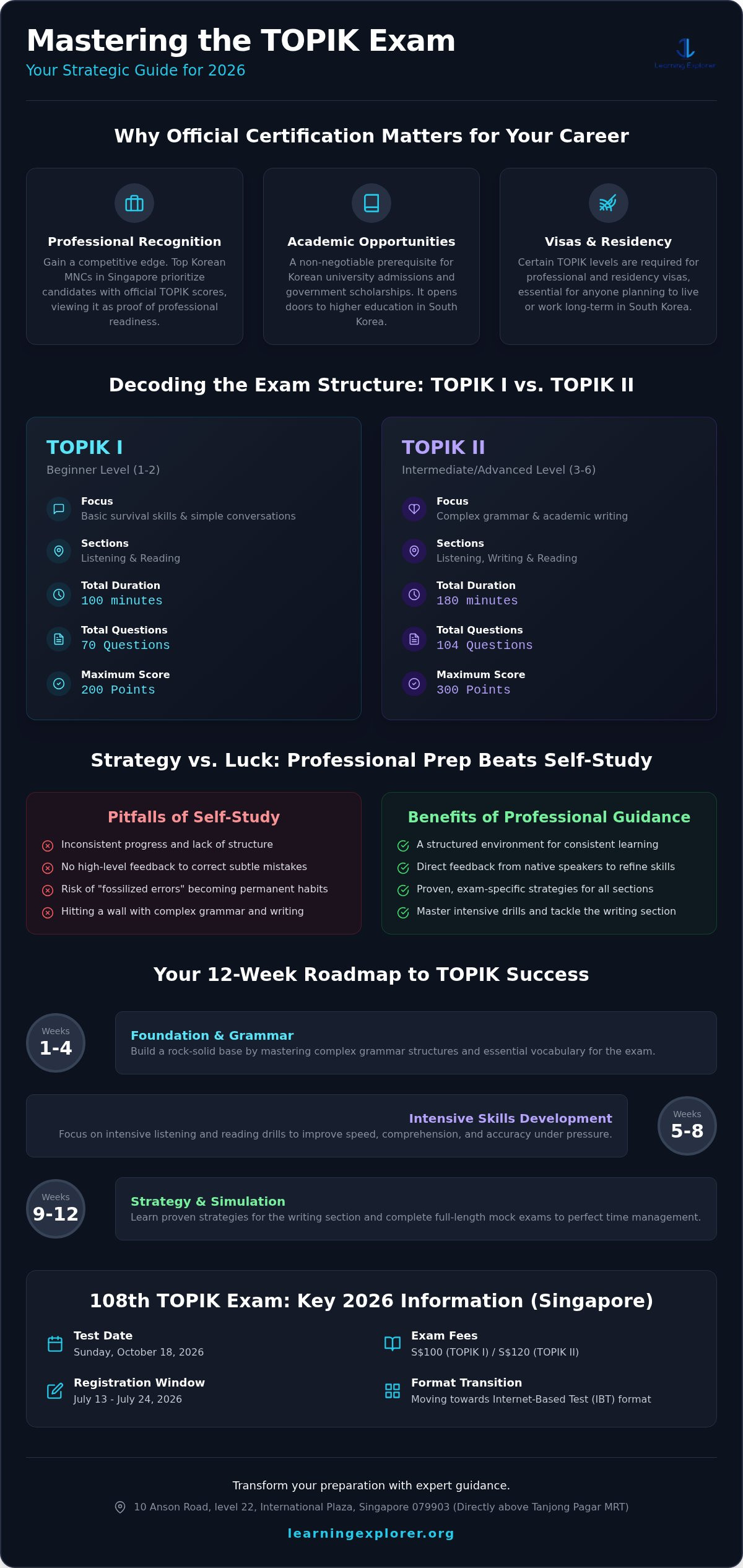
The Test of Proficiency in Korean (TOPIK) isn’t just another language certificate. It’s the official benchmark used by the South Korean government to measure your ability to navigate both daily life and academic settings. If you want to learn korean singapore, understanding this exam is your first step toward professional recognition. The test is divided into two main categories: TOPIK I for beginners (Levels 1 and 2) and TOPIK II for intermediate to advanced learners (Levels 3 to 6). While TOPIK I focuses on basic survival skills and simple conversations, TOPIK II demands a deep grasp of complex grammar and academic writing.
To better understand this concept, watch this helpful video:
2026 marks a significant shift as the exam transitions toward the Internet-Based Test (IBT) format. While the traditional paper-based test remains the standard at the Singapore Korean International School (SKIS), the digital move means your preparation needs to evolve. You’ll need to be as comfortable with a digital interface as you are with a pen. Achieving a high score directly impacts your career growth. Major Singapore-based Korean MNCs like Samsung, Hyundai, and LG often prioritize candidates with official TOPIK scores, viewing them as evidence of cultural commitment and professional readiness.
Why Official Certification Matters for Your Career
In the competitive job market of the Singapore CBD, a TOPIK certificate provides instant validation for HR departments. It proves you can handle professional Korean environments without a translator. Beyond employment, it’s a non-negotiable prerequisite for Korean university admissions and government scholarships. If you’re planning to live or work in South Korea, certain levels are required for professional and residency visas. It transforms your resume from “conversational” to “certified professional.”
The 2026 Testing Landscape in Singapore
Timing is everything when you learn korean singapore. For the current year, the 108th TOPIK test is scheduled for Sunday, October 18, 2026. You must be ready to act quickly; the registration window is narrow, running from July 13 to July 24, 2026. Examination fees are set at S$100 for TOPIK I and S$120 for TOPIK II. Because the testing environment is evolving, it’s vital to choose a professional language school that stays updated with these changes. You can find expert guidance at our training center located at 10 Anson Road, level 22, International Plaza, Singapore 079903, situated directly above Tanjong Pagar MRT. We ensure you aren’t just learning the language, but mastering the specific strategies needed for the digital transition.
Decoding the TOPIK I and TOPIK II Structure
Mastering the TOPIK exam requires more than just a wide vocabulary. It demands an understanding of a rigorous academic framework that differs significantly from the casual phrases you hear in K-dramas. When you decide to learn korean singapore, you must prepare for a test that measures precision and logic. According to the official Study in Korea portal, these scores are vital for anyone seeking scholarships or university placement in Korea. The structure is split into two distinct exams, each with its own set of challenges.
| Feature | TOPIK I (Beginner) | TOPIK II (Intermediate/Advanced) |
|---|---|---|
| Sections | Listening, Reading | Listening, Writing, Reading |
| Questions | 70 Questions | 104 Questions |
| Duration | 100 Minutes | 180 Minutes |
The scoring system is cumulative. For TOPIK I, you need over 80 points for Level 1 and over 140 for Level 2. TOPIK II is more complex, with Level 3 starting at 120 points and the prestigious Level 6 requiring at least 230 points out of 300. Unlike conversational Korean, the exam tests your ability to process information quickly and accurately under pressure. If you’re aiming for the higher levels, the Writing section is often the biggest hurdle. It’s the only part of the test that isn’t multiple choice, requiring you to compose two short responses and two full-length essays.
TOPIK I: Mastering the Basics (Levels 1-2)
Success in TOPIK I hinges on your grasp of high-frequency vocabulary and survival grammar. You’ll need to identify main ideas in simple dialogues and read short texts about daily life. A common trap for beginners is poor time management; spending too much time on a single difficult reading passage can cost you easy points later. Focus on building a solid foundation of about 1,500 to 2,000 core words. This baseline ensures you can navigate the 100-minute session without feeling overwhelmed by the pace.
TOPIK II: The Path to Advanced Proficiency (Levels 3-6)
TOPIK II is a marathon that tests your mental stamina. The three-hour duration is split into two sittings, with the Writing section demanding immediate focus. You must analyze data for a descriptive essay and then argue a position on a social issue for a 700-word piece. Reading passages become significantly more academic, covering topics like economics, science, and traditional culture. Navigating these complexities is much easier when you have a partner. You might want to explore a professional TOPIK prep course to get the structured feedback necessary for these advanced levels.
Strategy vs. Luck: Why Professional Prep Beats Self-Study
Relying on luck or casual media exposure is a common trap for many aspiring linguists. While binge-watching K-dramas might help you pick up trendy slang or the general melody of the language, it rarely provides the grammatical rigor needed for the TOPIK II academic essays. If you want to learn korean singapore for professional advancement, you need a strategy built on precision rather than just immersion. Without a native teacher to guide you, you risk developing “fossilized errors”-incorrect grammar patterns that become so ingrained in your habits that they are nearly impossible to correct later.
The Writing section remains the most significant hurdle for independent learners. It’s not just about what you say, but how you structure it according to strict Korean academic logic. Professional feedback is the only way to master the nuances between different honorific levels and formal writing styles. Stepping into a structured classroom environment also provides a psychological edge. Being surrounded by other career-driven professionals in the heart of the CBD transforms your study from a lonely chore into a collaborative mission with clear milestones.
The Pitfalls of Independent Learning
Studying alone often leads to a lack of accountability and inconsistent study patterns. It’s easy to skip a session when a mobile app is your only teacher. More importantly, independent learners often struggle with:
- Nuance Blindness: Failing to distinguish between the formal ‘Snoep-nida’ style used in business and the informal styles used among friends.
- Passive Consumption: Over-relying on listening and reading without enough active production or speaking practice.
- Limited Scope: Focusing only on vocabulary you like, rather than the broad academic range required for Levels 5 and 6.
The Learning Explorer Advantage
Choosing a professional path means gaining access to vetted materials that are specifically designed for exam success. At Learning Explorer, we act as your knowledgeable guide, providing real-time corrections that no software can replicate. Our training center at 10 Anson Road, level 22, International Plaza, Singapore 079903, offers the perfect environment to focus away from daily distractions. You’ll benefit from:
- Certified Native Speakers: Get immediate feedback on your writing and pronunciation from experts who understand the TOPIK criteria.
- Curated Content: Move beyond unorganized free resources and utilize high-quality language courses singapore materials that align with the 2026 testing standards.
- Peer Motivation: Join a community of learners who share your goals, creating a creative catalyst for better outcomes and shared success.
Our location, directly above Tanjong Pagar MRT, ensures that your preparation fits seamlessly into your professional schedule, reducing the administrative burden of commuting and allowing you to focus entirely on your mastery of the Korean language.
Your 12-Week Roadmap to TOPIK Success
Success isn’t accidental. It’s the result of a deliberate, phased approach that respects your time as a busy professional. When you set out to learn korean singapore, a 12-week timeline provides the perfect balance between intensive study and sustainable progress. This roadmap ensures you aren’t just memorizing words, but building the mental stamina required for the three-hour TOPIK II marathon. By breaking your preparation into four distinct three-week blocks, you can track your growth and address weaknesses before they become exam-day hurdles.
- Weeks 1-3: Conduct a baseline diagnostic test to identify your current level. Focus heavily on core vocabulary expansion to build your linguistic foundation.
- Weeks 4-6: Transition into grammar mastery. Combine this with intensive listening drills to sharpen your ability to process spoken Korean at natural speeds.
- Weeks 7-9: Enter the writing workshops. This is where you master the specific connectors and structures needed for the daunting 700-word academic essay.
- Weeks 10-12: Shift to full-length mock exams. This phase is about fine-tuning your time management and getting comfortable with the exam’s rhythm.
Phase 1: Building a Strong Linguistic Core
Your journey begins with a clear-eyed assessment of where you stand. An initial diagnostic test reveals whether your struggle lies in listening comprehension or grammatical accuracy. Once you know your weak points, you can focus your energy where it matters most. The “Top 2,000” vocabulary list represents the essential lexical foundation required to navigate approximately 80% of the TOPIK I and II exam content with confidence. Maximize your efficiency by integrating study into your daily routine. Use your commute via Tanjong Pagar MRT to review flashcards or listen to Korean podcasts, turning transit time into a productive learning session.
Phase 2: The Writing and Strategy Breakthrough
As you move into the second half of your preparation, the focus shifts from “what” you know to “how” you apply it. You must learn to think in Korean rather than translating from English in your head; this is the secret to finishing the long-form essay within the time limit. We teach you techniques to skim academic reading passages, identifying key arguments without getting bogged down by every single unfamiliar word. In the final weeks, your goal is to eliminate the small, repetitive mistakes that often cost candidates their target level. Ready to start your journey? Enroll in our TOPIK Preparation Course and let our native experts guide your 12-week transformation.
Elevate Your Skills at Learning Explorer Singapore
Achieving your target TOPIK level doesn’t have to be a source of constant stress. At Learning Explorer, we specialize in transforming the labor of seeking unorganized resources into the satisfaction of true linguistic mastery. When you choose to learn korean singapore with us, our TOPIK Preparation Course provides the creative catalyst you need to move beyond basic survival phrases. We act as your knowledgeable guide, offering a professional ally in your quest for career advancement and academic success. Our mission is to reduce your administrative burden while simultaneously enhancing your professional impact.
Our training center is conveniently situated at 10 Anson Road, level 22, International Plaza, Singapore 079903. This prime location, directly above Tanjong Pagar MRT, means you don’t have to sacrifice your personal time for professional growth. We keep our class sizes small. This ensures every student receives personalized, high-quality feedback from our certified native-speaker instructors. This focus on individual engagement is what sets our practitioners apart. You’ll work with vetted, high-quality materials that are far superior to the overwhelming and unorganized nature of external sources.
Convenient Learning for Busy Professionals
We understand that your schedule is demanding. That’s why we’ve designed our environment to be professional, kind, and mission-driven. Our sessions are perfectly timed for after-work classes in the heart of the CBD, making it easy to transition from the office to the classroom. Whether you prefer the collaborative energy of a group format or the tailored focus of private lessons, we offer flexible corporate-friendly schedules that suit your corporate lifestyle. We prioritize your time, creating a sense of momentum and ease throughout your learning journey.
Proven Methodology for Exam Excellence
Our curriculum is strategically aligned with the 2026 global TOPIK standards, ensuring you’re prepared for the latest testing formats and the shift toward digital assessments. We don’t just teach you to pass; we teach you to excel. By focusing on transformative results, we help you move from ‘survival’ Korean to a level of mastery that commands respect in professional environments. Join a community of practitioners dedicated to professional excellence and discover the satisfaction of reaching your goals. We provide the expert guidance you need to turn your aspirations into an official TOPIK certification.
Unlock Your Professional Potential in 2026
Securing a high TOPIK score is more than just a personal milestone. It’s a strategic move for your career in the Singapore CBD. You’ve seen that passing the 2026 exams requires a blend of core linguistic mastery and specific test-taking strategies that self-study apps simply can’t provide. By following a structured roadmap and receiving feedback from native speakers, you can eliminate fossilized errors and approach the daunting writing section with total confidence.
When you choose to learn korean singapore at our center, you gain a professional ally dedicated to your success. Our small, interactive classes are designed specifically for adult learners who need efficiency and engagement. We offer the expertise of certified native-speaker instructors in a convenient location at International Plaza, Tanjong Pagar. Don’t leave your results to luck. Enroll in our TOPIK Preparation Course at Learning Explorer today! We’re ready to help you turn your hard work into a life-changing certification.
Frequently Asked Questions
When are the TOPIK test dates in Singapore for 2026?
The 108th TOPIK exam in Singapore is scheduled for Sunday, October 18, 2026. You must register between July 13 and July 24, 2026, to secure your slot. It’s vital to mark these dates in your calendar early because the Singapore Korean International School doesn’t accept late registrations under any circumstances.
What is the passing score required for TOPIK Level 3?
You need to achieve a minimum score of 120 points out of 300 to earn a TOPIK Level 3 certificate. This level is the entry point for the TOPIK II exam and signifies an intermediate proficiency. It demonstrates that you can maintain social relationships and use basic public facilities in a Korean-speaking environment.
How much does the TOPIK exam registration cost in Singapore?
The registration fee for the TOPIK I exam is S$100, while the TOPIK II exam costs S$120. These fees are subject to current GST rates and must be paid during the official registration window. Always double-check your target level before completing the payment since these fees are typically non-refundable once processed.
Is the TOPIK certificate valid forever or does it expire?
Your TOPIK certificate remains valid for exactly two years from the date your results are officially announced. For the October 2026 session, results are released on December 10, 2026, meaning your certification will be valid until late 2028. This validity period ensures that your language proficiency remains accurate for employers and academic institutions.
Can I take the TOPIK II exam without passing TOPIK I first?
Yes, you can register for the TOPIK II exam directly without having previously passed TOPIK I. There are no prerequisite levels required to sign up for either test. This allows you to learn korean singapore at your own pace and jump straight into the intermediate or advanced levels whenever you feel ready.
What is the difference between the PBT and the new IBT format?
The Paper-Based Test (PBT) uses traditional printed booklets and pens, while the Internet-Based Test (IBT) is conducted on computers. While the IBT is being phased in globally, Singapore currently relies on the PBT format for its main testing sessions. The core linguistic content is identical, but the IBT requires faster typing skills for the writing section.
Where is the TOPIK test center located in Singapore?
The official TOPIK examination is held at the Singapore Korean International School (SKIS), located at 71 Bukit Tinggi Road, Singapore 289759. While we provide expert coaching at International Plaza, the actual exam venue is managed solely by SKIS. Plan your travel carefully on test day as the school is located within a residential area.
How many hours of study are needed to reach TOPIK Level 4?
Reaching TOPIK Level 4 generally requires between 400 and 600 hours of cumulative study. This timeline can be shortened significantly if you learn korean singapore through a structured curriculum with native speakers. Professional guidance at our center at 10 Anson Road, level 22, International Plaza, Singapore 079903, helps you focus on high-yield vocabulary and the specific writing structures that examiners look for.