What if the difference between securing a 4.16% rental yield in Ho Chi Minh City and missing out entirely isn’t your capital, but your ability to speak the local language? You’ve likely felt that uncomfortable shift during a site visit when the conversation moves into Vietnamese, leaving you to rely on a translator’s filtered summary. It’s a common struggle for Singapore based investors who fear that legal nuances are being lost. Learning conversational vietnamese for property investors changes this dynamic, serving as your most powerful due diligence tool. We understand that feeling of being ‘out of the loop’ when your capital is on the line.
This guide reveals how basic fluency helps you build rapport with landlords and manage the Land Law 2024 with confidence. We’ll preview the essential terminology and networking strategies you need to unlock exclusive opportunities in 2026. Whether you’re visiting our team at 10 Anson Road, level 22, International Plaza, Singapore 079903, situated directly above Tanjong Pagar MRT, or studying on the go, this is your roadmap to becoming a strategic partner in Vietnam’s property market.
Key Takeaways
- Understand why Singaporean investors are leading capital inflows into Vietnam and how language proficiency bridges the gap between being an outsider and a strategic partner.
- Learn how mastering conversational vietnamese for property investors allows you to build ‘Tình Cảm’ (rapport) with local developers to secure more favorable terms and pricing.
- Discover how to conduct more effective due diligence by asking direct questions during site visits and reducing reliance on third-party translators.
- Gain a high-level understanding of essential real estate terms, including the ‘Pink Book’ and ‘Red Book’, to navigate the Housing Law 2023 with greater confidence.
- Explore flexible training modules at our CBD center, designed specifically for busy executives to gain practical fluency without the administrative burden of unvetted resources.
The Rise of Vietnam Real Estate: Why Singapore Investors Need a Language Edge
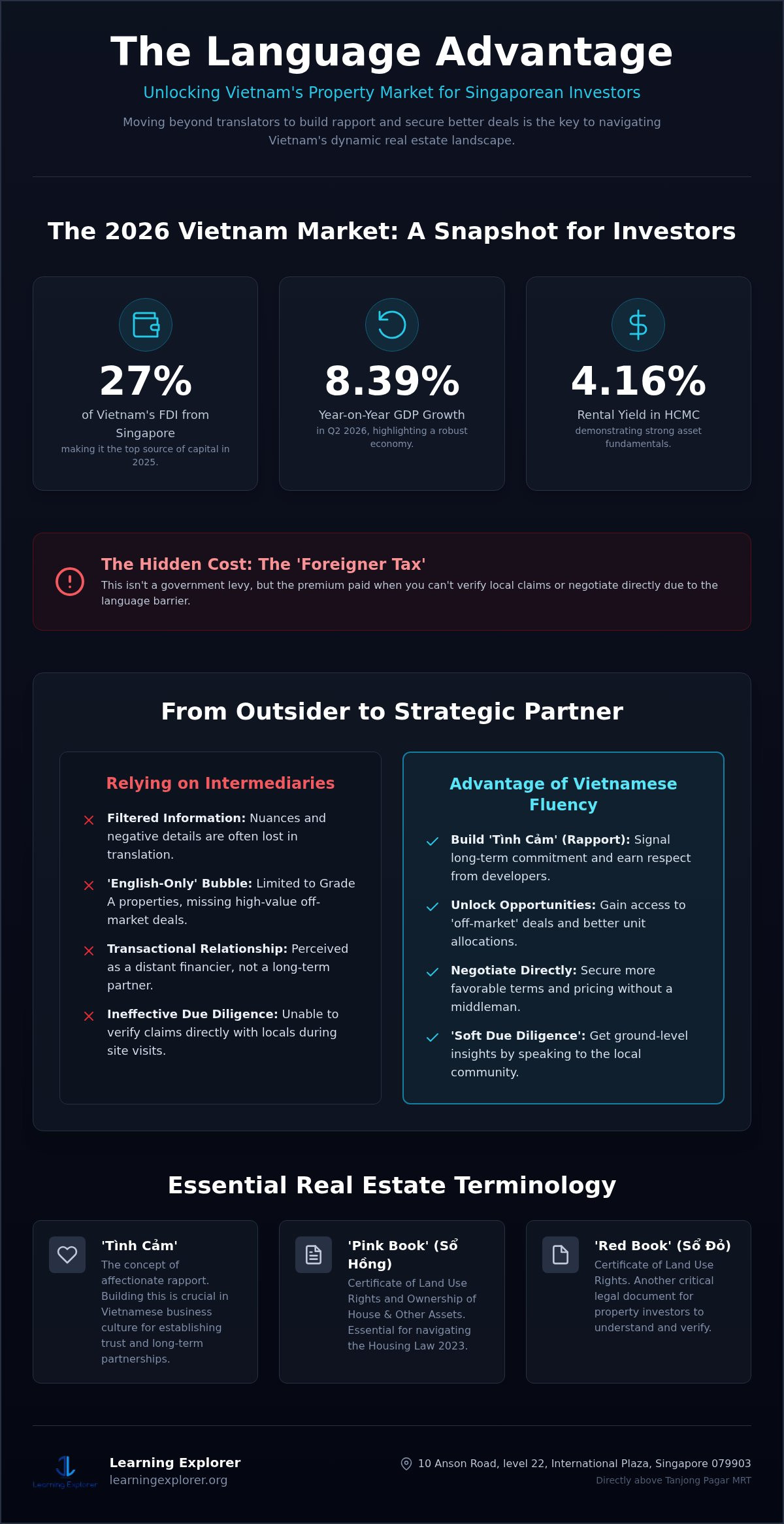
The Vietnamese property market in 2026 is no longer just about speculative gains. It’s a mature environment where Singaporean investors are leading the charge. In 2025, Singapore contributed 27% of Vietnam’s total US$38.4 billion registered FDI, making it the top source of capital. This influx is driven by an economy that grew by an estimated 8.39% year-on-year in the second quarter of 2026. However, entering this market comes with a hidden cost: the communication gap. Relying purely on intermediaries often results in what we call a ‘Foreigner Tax’. This isn’t a government levy, but the premium you pay when you can’t verify local claims or negotiate directly with sellers.
The 2026 Market Landscape for Singaporeans
Investors are currently prioritizing assets with strong fundamentals rather than broad market momentum. While residential units in Ho Chi Minh City and Hanoi remain the primary focus, there is a significant shift toward industrial and logistics sectors. This is a direct result of global supply chain diversification strengthening Vietnam’s economic landscape. Success in 2026 requires ‘Soft Due Diligence’. This means looking beyond the glossy brochures and understanding local sentiment. You need to know if a proposed urban development corridor is actually gaining traction or if the local community is skeptical about the construction progress.
Breaking the ‘English-Only’ Bubble
Many investors get stuck in an ‘English-only’ bubble, limiting their reach to Grade A buildings in central districts. While the office occupancy rate in Ho Chi Minh City hit 88% in early 2026, the real value often lies in satellite locations where English isn’t widely spoken. Mastering conversational vietnamese for property investors allows you to step outside this bubble. It gives you the power to find ‘off-market’ opportunities before they reach international agencies. You’ll build genuine trust with local landlords who value direct communication and transparency.
Learning these skills doesn’t have to be a chore. At Learning Explorer, we provide a supportive environment for busy professionals. Our center is located at 10 Anson Road, level 22, International Plaza, Singapore 079903, directly above Tanjong Pagar MRT. We focus on the practical language skills that reduce your administrative burden and increase your deal-making confidence. By speaking the language, you transform from a distant financier into a strategic partner who understands the ground reality.
Key Conversational Scenarios: Where Vietnamese Proficiency Wins the Deal
Success in Vietnam’s real estate market often depends on the strength of your personal network. While data provides the “what,” language provides the “how.” The robust Singapore-Vietnam economic partnership has opened doors for massive capital inflows, but walking through them requires more than just a signature. It requires rapport. In a market that saw over 580,000 successful transactions in 2025, standing out from the crowd of international buyers is essential for securing the best terms.
Building Rapport with Local Developers
In Vietnamese business culture, “face” and “Tình Cảm” (affectionate rapport) are foundational. When you utilize conversational vietnamese for property investors, you signal a long-term commitment that an English-only investor simply cannot match. This effort suggests you’re here to stay, not just to flip a unit for a quick profit. Developers and landlords often reward this respect with better unit allocations or early access to previews. Simple phrases that acknowledge their local expertise can transform a cold transaction into a genuine partnership. It’s about moving from being a “foreign buyer” to a “trusted associate.” Just as understanding cultural nuances is critical in Vietnam, investors expanding across Southeast Asia will also benefit from mastering essential thai business etiquette for meetings to build the same level of trust with Thai partners and developers.
The Art of the Site Visit
Showrooms are designed to impress, but the real story of a property is found in the surrounding streets. Relying on an agent’s translation can lead to an information gap where negative details are softened. By speaking directly to locals, you can verify infrastructure claims through direct inquiry. Ask the neighborhood shopkeeper about seasonal flooding or the reality of peak hour traffic. These ground-level insights are the ultimate due diligence. You might discover that a “planned” park has been a vacant lot for years, or that a new metro entrance is actually two blocks further than advertised.
Networking at property launches in HCMC or Da Nang becomes significantly more effective when you can engage with other local buyers. You aren’t just an observer; you’re a participant who can gauge market sentiment in real time. If you want to start building these skills to protect your capital, consider joining a conversational Vietnamese course tailored for your professional needs. This small investment in communication can prevent costly mistakes during the due diligence process and give you the confidence to negotiate with authority.
Talking to neighbors also helps you understand the “vibe” of a district. Is it a growing hub for young professionals or a quiet residential pocket? This qualitative data is hard to find in spreadsheets but easy to gather over a quick conversation. It’s these small details that determine your long-term rental yield and resale value.
Strategic Advantage: Vietnamese Fluency vs. Relying on Intermediaries
Many Singaporean investors assume that hiring a high-priced consultant is enough to bridge the gap. While agents are necessary, they are also intermediaries with their own incentives. Relying solely on them creates an ‘Information Gap’ where nuances are lost. When you invest in conversational vietnamese for property investors, you gain the ability to cut through the noise. You can hear what isn’t being said. You can pick up on non-verbal cues and side conversations between sellers and their staff. This isn’t just about translation; it’s about understanding Vietnamese business culture and how power dynamics shift when a foreigner shows they’ve made the effort to learn.
Vietnamese Proficiency vs. English-Only Investing
The psychological advantage of speaking the local tongue in a boardroom is immense. It signals respect and intelligence. It tells the developer that you aren’t just a passive source of capital, but an active participant. This often eliminates the ‘foreigner pricing’ that many outsiders unknowingly accept. You’ll find that negotiation power shifts in your favor when you don’t need to pause for a translator every thirty seconds. It keeps the momentum of the deal alive and allows you to build a direct line of communication with the decision-makers.
| Feature | English-Only Investor | Vietnamese-Fluent Investor |
|---|---|---|
| Deal Access | Limited to public listings | Access to off-market local deals |
| Negotiation | Filtered through agent | Direct and transparent |
| Risk Level | High (Information asymmetry) | Reduced (Independent verification) |
| Pricing | Often ‘Foreigner Premium’ | Market-aligned rates |
Beyond the Sales Pitch
Red flags often appear in the verbal explanations of legal documents. An agent might say a project is “fully cleared,” but a quick conversation with a local official or neighbor might reveal pending land use issues. By gaining basic fluency in conversational vietnamese for property investors, you can perform independent verification, which is the cornerstone of risk mitigation. You don’t need a third party to ask about the status of a Land Use Rights Certificate (LURC) or to confirm if mortgage rates are staying near the 12% average seen in early 2026. This autonomy allows you to move faster and with higher confidence during the due diligence phase.
Learning these skills is a strategic move for serious investors. It’s about moving from the labor of seeking information to the satisfaction of discovery. Our team at our Tanjong Pagar center is ready to help you bridge this gap. We’ll guide you through the specific terminology that matters most in a property context, ensuring your investment is backed by your own understanding rather than someone else’s summary. This self-reliance is what distinguishes a successful long-term investor from someone just following the crowd.
Essential Vietnamese Vocabulary for Property Investors
Mastering the linguistic tools of the trade is the final step in moving from a passive observer to a confident negotiator. While previous sections explored the strategic reasons for entering the market, this section provides the specific vocabulary needed for execution. Having a targeted vocabulary allows you to verify the 50 year ownership terms granted under the Housing Law 2023 without waiting for a translation. It transforms a site visit from a guided tour into a rigorous inspection. By focusing on conversational vietnamese for property investors, you equip yourself with the exact phrases needed to navigate the current 12% to 13% mortgage rate environment with authority.
Legal and Structural Terminology
Understanding the specific document names used in Vietnam prevents costly misunderstandings during the due diligence phase. The ‘Sổ Hồng’ (Pink Book) is the essential certificate for condominium investors, representing ownership of houses and residential land. If you’re discussing landed property or villas, you’ll hear references to the ‘Sổ Đỏ’ (Red Book). Knowing these terms helps you clarify the Land Use Rights Certificate (LURC) status immediately. Use these keywords to guide your discussions:
- Hợp đồng đặt cọc: Deposit Agreement. This is the first legal hurdle in any transaction.
- Sở hữu lâu dài: Freehold (typically reserved for local citizens).
- Sở hữu có thời hạn: Leasehold (the standard 50 year term for foreign nationals).
- Lãi suất: Interest rate. Vital for calculating your financing costs and debt service ratios.
- Lợi nhuận cho thuê: Rental yield. Use this to discuss the 4.16% average yields found in major urban hubs.
Networking and Rapport Starters
In the Vietnamese real estate context, ‘investment’ (đầu tư) refers to the strategic allocation of capital into land use rights or property assets to generate long-term value or rental income. To discuss these assets effectively, you must start with the right tone. Business settings require formal greetings that acknowledge seniority. Use “Chào Anh” for men older than you and “Chào Chị” for women. These small signs of respect open doors that remain closed to those who only use English. You might ask, “Tôi có thể xem Sổ Hồng không?” (Can I see the Pink Book?) to signal that you’re an informed buyer who understands the local legal framework.
If you’re ready to build this professional toolkit, you can enroll in a conversational Vietnamese course designed specifically for the Singaporean business community. Our instructors focus on these high-impact phrases that reduce your administrative burden. Visit us at our International Plaza center, located conveniently above Tanjong Pagar MRT, to see how we tailor our curriculum for property professionals. Learning these action-oriented verbs like ‘Kiểm tra’ (to inspect) or ‘Ký’ (to sign) ensures you remain in control of every document that crosses your desk during a deal.
Master Business Vietnamese at Learning Explorer’s Singapore CBD Center
Mastering the nuances of the Vietnamese market requires a learning partner that understands the high stakes environment of real estate. At Learning Explorer, we provide specialized modules that go beyond standard language training. Our conversational vietnamese for property investors program is designed to fit the specific needs of Singapore based executives who require immediate, practical results. By focusing on real world application, we help you reduce the administrative friction often associated with cross border deals and increase your engagement with local stakeholders.
Why Learning Explorer for Singapore Professionals?
We focus on conversational fluency that yields tangible business outcomes rather than rote memorization. Our native speaking bilingual instructors bring years of experience in corporate training, ensuring that every session is relevant to your professional life. We maintain small group sizes to maximize your speaking time, allowing you to practice site visit scenarios and negotiation tactics in a supportive environment. Our center is conveniently located at International Plaza, situated directly above Tanjong Pagar MRT, making it easy to attend classes during your lunch hour or immediately after work without disrupting your busy schedule.
Start Your Vietnamese Journey Today
Choose a learning format that aligns with your professional goals and current project timelines. For those with specific, upcoming deal deadlines, our private coaching offers a creative catalyst for better outcomes through intensive, one on one focus. If you prefer a collaborative environment, our group classes provide a structured path toward proficiency alongside other like minded professionals. As you look to master regional languages for growth, you’ll find that Vietnamese is a visionary addition to your skill set. Investors who are also expanding into Thailand will find that applying the same strategic prioritization approach — such as learning how to learn the Thai writing system fast — delivers equally powerful results when building credibility with local partners. Integrate your training into your work schedule and transition from the labor of seeking information to the satisfaction of expert discovery. Take control of your investment narrative and ensure you’re always positioned as a strategic partner on the ground.
Secure Your 2026 Investment Edge in Vietnam
Mastering conversational vietnamese for property investors is no longer a luxury; it’s a strategic necessity for those looking to lead in 2026. By bridging the communication gap, you move beyond the limitations of filtered translations and ‘foreigner pricing’. You gain the unique ability to verify legal nuances like the Pink Book status directly and build the rapport required for long-term partnership success. This autonomy ensures your due diligence is rooted in ground-level reality rather than third-party summaries.
Our team at Learning Explorer serves as your visionary guide in this journey. We offer native-speaker bilingual instructors and customized corporate training solutions designed to fit the busy schedules of CBD professionals. We’re located directly above Tanjong Pagar MRT, making it easy to integrate learning into your daily workflow. Book Your Conversational Vietnamese Trial Lesson at International Plaza today. Take the first step toward reducing administrative burdens and enhancing your professional impact in Southeast Asia’s most dynamic market. Your next great real estate opportunity is waiting; make sure you have the voice to claim it.
Frequently Asked Questions
Is Vietnamese hard for English speakers to learn for business?
Vietnamese can be challenging due to its six tones, but its grammar is relatively simple compared to European languages. For business and property contexts, you don’t need literary mastery; you need functional fluency. Our instructors focus on the specific vocabulary that drives deals, making the learning curve much more manageable for busy Singaporean professionals. We prioritize practical communication over abstract theory to ensure you see results quickly and can engage with local partners confidently.
Can I buy property in Vietnam using only English?
Yes, you can buy property using only English, but you’ll be entirely dependent on intermediaries and translators. This often leads to ‘foreigner pricing’ and missed nuances in legal discussions. While major developers in HCMC and Hanoi have English speaking staff, the secondary market often requires Vietnamese. Learning conversational vietnamese for property investors allows you to verify claims independently and build direct rapport with landlords and local stakeholders, reducing your reliance on third party summaries.
How long does it take to reach conversational proficiency for investing?
Most professionals reach basic conversational proficiency for property discussions within three to six months of consistent study. This timeline depends on whether you choose our intensive modules or weekly group sessions. By focusing strictly on real estate terminology and common negotiation scenarios, you can start using your skills during site visits much sooner than you might expect. Our native speaker instructors tailor the curriculum to ensure high impact results that respect your limited time.
Are there specific dialects I should learn for HCMC vs. Hanoi?
The Southern dialect is standard in Ho Chi Minh City, while the Northern dialect is used in Hanoi. While the two are mutually intelligible, learning the accent of your primary investment area helps build better rapport. Our courses provide exposure to these regional variations. This ensures you feel confident whether you’re networking at a property launch in District 1 or inspecting an industrial site near Hanoi, allowing you to fit in more naturally with local teams.
Does Learning Explorer offer private Vietnamese tutoring in the CBD?
Yes, we offer flexible private tutoring and customized corporate training at our center in International Plaza. We’re situated directly above Tanjong Pagar MRT, making it convenient for CBD workers to attend sessions before or after their work day. Our private modules allow you to focus specifically on the property sectors and deal structures that matter most to your portfolio. This personalized approach ensures your learning journey is efficient and directly applicable to your professional investment goals.
What are the most important property terms to know in Vietnamese?
Essential terms include ‘Sổ Hồng’ (Pink Book) for condo ownership and ‘Hợp đồng đặt cọc’ for deposit agreements. You should also recognize ‘Lợi nhuận cho thuê’ (rental yield) and ‘Lãi suất’ (interest rate). Understanding these core phrases helps you navigate the Housing Law 2023 with greater confidence. Our conversational vietnamese for property investors course covers these terms extensively to ensure you aren’t left behind during technical discussions or when reviewing Land Use Rights Certificate (LURC) status.
How can I practice Vietnamese while living in Singapore?
Singapore offers several ways to practice, including joining local Vietnamese community groups or visiting authentic eateries. However, the most effective method is structured practice with our native speaker bilingual instructors. We provide interactive environments where you can role play site visits and negotiations. This targeted practice ensures that your limited study time translates directly into improved professional impact and deal making confidence when you’re on the ground in Vietnam, regardless of your current level.
Is conversational Vietnamese enough for legal due diligence?
Conversational skills are a powerful tool for ‘soft’ due diligence, such as talking to neighbors and verifying local infrastructure claims. However, for formal legal reviews and contract signing, you should still engage legal professionals. Your language skills serve as an extra layer of protection, allowing you to spot red flags in verbal explanations and ensure that what’s being said matches the written documents. It reduces your administrative burden by helping you filter out problematic deals early.