What if the most critical factor in your next negotiation isn’t your data, but the way you position your hands when you say hello? Imagine entering a high-stakes boardroom at 10 Anson Road, level 22, International Plaza, Singapore 079903, and feeling the immediate tension of an unintentional cultural slip. Mastering essential thai business etiquette for meetings is about more than just avoiding gaffes; it’s about building the trust necessary for long-term success. We know how taxing it is to worry about offending senior partners or misinterpreting indirect communication styles. You deserve to walk into every room feeling like a prepared, respectful ally.
This guide provides the expert roadmap you need to navigate Thai corporate culture with ease. We’ll break down the subtle nuances of the ‘Wai’ gesture and the vital concept of ‘Kreng Jai’ to ensure you never lose face. You’ll gain a clear checklist of do’s and don’ts, from 2026 digital business card trends to traditional social hierarchies. Whether you’re meeting above Tanjong Pagar MRT or in the heart of Bangkok, these insights will give you the confidence to secure the outcomes you’ve worked so hard to achieve.
Key Takeaways
- Learn the social mechanics of the ‘Wai’ and why allowing the senior partner to receive the gesture first is crucial for a positive start.
- Understand how the concept of ‘Kreng Jai’ influences seating arrangements and decision-making during high-stakes negotiations.
- Navigate the 2026 landscape of essential thai business etiquette for meetings, from conservative dress codes to the strategic use of digital business cards.
- Master the art of ‘Jai Yen’ (cool heart) and the three-second rule to maintain harmony and avoid causing your counterparts to lose face.
- Discover how basic Thai language skills serve as your ultimate secret weapon for building deep rapport and securing regional success.
The Foundation of Respect: Mastering the ‘Wai’ and First Impressions
In Thai corporate culture, the first few moments of an encounter set the tone for the entire relationship. The ‘Wai’ is much more than a simple greeting; it is a profound visual representation of respect and social standing. Unlike Western introductions that often prioritize immediate equality, the Wai acknowledges the specific hierarchy within the room. Understanding how to execute this gesture correctly is a core part of essential thai business etiquette for meetings. Whether you are preparing for a trip to Bangkok or hosting partners at 10 Anson Road, level 22, International Plaza, Singapore 079903, these small details make a massive impact on your professional reputation.
To better understand this concept and see how professional poise impacts your interactions, watch this helpful video:
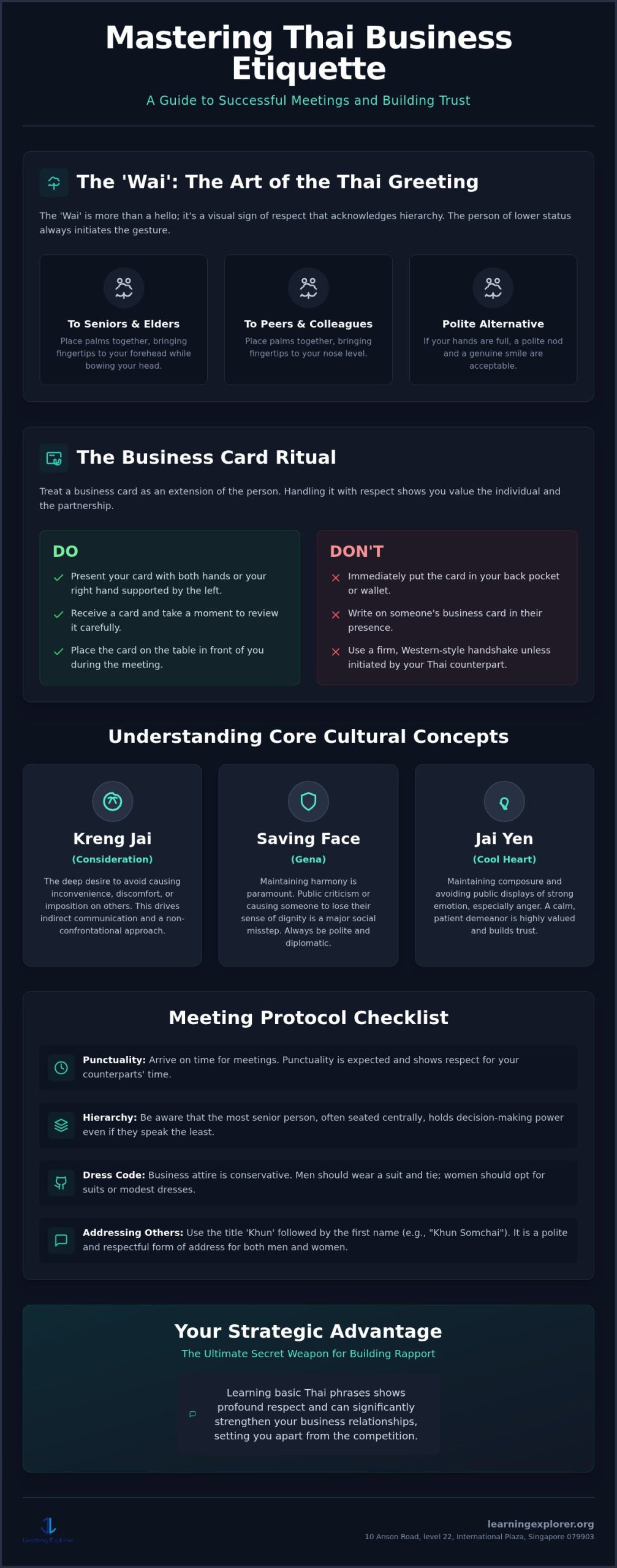
The most important rule to remember is the ‘Junior to Senior’ sequence. It reflects Thai cultural values by acknowledging seniority through action. In Thailand, the person of lower status or age always initiates the Wai. If you are meeting a senior partner, wait for a natural moment to offer the gesture first. Your hand positioning sends a clear message: for colleagues of equal status, your fingertips should reach your nose. When greeting a senior executive or an elder, aim higher, with your fingertips reaching your chin or forehead as you bow your head slightly. If your hands are full or the setting is exceptionally informal, a polite nod and a genuine smile are perfectly acceptable alternatives to a full Wai.
Meeting and Greeting: The First 60 Seconds
Address your counterparts using the title ‘Khun’ followed by their first name, such as Khun Somchai. This strikes the right balance of respect and friendliness. Don’t be misled by the famous Thai smile; in a boardroom, a smile often serves as a social lubricant to maintain harmony or mask discomfort rather than just expressing happiness. Above all, avoid intrusive physical contact like back-slapping or firm, Western-style handshakes. Respecting personal space is vital for building a foundation of trust that lasts.
The Business Card Exchange Ritual
When exchanging business cards, treat the physical card as an extension of the person’s identity. Present your card using both hands or your right hand supported by your left elbow. Once you receive a card, take a moment to review the details carefully before placing it on the table in front of you. You should never shove a card into your back pocket or write on it, as this is seen as a sign of disrespect toward the individual. By treating their card with care, you signal that you value the partnership as much as the person.
Hierarchy and the Concept of ‘Kreng Jai’ in the Boardroom
If the ‘Wai’ is the physical manifestation of respect, then ‘Kreng Jai’ is the emotional engine that drives every interaction. This concept refers to the deep desire to avoid upsetting, inconveniencing, or causing discomfort to another person. In a professional setting, mastering essential thai business etiquette for meetings requires a deep appreciation for these social layers. It influences everything from seating arrangements to feedback cycles. Hierarchy dictates that the most senior member of the Thai team usually sits in the middle of the table, flanked by their advisors. You might notice that the person speaking the most isn’t actually the one in charge; the silent senior at the center often holds the final decision-making power.
Navigating Social Standing
Thai society values status derived from age, job title, and even the prestige of one’s university. While you should show respect to senior partners, you don’t need to be subservient. A calm and professional demeanor is best. This ties into the concept of ‘Face’ or Gena, where public criticism is seen as a major social failure. As noted in this U.S. government business travel guide, maintaining a polite and non-confrontational tone is crucial for preserving rapport. Protecting a partner’s dignity ensures the relationship remains intact even during difficult negotiations. Subordinates will rarely contradict their boss in your presence, as doing so would cause the leader to lose face and damage the internal harmony of the team.
Decision-Making and ‘Kreng Jai’ Dynamics
One of the biggest challenges for Singaporean managers is interpreting the word ‘Yes.’ In a Thai boardroom, ‘Yes’ frequently means ‘I am listening’ or ‘I understand,’ rather than a formal agreement to terms. This is essential thai business etiquette for meetings to internalize early. Because of ‘Kreng Jai,’ partners may avoid delivering bad news or highlighting project risks to prevent causing you stress. It’s a core part of the process that can lead to unexpected delays in project timelines as issues remain unaddressed to maintain a pleasant atmosphere. To elicit honest feedback, try asking open-ended questions in private settings rather than in front of the whole group. If you want to master these subtle communication cues, enrolling in a Conversational Thai Course can provide the cultural fluency needed to lead effectively. It helps you read between the lines and build the genuine trust required for long-term regional expansion.
Meeting Logistics: Punctuality, Dress Code, and Seating
Logistics in Thailand are often a blend of rigid preparation and fluid execution. When it comes to essential thai business etiquette for meetings, your own punctuality is non-negotiable. Even if Bangkok’s notorious traffic causes your counterparts to arrive late, your presence on time signals respect for their schedule. Dress code follows a path of professional conservatism. In the business districts of Bangkok, men typically wear dark suits and ties, while women opt for modest corporate attire. Even in 2026, with rising temperatures, maintaining this formal appearance remains a sign of high-level commitment and professional respect.
Before the first slide of your presentation appears, expect a significant period of small talk. Jumping straight into business is often viewed as aggressive or impolite. This is the time to offer a small gift from Singapore, perhaps some local artisanal tea or premium treats. Present the gift with both hands to show sincerity. Avoiding common etiquette mistakes during this initial phase builds the necessary rapport to move forward. It’s a social bridge that proves you value the person as much as the profit.
The Anatomy of a Thai Business Agenda
A Thai meeting agenda prioritizes relationship building over immediate task completion. Don’t feel frustrated if the formal meeting ends without a signed contract; first meetings are almost exclusively for establishing trust. The real work often happens during the lunch or dinner that follows. These social settings allow your partners to observe your character in a more relaxed environment. If you’re invited to a meal, accept it as a vital part of the negotiation process. It’s where the “Jai Yen” or cool heart of a partnership is truly tested beyond the boardroom walls.
Seating Arrangements and Body Language
Seating is rarely random. The guest of honor usually sits opposite the host or at the head of the table to facilitate easy conversation. Be mindful of your body language throughout the session. Never point your feet at anyone or use them to move objects, as the feet are considered the lowest part of the body. Conversely, the head is sacred; never reach over someone’s head or touch it. Maintaining a calm, “Jai Yen” attitude is vital. Even if negotiations become difficult, showing anger or impatience will cause everyone to lose face and likely end the deal. If you’re visiting our Tanjong Pagar centre, we can help you practice these nuances and refine your approach before your flight.
The Art of Indirect Communication: Saving Face and ‘Jai Yen’
Communication in Thailand is an intricate dance of what is said and what is left unsaid. Central to this is the contrast between ‘Jai Rorn’ (a hot heart) and ‘Jai Yen’ (a cool heart). While Singaporean business culture often values efficiency and directness, showing impatience or ‘Jai Rorn’ is seen as a sign of weakness or poor breeding in a Thai boardroom. Success requires ‘Jai Yen,’ a state of calm patience that prioritizes the relationship over the immediate task. One practical way to demonstrate this is through the ‘Three-Second Rule.’ After your counterpart finishes speaking, wait for three seconds before responding. This pause signals that you’ve deeply considered their words rather than simply waiting for your turn to talk.
Interpreting non-verbal cues is another pillar of essential thai business etiquette for meetings. You’ll encounter many types of smiles; some indicate agreement, while others mask confusion or even polite disagreement. When you must deliver constructive criticism, use the ‘Sandwich Method.’ Start with a sincere compliment, deliver the feedback gently in the middle, and close with a positive statement about the future of the partnership. This protects the recipient’s dignity and keeps the project moving without damaging the underlying rapport.
Decoding the Thai ‘Yes’
In many instances, maintaining social harmony is more important than delivering a harsh truth. A Thai ‘Yes’ often functions as a polite acknowledgement of your presence rather than a binding commitment. To get to the heart of the matter, avoid asking simple ‘Yes/No’ questions. Instead, use open-ended phrases like “How do you feel about this timeline?” or “What challenges might we face with this approach?” This allows your partners to provide honest input without feeling like they are contradicting you directly. Jai Yen is the ultimate professional virtue in Thailand, representing a leader who remains composed regardless of the pressure.
Managing Disagreements Without Losing Face
If a controversial topic arises, never address it for the first time during a formal board meeting. Instead, arrange private one-on-one ‘pre-meetings’ or use trusted third-party intermediaries to deliver difficult messages. This allows both parties to reach a consensus in private, ensuring that the public meeting remains a smooth and harmonious affair. If a project hits a hurdle, stay calm and polite. Losing your temper will only cause your partners to withdraw. If you’re looking to bridge these cultural gaps, join our Conversational Thai Course to develop the linguistic and social tools needed for seamless regional leadership. This investment helps you move from being a visitor to a valued partner in the Thai market.
Beyond Etiquette: Building Long-Term Rapport with Language
While understanding the do’s and don’ts of a boardroom is vital, the ultimate secret weapon for any Singaporean professional is the Thai language itself. Learning basic phrases isn’t just about communication; it’s the highest form of ‘Kreng Jai’ in action. It demonstrates that you’ve moved beyond the labor of seeking basic information to the satisfaction of genuine cultural discovery. When you make the effort to speak their tongue, you signal a deep respect for your partners that transcends standard corporate protocols. This commitment often serves as the creative catalyst for securing successful business outcomes that others might miss.
Language proficiency allows you to spot the subtle nuances in ‘Face’ and hierarchy that are often lost in translation. You’ll begin to notice how the choice of particles or the specific use of titles like ‘Khun’ reinforces the social standing discussed in previous sections. This level of awareness helps you navigate high-stakes negotiations with a “Jai Yen” (cool heart) because you understand the ‘why’ behind the social rhythm. By leveraging the ‘Singapore-Bangkok Connection,’ firms can prepare for regional expansion with a level of cultural fluency that builds immediate trust and reduces the risk of social gaffes.
The ROI of Learning Thai for Business
Breaking the ice with senior Thai partners becomes significantly easier when you can offer a greeting with correct pronunciation and tone. It reduces the administrative burden of constant clarification and increases engagement from the very first minute. Understanding the cultural context behind the words also helps you avoid ‘Jai Rorn’ mistakes that can lead to a loss of face. To gain a broader perspective on your regional strategy, explore our analysis on What is the Most Useful Language for Business in Southeast Asia? to see how Thai fits into the shifting 2026 economic landscape.
Practical Training at International Plaza
For CBD professionals, high-quality training is just a short walk away. Our center is located directly above Tanjong Pagar MRT, making it easy to fit a session into a busy workday. Working with native-speaker instructors is the most efficient way to master the ‘Wai’ and proper forms of address in a supportive environment. This hands-on approach ensures you don’t just learn the rules of essential thai business etiquette for meetings, but you embody them. For more specific tips, check out our Thai for Singapore Business Travelers: 2026 Guide to streamline your next trip. At Learning Explorer, we position ourselves as your reliable ally, helping you transition from a visitor to a knowledgeable guide in the Thai market. To further deepen your cultural immersion, our guide on how to learn the Thai writing system fast offers a strategic 80/20 approach that busy professionals can apply immediately.
Lead with Cultural Confidence
Mastering the social mechanics of a Thai boardroom transforms you from an outsider into a trusted partner. By prioritizing ‘Jai Yen’ and understanding the deep influence of hierarchy, you protect the dignity of your counterparts while advancing your professional goals. These nuances of essential thai business etiquette for meetings are the foundation of long-term trust in the region. You don’t have to navigate these complexities alone.
Take the next step in your regional career. Enhance your professional rapport with our Conversational Thai Course in Singapore. We’re located at International Plaza, Level 22, above Tanjong Pagar MRT. Our expert native-speaker instructors provide a tailored curriculum specifically for corporate professionals, ensuring you gain the skills to lead with poise. We’re here to reduce your burdens and increase your engagement in every high-stakes negotiation. Start your journey toward the satisfaction of discovery and watch your professional impact grow.
Frequently Asked Questions
Do I need to Wai everyone in a Thai business meeting?
No, you don’t need to Wai every person in the room. In professional settings, you should primarily initiate the gesture for those who are significantly older or higher in the corporate hierarchy. If a junior staff member Wais you, a polite nod or a warm smile is an appropriate response. Mastering these nuances of essential thai business etiquette for meetings ensures you project the right level of respect without appearing socially awkward.
What should I do if a Thai partner gives me a gift during a meeting?
When a Thai partner presents a gift, accept it using both hands and offer a sincere thank you. It is customary to set the gift aside and open it later in private, rather than in front of the giver. This practice prevents any potential for “losing face” if the reaction is misinterpreted. If you’re reciprocating, choosing a high-quality item from Singapore shows you value the relationship and have put effort into the exchange.
Is it okay to disagree with a senior Thai executive in public?
Directly contradicting a senior executive in a public meeting is generally considered a major social gaffe. It causes the individual to “lose face,” which can permanently damage your rapport. If you have a conflicting view, it is much more effective to raise the issue during a private one-on-one session or via a follow-up email. This approach allows you to address hurdles while maintaining the social harmony that Thai partners value so highly.
What is the most appropriate dress code for a business meeting in Bangkok?
The most appropriate dress code for Bangkok’s corporate districts remains professional conservatism. For men, this typically means a dark business suit and tie, while women should opt for modest corporate dresses or suits that cover the shoulders. Even with the tropical heat, maintaining this formal standard signals that you take the meeting and your partners seriously. It is a visual cue of your professionalism and commitment to the local business culture.
How do I address a Thai business partner correctly using titles?
Address your Thai partners using the title “Khun” followed by their first name. This is the standard polite form of address that works well in almost any professional scenario. If they hold a specific title like Doctor or a high-ranking military rank, use that instead to acknowledge their social standing. Our native-speaker instructors can help you practice these specific honorifics to ensure your pronunciation is respectful and natural during your first interaction.
Why do Thai business meetings take longer than those in Singapore?
Thai meetings often take longer because they prioritize the relationship-building process over immediate task completion. While Singaporean culture values rapid efficiency, Thai partners prefer to establish trust and personal rapport through extended small talk before diving into the agenda. Expect several rounds of socializing and perhaps a shared meal. Viewing this time as an investment in the partnership rather than a delay will lead to better long-term results.
What are the most common body language taboos to avoid in Thailand?
The most critical body language taboos involve the feet and the head. Never point your feet at anyone or use them to move objects, as they are considered the lowest part of the body. Conversely, do not touch anyone’s head or reach over it, as the head is considered sacred. Understanding these boundaries is a core part of essential thai business etiquette for meetings, helping you maintain a respectful presence throughout your stay.
Can I use English in Thai business meetings, or should I learn Thai?
While English is widely used in corporate Bangkok, learning basic Thai phrases is the ultimate sign of respect. Speaking a few words demonstrates “Kreng Jai” and a genuine interest in the local culture, which can be your secret weapon for building deep rapport. Beyond spoken language, professionals who also invest time to learn the Thai writing system fast gain an additional edge in reading menus, signage, and documents that further signals cultural commitment to your partners. Our Conversational Thai Course provides the linguistic tools needed for these high-stakes interactions. Visit our Tanjong Pagar centre for a consultation to see how we can prepare you for regional success.