Did you know that communication gaps and language barriers can slash your team’s productivity by as much as 40%? In Singapore’s fast-paced 2026 economy, many HR leaders struggle with building a business case for corporate language training because executives often view it as a “nice-to-have” luxury rather than a strategic necessity. We understand the frustration of seeing your budget requests stalled while your international teams face daily friction in regional trade corridors. It’s time to change that narrative.
You know that your people are your greatest asset, but proving their linguistic potential in a spreadsheet is a difficult challenge. This guide promises to help you master the art of quantifying the value of language skills, turning communication into hard ROI that speaks directly to your CFO’s priorities. We’ll show you how to align your training initiatives with regional growth and select a reliable partner located right here in the CBD at 10 Anson Road, level 22, International Plaza, Singapore 079903. You’ll gain access to a structured template designed to secure executive buy-in and a clear roadmap for managing multi-language programs with ease.
Key Takeaways
- Define language skills as essential strategic infrastructure to reduce administrative burdens and friction in your regional operations.
- Master the four pillars of ROI to quantify the tangible impact of communication on your bottom line when building a business case for corporate language training.
- Compare the effectiveness of professional, instructor-led coaching against self-paced apps to ensure your team gains true conversational competence for high-stakes environments.
- Utilize our structured proposal template to present a clear, data-driven argument that resonates with executive leadership and secures your 2026 training budget.
- Discover how high-quality, vetted materials and native-speaker instructors can transform your workforce into a more engaged and globally mobile team.
The Strategic Importance of Language Proficiency in Singapore’s Regional Hub
Language isn’t just a communication tool for Singapore-based multinational corporations; it’s strategic infrastructure. When your firm manages operations across the ASEAN bloc, the ability to negotiate in a local tongue becomes as critical as your IT systems or logistics networks. Building a business case for corporate language training requires shifting the perspective from a “soft skill” to an operational necessity. The multilingual landscape of Singapore serves as a unique platform, yet the real challenge lies in bridging the gap between your CBD headquarters and regional offices in Hanoi or Bangkok.
To effectively pitch this strategic shift to your leadership team, you’ll need a structured approach. Watch this helpful video on how to frame a project business case:
Overcoming the Invisible Costs of Miscommunication
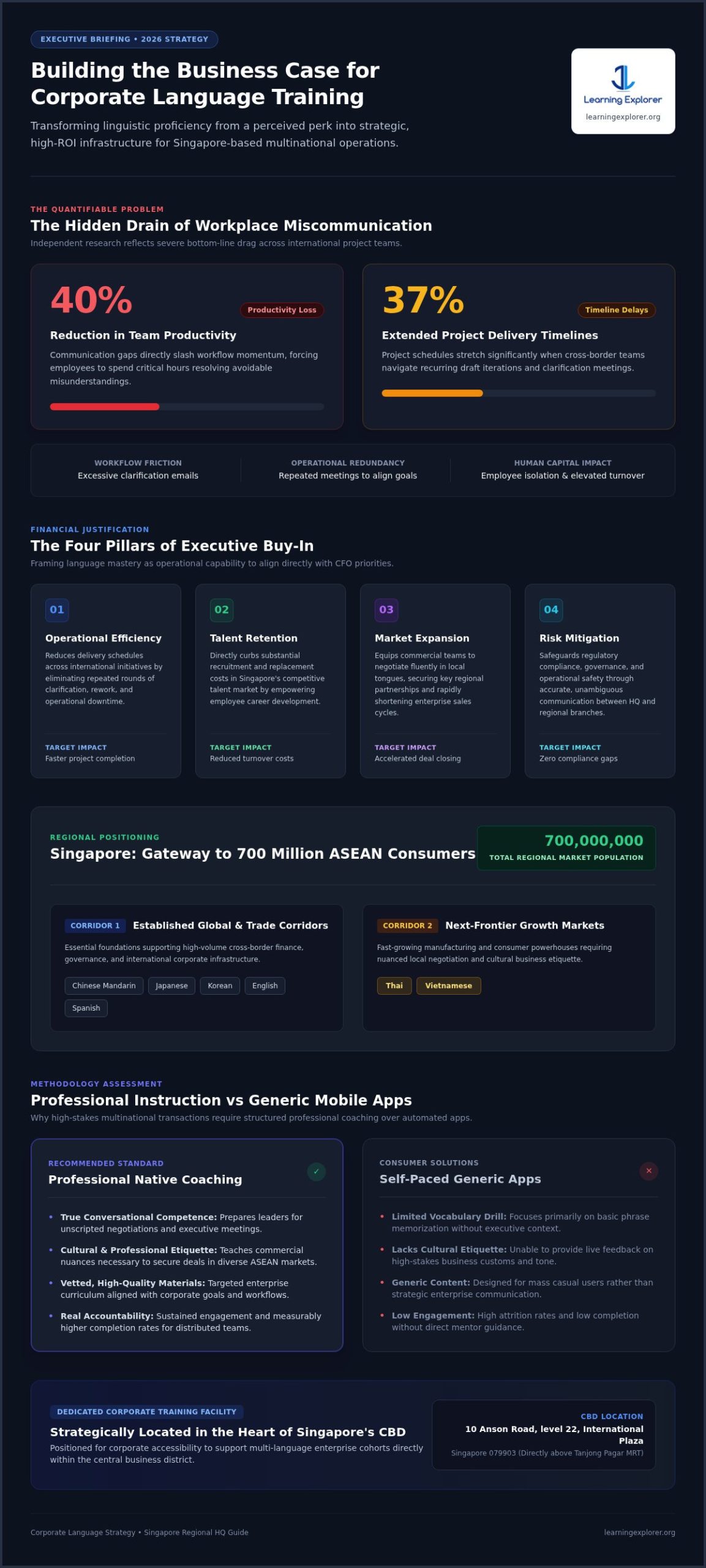
Miscommunication isn’t just awkward; it’s expensive. Workplace research from the Grammarly/Harris Poll suggests that communication gaps cause a 40% reduction in productivity and extend project timelines by 37%. Think about the hours your team spends drafting clarification emails or sitting through redundant meetings to fix simple misunderstandings. These are the invisible costs that drain your resources. There’s also an emotional toll. Employees who struggle to express themselves often feel isolated or disengaged, which leads to higher turnover. Investing in language courses singapore provides your staff with the tools to navigate these high-stakes interactions with confidence. Our training center at 10 Anson Road, level 22, International Plaza, Singapore 079903, is strategically located to support your CBD-based team with professional instruction that reduces these administrative burdens.
Singapore as the Gateway to Southeast Asia
As we move through 2026, Singapore remains the gateway to a 700-million-strong ASEAN market. While Mandarin and Japanese continue to support established trade corridors, emerging markets in Vietnam and Thailand present the next frontier for growth. Mastery of Thai or Vietnamese acts as a creative catalyst for your business development teams. It transforms the labor of seeking new leads into the satisfaction of discovery and genuine partnership. By building a business case for corporate language training, you’re positioning your firm to capture regional opportunities that others might miss due to a lack of cultural nuance. Using high-quality, vetted materials ensures your team doesn’t just learn words, but understands the professional etiquette required to close deals in these diverse markets.
Quantifying the ROI: The Four Pillars of Your Business Case
Proving the value of a training initiative requires more than just anecdotal evidence of “better communication.” To secure executive buy-in, you need a framework that translates linguistic ability into financial impact. When building a business case for corporate language training, focus on these four pillars of Return on Investment:
- Operational Efficiency: Reducing the time-to-completion for international projects by eliminating the need for constant clarification and rework.
- Talent Retention: Investing in employee growth to reduce the high costs associated with professional turnover in the competitive Singapore market.
- Market Expansion: Enabling your business development teams to negotiate directly in local languages like Thai, Vietnamese, or Japanese to accelerate sales cycles.
- Risk Mitigation: Ensuring compliance and operational safety through clear, unambiguous communication across your regional headquarters.
This strategic approach aligns with Harvard Business Review’s research on corporate language strategy, which highlights how enterprise-wide fluency reduces operational friction. By identifying these pillars, you move the conversation from a discretionary expense to a high-impact investment.
Measuring Productivity Gains
Start by calculating the “Communication Tax” currently affecting your workforce. While we previously noted the high percentage of productivity lost to communication gaps, you can quantify this locally by auditing the time your PMEs spend on rework. Set clear KPIs for your program, focusing on speed of delivery, technical accuracy, and employee confidence in high-stakes meetings. ROI in language training is the ratio of training cost to hours saved in cross-border coordination. If your team saves just two hours of rework per week, the program often pays for itself within the first quarter. You might start by exploring professional course options that target these specific functional gaps.
Retention and Employee Engagement
In the Singapore CBD, top talent expects more than just a paycheck; they want a clear path for professional development. Providing structured instruction in languages like Korean, Spanish, or Mandarin signals that you’re invested in their long-term career mobility. This investment reduces the labor of seeking information within global teams, replacing frustration with the satisfaction of discovery. Unlike the overwhelming nature of self-study apps, using high-quality vetted materials ensures that your employees feel supported rather than burdened. Professional, instructor-led training provides the human connection necessary to keep learners engaged and loyal to your firm. Building a business case for corporate language training isn’t just about the bottom line; it’s about fostering a culture of excellence and regional expertise.
Professional Instruction vs. Generic Apps: Evaluating Training Models
While mobile apps offer a sense of convenience, they often fail to deliver the professional nuance required for high-stakes Singapore boardrooms. Generic digital platforms focus on basic vocabulary recall, yet they lack the role-specific simulations and live pronunciation coaching essential for regional leadership. When building a business case for corporate language training, it’s vital to distinguish between casual learning and professional development. Busy professionals often cite time as their biggest barrier. Flexible intensive and group formats address this objection directly, allowing your staff to integrate learning into their CBD schedules without disrupting core operations. Live, instructor-led sessions foster engagement levels that self-paced apps simply can’t match, ensuring your team doesn’t just play with a language but actually masters it for business.
The Human Element in Professional Communication
Negotiation is about more than just words; it’s about reading the room. In high-stakes environments, a translation algorithm can’t replace the nuance of a bilingual guide who understands professional tone. Our instructors act as mentors, helping staff transition from the labor of seeking the right word to the satisfaction of discovery in a new language. This human connection is a core reason why many consider us the best language school singapore for corporate needs. Certified native-speaker instructors help your team with accent neutralisation and cultural etiquette, preventing the friction caused by social misunderstandings. This approach aligns with national workforce development goals that prioritize high-quality, capability-building instruction over passive content consumption.
Customisation for Industry-Specific Needs
Every sector has its own linguistic demands. A logistics firm expanding into Thailand needs different vocabulary than a fintech startup targeting Vietnam. Professional instruction allows for a curriculum tailored to Finance, Tech, or Logistics, focusing on Japanese technical terms or Business Mandarin writing. This specificity transforms the training from a generic perk into a functional tool. Partnering with a professional school also reduces the administrative burden on your HR department. You gain a strategic ally that handles progress tracking and reporting instead of managing hundreds of individual app licenses. This efficiency is a cornerstone when building a business case for corporate language training; it proves you’re optimizing both employee time and organizational resources. We use only high-quality, vetted materials from reputable institutions like Oxford University Press. This ensures your team learns from structured, reliable sources rather than unorganized and overwhelming web content.
Step-by-Step Template for Your Corporate Language Training Proposal
Securing budget approval for new initiatives requires a document that resonates with the priorities of the C-suite. Building a business case for corporate language training is significantly easier when you follow a structured, professional format that speaks the language of your CFO. Use this five-part template to organize your data and present a compelling argument for your 2026 regional expansion goals.
- Section 1: Executive Summary – Aligning language skills with specific corporate growth targets in ASEAN markets.
- Section 2: Problem Statement – Identifying current communication friction points, such as delayed project timelines or client misunderstandings.
- Section 3: Proposed Solution – Selecting a CBD-based partner focused on instructor-led coaching and vetted materials.
- Section 4: Financials & ROI – Projecting the value of improved efficiency and the cost-avoidance of operational errors.
- Section 5: Implementation Roadmap – Outlining group sizes, flexible schedules, and training locations.
By following this logical flow, you move from the labor of seeking approval to the satisfaction of discovery as stakeholders recognize the strategic value of your proposal. This framework helps you position language training as a catalyst for better regional outcomes rather than a discretionary expense.
Drafting the Executive Summary
Your summary should be the most punchy part of the document, designed for quick executive scanning. Use action-oriented verbs like Transform, Enable, and Accelerate to describe the impact on your workforce. Focus on the benefit to the ultimate beneficiary, whether it is a regional partner in Thailand or a new client base in Vietnam. Keep this section benefit-driven; it should promise to reduce administrative burdens while simultaneously enhancing the professional impact of your international teams.
Defining the Implementation Strategy
Be specific about how the training will integrate into the daily workflow of busy professionals. Choose between private coaching for leadership or group intensive classes for regional project teams. Leverage the convenience of a training center situated directly above Tanjong Pagar MRT. This accessibility ensures that your CBD-based teams can attend sessions with minimal disruption to their core duties, maintaining high engagement levels throughout the program.
When you reach the financials, contrast the investment with the cost of inaction. A sample sentence for this section might read: “The annual investment per employee for Business Mandarin training represents a fraction of the potential revenue lost from a single mismanaged regional contract due to linguistic or cultural errors.” This comparison helps executives view the program as a vital risk-mitigation tool. If you are ready to finalize your pitch, reach out to our team for a customized training quote to include in your proposal. Building a business case for corporate language training is about proving that clear communication is the fastest route to regional growth.
Why Learning Explorer is the Strategic Ally for Singapore MNCs
Choosing the right partner is the final, most critical step in building a business case for corporate language training. You aren’t just looking for a service provider; you need a strategic ally that understands the taxing nature of regional leadership. At Learning Explorer, we position ourselves as a knowledgeable guide, dedicated to reducing your administrative burden while maximizing employee engagement. Our instructors bring a professional and deeply empathetic approach to every session, ensuring that your team feels supported throughout their learning journey. We replace the labor of seeking with the satisfaction of discovery, using high-quality, vetted materials that far outperform the unorganized and overwhelming content found in generic digital libraries.
Our dual promise is simple: we help you increase operational efficiency while simultaneously enhancing the professional impact of your workforce. By providing a structured, instructor-led environment, we ensure that the linguistic skills your team acquires are immediately applicable to high-stakes negotiations and regional project management.
Convenience in the Heart of the CBD
For busy PMEs and executives, time is the most precious resource. Our training facility is strategically located at International Plaza, situated directly above Tanjong Pagar MRT. This prime location allows for seamless attendance, as employees can transition from their desks to the classroom in minutes. We provide a professional environment specifically designed for adult learners, offering a quiet, focused space that consumer-grade apps or crowded cafes can’t replicate. This physical presence in the CBD fosters a sense of commitment and community, which is essential for maintaining long-term training momentum.
Customised Corporate Solutions
Every multinational corporation has unique goals, whether it’s expanding into the Thai market or strengthening ties with Japanese partners. We offer tailored Business English, Mandarin, and Japanese courses, alongside conversational modules for Korean, Spanish, Thai, and Vietnamese. Our native-speaker instructors are bilingual and possess a deep understanding of the local Singapore market, ensuring that cultural etiquette is taught alongside grammar and syntax. This high-touch guidance is what distinguishes us from scalable online products that lack personalized nuance. We work closely with HR departments to manage the logistical details, allowing you to focus on high-level strategy. If you’re ready to secure your 2026 budget and transform your team’s communication capabilities, request a customized corporate training proposal from Learning Explorer today. Building a business case for corporate language training is a mission-driven investment in your company’s regional future.
Transforming Communication into Strategic Growth
The path to regional expansion in 2026 requires more than just a vision; it demands a team that can navigate diverse linguistic landscapes with confidence. You’ve learned that language is strategic infrastructure. By quantifying the four pillars of ROI, you can turn a “nice-to-have” skill into a boardroom priority. Building a business case for corporate language training is about proving that clear communication reduces administrative friction and accelerates market entry.
Don’t settle for generic apps when high-stakes negotiations are on the line. Our certified native-speaker instructors use high-quality materials from reputable partners like Oxford University Press and Seoul National University to ensure your team achieves professional fluency. Located directly above Tanjong Pagar MRT, we provide the convenience your CBD-based executives need to succeed without disrupting their busy schedules. It’s time to transition from the labor of seeking to the satisfaction of discovery.
Ready to lead your firm toward a more connected future? Request a Personalised Corporate Training Consultation at Learning Explorer today. We’re here to be your visionary ally in reducing burdens and inspiring your workforce to reach new heights.
Frequently Asked Questions
How do I calculate the ROI of language training for a small team?
Calculating the ROI involves comparing the cost of training against the productivity gains achieved through reduced communication friction. Focus on metrics like decreased project lead times and a reduction in the time spent on clarifying internal emails. By auditing the “Communication Tax” on your team’s output, you can present a data-driven argument that shows how building a business case for corporate language training directly accelerates revenue and reduces the administrative burden on HR.
What is the most useful language for business in Southeast Asia in 2026?
Thai and Vietnamese are currently the most strategic languages for business expansion due to the rapid growth of these ASEAN trade corridors. While Mandarin and Japanese remain vital for established partnerships, the ability to negotiate directly in Thai or Vietnamese provides a unique competitive edge. Mastering these languages allows your team to navigate local markets with a level of cultural nuance that generic translation tools simply cannot provide.
How long does it take for employees to reach professional fluency?
Employees typically reach a functional level of professional fluency within 150 to 200 hours of structured instruction. The exact duration varies based on the learner’s starting point and the intensity of the chosen format, such as private coaching or group intensive classes. By using high-quality, vetted materials, we ensure that every session is optimized for speed, helping your team master Business Mandarin or Japanese without unnecessary delays.
Can language training be customized for specific industries like Fintech or Law?
Language training can be deeply customized to meet the unique linguistic demands of the Fintech, Law, or Logistics sectors. This ensures your staff learns the technical jargon and professional writing styles essential for their specific roles. When building a business case for corporate language training, highlighting this industry-specific focus proves that the program is a functional tool designed to reduce operational risks and enhance client rapport.
Why is instructor-led training better than mobile apps for corporate teams?
Instructor-led training is superior because it offers real-time feedback and the human empathy required for professional relationship building. While apps focus on rote memorisation, live sessions with native-speaker instructors allow for accent neutralisation and nuanced negotiation practice. This high-touch approach ensures that your team doesn’t just learn a language but gains the conversational confidence needed to represent your brand effectively in regional headquarters across Singapore and beyond.
What are the logistical benefits of a CBD-based language school in Singapore?
The primary logistical benefit is the extreme accessibility for your workforce, which directly impacts attendance rates and program success. Our training center is located at International Plaza, which sits directly above Tanjong Pagar MRT. This eliminates the need for long commutes, allowing your PMEs to transition from high-stakes meetings to their language modules in minutes. A CBD presence also ensures that the training environment remains professional and aligned with your corporate culture.
How does language training improve talent retention in MNCs?
Language training improves talent retention by signaling a deep commitment to an employee’s long-term career trajectory within the firm. Staff who feel linguistically equipped for regional leadership roles are significantly more likely to remain with their employer. This investment reduces the labor of seeking new opportunities elsewhere, as employees find the satisfaction of discovery and growth right within your organization’s global network, fostering a loyal and highly skilled workforce.
What should be included in a corporate language proficiency assessment?
A robust corporate assessment should include a mix of oral communication tests, role-specific simulations, and cultural etiquette evaluations. It’s not enough to test grammar; you must measure an employee’s ability to handle high-stakes business interactions. These assessments provide a clear benchmark to track progress and justify your budget. Starting with a professional evaluation ensures that the training curriculum is perfectly aligned with your firm’s specific operational needs and growth targets.