Romanised Korean can look like a shortcut, but it may hide how words are actually pronounced. A better basic korean lesson starts with Hangul, then connects what you read to phrases you can use and sentence patterns you can adapt. For example, practise reading a greeting in Hangul, listening to it, and saying it aloud rather than relying on its romanised spelling alone.
If unfamiliar symbols feel intimidating, you’re not alone. It’s also easy to memorise a greeting without knowing how to adapt it when you want to introduce yourself. This practical beginner lesson will help you take those first steps: recognise common expressions, practise polite greetings, and build a simple self-introduction. You don’t need to learn every letter or grammar rule before trying your first phrase.
We’ll start with how Hangul works, move into useful phrases, and show how basic sentence patterns help you create new expressions instead of relying on memorised lines. You’ll also find a manageable routine for practising and a guide to choosing between self-study, group lessons, and private lessons. Start with a small set of sounds and phrases, review them regularly, and add new material when you can recall what you have already practised.
Key Takeaways
- A basic korean lesson introduces the foundations of reading, pronunciation, useful phrases, and simple sentence building. It is a starting point, not a promise of instant fluency.
- Learn how Hangul symbols combine into syllable blocks, and connect the script with spoken Korean instead of relying on romanisation alone.
- Practise a flexible sentence pattern so you can change a name or role, rather than depending only on memorised phrases.
- Build a repeatable routine that moves from Hangul review to listening, speaking, and creating a sentence of your own.
- Compare self-study, group lessons, and private lessons by the kind of feedback and interaction you need. If you want guided practice, explore conversational Korean learning in Singapore.
What Does a Basic Korean Lesson Teach First?
A basic Korean lesson introduces the writing system, pronunciation, useful phrases, and simple sentence building. Rather than trying to cover everything at once, it connects these foundations: recognise a written form, hear how it sounds, and practise using a short expression in context. The aim is a practical starting point, not fluency or mastery after one lesson.
For a visual overview of beginner topics, watch this lesson from Learn Korean with KoreanClass101.com:
A useful first Korean lesson connects Hangul, pronunciation, practical phrases, and simple sentence building. Start with a small set of Hangul symbols. Look at a written example, listen to how it is spoken, and repeat it aloud. Then practise a polite greeting and a short self-introduction. This sequence turns unfamiliar writing into something you can hear and use, rather than a page of symbols to memorise.
What Should a Beginner Be Able to Do After One Lesson?
Keep the first milestone modest. After an introductory lesson, you might recognise some Hangul, identify a polite greeting, and attempt a brief introduction. You may still need notes or a model to recall the words. That’s normal: repeated practice helps new sounds and forms become more familiar.
Use this checklist to notice progress without setting an artificial deadline:
- I can recognise some of the Hangul forms I practised.
- I can follow and repeat a short spoken example.
- I can try a polite greeting or simple self-introduction.
Mark what feels comfortable and what needs another review. If you can recognise a form but cannot say it yet, make listening and speaking your next practice step. Progress is easier to build when you know what to revisit.
Why Learn Hangul Alongside Spoken Phrases?
Hangul is the Korean writing system. Learning its forms alongside spoken examples helps you connect what you see with what you hear. You can explore the Korean alphabet for an overview of its letters and structure, then return to beginner materials to practise at a manageable pace.
Romanisation can offer an initial clue, but it shouldn’t replace exposure to Hangul and recorded or spoken Korean. A romanised spelling may not make every sound clear. Instead, look at the written form, listen to a model, and repeat it aloud. If the spelling and sound seem different, use the audio as your pronunciation reference. Reading, listening, and speaking reinforce one another as you learn phrases and build your first sentences.
Learn Hangul and Korean Pronunciation in Your First Lesson
Hangul can seem unfamiliar at first, but you don’t need to learn every letter and sound at once. Start with a small group of symbols, practise how they look and sound, then build up gradually. A basic korean lesson is more useful when it pairs written Hangul with listening and speaking, rather than treating pronunciation as a separate task.
Romanisation can offer a rough first clue, but it uses English letters to represent Korean sounds and can’t capture every distinction neatly. Use it as a temporary aid, not a substitute for reading Hangul and listening to Korean. The Defense Language Institute Foreign Language Center provides free eLearning products for independent study, which may offer another way to practise alongside a lesson.
How Are Hangul Letters Combined Into Syllable Blocks?
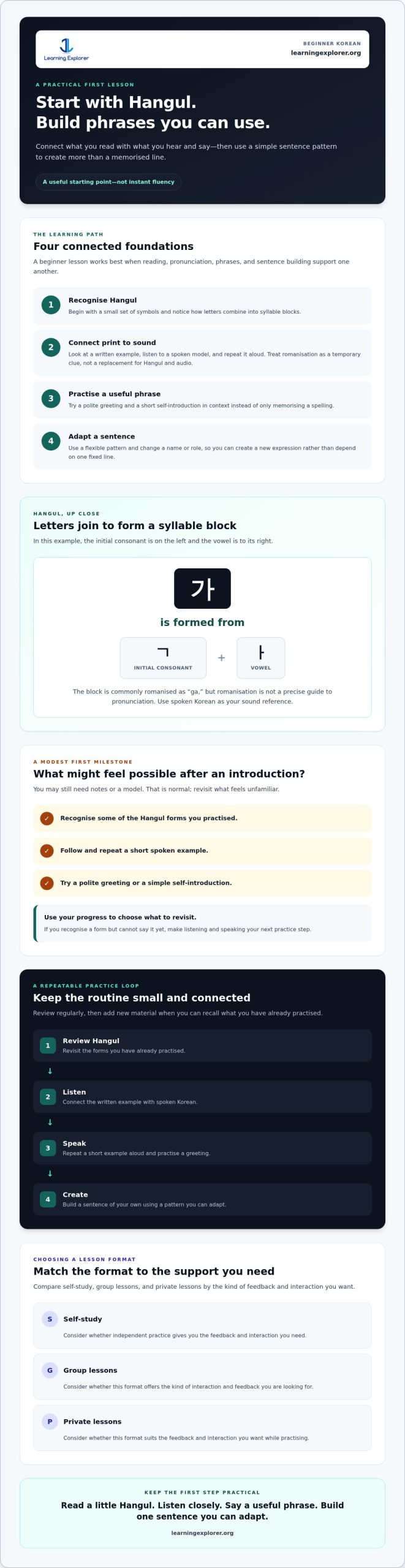
Hangul letters are grouped into syllable blocks. For example, 가 consists of the initial consonant ㄱ and the vowel ㅏ. The consonant appears on the left, and the vowel sits to its right. Together they form one block, commonly romanised as “ga.” This example shows how letters combine, but romanisation isn’t a precise guide to pronunciation.
Focus on recognising a few letters and noticing their positions within a block. You don’t need to memorise the entire sound system before you begin reading. Learn a small set, check whether you can recognise it without looking at your notes, and add more as the patterns become familiar.
How Can Beginners Practise Korean Sounds?
Pair each written example with an audio recording or instructor model when one is available. Listen first, repeat the sound, then look back at the Hangul. This helps you connect the symbol to what you hear and say.
Try this simple practice loop:
- Look at one Hangul syllable or short word.
- Listen to a clear spoken model more than once.
- Repeat it aloud, then record a short attempt.
- Listen back and compare your attempt with the model.
Some Korean sounds won’t match neatly with familiar English spellings, so don’t worry if a romanised version seems confusing. Listen for the sound rather than relying on an English-letter approximation, and ask an instructor for feedback if you’re unsure. Learning Explorer offers conversational Korean courses in Singapore. You can explore conversational Korean learning if you’d like guided practice.
Build Your First Korean Sentences Without Memorising Random Phrases
You don’t need to master every Korean grammar rule before you start speaking. Begin with a useful expression, then learn a small pattern that lets you change one part and make a new sentence. That shift turns a basic korean lesson from phrase collecting into practical sentence building.
For example, 은 and 는 are topic markers. In 저는, “I” is presented as the topic of the sentence. You don’t need to learn every detail about these markers right away. Notice how they work in a model sentence, then practise saying the whole sentence aloud.
| Practice approach | What you learn |
|---|---|
| Memorise an isolated phrase | One expression for one familiar situation |
| Learn a reusable pattern | A structure you can adapt with a different name or role |
Which Korean Greetings and Expressions Can Beginners Practise?
안녕하세요 (annyeonghaseyo) is a common polite greeting. Practise it as a friendly, respectful way to greet someone in many everyday situations, while remembering that context and your relationship with the other person still matter.
감사합니다 (gamsahamnida) is a polite way to say “thank you.” The romanisation is a guide to the Korean spelling, not an exact pronunciation instruction. Listen to a spoken model and repeat it, paying attention to how the full word sounds rather than reading each English letter as if it were an English word.
How Can You Make a Simple Korean Self-Introduction?
Try the pattern 저는 ___예요/이에요, meaning “I am ___.” Use 예요 after a noun ending in a vowel sound, as in 저는 민수예요 (“I’m Minsu”). Use 이에요 after a noun ending in a consonant, as in 저는 학생이에요 (“I’m a student”). The name or role goes before the polite ending.
Korean sentence order doesn’t always match English, so learn this pattern as a complete unit before analysing every grammar rule. Replace the example with your own name or role and practise introducing yourself. To explore additional Korean language learning opportunities, consult the Center for Applied Linguistics resource guide as you plan what to study next.
Practise a Basic Korean Lesson With a Simple Weekly Routine
A steady routine helps turn new Korean into something you can recall and use. Keep each review manageable, and repeat the same learning sequence so you’re not spending your practice time deciding what to do next. There’s no fixed session length that guarantees progress; consistency and active practice matter more than racing through a long list.
Follow this sequence whenever you sit down to study:
- 1. Review Hangul. Look over a small group of letters or syllable blocks. Try to recognise them before checking your notes.
- 2. Listen and repeat. Play a spoken model, listen closely, then say it aloud. Repeat any sound that still feels uncertain.
- 3. Practise a phrase. Choose one expression for a practical context, such as greeting someone or introducing yourself.
- 4. Create one sentence. Adapt a pattern you’ve learned with a different name, role, or detail. Say it aloud, then write it down.
Use a simple tracker after each session. Note which Hangul forms you recalled, which phrase you could say without looking, and any pronunciation or sentence-building questions to revisit. This gives your next practice session a clear starting point and helps you avoid repeatedly studying only what already feels easy.
How Should You Review New Korean Words and Phrases?
Keep related vocabulary together. A small “greetings” set or “introducing yourself” set is easier to practise in context than a long mixed list. Cover the meanings and try to recall each word or phrase before checking your notes. Then listen to the sound and repeat it instead of only rereading the spelling.
Bring back older material as you add a little new content. For example, review a familiar greeting before practising a new self-introduction. If you can recognise a word but can’t recall its meaning or say it comfortably, keep it in your review set. There’s no need to move on just because it appeared in an earlier session.
How Can You Tell When You Need More Guided Practice?
Self-study can work well, especially when you have clear examples and a routine. Consider getting feedback if the same pronunciation questions keep returning, you’re unsure how to form a sentence, or it’s difficult to maintain regular practice alone. An instructor can help clarify a point and give you a chance to use Korean with another person.
If you’d like structured support, you can learn more about Learning Explorer’s conversational Korean course in Singapore. Check which lesson format and current arrangements fit your goals, and use guided practice to complement the independent routine you’ve built.
Continue Learning Korean With the Right Lesson Format in Singapore
A basic korean lesson can help you begin, but your next step should fit how you learn best. Consider how much feedback you want, whether you value practising with other learners, and how lessons could fit your schedule. There isn’t one format that suits everyone. Choose an approach you can sustain and that gives you a way to practise the skills you care about.
Which Korean Lesson Format Fits Your Learning Goals?
- Self-study: A good fit if you prefer to set your own pace and can keep up regular practice. You can revisit Hangul or phrases as often as you need, though you’ll need ways to check pronunciation and clarify questions.
- Group lessons: Consider this format if you’d like instructor guidance and opportunities to practise Korean with others. Ask how interaction and feedback work in the current class.
- Private lessons: This may suit learners who want individual attention. Ask how the instructor can tailor practice to your starting point and goals.
Learning Explorer offers conversational Korean courses in Singapore, with group, private, and intensive formats. Current class availability and arrangements can change, so confirm the details directly rather than assuming a particular format or schedule is open.
What Should You Ask Before Choosing a Korean Course?
Before enrolling, ask how the course supports beginners with Hangul, speaking practice, and feedback. Find out whether the teaching approach matches your goals, such as everyday conversation or building confidence with introductory phrases. You can also ask about current schedules, instructor details, and which format is suitable for your experience level.
Learning Explorer is located in Singapore’s Central Business District, which may be convenient if you’re looking for lessons in that area. Check the current course arrangements and location details directly. For wider course-selection context, look for the guide titled Language Courses in Singapore.
If you’re ready to move from independent practice to structured learning, use your goals and preferred learning format to ask which option may suit you. You don’t need to have mastered the basics first.
Take Your First Steps in Korean Further
A useful basic korean lesson gives you more than a list of phrases. Start by recognising Hangul, connect written forms with spoken sounds, and practise a simple sentence pattern you can adapt. Then return to those foundations regularly, building confidence one small step at a time.
You don’t need to master everything before you begin speaking. A polite greeting, a short introduction, and a steady review routine are meaningful progress. If you’d like guidance as you continue, Learning Explorer offers conversational Korean courses in group, private, and intensive formats. Its instructors are certified native speakers who are also bilingual. Ask the school about current class arrangements and which format may fit your goals.
Explore conversational Korean learning with Learning Explorer and ask about a course format that fits your goals in Singapore.
Frequently Asked Questions
Is Korean hard to learn for beginners?
Korean can feel challenging at first, but beginners can make it manageable by learning one foundation at a time. Start with Hangul, then practise a few sounds, greetings, and simple sentence patterns. Some pronunciation and grammar may feel unfamiliar if you’re used to English, so expect to review. You don’t need to understand every rule before you can begin recognising words or trying short expressions.
Can I start learning Korean without knowing Hangul?
Yes, you can start with spoken phrases or romanised examples, but make Hangul an early part of your learning. Romanisation can help you recognise a word at first, though it may not show Korean pronunciation precisely. Learning the script helps connect written forms with what you hear. Begin with a small group of letters and practise them alongside audio instead of waiting until you know the whole alphabet.
What should I learn first in a basic Korean lesson?
A basic korean lesson can start with Hangul recognition and pronunciation, then introduce a polite greeting and a simple self-introduction. Practise one reusable sentence pattern so you can change a name or role rather than memorising only one line. Keep the first goal practical: recognise a few written forms, listen to a spoken model, and try using a short expression. Revisit anything that still feels unfamiliar.
How do I pronounce Korean words accurately?
Pair Hangul with a clear audio recording or instructor model. Listen to the full word, repeat it aloud, and record a short attempt so you can compare what you said with the model. Use romanisation only as a rough reference, since English spellings may not represent Korean sounds closely. If a particular sound remains unclear, ask a Korean speaker or instructor for feedback and keep practising that example.
How long does it take to learn basic Korean?
There’s no single timeline for learning basic Korean. Progress depends on your goals, how often you practise, and how much time you spend listening and speaking as well as reviewing Hangul. Set practical milestones instead of a deadline: recognise the symbols you’ve studied, greet someone politely, or introduce yourself with a simple pattern. Regular review can help you build on those foundations at a pace that suits you.
Is a Korean class better than learning Korean by yourself?
It depends on how you prefer to learn. Self-study gives you control over your pace, while a class can provide instructor guidance and opportunities to practise with others. A private format may suit someone seeking individual attention. Learning Explorer offers conversational Korean courses in group, private, and intensive formats. Ask about current arrangements, schedules, and feedback so you can choose an option that fits your needs.
Can adults learn Korean in Singapore as beginners?
Yes. Adults can begin learning Korean in Singapore without prior experience, starting with Hangul, useful expressions, and simple speaking practice. Learning Explorer offers conversational Korean courses for adult learners, as well as group, private, and intensive learning formats. Confirm current class availability, schedules, and which format is suitable for beginners directly with the school. Choose a learning routine you can maintain alongside your other commitments.