What if your next presentation felt like a conversation you could guide, rather than a performance you had to survive? A business english presentation skills course Singapore professionals can use should do more than polish pronunciation. It should help you shape a clear message, explain it in natural workplace English, and stay composed when questions shift the discussion.
If you know your subject but find it difficult to organise your ideas in English, or feel anxious in front of colleagues, clients, or senior stakeholders, you’re not alone. Confident presenting takes language practice and a structure that makes your thinking easy to follow. This guide explains what to look for in presentation training, how Business English practice can strengthen your delivery and Q&A, and how to compare private, group, intensive, and customised corporate learning. Learning Explorer offers Business English courses for individuals and organisations, taught by certified native-speaker instructors who are also bilingual. Explore practical ways to communicate more clearly and respond with confidence.
Key Takeaways
- Use a clear structure to help colleagues, clients, and stakeholders follow project updates, proposals, and recommendations.
- Assess a business english presentation skills course singapore by how it combines language accuracy, useful vocabulary, signposting, and audience awareness.
- Compare private, group, intensive, and customised corporate learning to find a format that suits your practice needs and work schedule.
- Prepare with a focused message, organised points, rehearsal, and adaptable phrases for questions and transitions.
- Explore how structured Business English learning can support more confident workplace communication.
Why Business English presentation skills matter in Singapore workplaces
A project update can feel straightforward until you need to explain a delay in English. A proposal may be well researched, yet its recommendation can get lost if the key points arrive out of order. In Singapore workplaces, presentations often require you to make complex information clear to people with different roles, priorities, and familiarity with the subject.
Business English presentation skills mean organising and delivering a workplace message in clear, purposeful English, while adapting your language and delivery to your audience. Effective presentations draw on both communication and subject knowledge. A clear structure shows how points connect, while precise wording and signposts help listeners follow your argument. These skills can support understanding, but they can’t guarantee a particular decision or response.
For an introduction to the broader skill of speaking to an audience, explore this overview of public speaking. The video below also shares presentation and confidence tips.
Where professionals use presentation English
Presentation English is useful for team briefings, client pitches, project updates, and stakeholder presentations. The purpose shapes the message: a briefing may focus on progress and next steps, while a client pitch needs to explain a proposal clearly. Think about what your audience already knows. Colleagues familiar with a project may need a concise update; stakeholders new to the details may need context and definitions of unfamiliar terms. In Singapore’s CBD, professionals moving between offices, meetings, and client discussions may encounter all these situations.
What makes presenting in English challenging?
Knowing what you want to say doesn’t always make it easy to say smoothly. You may need to organise ideas quickly, choose precise vocabulary, and signal transitions so listeners can distinguish the main point from supporting details. Delivery adds another challenge: speaking too quickly can blur key information, while searching for words can disrupt your pace. Questions can feel especially demanding when you have to understand, think, and respond under pressure.
Confidence and English proficiency are related, but they aren’t the same. A fluent speaker may still feel anxious in front of senior stakeholders; another presenter may feel at ease but want help with vocabulary or sentence structure. A business english presentation skills course singapore learners consider should address their specific needs, whether that means shaping a clear storyline, practising transitions, refining spoken English, or preparing responses. Repeated, practical practice gives you space to work on these skills before using them in a workplace presentation.
What a Business English presentation skills course should help you practise
A Business English presentation skills course applies workplace English to the full presentation process: planning a message, choosing language for the audience, delivering key points, and responding to discussion. It brings language and communication together. Grammar and vocabulary matter, but so do structure, signposting, and understanding what listeners need to know.
This differs from general English practice by applying communication skills to a specific task. General lessons can strengthen speaking, listening, vocabulary, and accuracy, all of which support professional communication. Presentation practice puts those skills to work when explaining a recommendation, introducing a proposal, or summarising project progress. English has a long-standing place in Singapore’s economic story; a speech preserved by the National Archives discusses the role of English in Singapore’s economy.
Build a clear message and presentation structure
Begin with the purpose: what should your audience understand by the end? Consider who is listening, then choose one central message to guide the presentation. Arrange supporting points in a logical order and close by restating the main idea or clarifying the next step.
Signposts help make that structure clear as you speak. Try “First, I’ll outline the current situation,” “The next point is…” or “To sum up, the recommendation is…” Concise wording also helps. Instead of describing every project detail, state the key result, explain why it matters, and give the supporting evidence. The aim isn’t to oversimplify, but to make your reasoning easier to follow.
Practise delivery, visuals, and audience questions
Practise your pace, emphasis, pronunciation, and professional tone. Pause after an important point, stress the words that carry your meaning, and speak at a pace that gives listeners time to process information. Slides should reinforce your spoken message, not reproduce a full script. A short heading, chart, or key phrase can guide attention while you explain the detail.
Make questions part of your rehearsal, not an afterthought. Practise confirming what someone means, asking for clarification, and responding in a few organised sentences. If you’re unsure, you can say, “I don’t have that figure with me, but I can clarify the point.” This lets you respond calmly without pretending to know something you don’t.
To explore structured Business English learning for professional communication, take a look at Learning Explorer’s English courses for adults. A business english presentation skills course singapore learners choose should give them a practical setting to connect accurate language with a clear message and purposeful delivery.
Compare presentation training formats for Singapore professionals
The right format depends on what you want to practise, how much individual attention you prefer, and whether you’re learning alone or with colleagues. A business english presentation skills course singapore professionals choose may take different forms. Compare the learning experience against your needs rather than assuming one format suits everyone.
| Format | Interaction and personalisation | Peer practice | May suit |
|---|---|---|---|
| Private | Focused interaction around individual learning goals and presentation needs. | Limited peer practice, with attention centred on your own speaking tasks. | Learners who want to work on specific challenges, such as phrasing, structure, or answering questions. |
| Group | Shared instruction and practice, with less individual focus than private learning. | Opportunities to present ideas to peers and learn from different communication styles. | Learners who value discussion and want to practise presenting in front of others. |
| Intensive | A concentrated learning format for focused practice. | Peer practice depends on whether learning is individual or in a group. | Those who prefer a more focused period of learning and can make room for it in their work schedule. |
| Customised corporate | Learning can be shaped around an organisation’s communication goals. | Can give colleagues a shared context for practising workplace communication. | Companies looking to develop presentation English around relevant team or organisational needs. |
Private lessons or group learning?
Private learning suits people who want to focus closely on their own presentation tasks or practise at a pace that works for them. Group learning offers a different benefit: presenting to peers creates an opportunity to practise speaking to an audience and hear how others express their ideas. Neither format is universally better. Consider whether focused individual attention or shared practice feels more useful and motivating.
When does corporate training make sense?
Corporate training can suit teams with shared communication needs, such as explaining recommendations or presenting project information in English. Learning Explorer offers customised corporate language training, shaped around relevant workplace goals. For wider context on course options, read this Singapore English language school guide.
Whichever format you choose, look for a clear connection between practice and real communication tasks. Stanford Graduate School of Business also shares guidance on confident and compelling presentations, including planning and delivery. Use your presentation goals to decide which learning environment will help you practise consistently.
Prepare for an English presentation with a practical step-by-step framework
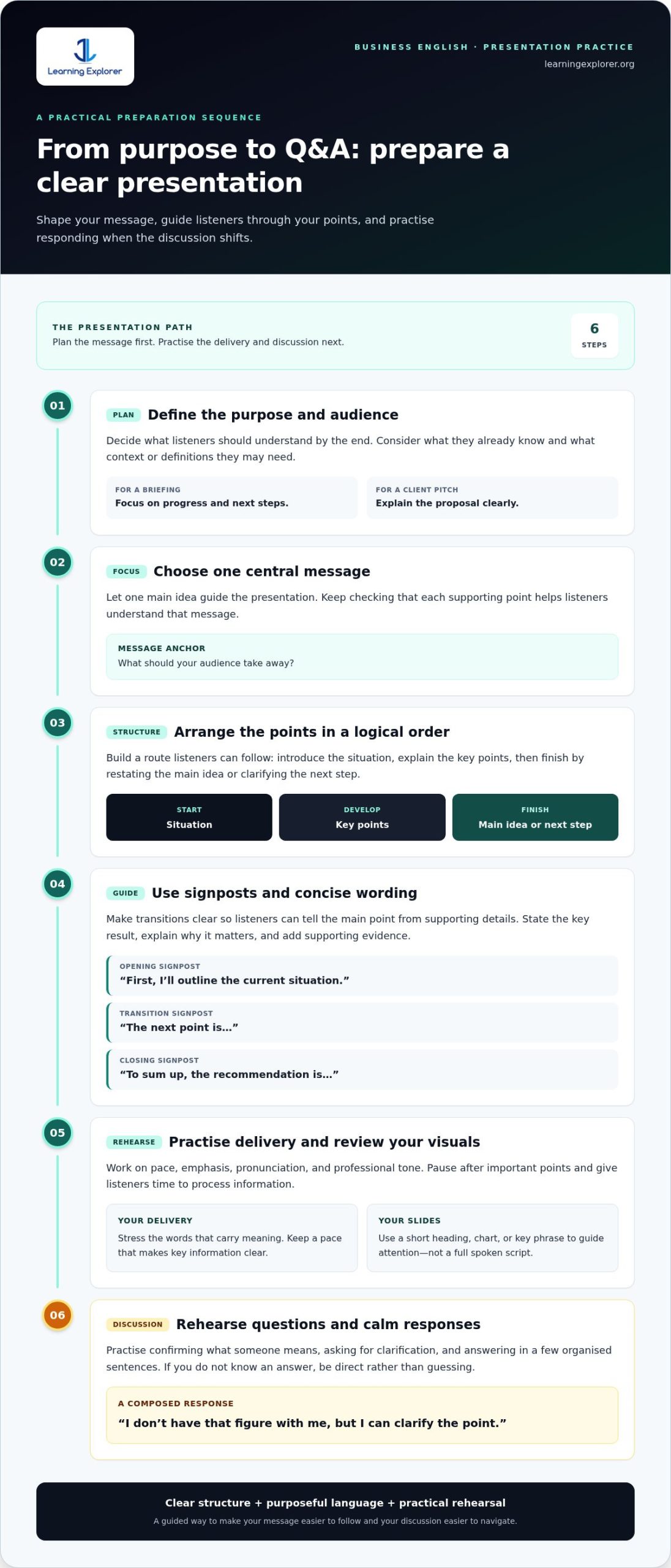
A simple preparation sequence can make a presentation easier to organise and deliver. Start with your audience, then shape one message around what they need to know. Use these steps as a flexible guide, not a script to follow word for word.
- 1. Define your audience. Consider what listeners already know, what they need from you, and what questions they may have.
- 2. Choose one main message. Complete this sentence: “By the end, I want my audience to understand that…” Keep the answer focused.
- 3. Organise your supporting points. Arrange details in a logical order, such as context, key finding, and recommendation. Add transitions like “Next, let’s look at…” and “This leads to my main recommendation.”
- 4. Rehearse aloud. Practise the opening, transitions, and close. Note any phrases that feel awkward or difficult to say, then simplify them.
- 5. Prepare for questions. Think through likely questions and the evidence or examples that could help you respond. Prepare key points, not fixed answers.
Plan the message before writing slides
Start with your audience’s needs and the takeaway you want them to remember. Build a clear route through your supporting points, using signposts to show how they connect. Then create simple slides that reinforce what you’re saying, such as a short heading or relevant visual. Avoid filling slides with a full speech. Your audience should be able to listen without reading the same explanation on screen.
Rehearse delivery and prepare for Q&A
Practising aloud helps you notice where your pace, pronunciation, or wording needs attention. If a sentence feels unnatural, replace it with language you can say clearly under pressure. Useful phrases include “Could you clarify which part you mean?” and “Would it help if I explained that another way?” To check understanding, try “Does that address your question?” If you’re unsure of an answer, say so directly and explain what you can clarify.
Prepare by understanding your audience, choosing one message, organising its support, rehearsing aloud, and anticipating questions.
- Is the main point clear from the opening?
- Do the supporting points follow a logical sequence?
- Does the presentation fit its allotted time?
- Do the slides support rather than repeat the spoken message?
- Have you considered likely questions and ways to clarify your meaning?
Practise these steps with guidance through a Business English course designed for professional communication.
Build workplace presentation confidence with Learning Explorer in Singapore
Presenting well in English involves more than delivering a polished speech. You need workplace-appropriate language, organised thinking, and a message your audience can follow. Learning Explorer’s structured Business English course supports professional communication for individuals and corporate clients. Classes are taught by certified native-speaker instructors who are also bilingual.
For professionals in Singapore, a useful benchmark for a business english presentation skills course singapore is how well it connects language learning with practical workplace communication. Identify what you want to improve: clearer phrasing, a stronger presentation structure, or more confidence contributing to professional discussions. Knowing your priority helps you choose a suitable learning format.
Choose a learning format that fits your goals
Private, group, and intensive classes offer different ways to learn. Private classes may suit individuals who want focused attention on personal communication goals. Group classes provide a shared setting for discussion and practice. An intensive format may appeal if you prefer a concentrated approach. Choose according to the interaction and practice you need, as well as what fits your work commitments.
Organisations can explore customised corporate language training built around shared communication needs. For example, a team may want to strengthen how colleagues explain ideas or contribute to workplace discussions. Customisation connects learning with relevant organisational priorities while recognising that employees may need different kinds of practice.
Take the next step toward clearer presentations
Start by identifying one presentation challenge. You might find it difficult to structure ideas, explain a recommendation clearly, or respond to questions with composure. Then consider whether private, group, or intensive learning suits your individual goals, or whether customised corporate training fits your organisation better.
Learning Explorer’s Business English course offers structured professional communication learning for individuals and corporate clients. For in-person learning, the centre is at 10 Anson Road, level 22, International Plaza, Singapore 079903, directly above Tanjong Pagar MRT.
Take the next step at a pace that suits your goals. Explore Business English courses with Learning Explorer and find a practical starting point for workplace communication.
Make your next presentation a chance to grow
Clear workplace presentations combine a focused message with English that helps your audience follow each point. Prepare by identifying who you’re speaking to, organising your ideas, and rehearsing aloud, including how you’ll handle questions. Then choose a learning format that matches the practice you need.
Learning Explorer offers Business English courses for individual and corporate learners, taught by certified native-speaker instructors who are also bilingual. Individuals can choose private, group, or intensive learning, while corporate language training can be customised. A business english presentation skills course singapore professionals choose can provide structured learning to support broader workplace communication practice.
Start with the presentation challenge you most want to work on, then explore a suitable learning path. Explore Business English courses with Learning Explorer and take a confident next step towards expressing your ideas more clearly.
Frequently Asked Questions
Can a Business English course help me give presentations at work?
Yes. A Business English course can help you practise professional communication, including organising ideas and expressing them clearly. For presentation goals, look for practice that brings together workplace vocabulary, transitions, delivery, and audience questions. Learning Explorer offers Business English courses for individuals and corporate clients, with private, group, and intensive formats. Consider which situations you want to handle more comfortably, such as explaining a recommendation or responding to questions.
What should a business English presentation skills course include?
A business english presentation skills course should connect message structure with practical English use. Useful areas include opening a presentation, explaining ideas concisely, signposting transitions, speaking with slide support, and responding to questions. Practice is most relevant when it reflects your workplace goals and the audiences you address. Look for learning that brings language and delivery together, so you can practise the presentation as a whole rather than focusing only on slides or confidence.
How can I improve my English presentation skills for work?
Start by identifying your audience and the one message you want them to remember. Organise supporting points in a logical order, add clear transitions, and keep slides focused on the spoken message. Rehearse aloud to notice phrases that feel difficult to say naturally, then prepare for likely questions. If guided practice would help, structured Business English learning can help you work on professional vocabulary, clarity, and workplace communication.
Are private or group English presentation lessons better?
The best format depends on what you want to practise. Private lessons can focus on individual communication goals, such as explaining a recommendation or refining your phrasing. Group learning offers opportunities to present ideas to peers and practise speaking in front of others. Intensive learning may suit someone who prefers a concentrated study format. Consider your schedule, preferred learning environment, and whether focused attention or peer practice feels more useful.
Can companies arrange Business English presentation training in Singapore?
Yes. Learning Explorer offers Business English courses for corporate clients, and its corporate language training can be customised. Organisations can begin by identifying the workplace communication situations employees need to handle, such as presenting updates or explaining proposals. Those goals can guide the learning approach. Group and intensive classes are available, alongside customised corporate programmes, giving organisations a way to connect English learning with relevant workplace needs.
Where is Learning Explorer’s training centre in Singapore?
Learning Explorer’s training centre is at 10 Anson Road, level 22, International Plaza, Singapore 079903, directly above Tanjong Pagar MRT. The Central Business District location may be convenient for learners working nearby. Learning Explorer offers Business English courses in private, group, and intensive formats, as well as customised corporate language training. Consider whether individual practice or a shared learning setting better fits your professional communication goals and work schedule.