What if the English phrase that makes a conversation sound natural is also the one most likely to confuse you? If someone says they want to “break the ice,” they’re not talking about frozen water. Idioms carry meanings beyond their individual words, so translating them literally can lead you in the wrong direction.
It’s understandable to recognise an expression but hesitate before using it. “Break the ice” describes easing tension when people first meet, while “on the same page” means people share an understanding. But even a correctly understood idiom can sound out of place if the situation or tone isn’t right, especially in a workplace conversation.
This guide explains what common idioms mean and shows how they work in everyday and professional English. You’ll find short examples, guidance on when an expression sounds natural, and alternatives for situations where plain wording works better. The goal isn’t to squeeze idioms into every conversation. It’s to understand the context, tone, and meaning so you can use them when they fit.
Key Takeaways
- Idioms can’t always be understood word by word. Use context to work out what a speaker means.
- Consider the speaker, audience, and purpose before deciding whether an expression fits.
- Learn common expressions for conversation, teamwork, and sharing updates, along with their meanings and natural examples.
- Build a simple practice habit: notice an expression, record where you heard it, and try it in a familiar situation.
- Choose clearer wording when an idiom might sound forced, confusing, or too informal.
What Are English Idioms and Why Do Speakers Use Them?
English idioms are expressions whose intended meaning differs from the literal meaning of their words. Listeners understand them through context and shared familiarity, rather than by interpreting each word on its own. For a broader introduction to what an idiom is, see Wikipedia’s overview of their linguistic and cultural aspects.
How Is an Idiom Different from a Literal Phrase?
A literal phrase means what its words say. If a colleague says, “The room is cold,” they may be describing the temperature. An idiom communicates a different idea: if someone says they’ll “break the ice” at a meeting, they mean they’ll help people feel more comfortable, not damage a frozen surface.
The surrounding sentence often makes the intended meaning clear. “She broke the ice by asking everyone to share a fun fact” describes a social action that helps a group relax. If you hear an unfamiliar expression, look at what happened before and after it. Then consider what the speaker is trying to communicate.
Why Do Idioms Appear in Everyday and Workplace English?
Familiar expressions can make informal conversation feel relaxed and natural. Friends might use “break the ice” to describe starting a conversation with strangers. At work, a colleague who says, “Let’s make sure we’re on the same page before the presentation,” means the team should share an understanding of the plan.
That shared context matters. During a project discussion, colleagues are more likely to understand “on the same page” as agreement about a task than as a comment about a physical page. Still, the expression may be less suitable in a formal report or when someone might not know it. Idioms are one option, not a requirement for clear English. If a phrase could confuse your audience, say exactly what you mean: “Let’s confirm the plan before the presentation.”
Use an expression when it fits the relationship, purpose, and level of formality. In a casual team chat, it may help the conversation flow. In an important instruction or written update, direct wording can be more precise. Understanding idioms gives you another way to communicate, while recognising when plain language will serve your message better.
How to Understand an Idiom from Context, Tone, and Situation
Context helps you infer an idiom’s meaning by showing what is happening, who is speaking, and what they want to communicate. Instead of translating each word, use the surrounding conversation as a guide. This makes unfamiliar idioms easier to understand and helps you judge whether they fit the moment.
Try this three-step process:
- Read the surrounding sentence. Notice the topic and details that explain what the speaker is discussing.
- Identify the situation. Is this a friendly chat, a team update, or a formal discussion with a client?
- Infer the intended meaning. Check whether your interpretation makes sense in that situation and fits the speaker’s response.
For example, if a colleague says, “Keep me in the loop about the launch,” while discussing project updates, they likely want you to share relevant news. The topic points to information, not a literal loop. If the meaning still isn’t clear, look up the full expression in a reliable learner dictionary and review its example sentences.
What Clues Help You Work Out an Unfamiliar Idiom?
Pay attention to the speaker’s goal and the listener’s reaction. A friendly laugh, a question, or a quick agreement can help reveal whether a phrase is playful, reassuring, or practical. Don’t rely on tone alone, though. Consider the topic, relationship, and words around the expression together. If those clues don’t lead to a clear meaning, a learner dictionary can provide a definition and show how the phrase is used.
How Do Formality and Audience Affect Idiom Choice?
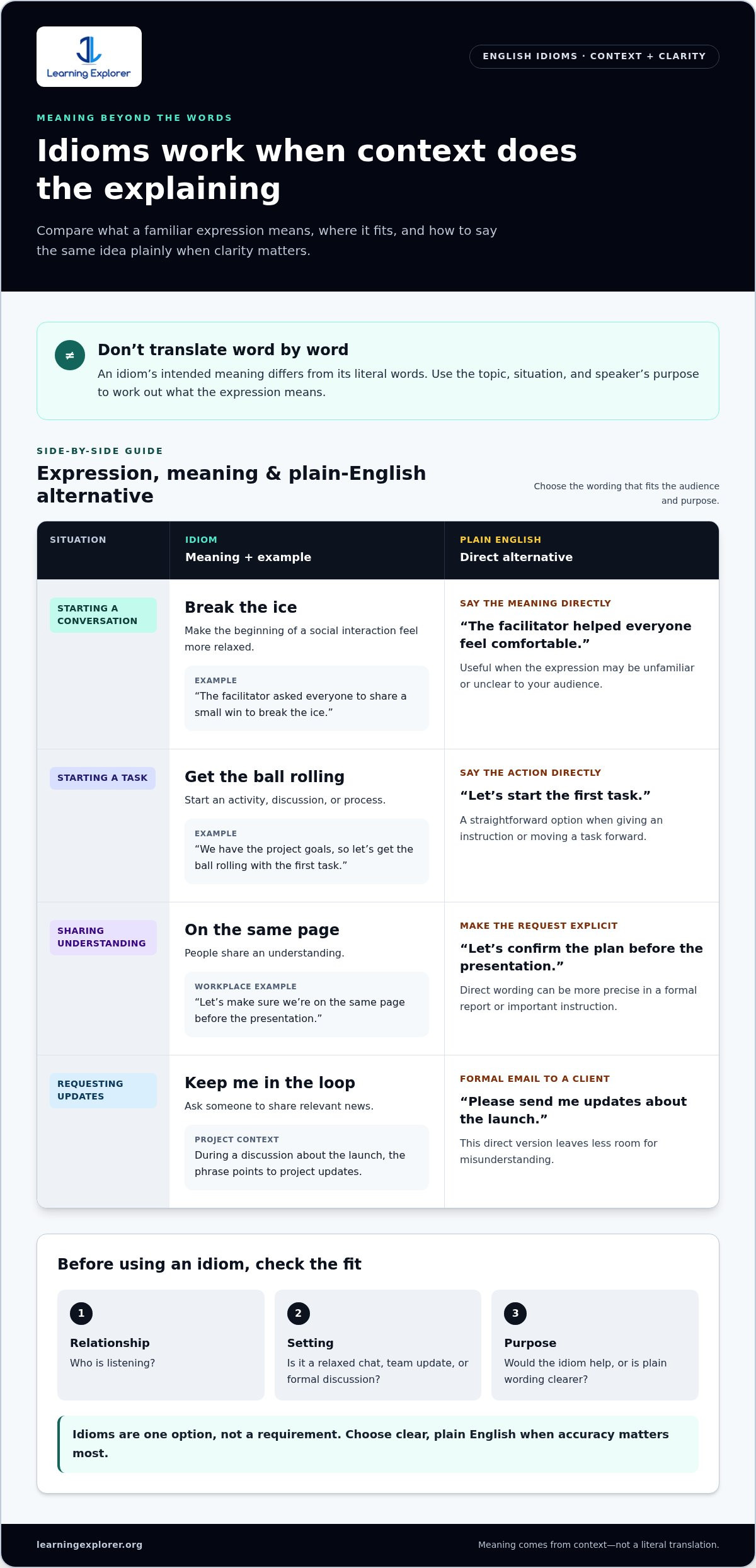
The same idea can call for different wording depending on who’s listening. In a relaxed chat with a teammate, you might say, “Keep me in the loop about the launch.” In a formal email to a client, write, “Please send me updates about the launch.” The second version is more direct and leaves less room for misunderstanding.
Before using an expression, consider your relationship with the listener, the setting, and the purpose of the message. An idiom that feels familiar among colleagues may sound too casual in a client presentation or an important written instruction. Clear, plain English is a strong choice when accuracy matters most. English conversation practice can help you explore how tone and setting shape everyday language. Practise English in conversation to build confidence choosing words that fit.
Common English Idioms with Meanings and Real-Life Examples
These familiar idioms can appear in casual conversation and at work. The short exchanges show how they sound aloud, while the plain-English alternatives make each meaning clear. Use them when they suit the conversation, not simply to make a sentence sound more fluent.
Idioms for Starting Conversations and Building Rapport
- Break the ice means to make the beginning of a social interaction feel more relaxed.
Example: “The facilitator asked everyone to share a small win to break the ice.”
Plain-English alternative: “The facilitator helped everyone feel comfortable.”
In conversation: “I’m not sure how to start.” “Ask everyone what they’re looking forward to. It might break the ice.” - Get the ball rolling means to start an activity, discussion, or process.
Example: “We have the project goals, so let’s get the ball rolling with the first task.”
Plain-English alternative: “Let’s start the first task.”
In a meeting: “Who wants to begin?” “I can get the ball rolling with a quick overview.”
Both expressions are conversational. They can work well in a team discussion or group activity, while a direct alternative may be better for formal instructions.
Idioms for Teamwork, Updates, and Changing Plans
- Be on the same page means to share an understanding or agree on a plan.
Example: “Before we divide the tasks, let’s make sure we’re on the same page about the deadline.”
Plain-English alternative: “Let’s confirm that we understand the deadline in the same way.”
In conversation: “Are we ready to send the proposal?” “Let’s check that we’re on the same page about the final changes first.” - Keep someone in the loop means to give someone relevant information or updates.
Example: “Please keep the support team in the loop if the delivery date changes.”
Plain-English alternative: “Please update the support team if the delivery date changes.”
In conversation: “Should I tell Priya about the new schedule?” “Yes, keep her in the loop.” - A learning curve describes the process of gaining skill or becoming familiar with something new.
Example: “There’s a learning curve with the new scheduling tool, but the team is getting more confident.”
Plain-English alternative: “It takes time to learn the new tool.”
Notice which expressions feel natural in conversations you hear, then practise them in a similar situation. These idioms give you useful options, but clear, direct wording remains just as effective.
How to Practise Idioms Without Sounding Forced or Unclear
Build a small, useful practice habit instead of trying to memorise a long list. Notice an expression in a conversation, reading, or programme, then write down the words around it. That context helps you remember not just what it means, but when it fits.
How Can You Remember Idioms Beyond Memorising a List?
For each expression, note its meaning, a natural example sentence, its tone, and the situation where you heard it. Then practise recalling it from a short scenario instead of rereading the definition. For example, if a meeting is running short on time, you might remember “cut to the chase,” which means to get to the main point. A direct alternative is “Let’s go straight to the main point.”
Try this repeatable routine:
- Notice: Write down an expression you hear or read.
- Record: Add the surrounding context, meaning, tone, and an example.
- Practise: Create an original sentence about a situation you actually encounter, such as giving a project update or starting a discussion.
- Review: Cover the definition and see if you can recall the expression from your example. Revisit a small set regularly, and use a phrase only when it feels appropriate.
Practise aloud, too. If the expression feels awkward in your sentence, or you need to explain it afterwards, try a clearer alternative. The goal isn’t to insert an idiom into every conversation. It’s to have another natural option when it suits your meaning and audience.
When Should You Choose a Clear, Literal Alternative?
Choose direct wording for instructions, deadlines, responsibilities, and other messages where precision matters. “Please send the revised file by Thursday” is clearer than “Let’s get the ball rolling soon” if someone needs a specific action and deadline. Plain English also helps when the listener may not know an expression or share the context behind it.
Replacing an idiom doesn’t weaken your message. “Keep me in the loop” can become “Please send me relevant updates,” preserving the request while making it explicit. English conversation practice gives you a chance to try expressions in realistic situations and notice how your word choice affects clarity and tone. Explore building confidence when speaking English through practical conversation practice.
Build Natural English with Idioms You Can Use with Confidence
Using an expression naturally starts with understanding its meaning and tone. Notice how people use idioms in conversation, books, articles, and other media. Look at the situation and the speaker’s purpose before deciding what a phrase means or whether you’d use it yourself.
How Can English Practice Help Idioms Feel More Natural?
Conversation practice gives you a chance to try an expression in context and consider how it sounds to someone else. Does it fit the situation? Is the tone friendly, professional, or too casual? Could your listener understand the point without needing an explanation? Feedback on these questions can help you make deliberate choices and communicate with greater confidence in everyday and workplace conversations.
Keep the practice manageable. Choose one expression you’ve encountered, write an original sentence connected to a real conversation you expect to have, and practise saying it aloud. If it feels unnatural, adjust the sentence or choose a plain-English alternative. Regular practice helps you build judgement, not just memorise phrases.
Choose Your Next Small Step in English Learning
This week, try one expression in a conversation where it genuinely fits. Keep a personal list with its meaning, an example, the situation where you heard it, and a clear alternative. Over time, you’ll have a useful record to review and draw on, rather than a list of phrases you’re unsure how to use.
For more guidance on learning English as an adult, explore the guide to an adult English course in Singapore. If you’d like structured opportunities to practise speaking, consider English learning in Singapore. Take the next step at a pace that feels comfortable, and focus on communicating clearly. The right expression is the one that helps your listener understand you.
Use English Expressions with Confidence
Idioms become easier to use when you understand their meaning, tone, and setting before trying them in conversation. Notice how people use expressions, practise with examples that reflect your own life, and choose plain English whenever clarity matters most.
Keep building your skills one conversation at a time. You don’t need to use an idiom in every exchange. Confidence comes from knowing when an expression fits and when a direct phrase will communicate your meaning better.
Learning Explorer offers English courses for adult and corporate learners, with private, group, and intensive formats. Classes are interactive and taught by native-speaker instructors who are bilingual. Explore English learning with Learning Explorer and take the next step in practising English with greater confidence.
Frequently Asked Questions
What is an idiom?
An idiom is an expression whose intended meaning differs from the literal meaning of its individual words. For example, “break the ice” means to make a social interaction feel more relaxed, not to crack frozen water. Context helps reveal what a speaker intends. Idioms appear in everyday conversation and workplace communication, but you can choose plain English whenever it expresses your meaning more clearly.
How can I understand an idiom I have never heard before?
Start by reading or listening to the full sentence instead of translating each word separately. Consider the situation, the speaker’s purpose, and the response that follows. For example, a comment about sharing project news can help clarify an unfamiliar expression in a work conversation. If the meaning remains uncertain, look it up in a learner dictionary and compare its example sentences with the context where you encountered it.
Are idioms appropriate in professional communication?
Some familiar idioms can suit relaxed conversations with colleagues, but they may sound too casual in formal writing or important instructions. Think about your audience, relationship, and purpose before using one. If a phrase could confuse someone or make your message less precise, choose a straightforward alternative. Clear communication matters more than adding expressions to sound fluent, especially when explaining a task or sharing important information.
Can I use idioms in a business meeting?
Yes, if an expression is familiar to the people listening and fits the discussion. “Be on the same page” can work in a collaborative meeting to mean sharing an understanding. In Singapore workplaces, colleagues may have different levels of familiarity with particular expressions, so consider your audience. Avoid idioms when discussing decisions, deadlines, or instructions if direct wording would make the next steps clearer.
What is the best way to learn English idioms?
Learn expressions through examples and situations rather than trying to memorise long lists. Record each phrase with its meaning, tone, and a sentence connected to your life. Then practise recalling it from the situation and try it in a suitable conversation. Keep a plain-English alternative alongside it. This approach helps you remember not only what an expression means, but also when it may be useful.
Do idioms have the same meaning in every English-speaking setting?
Not always. Familiarity with an expression and the way it sounds can vary across speakers and situations. A phrase that feels natural in one conversation may seem unusual or too informal in another. Pay attention to how people around you use it, and consider who you’re speaking with. If you’re unsure your meaning will be understood, choose plain English to keep the message clear.