What if the best Japanese Language Course isn’t the one with the most classroom hours, but the one you can fit into your routine and use actively? When comparing courses, check whether the class format works with your schedule and whether lessons include opportunities to practise speaking and listening. The teaching approach, class setting and learning materials can tell you more than a short course description.
This guide will help you compare those essentials and choose a Japanese course that supports your goals, whether you’re learning for everyday conversation, work or personal interest. Consider how private and group classes, along with in-person and online delivery, can shape your learning experience. You’ll also see how communicative practice and relevant teaching materials can support your studies. Learning Explorer Language Centre offers conversational Japanese classes with communicative teaching, native-teacher instruction and a syllabus and materials sourced from AJALT in Japan. Use these points to find an approach that fits your goals and routine in Singapore.
Key Takeaways
- Start with what you want to do in Japanese, then look for lessons that connect study with practical communication.
- Choose a Japanese Language Course by weighing your learning goals alongside the time and routine you can realistically commit.
- Compare private and group learning, then consider whether online or in-person classes better suit your weekly schedule.
- Review how course materials and teaching methods help you practise using Japanese, not just learn about it.
What to look for in a Japanese language course in Singapore
Start with the decision that matters most: what would you like to do in Japanese? If you want to introduce yourself, follow a simple conversation or speak with colleagues, prioritise lessons that give you opportunities to practise listening and responding. If your interest is cultural or personal, consider what would keep you curious, such as recognising familiar phrases in films or learning language connected to a hobby. Your goal gives you a practical way to compare courses.
A Japanese Language Course can treat the language mainly as a subject to study or as a means of communication. Studying concepts in isolation may help you recognise patterns, while conversational learning connects those patterns with listening and responding. For a wider view of methods and history, explore this overview of Japanese language education. As you compare options, check whether the teaching approach matches how you hope to use Japanese.
Start with your reason for learning Japanese
Picture a real situation, not just a broad ambition. You might want to greet someone, ask a question while travelling or take part in a conversation about an interest. These examples help you decide whether speaking and listening should be central to your learning. Cultural curiosity can be a strong reason too, even if you don’t have a specific conversation goal yet. A course that connects language with what motivates you may feel more relevant.
Be honest about your starting point. You might recognise a few expressions, have studied before or be beginning without prior experience. Describe what you can currently understand and say instead of choosing a level based on what you think you should know. That gives you a clearer basis for considering the pace and starting point that feel appropriate.
Look beyond a course title
A short course title can’t show the full learning experience. Read the description for details about what learners do during lessons, how the teaching approach supports the stated goal and what resources guide practice. If your aim is everyday conversation, for example, look for a clear connection between language patterns and opportunities to speak and listen, rather than relying on a broad label alone.
Use this checklist to compare options:
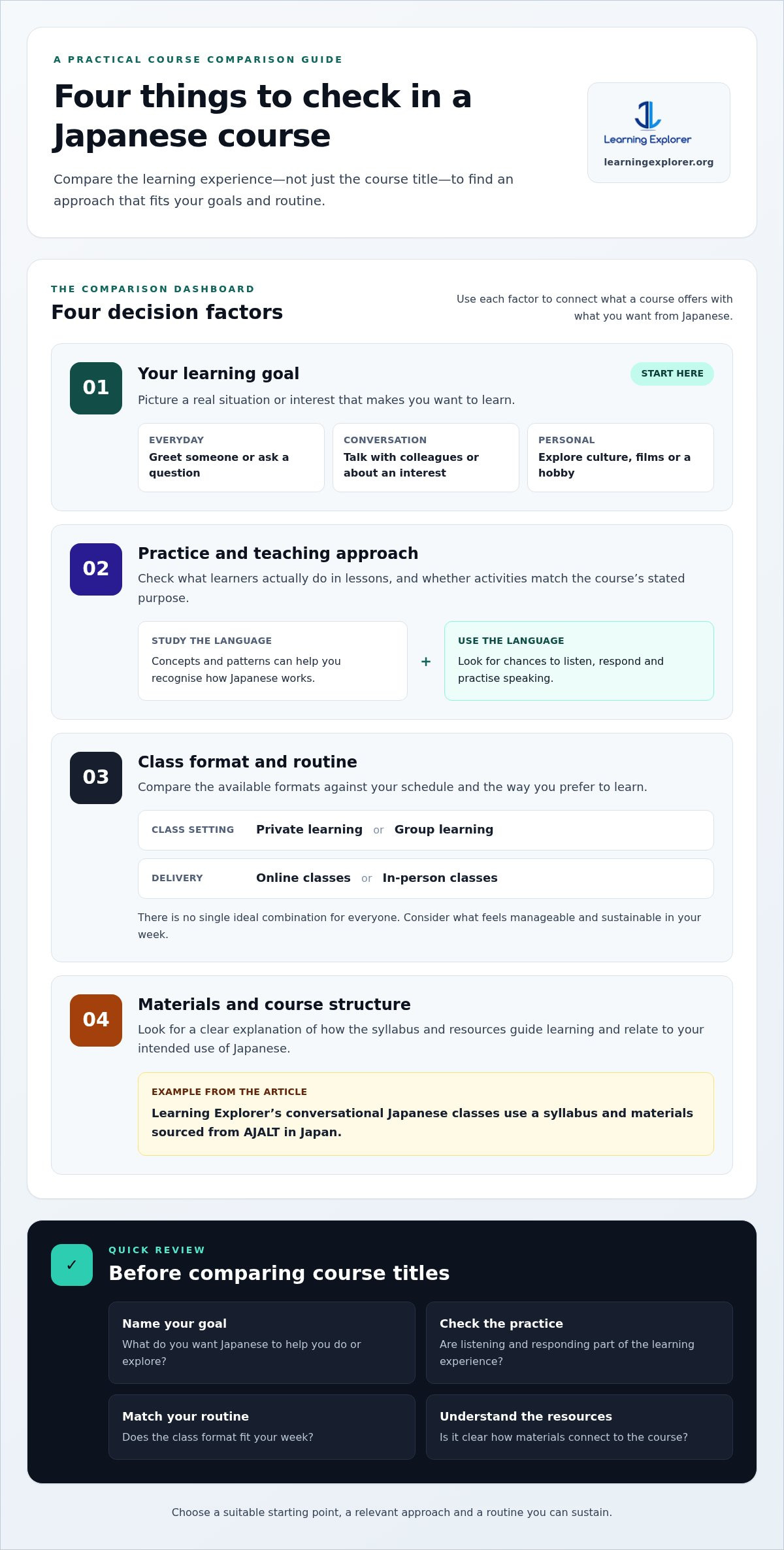
- Goals: Identify the situations or interests you want Japanese to support.
- Preferred format: Consider whether private or group learning, and online or in-person classes, suit your routine.
- Teaching approach: Look for a clear description of how learning activities relate to your goal.
- Learning materials: Check how resources fit into the course, rather than considering only their names.
There isn’t one ideal combination for everyone. Choose based on what keeps learning meaningful and manageable for you. A course can provide structure, but fluency and the time it takes to learn depend on individual circumstances. Focus on a suitable starting point, a relevant approach and a routine you can sustain.
How Japanese course materials and communicative teaching support learning
When comparing Japanese classes, consider how the teaching approach and learning materials work together. A course description is more useful when it explains the learning experience in concrete terms instead of relying on a broad label. This helps you judge whether the course suits your priorities, whether you’re starting with everyday language or building on what you already know.
Materials can help organise and revisit what you learn. Look for a clear explanation of how content is introduced and connected, and whether the resources relate to the kind of Japanese you want to learn. These details give you a practical basis for assessing a course without assuming that one resource or method suits everyone.
What communicative Japanese lessons aim to develop
As you review a course, consider whether its approach gives learners an active role in using Japanese. Look for a clear connection between the course aims and what learners do in lessons. Recognising information and being ready to use it are different parts of learning, so consider whether the course makes room for practice as well as explanation.
Think about the situations that motivate you and whether the course description explains how learning relates to them. If you want to communicate more comfortably in everyday settings, for example, you may value an approach that keeps practical use in view. The point isn’t to expect a particular result from a method, but to check whether the learning focus fits your reasons for studying.
For adults balancing other commitments, a relevant focus can help keep a learning goal in view. A clear course description lets you understand what the lessons are designed to support and decide whether that purpose matches what you want from your Japanese studies.
Why the source of course materials matters
Materials provide a reference point for learning, so it’s useful to understand their role in a course. Look for an explanation of how the syllabus and resources relate to the course’s overall direction. That context helps you see whether the content has a coherent basis, rather than being presented as unrelated topics.
Also consider whether the materials relate to your intended use of Japanese. You don’t need to evaluate every resource in advance. Instead, look for clarity about how the course is organised and how its content supports its stated focus. This makes it easier to compare the learning experience with your priorities.
Learning Explorer’s conversational Japanese classes use a syllabus and materials sourced from AJALT in Japan. Read about conversational Japanese classes to see how this course option fits the way you want to study.
Compare private, group, online, and in-person Japanese classes
Class format affects how you take part and how learning fits into your week. Separate the decision into two questions. First, consider whether you prefer learning individually or with others. Then think about which setting makes it easiest for you to attend and focus. This keeps the comparison personal instead of turning it into a search for one universally “best” option.
Private or group Japanese lessons: which suits your preference?
Private lessons are one-to-one, while group lessons bring learners together in a shared class. Neither format guarantees a particular outcome. Think about how you prefer to participate: would you rather focus on an individual exchange, or feel at ease learning alongside other people?
| Format | Consider this preference |
|---|---|
| Private | You value an individual learning setting and direct interaction. |
| Group | You enjoy sharing a class experience with other learners. |
Imagine yourself contributing during a lesson. If you prefer time to think before speaking, a one-to-one setting may feel more comfortable. If other learners’ questions and perspectives help you engage, a shared class may suit you. These are preferences, not predictions about progress. Consider how each setting feels for asking questions, listening and taking part, then choose the environment that seems most welcoming to you.
Online or in-person Japanese classes in Singapore
For the setting, think about what helps you protect time for learning. An online class avoids adding a journey to your day, while an in-person class gives you a dedicated place to attend. Ask yourself where you can concentrate, what might interrupt your attendance and how much effort it takes to make the class part of an ordinary week.
Picture a typical day when you might attend. Would joining from home make it easier to set aside time, or would leaving your usual environment help you focus? If you’ll travel to class, consider the route and how it fits around work or other plans. These details can matter as much as the class label, especially when your calendar is already full.
Use your answers to narrow your preference without treating the choice as permanent or as a measure of how serious you are about learning. A format is useful when it supports participation and feels manageable alongside your responsibilities. Learning Explorer offers online and in-person Japanese classes. See Japanese classes with Learning Explorer and consider which setting best matches your preferences.
Choose a Japanese course that fits your goals and weekly routine
A good course choice should support what you want to do in Japanese and the time and attention you can realistically give it. Instead of trying to predict how quickly you’ll progress, make a decision based on clear priorities. A practical goal and an honest look at your week can help you choose a starting point that feels sustainable.
Use this four-step process:
- Define a goal. Name one or two situations where you’d like to use Japanese.
- Choose a learning arrangement. Consider the setting in which you’re most likely to participate and stay engaged.
- Review the approach. Check that the course’s stated focus connects with what you want to practise.
- Plan attendance. Identify a realistic place in your week for learning and practice.
Turn a broad interest into a practical learning goal
“I want to learn Japanese” is a worthwhile start. To make it more actionable, choose one or two communication situations as an initial focus. You might want to introduce yourself, follow a simple exchange or talk about an interest. Think about what you’d like to practise, not what proficiency level you expect to reach or how quickly you’ll reach it.
This approach can be especially helpful for adults balancing work and personal responsibilities. A modest, relevant aim gives you a way to judge whether a Japanese Language Course matches your motivation without turning learning into another source of pressure. If your interest is cultural or personal, choose a communication goal connected to what you enjoy. The guide “Japanese Language Learning in Singapore” offers broader context as you shape your own direction.
Make class attendance realistic
Look at your week as it actually is. Identify a period when you can give learning your attention, then consider what might regularly compete with that time. A demanding workday, family plans or an unpredictable routine may affect what feels manageable. Planning around those realities helps you make a thoughtful choice rather than relying on an ideal schedule you may struggle to maintain.
Keep the plan flexible enough for real life. Decide when you’ll set aside time for lessons and what small practice habit could support your goal between them. You don’t need to map out every step of your progress in advance. A realistic routine, paired with a clear purpose, gives you a steady place to begin and adjust as your needs evolve.
To consider how the course fits your goal, read about conversational Japanese classes.
Learn conversational Japanese with Learning Explorer in Singapore
Choosing a course is easier when its approach, materials and class format align with the way you want to learn. Learning Explorer Language Centre offers conversational Japanese classes with communicative teaching and native-teacher instruction. Classes are available privately or in groups, online or in person. This gives you a choice of learning arrangement to consider alongside your goals and routine.
What makes Learning Explorer’s Japanese classes relevant
Communicative teaching keeps using Japanese to express and understand meaning central to the learning approach. Learning Explorer sources its Japanese syllabus and materials from AJALT in Japan, giving the course a defined foundation. Together with native-teacher instruction, these are clear features to consider if you’re looking for conversational Japanese. They don’t promise a particular outcome or timeline.
When deciding whether the course suits your purpose, consider whether you want communication to be central to your studies and whether the materials provide a clear structure for learning. Learning Explorer’s Japanese classes use communicative teaching and AJALT-sourced materials, while the choice of private or group learning lets you select a class setting that feels right for you.
Take the next step towards learning Japanese
Learning Explorer Language Centre has taught adults in Singapore since 2015. Japanese classes are available online or in person, privately or in groups. Think about which format feels manageable alongside your other commitments. Online lessons may fit a week when travelling is difficult, while an in-person class may suit learners who prefer attending at a physical location.
Learning Explorer’s CBD centre is at 10 Anson Road #22-07, International Plaza, Singapore 079903. Consider how getting there would fit around your workday or other plans. If online learning better suits your routine, it offers a way to attend without travelling to the centre. Either way, begin with a clear idea of what you want to practise, then choose the format that supports it.
You don’t need every learning goal mapped out before starting. Explore the course, review the class formats and decide which one aligns with your interests and schedule. A suitable Japanese Language Course can give you a structured place to begin while keeping your personal goals in view.
Explore Japanese courses at Learning Explorer and find a class format that fits your plans for learning conversational Japanese.
Take your next step with confidence
You don’t need to have every detail of your Japanese learning journey planned before you begin. Start with a clear reason for learning and one practical situation you’d like to handle. As your interests develop, you can refine what you want to focus on. That keeps your goal personal and gives you a useful point of reference as you learn.
Choosing a Japanese Language Course is about more than a course title. It’s a chance to make space for a skill you’re curious about in a way that feels relevant to your life. Let your priorities guide the next step instead of waiting until you feel completely ready. A manageable beginning can turn an intention into a meaningful learning experience.
Use your goals and weekly routine to decide what you want from a class. Explore Japanese courses at Learning Explorer to take the next step towards learning conversational Japanese.
Frequently Asked Questions
Is Japanese difficult for English speakers to learn?
Japanese can feel challenging for English speakers because its sentence structure and writing systems differ from English. For example, Japanese often places the verb at the end of a sentence, and particles help show how words relate to one another. These differences take practice, but you can approach them gradually. Start with useful phrases and basic sentence patterns, then build familiarity through listening, speaking and reading.
Can adults start learning Japanese with no previous experience?
Yes, adults can begin learning Japanese without previous experience. Start by being clear about what you already know, even if that’s only a few words picked up from media or travel. Then focus on basics such as greetings, introducing yourself and understanding simple questions. A conversational Japanese course can give beginners a structured starting point. You don’t need to master the writing systems before taking your first steps.
How long does it take to learn conversational Japanese?
There’s no single timeline for learning conversational Japanese. It depends on your goals, how regularly you practise and how much Japanese you encounter outside lessons. Define what “conversational” means for you: perhaps introducing yourself, asking for directions or chatting about a familiar interest. These specific aims are more useful than expecting a fixed proficiency level by a certain date. Review your progress against practical situations that matter to you.
What is the difference between hiragana, katakana, and kanji?
Hiragana and katakana are phonetic systems, while kanji are characters that generally carry meaning as well as pronunciation. Hiragana is used for many grammatical endings and native Japanese words; katakana commonly represents foreign loanwords and names. Kanji appear in many words and can have more than one reading depending on context. You’ll encounter the three systems together in written Japanese, so learning their distinct roles helps make texts easier to understand.
Can I learn Japanese online in Singapore?
Yes, you can take Japanese classes online in Singapore. This format may suit you if getting to a physical class is difficult or you’d rather make learning part of your home routine. Before a lesson, choose a quiet place, set aside time without competing tasks and keep your learning materials nearby. These habits can help you focus. Online learning is one option alongside in-person classes.
Do I need to learn Japanese writing before I can speak it?
No, you don’t need to master Japanese writing before you start speaking. You can practise listening and speaking while learning to recognise hiragana, katakana and kanji over time. For example, you might work on saying a greeting aloud while also learning how it looks in writing. Combining the skills can help connect spoken expressions with written forms, but the balance depends on your personal goals and what you find motivating.