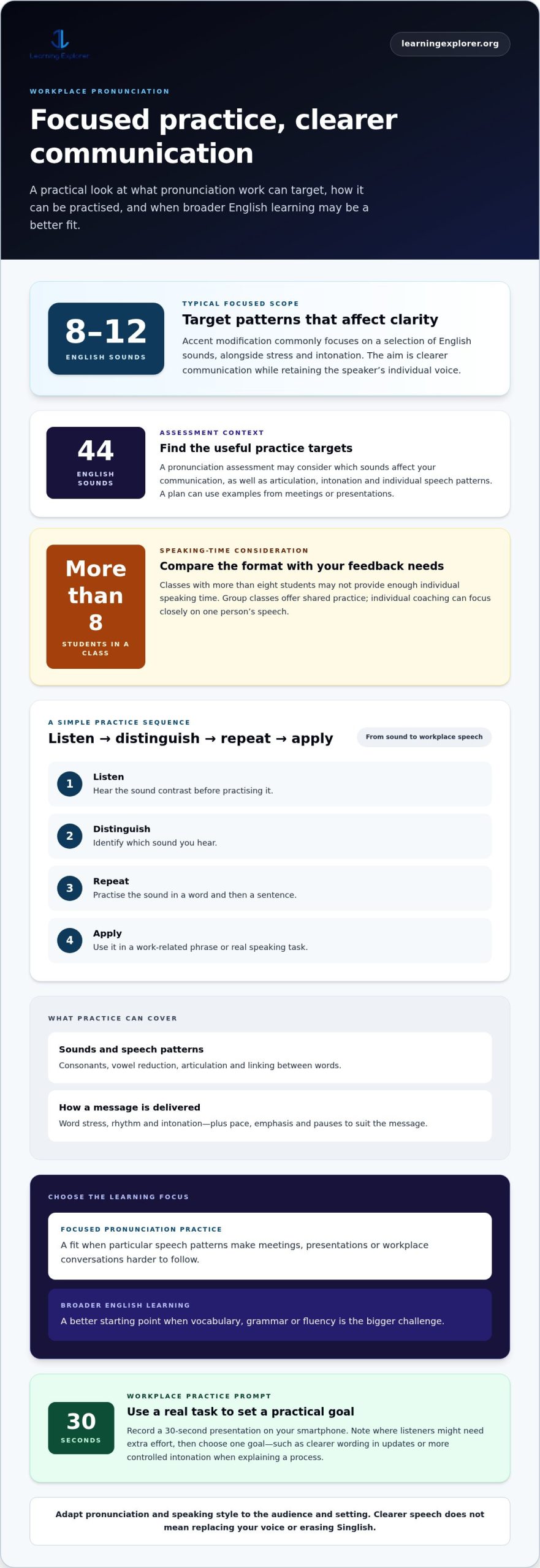
A clearer speaking style doesn’t require you to give up your voice. English accent reduction for professionals in Singapore may suit adults who want to be understood more easily in meetings, presentations or everyday workplace conversations. Accent modification commonly focuses on 8-12 English sounds, alongside stress and intonation, while aiming to retain the speaker’s individual voice.
If you’ve ever repeated a point or wondered whether your pronunciation distracted from your message, you know how frustrating that can be. English accent reduction for professionals in Singapore is better understood as focused pronunciation practice: it targets speech patterns that affect clarity, while a broader English course develops skills such as vocabulary, grammar and fluency. Learn who may benefit, what practice can involve and how to adapt your speech for different work settings without treating Singlish as something to erase.
This guide explains how to decide whether focused pronunciation practice or a broader English course better suits your goals, and what a practical learning path can involve.
Key Takeaways
- Identify the work situations where listeners struggle to follow you, then focus practice on the speech patterns that affect clarity most.
- Adapt pronunciation and speaking style to the audience and setting while keeping Singlish as part of your everyday voice.
- Beginners can build confidence with clear, deliberate speech and regular listening and imitation practice.
- Use real conversations and presentations to turn pronunciation practice into skills you can apply at work.
- Choose between focused pronunciation practice and broader English learning by starting with the communication goal you want to achieve.
What is the difference between accent reduction and a general english course?
Accent reduction targets pronunciation patterns that affect how easily listeners understand you. A general English course can cover broader skills, such as vocabulary, grammar and fluency, alongside speaking.
For a practical look at accent-aware speaking, watch this video:
Accent Reduction and General Pronunciation
General pronunciation practice helps learners produce sounds clearly across everyday speech. Accent modification narrows the focus to patterns that may make workplace communication harder, such as particular consonants, vowel reduction or linking between words. A programme generally targets 8-12 English sounds, alongside stress and intonation. Compare the focus with your goal: clearer presentations may call for targeted work, while broader language gaps may need a general course.
Neither approach requires replacing your voice. The useful measure is whether listeners can follow your message in the situations that matter to you.
Pronunciation Assessments and Personalised Plans
A pronunciation assessment can examine articulation, intonation and individual speech patterns to identify useful practice targets. An assessment may consider which of English’s 44 sounds affect your communication, then shape a plan around examples from meetings or presentations. When choosing an accent coach in Singapore, look for an assessment that connects feedback to specific workplace situations. Ask how practice goals will be set and how progress will be reviewed.
Lesson fees depend on the format and scope of instruction; the price is given after a quote request.
Auditory Discrimination and Pronunciation Drills
Auditory discrimination means learning to hear differences between sounds before practising how to produce them. For example, listen for a contrast, identify the sound you hear, then repeat it in a word and a sentence. Pronunciation drills build control through focused repetition, rather than asking you to change every feature of your speech at once.
Use a short sequence: listen, distinguish, repeat, then apply the sound in a work-related phrase. This connects careful practice with everyday speaking.
Stress, Rhythm, Intonation and Voice Control
Pronunciation involves more than individual sounds. Word stress, vowel reduction, articulation, liaison, rhythm and intonation can all shape how a message comes across. These are common areas for focused practice, especially if you want to make key points clearer in presentations or discussions. Voice control also involves adjusting pace, emphasis and pauses to suit your message.
Practise with a short presentation excerpt: mark the key words, say them with clear stress, then repeat the passage at a measured pace. Check whether the emphasis supports your meaning and whether listeners can follow each point.
Who Should Consider Accent Modification?
Consider focused pronunciation practice if listeners often ask you to repeat key points during meetings, calls or presentations. In Singapore, professionals can explore individual coaching or group classes. Workplace funding depends on your employer’s training policies and course arrangements, so discuss any learning budget with HR.
Clear English for Workplace Communication
Pronunciation practice may help when a specific speech pattern repeatedly obscures names, technical terms or action points. For example, a project lead might practise saying product names clearly before an international client presentation. The aim is intelligible communication across language backgrounds, not sounding identical to colleagues.
Start with one work task. Record a 30-second presentation on your smartphone, then note where listeners might need extra effort to follow your message. Use that example to identify a practical learning goal, such as clearer wording during updates or more controlled intonation when explaining a process.
Accent Training for Professional Communication
Focused coaching can connect pronunciation practice with real workplace tasks. You might rehearse a project update, client call, job interview or question-and-answer session, then apply feedback to the same scenario. For candidates navigating competitive hiring stages, resources like the Job Hunt Mode Blog can help you understand company-specific recruitment expectations. Choose practice that reflects your role and communication needs, rather than drills disconnected from the language you use at work.
Group classes offer shared practice, while individual coaching can focus closely on one person’s speech. Classes with more than eight students may not provide enough individual speaking time. Consider whether you need sustained personal feedback or benefit from hearing other speakers practise similar skills.
Focused pronunciation practice may suit professionals who understand English well but feel less confident speaking in formal settings. For instance, a client-facing consultant may want to deliver recommendations with clear emphasis and steady pacing. If vocabulary or sentence structure is the bigger challenge, broader English learning may be a better starting point.
Corporate communication programmes can focus on shared workplace situations, such as team briefings or customer discussions. A useful programme starts by identifying the team’s communication tasks, then uses role-play and feedback to practise them. Managers can choose scenarios based on actual meetings, rather than asking employees to change every feature of their speech.
When choosing a coach or programme, compare the assessment process, the amount of speaking practice and how feedback relates to your work. Ask how progress is tracked and whether you will practise presentations, conversations or another priority task. A clear plan should show what to practise between sessions and how each activity supports your communication goal.
Confidence often grows through preparation, not imitation. Before a formal meeting, select one communication skill to practise, such as stressing key words in a recommendation. Then deliver the same point aloud and review whether the main message is easy to follow. For broader workplace language skills, explore English learning options.
Maintaining Singlish while adapting speech style
Pronunciation practice can improve speech clarity without requiring you to abandon Singlish or your cultural identity. In Singapore, Singlish blends English, Mandarin, Tamil, Malay and local dialects, including Hokkien, Cantonese and Teochew.
Speech Assessment and Goal Setting
A useful speech assessment identifies which patterns affect understanding in a particular setting. Start with one goal, such as making project updates easier for international colleagues to follow. Compare how you speak in a team discussion and a formal presentation, then decide what to adapt. This keeps practice focused on communication, rather than changing every feature of your voice.
Set goals around observable actions: pronounce key terms clearly, stress the main point or pause between ideas. A short recording of a work update can help you notice which patterns to practise. Keep the example relevant to your role so each task supports a real communication need.
Speech Clarity and Listener Perceptions
Listeners interpret speech through pronunciation, pacing and context. If a key word is hard to distinguish, a colleague might miss an instruction or ask you to repeat it. That doesn’t mean your accent is a problem; it shows where a small adjustment could improve clarity. Focus on words carrying essential information, such as a deadline or decision.
You don’t need to erase Singlish to communicate effectively. The aim of pronunciation practice is clear, effective speech while retaining your individual voice. If you’re concerned about losing clarity, confidence or cultural identity, set goals around intelligibility and context, not sounding like someone else. Keep local expressions that fit the conversation, and adapt pronunciation when a work setting calls for extra clarity.
Stress Patterns and Speech Rhythm
Stress and rhythm shape which ideas listeners notice first. In a sentence such as “We need the revised figures today,” emphasise “revised figures” and “today” if those carry the key message. Practise the sentence at a measured pace, then use the same emphasis in a meeting. This is speech control, not a demand to adopt one fixed accent.
English varieties can differ slightly in pronunciation and vocabulary while remaining mutually intelligible and grammatically correct. Choose a speech style that suits the context: use wording and pacing that help an international audience follow a formal briefing, then speak more naturally with familiar colleagues. Flexible choices let you adapt without treating Singlish as something to remove.
Try this three-step practice: choose a real work sentence, mark the words that carry its meaning, then say it aloud with deliberate stress and pauses. For example, emphasise the decision and next action in a meeting summary. Check whether the message sounds clear and still feels like your own voice. Repeat with another task, such as a client call, if that setting presents a different challenge.
Is accent training suitable for beginners?
Yes. Beginners can practise pronunciation while building English skills. In Singapore, accent training can take the form of individual coaching, group classes or online lessons. Choose based on how much speaking practice and feedback you need.
To get started, pick one work phrase, such as introducing yourself in a meeting. Practise it slowly, listen to how each word sounds, then repeat it in a complete sentence. This keeps practice manageable as you develop vocabulary and confidence.
Accent Modification for Non-English Speakers
Learners whose first language isn’t English can work on pronunciation alongside basic English. Start with words you use often, such as your name, job title or a common workplace greeting. Practise the sounds in those words before using them in a sentence. A focused goal makes it easier to notice which sounds need more attention.
Pronunciation practice isn’t a replacement for learning vocabulary or grammar. If you’re preparing to explain a task, first learn the key words, then practise saying them clearly. This connects pronunciation to useful language skills and gives each exercise a real communication purpose.
Listening to and Mimicking Native Speakers
Choose a short podcast, film or audiobook excerpt featuring a native English speaker. Listen for one pattern at a time, such as a sound at the start of a word or the speaker’s intonation. Repeat a sentence, then compare your version with the model. Focus on a short section instead of copying an entire conversation.
Choose material that matches your goal. For example, someone preparing for a presentation can practise a speaker’s clear transitions between ideas. Mimicking is a listening exercise, not a requirement to adopt another person’s accent. Ask a teacher or language partner whether your words are easy to understand.
Speaking Slowly and Clearly
Slowing down can give beginners more control over individual sounds and word endings. Read a short work message aloud, pausing between its main ideas. For example, separate a request from its deadline: “Please send the report. I need it before the meeting.” Then repeat it at a natural pace without rushing.
Clear speaking depends on pronouncing each word carefully, not stretching every syllable. Practise a challenging sound on its own, then use it in a familiar word and sentence. If “th” feels difficult, practise it in “think” before saying, “I think we should review the plan.” A teacher’s feedback can help refine the sound.
Class size affects individual speaking time. English pronunciation classes with more than eight students may not leave enough time for each learner to speak. Before choosing a format, consider whether you need frequent individual feedback or prefer practising alongside others. Online lessons offer a remote setting, while in-person classes allow direct interaction in a shared room.
Try a simple practice routine: select one phrase, listen to a model, repeat it slowly, then use it in a short workplace exchange. For example, practise asking a colleague to clarify a deadline. Note which words felt difficult and bring those examples to your next lesson. Regular, focused practice helps develop pronunciation and speaking skills together.
Accent reduction course FAQs
These answers explain what learning can involve, how to practise between sessions and what progress may look like. Use them to connect pronunciation practice with the vocabulary and workplace situations you want to handle more clearly.
How many English sounds do learners usually practise?
Most students focus on 10-12 core English sounds to improve clarity. A useful starting point is to practise one target sound in isolation, then in a word, and finally in a sentence. For example, use a target sound in a work term before practising the full phrase where its meaning matters.
This sequence helps you notice whether the sound stays clear during natural speaking. A coach may also use role-play conversations, so you can apply pronunciation techniques in situations such as explaining a task or responding to a colleague.
What happens during a typical session?
A session may combine sound practice with a realistic speaking activity. For example, practise a phrase, use it in a simulated client conversation, then receive feedback on pronunciation and delivery. A session can end with suggestions for at-home practice, giving you a specific task to repeat before the next lesson.
Regular practice matters. Learners may be asked to repeat target sounds hundreds or sometimes thousands of times per week. Break that work into short practice periods, then use each sound in meaningful vocabulary rather than repeating it without context.
How long does accent training take?
English accent training group classes in Singapore typically run for 8 to 12 weeks, with one or two sessions per week. A typical term includes 8 to 10 sessions. Learners may notice improvement within 8 to 12 weeks with regular practice, while significant changes may require several months.
Progress depends on which sounds you practise, how consistently you use them and whether you apply them in everyday speech. Track one clear example, such as saying a presentation opening, and compare later attempts for pronunciation and ease of delivery.
How can I keep practice connected to real communication?
After each practice, write down one useful feedback point and one phrase to repeat. For example, note a word that needs clearer articulation, then include it in a short spoken update. This makes your next practice task specific and relevant to your work.
For structured English learning that supports workplace communication, explore English course options.
How much do English accent reduction lessons cost in Singapore?
Accent reduction lessons in Singapore typically range from SGD $50 to $120 per hour for individual coaching, while group classes and corporate packages vary based on duration and class size. Pricing depends on the trainer’s experience, whether sessions are held online or in person, and the customized focus required for specific professional goals.
Which accent reduction coaches and programs for professionals are available in Singapore?
Professionals can choose individual coaching, group classes or corporate communication programmes focused on workplace tasks. There are numerous verified accent reduction tutors and specialized training centres available across Singapore to help you achieve your communication objectives.
Learning Explorer: Conversational English Course
Learning Explorer offers a Conversational English Course for learners who want to build everyday spoken English. If your goal is to participate more comfortably in discussions, practise conversations or develop broader speaking skills, this may be a useful next step. For workplace-focused language development, the Business English Course is another option.
Choose based on the communication situations you want to handle. A conversational course suits everyday exchanges, while a business course is for learners seeking English for professional contexts. Both offer a broader language-learning route; focused pronunciation practice has a narrower focus.
Choose the course that best matches your current English goals. Contact Learning Explorer to discuss your learning direction.
Make Your Next Conversation Count
Choose an upcoming conversation as your next practice opportunity. Before a meeting, decide which message matters most, then rehearse how you’ll express it. Afterward, notice which words felt natural and where you had to work harder to be understood. This reflection can turn a broad communication goal into a useful learning focus.
English accent reduction for professionals in Singapore can be part of a wider effort to communicate clearly while keeping your own voice. Match your learning direction to the situations you want to handle, whether everyday conversation or professional exchanges. A clear goal makes it easier to choose what to practise next.
Contact Learning Explorer to discuss training and explore a suitable path for your English learning goals. Take the next step at your pace, and keep building confidence in the conversations that matter to you.
Frequently Asked Questions
Are these classes suitable for beginners or only advanced speakers?
Beginners can practise pronunciation while building basic English skills. Start with useful phrases for your daily routine, such as greeting a colleague or asking for clarification. Learn the meaning and vocabulary first, then practise saying each phrase clearly. If forming sentences is still difficult, broader English learning can support your progress alongside pronunciation practice.
Can I really lose my accent as an adult learner?
Adult learners can work on speech patterns and develop clearer pronunciation without losing their accent. Set a practical goal, such as making your job title or a key instruction easier to understand. Practise that phrase, then use it in everyday conversations. The focus can be clearer communication while retaining the voice and identity that feel like yours.
Can I reduce my accent completely?
Complete accent removal isn’t necessary for effective communication, and training shouldn’t be framed as a promise to erase your accent. A more useful goal is making particular sounds or phrases easier for listeners to understand. For example, practise the names of products you discuss at work, then use them in a sentence. Keep the focus on clarity and your own communication priorities.
How long does it take to see results in accent reduction classes?
With regular practice, learners may notice improvement within 8 to 12 weeks, while significant changes can take several months. Your progress depends on how consistently you practise and use the target sounds in everyday speaking. Track a specific task, such as introducing a proposal, and compare how clearly you deliver it as your practice develops.
What Does English Accent Training in Singapore Actually Mean?
English pronunciation training in Singapore focuses on speech features that affect how clearly spoken English is understood. It may address selected sounds, word stress or intonation in situations such as explaining a work process. For professionals in Singapore, English accent reduction can mean adapting speech for a particular audience, not adopting one required way of speaking.
Will accent reduction make me sound like a different person?
No. Pronunciation practice isn’t meant to make you sound like someone else. You can work on a specific speech habit, such as rushing through a key phrase, while keeping your natural voice. Before practising, choose what you want listeners to understand more easily. That personal goal keeps changes relevant to your communication, not your identity.
What is English accent reduction or accent modification coaching?
Accent modification coaching focuses on pronunciation patterns that affect clarity. A coach may help you listen for a sound contrast, practise producing it, then use it in a realistic exchange. For example, rehearse a response to a colleague’s question and apply the target sound naturally. This differs from broader English learning, which can also develop vocabulary and grammar.
How long does accent coaching typically take, and how many sessions are recommended?
Singapore group classes typically run for 8 to 12 weeks, with one or two sessions each week; a term often includes 8 to 10 sessions. The useful amount of coaching depends on your goals and regular practice between lessons. Use a course period to practise a specific work task, then review the feedback and decide which speech patterns need further attention.