A lower per-learner fee isn’t always the better-value choice. For private vs group Japanese lessons, cost per learner is generally higher for private lessons than for group classes. The difference is what you get in return: one-to-one attention and feedback, or shared instruction and practice with other learners.
Weigh the lesson fee against your budget, but also consider how class size affects your time to speak and ask questions. Your schedule, learning goals, and any additional costs matter too.
This comparison explains how private and group Japanese lesson formats differ in Singapore, and how to assess learning value alongside cost. It also highlights extra expenses that may affect your budget, helping you choose a format that suits the way you want to learn.
Key Takeaways
- Compare the fee per learner with the instruction and speaking time you receive, not just the headline lesson price.
- Private lessons can suit learners who want focused feedback or targeted practice; group classes offer shared practice and interaction.
- Include possible materials, cancellation, transport, and venue charges when estimating the total cost.
- Check how class size, lesson length, and course structure affect the value you get from each format.
- Use your learning goals, schedule, and preferred learning environment to decide which option is the better fit.
Private lesson value and learning efficiency
Private Japanese lessons can make each session more responsive to one learner’s pace. In a one-hour lesson, a learner might spend 30 minutes or more speaking, rather than waiting for a turn among classmates. That extra practice can help a teacher notice recurring pronunciation, grammar, or listening difficulties and address them while they’re fresh.
The strongest value comes from matching the lesson to a specific goal. A beginner may need hiragana practice and everyday introductions, while a returning learner may need to rebuild conversational confidence. Someone preparing for JLPT N2 could focus on advanced grammar, reading, and timed listening exercises. A private curriculum can adjust emphasis as these needs change, instead of following one shared course plan.
That flexibility matters for feedback, too. A teacher can identify whether your main barrier is word choice, sentence structure, or pronunciation, then tailor examples to your needs. For instance, if you’re preparing to speak with Japanese colleagues, you can practise a work-related introduction and receive direct corrections. Group activities also provide useful practice, but they must serve several learners at once.
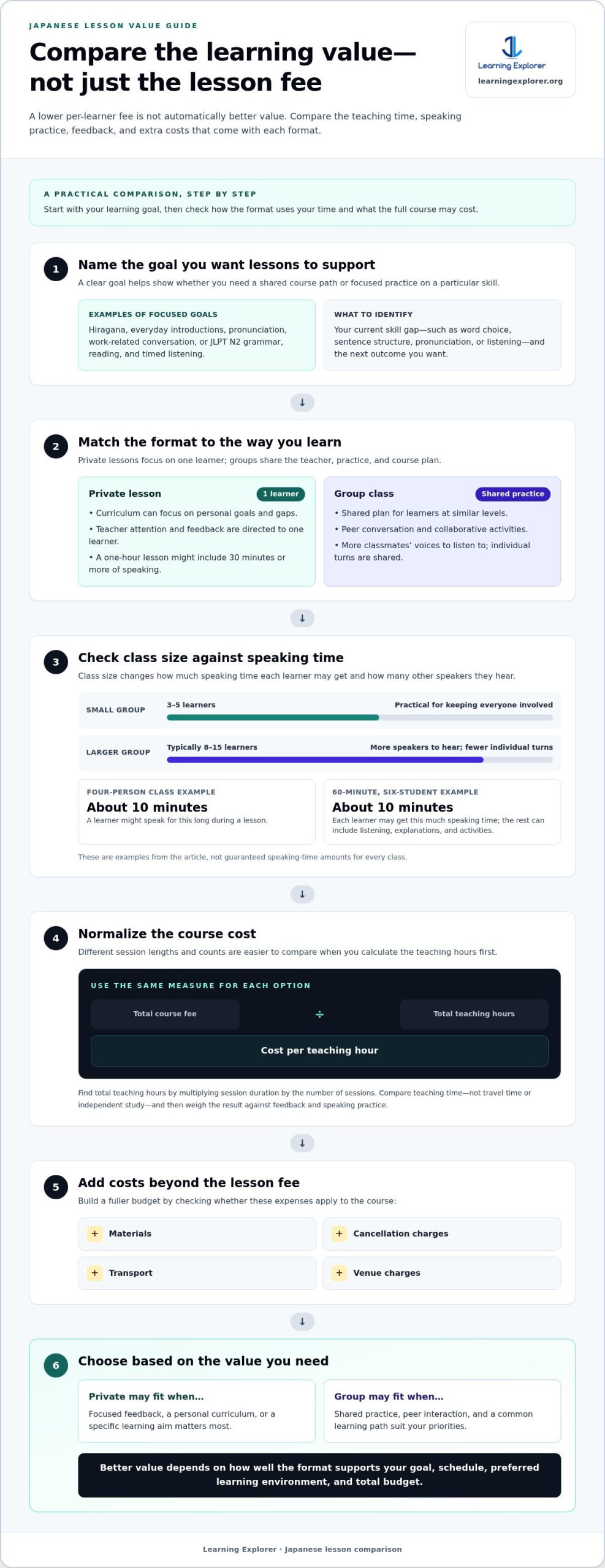
Group size affects how much speaking time each person gets. A group of three to five learners is often practical for keeping everyone involved, especially when classmates have similar Japanese levels. In a four-person class, each learner might speak for about ten minutes during a lesson. Larger classes can offer more listening practice with different speakers, but each student may get fewer individual turns.
| Option | Class size | Curriculum | Best fit |
|---|---|---|---|
| Private lesson | One learner | Can focus on personal goals and gaps | Targeted feedback or a specific learning aim |
| Small group | Three to five learners | Shared plan for learners at similar levels | Conversation with peers and collaborative practice |
| Larger group | Typically eight to fifteen learners | Shared starting point and progression | Listening to several classmates and group activities |
Textbooks provide a consistent route through vocabulary, grammar, and reading. Tailored materials can add practice for an immediate goal, such as ordering food, introducing yourself, or preparing for a work discussion. A useful sequence is to choose your goal, identify the skill gap, then select textbook exercises and practice tasks that address it.
Choose private lessons when focused feedback and a personalised curriculum matter most. Choose a group when shared practice, peer interaction, and a common learning path suit your priorities. The best value depends on how closely the format supports your next Japanese learning goal.
When the goal is conversational practice, collaboration, or social engagement, group classes can suit complete beginners and learners seeking conversation or collaborative subjects. Small Japanese lesson groups of three to five learners help keep everyone talking.
Private class curricula can be customised to a learner’s goals, strengths, and weaknesses through Learning Explorer programs. Private classes provide direct feedback focused on the learner’s specific areas. One student quoted in the page said material covered in three weeks of private lessons was covered in three months of group classes. Private instruction can also suit business language skills, pronunciation correction, exam preparation, returning learners, and advanced learners targeting gaps.
Class sizes and teacher-to-student ratios
A private class gives one student the teacher’s attention throughout the session. That one-to-one format makes it easier to pause over a difficult sound, repeat a phrase, or ask for another example. In a group, the teacher divides time among learners, so instruction and practice are shared. Consider how you want to learn Japanese: with close individual guidance or through conversation with classmates.
Class size shapes the balance between personal feedback and varied interaction. In a 60-minute group class with six students, each learner may get about 10 minutes of speaking time. The remaining lesson time can include listening, explanations, and activities with classmates. A private session can devote more of its time to one student’s questions and responses, while a group gives learners more voices and speaking styles to hear.
Consider session length and total teaching hours together. A longer class doesn’t automatically mean more useful practice if much of the time is spent waiting to speak. To compare formats, note each session’s duration and the number of sessions, then multiply them to find the total teaching hours. For example, if you’re comparing courses with different session lengths, calculate the total hours for each before weighing the timetable.
Next, calculate the cost per teaching hour by dividing the total course fee by the total teaching hours. This makes packages with different session lengths or counts easier to compare. Use teaching time, not time spent travelling or studying independently. Your private-versus-group comparison will be clearer when you also consider how much individual feedback and speaking practice each hour includes.
Consider a teacher’s approach alongside their qualifications. A certificate alone doesn’t show how a teacher explains Japanese grammar, corrects pronunciation, or supports listening practice. Some private Japanese teacher certificates can be earned through a few days of online study, so look at the teaching approach as well as the credential. For instance, if you struggle with long-vowel sounds, clear modelling and specific correction matter more than simply adding class time.
For group classes, shared starting requirements and a common course plan help learners progress together. Similar Japanese levels can also make pair work more balanced: classmates can practise introductions without one learner carrying the exchange. In private sessions, a teacher can adjust the pace when you need extra practice with a topic. Compare the learning structure, too, since clear lesson goals help both formats use class time purposefully.
Choose a format that matches your priorities. Select one-to-one instruction for focused correction and individual pacing; choose a group when peer conversation and shared activities matter more. Then compare total teaching hours and cost per teaching hour to see whether the format fits your learning needs and budget.
Additional materials, cancellation, travel, and venue costs
Keep trial lessons and package discounts separate from the advertised lesson format. Ongoing private Japanese lessons or a purchased package can often reduce the overall cost; treat a trial as a separate session unless it’s included in the package terms.
Start your budget with the lesson fee, then account for materials and delivery costs. A physical textbook, workbook, or original teaching materials may be charged separately, while some courses include learning resources. Before comparing course totals, check whether resources such as a printed textbook and online workbook are included.
Materials can influence learning beyond the initial purchase. A textbook provides a structured language progression, while audio files support listening practice between lessons. JLPT preparation may call for focused exercises, and business Japanese can involve relevant workplace scenarios. Compare the resources with your goal rather than paying for materials that don’t support your planned progress.
Cancellation terms affect the value of a lesson package. A late cancellation may incur an additional charge, so consider how much schedule flexibility you need before committing. For example, if your work shifts change, rescheduling terms may matter more than they would for someone attending a fixed weekly class. Include the cancellation policy in your total-cost comparison.
In-person lessons can add travel or venue costs if you or the teacher must travel, or if a separate teaching space is required. Online lessons avoid the trip to a physical classroom, but still require suitable internet access and a quiet place to practise. Compare the full arrangement: lesson fee, materials, transport, and venue use. A lower lesson fee may not mean a lower overall outlay once travel is included.
For a clear comparison, make a simple checklist before choosing a Japanese course:
- Materials: list textbooks, workbooks, audio, and any original resources.
- Schedule: note cancellation terms and how they fit your routine.
- Location: include transport and any separate venue charge.
- Format: compare in-person sessions with online lessons and their practical requirements.
Course fees depend on the format, lesson structure, materials, and any travel or venue needs; the price is provided after a quote request. Compare the complete course costs rather than relying on the lesson fee alone. For example, when choosing online JLPT preparation, weigh included resources and scheduling terms alongside the price; for in-person classes, account for transport too.
Private Japanese lessons may have additional charges for original teaching materials, late cancellations, and in-person transportation or venue costs.
Learning Explorer’s private conversational Japanese package includes a physical course book, e-workbook, audio files, recorded class videos and online support for each student. Checking these inclusions can help clarify which materials are already covered.
Group lesson cost advantages
Group Japanese lessons generally cost less per learner than private lessons. Several students share the teacher’s time and course structure, spreading the lesson cost across the class. Group study is worth considering if your budget matters and you’re comfortable learning alongside others. Weigh the lower individual fee against the course schedule, shared activities, and your personal learning goals.
A shared curriculum can make course planning more straightforward. Learners follow the same sequence, so a class can move from basic greetings to everyday conversation together. For example, classmates can practise introducing themselves, then switch partners and repeat the exchange. The teacher guides one common activity rather than creating separate lesson plans for each student.
The shared format creates useful practice beyond the teacher’s explanations. Pair work, role-plays, and group discussions let learners hear different voices and respond in real time. In a Japanese class, one learner might ask for directions while another gives them. These exchanges build listening and conversation skills, while classmates hear varied pronunciation and phrasing.
Group lessons can provide a regular rhythm when they run weekly on a set day. A fixed schedule may help you protect a consistent study slot around work or family commitments. It also means the class follows a shared progression. If you miss a session, later lessons may build on material the group has already covered, so attendance supports continuity.
For complete beginners, a shared starting point can be a practical advantage. Everyone can learn core expressions, practise reading familiar characters, and take part in the same guided conversation. If you want social engagement, classmates’ questions and examples can also help you stay involved. A group suits learners whose levels and goals align with the course plan.
Use these steps to assess whether the group format offers value for your needs:
- Compare the per-learner fee: group lessons generally cost less individually than private instruction.
- Match the learning plan: check whether the shared curriculum covers your priorities, such as conversation or reading.
- Consider the timetable: decide whether a weekly fixed session fits your routine.
- Value the interaction: weigh role-plays and peer discussion against the individual attention you’d prefer.
A lower group fee is most useful when the class pace and content match what you want to learn. If regular conversation and peer practice are priorities, shared lessons can make each session collaborative. If you need highly individualised instruction, weigh that benefit against the cost difference before choosing.
Private and group lesson cost comparison
Private lessons generally cost more per learner, while group lessons share instruction across classmates. To compare private vs group Japanese lessons cost, look beyond the format and consider teaching hours, course structure, and the support you need. The better fit depends on what you want each session to help you accomplish.
Private Japanese Lessons for Beginners
Private lessons give a beginner one-to-one attention, allowing the teacher to adjust explanations and practice to the learner’s pace. This suits someone seeking focused pronunciation correction or targeted preparation before speaking. The trade-off is a higher cost per learner than group study, with fewer opportunities to hear classmates’ questions and responses.
There isn’t one average cost for private Japanese lessons in Singapore. Fees depend on factors such as lesson length, session structure, and materials, and the exact price is provided in a quote for your course.
Group Japanese Lessons for Beginners
Group lessons give beginners a shared learning plan and peer interaction, generally at a lower cost per learner than private instruction. Classmates can practise greetings or simple conversations together and learn from each other’s questions. The trade-off is less individual attention, and the class pace may not suit every student equally.
For a beginner, choose a group if the shared course plan and routine fit your needs. Consider private instruction if individual pacing and feedback matter more than practising with classmates. This is the practical distinction behind private vs group Japanese lessons cost: the fee is only one part of the decision.
| Option | Cost structure | Instruction | Beginner fit |
|---|---|---|---|
| Private | Higher cost per learner | One-to-one attention | Personal pacing and focused correction |
| Group | Cost shared among learners | Shared teacher and course plan | Peer practice and collaborative conversation |
Compare courses by listing each option’s sessions and total teaching hours. Divide the course fee by those hours to calculate the cost per teaching hour. Then consider what the instruction covers, such as conversation, reading, or exam preparation. Using the same calculation for each option helps you compare different schedules consistently.
For example, a beginner seeking regular speaking practice may value group interaction, while a learner with a specific Japanese-language goal may prefer focused preparation. Neither format is automatically better. Compare how closely each course’s structure supports your intended progress.
Choose a group if shared practice, a common pace, and lower per-learner cost are priorities. Choose private lessons if personal feedback and tailored pacing matter more. Compare course duration, included materials, and schedule too, then select the format that best supports your learning goals.
Learning Explorer: Conversational English Course
Learning Explorer offers the Conversational English Course for learners whose next goal is building confidence in everyday English conversations. After comparing Japanese lesson formats, you may also be considering which language skills best support your personal or professional plans.
For workplace communication, Learning Explorer also offers a Business English Course. If you’re focused on Mandarin Chinese, explore the Conversational Mandarin Course or Business Mandarin Course according to your goals. These options offer a separate learning direction from the Japanese lesson comparison above.
If English is your next learning priority, contact Learning Explorer to discuss the Conversational English Course.
Choose a learning path you can sustain
Your next step is to turn your Japanese-learning goal into a routine you can maintain. Decide what you want to practise first, such as speaking more comfortably, improving pronunciation, or preparing for a specific learning milestone. Then choose a lesson format that supports that goal and fits naturally into your schedule.
A private-versus-group Japanese lesson cost comparison is most useful when it reflects the learning experience you want, not just the fee. Consider how you prefer to participate, how much individual feedback you need, and whether classmates will help you stay engaged. A clear priority makes it easier to choose a suitable starting point and adjust your plan as your skills develop.
If you’re ready to explore your next language-learning goal, contact Learning Explorer. Take the next step at your own pace and build a learning routine that works for you.
Frequently Asked Questions
How do Japanese language school course fees compare with private tutor rates in Singapore?
Compare the total cost for equivalent teaching time, rather than comparing a course package with one tutoring session. Course tuition can vary by language, proficiency level, and course duration. For a fair comparison, account for the course’s session structure and included materials, then compare these with the tutor’s lesson length and any separate preparation or learning materials. This helps you assess what each option delivers for your study plan.
How does class size affect the cost and value of group Japanese lessons?
Group lessons generally cost less per learner because students share the class and teacher. But class size also affects how much individual attention and speaking practice each learner receives. A larger class may offer more classmates to practise with, while requiring students to share teacher feedback across the group. Weigh the per-learner cost against your need for correction, conversation time, and interaction with classmates.
How much do online private and group Japanese lessons cost in Singapore?
Online lesson costs in Singapore depend on whether you choose private or group instruction, alongside course duration, proficiency level, and included learning materials. To compare options, calculate total course tuition and consider the teaching hours provided. Then account for any extra materials you may need. This gives you a clearer view of overall value than comparing online formats by lesson label alone.