Start with the Spanish you need for real trade-finance conversations, then build a steady learning routine around it. Spanish for trade finance professionals in Singapore should connect practical language skills with work situations such as discussing documents, payment terms and shipment details. Your timeline depends on your starting level, study time and how regularly you practise.
Fitting language learning around deadlines and detailed finance work can be challenging. A structured course makes progress more manageable by giving you a clear learning path and opportunities to practise, rather than leaving you to piece materials together on your own.
This guide explains how an online Spanish course can be structured, what affects the time it takes to learn, and how practical exercises and case studies can help you communicate in Spanish with greater confidence. It also covers how to compare learning formats and choose a sensible first step for your goals.
Key Takeaways
- Shape a realistic Spanish study plan around your current level, available practice time and professional goals.
- Use practical exercises and case studies to rehearse workplace conversations and connect vocabulary with real trade-finance scenarios.
- Compare course formats, schedules and instructor experience to find a learning approach that fits your working routine.
- Build a focused glossary of banking and trade-finance terms, then practise using those terms in context.
- Choose your next learning step based on the language skills you need most in your day-to-day work.
Online learning duration and course structure
There is no single timeline for learning Spanish for trade finance. Your starting level, weekly study time and practice frequency all shape your progress. Begin with a brief needs analysis: list the conversations you handle, the documents you discuss and the markets involved. Then build a learning sequence around those tasks. Someone supporting export transactions may prioritise shipment updates, while an import specialist may focus first on payment terms and document requests.
Build the course in practical stages. Start with core Spanish for introductions, clarification, dates, quantities and follow-up. Add trade vocabulary, then practise using it in complete workplace exchanges. For example, rehearse asking a supplier to clarify an invoice description. Finish each topic with a recap and a short speaking task. This structure connects vocabulary to actions instead of leaving you to memorise isolated terms.
Use trade finance concepts as the context for language practice, not as a substitute for specialist training. UCP 600 covers the application of rules to letters of credit. A Singapore trade finance course also covers Incoterms® rules 2020 and documentation under letters of credit. Spanish learners can practise explaining a letter of credit, requesting missing documents, or summarising a transaction. Keep legal interpretation separate from language practice.
Trade and commodity financing can provide useful role-play scenarios. You might explain how financing supports an agricultural commodity export or discuss the parties involved in an international trade transaction. Practise describing each party’s role, the goods and their movement through the supply chain. These exercises turn technical subject matter into manageable Spanish exchanges while keeping the financial concepts clear.
Use working capital and structured financing to anchor lessons around timing and funding needs. Practise asking when a supplier expects payment or describing a buyer’s cash-flow concern. For structured commodity finance, build vocabulary around the commodity, trade flow, financing arrangement and relevant documents. Include terms for guarantees where they fit the scenario. A useful lesson moves from key phrases to a short explanation, then to follow-up questions.
Singapore trade finance training discusses differences between Incoterms® 2010 and the 2020 rules. That comparison can support a focused language task: explain which version a discussion concerns, then ask a colleague to clarify the delivery term. Treat any scheme or guarantee as a subject for precise vocabulary practice. Don’t assume Spanish instruction provides finance advice. Review each lesson by recording new terms, correcting one sentence, and reusing those terms in the next exercise.
Practical exercises and case studies
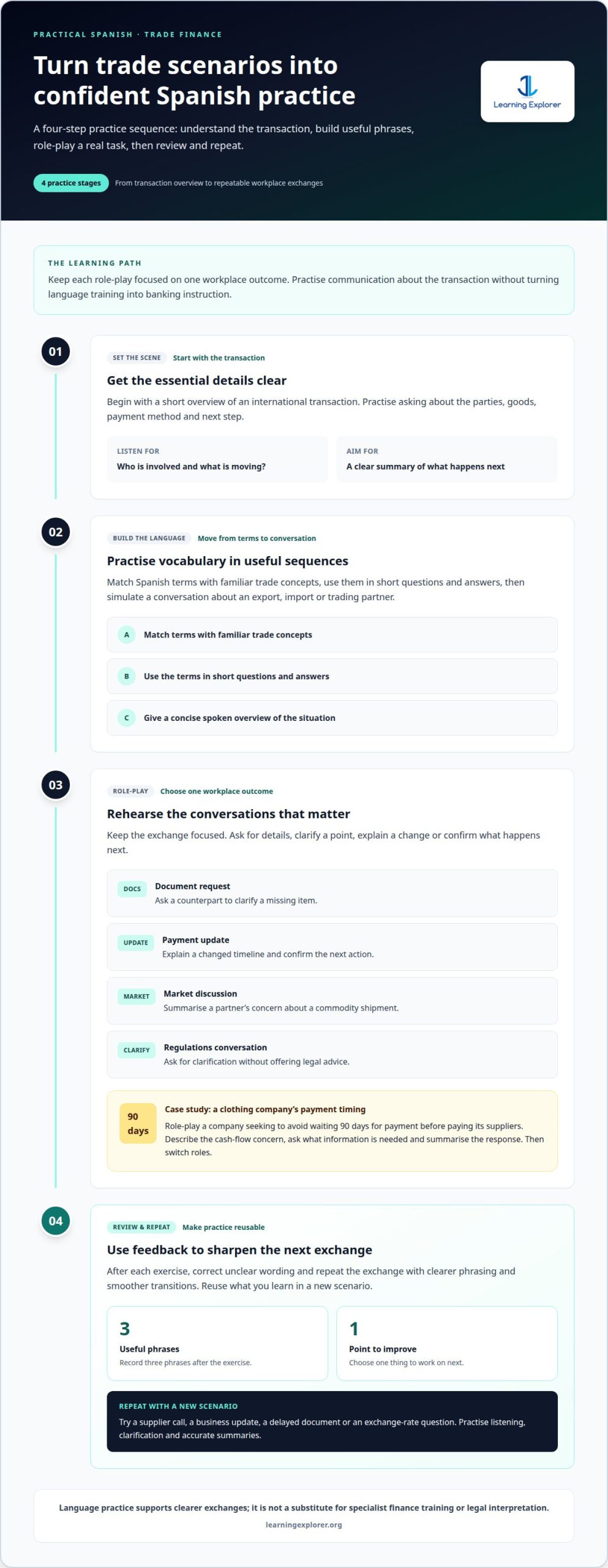
Practical Spanish training works best when you use the language to complete a task. Start with a short overview of an international transaction, then practise asking for details. For example, clarify the parties, goods, payment method and next step. This builds useful speaking habits without turning a language course into banking instruction. Keep each role-play focused on one workplace outcome, such as confirming receipt of a document or explaining a delay. A focused task also makes it easier to identify phrases that need more practice.
Use realistic case studies to connect vocabulary with business decisions. One case involved a clothing company seeking to avoid waiting 90 days for payment before paying its suppliers. Learners can role-play a discussion between the company and a banking contact. They might describe the cash-flow concern, ask what information is needed, and summarise the response. The exercise practises clear communication about capital while keeping financial decisions separate from language learning. Learners can then switch roles and repeat the exchange from the other party’s perspective.
Build exercises from simple to complex. First, match Spanish terms with familiar trade concepts. Next, use those terms in short questions and answers. Then simulate a business conversation involving an export, an import or a trading partner. Finish with a concise spoken overview of the situation. This sequence helps you handle different exchanges, not just recite a prepared script. Use corrections to identify unclear wording, then repeat the exchange with clearer phrasing and smoother transitions.
- Document request: Practise asking a counterpart to clarify a missing item.
- Payment update: Explain a changed timeline and confirm the next action.
- Market discussion: Summarise a partner’s concern about a commodity shipment.
- Regulations conversation: Ask for clarification without offering legal advice.
Case studies can also help prepare you for global communication. Use a scenario with Spanish-speaking participants in different roles, such as buyer, supplier and bank contact. Ask each person to explain their responsibility, then switch roles. In a second round, introduce a change, such as a delayed document or an exchange-rate question. The aim is to practise listening, clarification and accurate summaries, not to predict an outcome or interpret regulations. A short debrief can reveal where a question or response was unclear.
After each exercise, record three useful phrases and one point to improve. Reuse those phrases in the next scenario, perhaps moving from a supplier call to a business update. This review turns training into repeatable practice. For trade finance professionals in Singapore, choose Spanish examples from your daily work and adapt the vocabulary to your role. That keeps practice relevant while building confidence for international conversations. Note the phrases that help clarify meaning so you can revisit them before similar discussions.
Which Singapore language schools offer business or financial Spanish classes?
In Singapore, distinguish a dedicated business Spanish course from general Spanish lessons that include workplace practice. A financial focus should be evident in the course content, not just its marketing. Look for examples involving client introductions, payment discussions, document requests and trade-related meetings. A course centred on travel or everyday conversation can build useful foundations, but may not cover the tasks a trade finance professional handles.
Compare course outlines before deciding. Check whether lessons cover professional vocabulary, formal communication and role-play for business situations. Can learners practise explaining a delayed document or asking a Spanish-speaking counterpart to clarify a transaction detail? Find out whether activities are adapted for people working in banking, imports or exports. Concrete scenarios help you judge whether the learning focus matches your daily work.
Instructor experience matters, but subject expertise and teaching ability are distinct strengths. A skilled Spanish instructor can guide pronunciation, grammar and conversational fluency. Trade finance knowledge can help shape accurate workplace scenarios. Find out how the course handles unfamiliar technical terms: does it teach useful language for asking questions and summarising information, rather than expecting learners to interpret financial documents? A clear answer helps you assess the fit.
- Review the syllabus: Look for business meetings, customer communication, and finance-related scenarios.
- Inspect the practice: Check whether speaking tasks reflect calls, email follow-ups, or document discussions.
- Assess the teaching: Consider the instructor’s Spanish teaching experience and ability to support professional contexts.
- Match the level: Choose content that fits your current Spanish ability and work responsibilities.
A general conversational course can still help professionals who need stronger speaking foundations. It can build skills for introductions, clarification and keeping a conversation moving. To make that foundation relevant, practise with examples from your role. You might rehearse confirming a meeting time, summarising a client request or explaining which document needs attention. These tasks build transferable communication skills without presenting language lessons as specialist finance training.
In Singapore, compare course descriptions by asking what you will be able to do at the end. A good match connects course activities to your goals, such as participating in a client call or handling routine follow-up. If you want dedicated financial Spanish, prioritise a syllabus that names finance-related contexts and includes structured practice. If your immediate need is general speaking confidence, conversational Spanish can be a practical starting point.
For broader business context, Enterprise Singapore supports businesses, startups and investors in Singapore. The Singapore Business Federation provides networking and advocacy support. Their roles differ, so consider each alongside the course syllabus.
Are there Spanish-language trade finance or banking glossaries and training resources?
Keep language references separate from trade finance training. A glossary helps you recognise and reuse specialist terms; a finance course explains transactions, documents and processes. For Spanish learning, combine a reliable bilingual glossary with speaking practice. Organise terms by task, such as payment discussions, document requests and shipment updates. Add a plain-English definition and a sample sentence for each entry. This turns scattered vocabulary into a focused workplace reference.
Build your glossary from situations you handle. Start with a recent work task, such as explaining an invoice query. List the key concepts in English, then find their Spanish equivalents in a reliable language reference. Record the source and context beside each term. Banking terms can vary by context, so don’t copy a translation without checking how it is used. Ask a fluent speaker or instructor to review terms before using them in a professional conversation.
Use Singapore-specific trade information as subject context, not as Spanish instruction. Singapore Customs provides information on import and export regulations. Read a relevant page, note the English concepts, then practise explaining them aloud in Spanish. This helps you discuss real work topics while keeping regulatory interpretation separate from language study. For example, prepare a short explanation of an import process, then practise asking a colleague to clarify a step.
International trade references can also shape targeted vocabulary practice. UCP 600 concerns letters of credit, while Incoterms® rules help frame trade discussions. Treat these materials as sources for concepts, not as Spanish glossaries. Create a term card with the English concept, the Spanish equivalent, a short definition, and one workplace example. Review the card during a role-play, such as requesting clarification about a document or summarising a transaction.
- Group terms: Sort vocabulary by banking, payments, documents, and shipment topics.
- Check context: Record where each term appears and what it means there.
- Practise actively: Use new terms in a spoken summary or simulated call.
- Refresh regularly: Remove duplicates and add words from new work scenarios.
Singapore training resources may cover finance without teaching Spanish. According to IBF, its listed course is training only and sits under Corporate Banking. This distinction helps you choose complementary resources: specialist finance training for technical knowledge and Spanish lessons for communication skills. Don’t expect one to replace the other. Pair a banking topic with a language task, such as explaining a payment process in clear, simple Spanish.
Keep your glossary manageable by prioritising terms you use in real conversations. Review each entry for accuracy, pronunciation and a practical example. A Conversational Spanish Course can support general speaking practice, while a term bank keeps workplace vocabulary organised. Together, they offer a repeatable way to build confidence without treating a glossary as a substitute for professional finance guidance.
How can I compare Spanish course schedules, class sizes, teaching formats, and instructor qualifications in Singapore?
Start with your weekly work pattern. If you handle month-end deadlines, predictable lesson times and manageable practice between sessions may suit you better. Compare the schedule, lesson duration, attendance expectations and rescheduling options. Then map those commitments against recurring tasks, such as client calls or document reviews. A course schedule works only if you can attend consistently and practise Spanish between lessons.
Class size affects how much speaking time each learner gets. Ask how lessons balance instructor explanations, pair practice and individual feedback. In a small group, learners can take turns role-playing a bank call. In a larger class, structured breakout activities can still create speaking opportunities. Compare the actual classroom activities, not just the group label, and check whether you’ll get feedback on pronunciation, clarity and professional phrasing.
Choose a teaching format that matches your learning needs. Live online classes can provide scheduled interaction, while self-paced materials offer flexibility for reviewing vocabulary. Classroom lessons give learners direct practice with peers. IBF lists its trade finance course as classroom-facilitated training. Treat that as a distinction in format, not evidence about Spanish classes. Compare whether a Spanish course includes live conversation, independent exercises or both.
Instructor qualifications also need careful comparison. Mr. Victor Tan, a trade finance course trainer, has 15 years of banking experience in international trade finance and related banking areas. That experience relates to trade finance instruction, not necessarily Spanish teaching. For a language instructor, assess Spanish proficiency, teaching experience, and ability to guide adult learners. Ask how professional scenarios are adapted without confusing language coaching with financial advice.
Use a consistent checklist to evaluate each course. Record the schedule, class format, speaking practice, feedback approach and instructor background. Then assess the fit against one concrete goal, such as explaining a routine payment query in Spanish. If trade finance terminology is your priority, look for relevant scenarios. If you mainly want fluency, prioritise frequent speaking practice and correction.
- Match lesson times with your work calendar.
- Compare speaking opportunities and feedback for each learner.
- Separate finance expertise from Spanish teaching qualifications.
- Choose the format that supports your practice habits.
Make your choice based on the learning task you need most. For example, a learner preparing for Spanish-speaking client conversations should favour interactive speaking practice. A learner building foundations may need more guided language instruction first. Explore Spanish learning options as you compare formats and decide which skills to strengthen.
Learning Explorer: Conversational English Course
Learning Explorer offers the Conversational English Course for learners who also want to strengthen everyday workplace communication in English. It can complement Spanish study if your role involves switching languages during calls, meetings or routine follow-ups. For example, practise expressing a request clearly in English before working on how to communicate a similar idea in Spanish. The goals are distinct: this course develops conversational English, while Spanish practice supports communication with Spanish-speaking counterparts.
Choose this option if clearer spoken English is a separate professional goal, not a substitute for Spanish learning or trade finance training. For a business-focused English goal, Learning Explorer also offers the Business English Course. Contact Learning Explorer to discuss which course fits your language-learning priorities.
Turn your learning goal into a practical next step
A practical path to Spanish for trade finance professionals in Singapore starts with one communication goal. Choose a situation you want to handle more confidently, such as opening a client conversation or clarifying a routine request. Make that situation the focus of your next practice session. A clear target connects your study to your working day.
Keep your plan realistic and specific. For trade finance professionals in Singapore, learning Spanish can start with introductions, questions and follow-up phrases relevant to the role. Add complexity as your communication needs grow. Learning Explorer also offers the Conversational English Course, Business English Course and Conversational Mandarin Course for learners pursuing additional language goals.
Contact Learning Explorer to get started and explore a suitable learning path. Take the next step with purpose and build confidence one conversation at a time.
Frequently Asked Questions
What Spanish courses for trade finance professionals are available in Singapore?
Learning Explorer offers a Conversational Spanish Course in Singapore. It can help professionals build general speaking skills for workplace interactions, such as introducing themselves at a business event or arranging a follow-up meeting. You can connect language practice with familiar situations from your role. Keep Spanish learning focused on communication, while using specialist training for technical finance knowledge and procedures.
Are there Spanish courses tailored to banking, trade finance, or corporate finance?
Course content varies, so distinguish a general Spanish class from a syllabus that explicitly covers finance. Learning Explorer’s named Spanish offering is the Conversational Spanish Course. To assess a course’s relevance, look for work-related scenarios in its outline, such as introducing a company, discussing a meeting agenda or clarifying a routine request. These activities build professional communication without replacing technical banking or finance instruction.
Do Singapore providers offer evening, weekend, online, or private Spanish lessons?
Learning Explorer provides physical and online language classes. To fit lessons around an evening or weekend schedule, compare the available lesson times with your work commitments. Choose a format that lets you attend consistently and practise between sessions. For example, online lessons may suit learners travelling between meetings, while physical classes provide an in-person setting.
What Spanish proficiency level is useful for trade finance professionals working with Latin America or Spain?
A useful level of Spanish lets you handle the conversations your role requires. You might aim to introduce yourself, understand a meeting’s main points, ask someone to repeat a detail and arrange follow-up. Needs differ between relationship-building and technical discussions. List the tasks you expect to manage in Spanish, then practise those exchanges. For complex finance matters, language ability alone does not replace specialist knowledge.