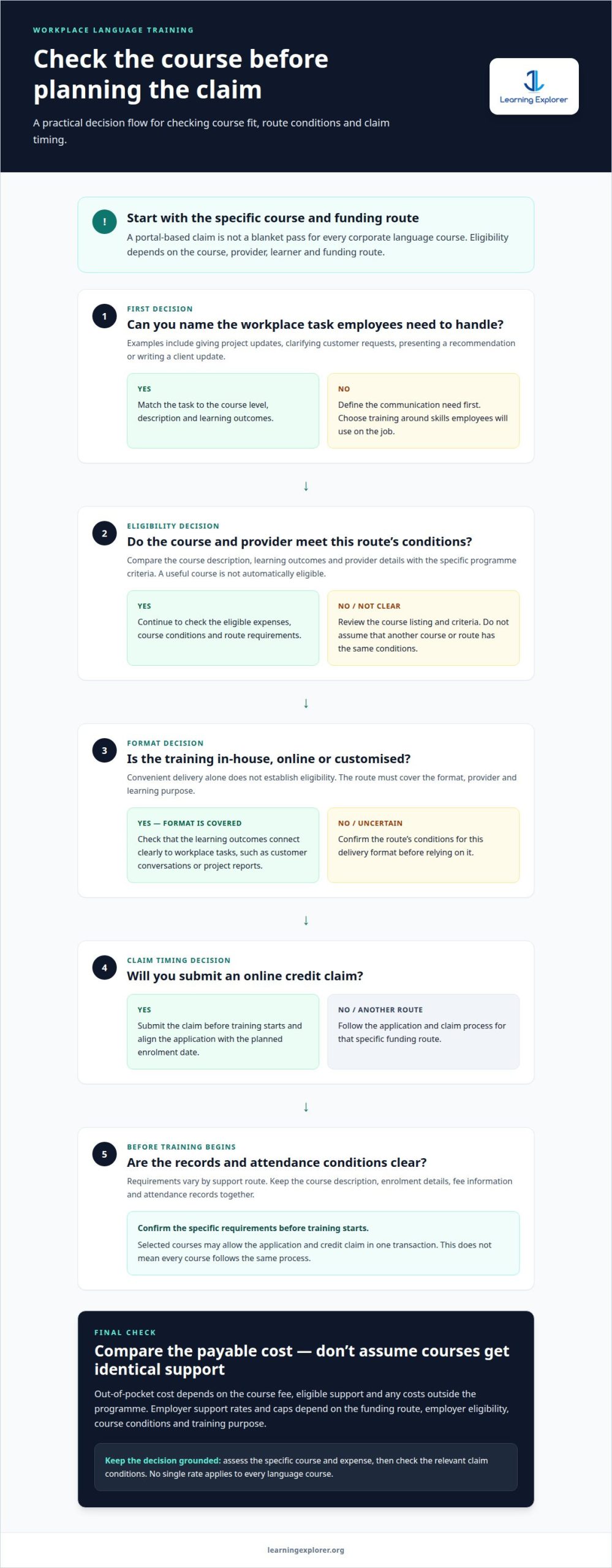
A portal-based claim is not a blanket pass for every corporate language course. Selected courses can be applied for and claimed in one transaction, while online credit claims must be submitted before training starts. Whether workplace language training qualifies depends on the course and funding route.
It’s understandable to want a clear answer before planning staff training. Application steps, eligibility and employer support can be difficult to untangle. This guide explains how course applications and claims work, what may affect funding access, and which other forms of workforce support could be relevant.
You’ll also see how to assess language training in practical workplace terms, from strengthening English and Mandarin communication to building confidence in other languages your team uses. The aim is to make funding options easier to understand so you can plan training around real communication needs and decide on the next step.
Key Takeaways
- Applications and claims are available for selected courses, so eligibility depends on the specific course and funding route.
- Workplace language training can focus on practical communication needs, such as clearer English or Mandarin for business situations.
- Different subsidies may have separate eligibility rules and application processes; understand how each applies before planning a combined funding approach.
- Employer support can help eligible businesses fund workforce development, but the programme and training purpose matter.
- Choose training around the communication skills your team needs to use on the job.
Can Workplace Language Courses Receive Training Support in Singapore?
Some workplace language courses may qualify for support, but eligibility depends on the course, provider, learner and funding route. For corporate language training in Singapore, assess course eligibility separately from whether its learning goals suit your team.
Course and Provider Eligibility
Eligibility means a course and provider meet the conditions of a particular training support programme. A course’s usefulness alone does not make it eligible. Compare its description, learning outcomes and provider details with the programme criteria. For example, an intermediate business English course focused on client meetings should clearly relate to employees’ communication tasks.
Course Fees and Out-of-Pocket Costs
Out-of-pocket cost is what the employer or learner pays after applicable support. The final amount depends on the course fee, eligible support and any costs outside the programme. Compare the payable amount for each course rather than assuming English and Mandarin classes receive identical support. For corporate language training Singapore funding, the key question is whether the specific course and expense meet the relevant conditions.
Finding Courses in the Online Portal
Search the course portal by language and workplace goal, then review each listing’s description and eligibility details. For example, look for business English if employees need to practise presenting updates or handling customer conversations. Selected courses may allow applications and credit claims in one transaction. Submit an online claim before the course starts, and align the application with the planned enrolment date.
Funding Documents and Attendance Requirements
Documents and attendance conditions vary by support route. Keep the course description, enrolment details, fee information and attendance records together, then follow the requirements for the specific programme. Confirm the conditions before training begins to avoid relying on paperwork or attendance rules from a different course or funding arrangement.
Choosing a Course Around Learning Goals
Start with a task employees need to handle more effectively. Staff giving project updates may need to explain decisions clearly, while customer-facing teams may need to clarify requests and respond appropriately. Match these scenarios to the course level and outcomes. This helps distinguish conversational practice from business communication training and gives managers a practical way to assess fit.
Employer support rates and caps depend on the funding route, employer eligibility, course conditions and training purpose. No single rate applies to every language course. For an intermediate business English course, define the workplace skill first, then assess the course information and relevant claim conditions. This grounds the funding decision in training employees will actually use.
Workplace English and business communication training
Workplace English training builds communication skills for real tasks, from customer conversations to project updates. A focused programme connects practice with employees’ day-to-day work.
Workplace Communication Training Topics
Business communication training uses workplace situations to develop clear, confident English. Employees need to share information accurately with colleagues, customers and partners. Course topics can include working life, projects, customers, security and logistics. A team might practise explaining a delivery delay, clarifying a customer request or summarising a project decision. These scenarios provide language relevant to everyday interactions.
Other useful topics include decision-making, innovation and performance. Learners can practise presenting a recommendation, responding to questions or describing a process change. Choose content that reflects the team’s actual communication needs, keeping practice connected to workplace outcomes rather than isolated vocabulary exercises.
Business Training Programmes and Benefits
Business training programmes help employees build skills for their roles and career development. Targeted language learning can make routine communication easier to manage. For example, a team that writes client updates can practise concise explanations and an appropriate tone. In meetings, learners can practise asking follow-up questions and confirming decisions.
Business presentations and report writing require different skills from casual conversation. A presentation may need a clear opening, organised points and confident responses to questions. A report may call for precise summaries, an appropriate tone and clear recommendations. Build practice around familiar tasks, such as presenting a project update or writing a customer-facing summary. These examples also make learning goals easier to discuss with staff.
Funding for In-House and Customised Training
In-house, online or customised delivery may qualify under a training support programme if its conditions cover that format, provider and learning purpose. A convenient format alone does not establish eligibility. For example, an online class tailored to customer conversations must still meet the relevant programme conditions.
Claims can run into problems when the course, participant, supporting records or submission timing do not meet the applicable requirements. Reduce avoidable errors by aligning the training plan with the eligibility criteria, keeping enrolment and attendance records together, and submitting the claim through the required process. For a customised course, clearly connect its learning outcomes to workplace tasks, such as customer calls or written project reports. This makes the purpose easier to explain and document.
Combining training support with other subsidies
Singapore employers may encounter several forms of support when planning workforce training. Each subsidy has its own purpose, eligibility conditions and claim process, so don’t assume two sources can automatically cover the same course cost. Identify the training objective first, then match each potential source to the specific expense or activity it may support. This clarifies the funding plan before staff enrol.
For example, a logistics company could plan language training to help staff explain delivery updates to customers. The employer might explore one source for eligible course fees and another for a separate workforce development activity. Whether both can contribute depends on their individual rules and how each expense is treated. Keep course fees, staff time and other training-related costs distinct in the budget rather than combining them into one unitemised figure.
A practical comparison helps prevent assumptions:
- Purpose: Match the subsidy to the stated training or business outcome.
- Eligibility: Review conditions for the employer, learners, course and delivery format.
- Cost coverage: Identify which expense each source may support.
- Claim sequence: Note when applications or claims must be made.
- Records: Keep relevant enrolment, attendance and payment information organised.
Consider a team that needs stronger English for project coordination and customer updates. The employer can describe these tasks as the training need, then compare available support routes with the course’s learning outcomes. If one source applies to a course fee and another relates to a different business activity, document those costs separately. Clear records help explain how the proposed training supports the business goal.
Timing matters too. A Singapore employer should understand each programme’s process before committing staff or setting a start date. An application submitted at the wrong stage, or costs recorded under the wrong purpose, can complicate a claim. Create a simple schedule showing the planned training, relevant funding route, key submission points and records needed for each claim. This is especially useful when several teams or locations are involved.
Don’t treat a subsidy as a discount that applies uniformly to every course. The amount and eligible expenses depend on the scheme’s terms, the employer’s circumstances and the training design. A focused plan links each funding source to a defined cost and outcome. This helps finance and learning teams assess support while keeping sight of the communication skills employees need at work.
Employer workforce training support
Employer support can help Singapore businesses develop staff capabilities while keeping daily operations moving. Start with a specific workforce need, such as more consistent shift briefings or clearer internal handovers. Then define how training could address it and which employees would benefit. A focused plan helps compare support options with the intended business outcome without treating every training expense as interchangeable.
Some workforce support is designed for staff time spent in training, rather than the course fee itself. Since 1 January 2022, Singapore’s absentee payroll funding rate has been fixed at S$4.50 per hour. This distinction matters when managers plan schedules and budgets: the cost of instruction and salary costs during training are separate considerations. Record them separately when preparing a workforce training plan.
Plan around the operational change you want to support. A retail team, for example, might need more consistent handovers between shifts, while supervisors may need to explain updated procedures clearly. Identify the relevant roles, describe the communication tasks and connect them to the learning outcomes. This creates a clearer rationale for training than a broad request to improve communication.
Before making commitments, review the support route’s conditions and application timing. Programmes may treat employers, employees, course formats and costs differently. A useful planning record can include:
- Workforce need: Describe the task or capability the team needs to strengthen.
- Participants: Identify the roles that will apply the learning at work.
- Training purpose: Explain how the planned learning connects to the operational need.
- Cost categories: Separate course fees from salary-related support and other expenses.
- Timing: Record the training period and any relevant application milestones.
Keep responsibilities clear when employees attend training. Managers can coordinate work coverage and document the business need, while employees follow the applicable enrolment and attendance process. For instance, a supervisor could establish a consistent handover process before training, then use the same work situation when discussing learning outcomes. This connects administration to a real workplace task instead of adding paperwork without purpose.
Build the plan around employee needs and business priorities. Clear objectives, distinct cost categories and practical scheduling help employers assess workforce support in context. A well-structured plan can reduce avoidable administrative confusion while keeping staff development connected to their daily work.
Can employers use enterprise credits or other grants to fund corporate language training?
Some employer grants support workforce transformation, but that does not mean every language course qualifies. In Singapore, distinguish support for course fees from funding intended for job redesign, capability building or workplace learning. The employer’s circumstances, training purpose, eligible costs and programme conditions determine whether a particular route fits. A grant’s headline amount alone does not establish that it covers a language course.
Only S$3,000 of the enterprise credit can be used for workforce transformation programmes. This limit matters when a business plans language classes alongside a wider change. For example, a company improving customer service could plan staff language practice separately from a redesigned customer-support workflow. Keep each activity’s purpose and costs distinct, so the proposed training does not become confused with the broader transformation project.
The grant may support eligible workforce transformation costs, but employers should check whether the proposed activity qualifies. These rates concern eligible transformation costs, not automatically every language course. Employers should distinguish a course that develops communication skills from costs tied to redesigning a role or process.
The Capability Transfer Programme provides up to 50% funding support to Singapore businesses to build local workforce capabilities. Workplace learning support can reach up to 90% for companies, while non-SMEs can receive up to 70%. Each route has its own purpose. A language course should be assessed against the relevant programme conditions, rather than assumed to qualify because it contributes to employee development.
For a proposed course, build a clear assessment:
- Define the business need: Identify a task, such as customer conversations or project handovers.
- Match the purpose: Separate language learning from job redesign or capability transfer.
- Map costs: Record course fees apart from other transformation expenses.
- Explain the link: Connect learning outcomes to the workplace need or business change.
- Review conditions: Follow the relevant grant’s criteria and claim process.
For example, a Singapore SME changing how staff handle customer enquiries could plan role redesign and language practice as related but distinct activities. Its budget should show which costs belong to each activity rather than grouping everything into one request. This gives the business a clearer basis for assessing whether a support route relates to the training, the transformation or separate elements of both.
Build the funding plan around a defined business outcome, not a grant headline. Language practice for customer communication differs from a role-redesign project, even when both support the same team. Distinct objectives and cost records help employers assess available options without assuming one grant covers every part of corporate language training.
Learning Explorer
Learning Explorer helps you connect workplace communication goals with practical language learning. Explore its courses when your team needs to build confidence in meetings, customer conversations or written updates. English learners can choose the Conversational English Course or Business English Course, while Mandarin learners can consider the Conversational Mandarin Course or Business Mandarin Course.
A team that speaks with customers may prioritise clear, natural conversations, while managers preparing staff for presentations may focus on business communication. Matching the learning goal to daily tasks gives employees relevant practice and helps employers plan focused training. Course selection is separate from assessing whether a particular funding route applies.
Contact Learning Explorer to discuss language learning for your workplace team.
Turn workplace goals into a learning plan
Choose a communication challenge your team encounters often, then define what employees need to do more confidently. They might need to contribute to discussions, explain decisions or write clearer updates. A specific goal gives your training plan direction and helps employees connect practice with their daily work.
Next, consider which learning format and course focus suit your team. Learning Explorer offers language learning for workplace communication, including English and Mandarin. A well-matched course gives employees practical opportunities to build skills they can apply in real interactions.
Funding rules and course eligibility are separate considerations, so keep the learning objective clear as you plan. If your organisation is ready to explore suitable language training, contact Learning Explorer about workplace language training. A thoughtful next step can help turn a communication need into a focused learning experience for your team.
Frequently Asked Questions
Can I combine learning credits with other subsidies?
Possibly, but separate support sources may cover different expenses and have distinct conditions. For example, an employer planning language classes alongside workplace redesign should keep the two activities and their costs clearly separated. Match each source to the expense it may support, then follow its application process. Don’t treat two forms of assistance as automatic discounts on the same course fee.
How do I register for a language course?
Contact Learning Explorer and share the language, workplace goal and learner needs you have in mind. For example, explain whether employees need to handle customer conversations or contribute more confidently in meetings. Learning Explorer offers language courses for workplace communication, and this information helps frame your enquiry. You can call +65 9725 8311 or email info@learningexplorer.org to discuss course registration.
How do I submit a claim for a course?
For a course that allows an online credit claim, sign in to the relevant claim portal through Singpass and submit the claim before training starts. Have the course details ready so you can select the correct training. The application and credit-claim process can vary by course. Keep a record of the submission and course information to track the claim alongside enrolment.
How is the estimated payable fee calculated?
The estimated payable amount depends on the course fee and support applicable to that enrolment. Eligible credit balances, subsidies and costs excluded from support can all affect the final amount. For example, two learners taking different courses may pay different amounts under the same workplace training plan. Treat the estimate as course-specific and separate it from salary-related support for staff time.
How often can I use available learning credits?
Learning credits can be used across multiple claims until the available balance runs out, with no limit on the number of claims. The credits do not expire, although some top-ups have expiry milestones. For example, an employee could use part of a balance for one eligible course and reserve the rest for another. The balance available for each claim determines how much credit remains to apply.
Where can I get more course information?
Contact Learning Explorer with the language you want to learn and the work situations your team needs to handle. A useful enquiry might describe the need to explain project updates, write clearer messages or speak with customers. You can reach the school at +65 9725 8311 or info@learningexplorer.org. Sharing your learning goal helps make the conversation about course fit more focused.
What are employer training programmes, and how can a business use them?
Employer training programmes provide structured ways to develop workforce skills, with conditions shaped by each programme’s purpose. Start by identifying a practical need, such as clearer customer communication, then connect it to relevant learning outcomes. Keep training costs distinct from broader business transformation expenses. This helps managers plan staff learning and assess which support route may fit.
Which Singapore language training providers offer courses that may qualify for support?
Learning Explorer offers language courses for individuals and corporate learners in Singapore. Whether a particular course qualifies for a funding route depends on the course and that route’s conditions, so the provider’s name alone does not establish eligibility. Match the course language and learning purpose to your team’s needs, then assess its specific information against the relevant support requirements before planning enrolment.