Fast progress in Vietnamese starts with a surprising priority: learn to hear the language clearly before memorising long word lists. If you’re wondering how to learn Vietnamese fast, build a daily routine around listening, useful everyday sentences, social pronouns, and the alphabet. Consistent practice matters more than an occasional marathon study session.
It’s understandable to want a clear timeline. With regular practice, learners may master basic phrases and recognise common words in one to two months, while speaking comfortably takes longer. Vietnamese has six tones, so listen closely to notice how pronunciation can change meaning. Its Latin-based alphabet also makes written words more approachable, though the diacritical marks deserve focused study.
This guide shows how to turn those building blocks into practical progress. You’ll learn to use short listening sessions, practise sentences for everyday situations, choose social pronouns carefully, study the alphabet, and establish a manageable daily habit. Start with the sounds and patterns you’ll use most, then build confidence through steady repetition.
Key Takeaways
- Choose listening material you can mostly follow, then replay short sections to notice pronunciation patterns.
- Use everyday sentences to practise grammar in context and make new structures easier to recall.
- Adapt your forms of address to the person and situation so conversations feel more natural and respectful.
- Build a manageable daily routine, with focused practice that you can sustain over time.
- Study the alphabet and its diacritical marks to connect written forms with the sounds you hear.
Comprehensible input and listening practice
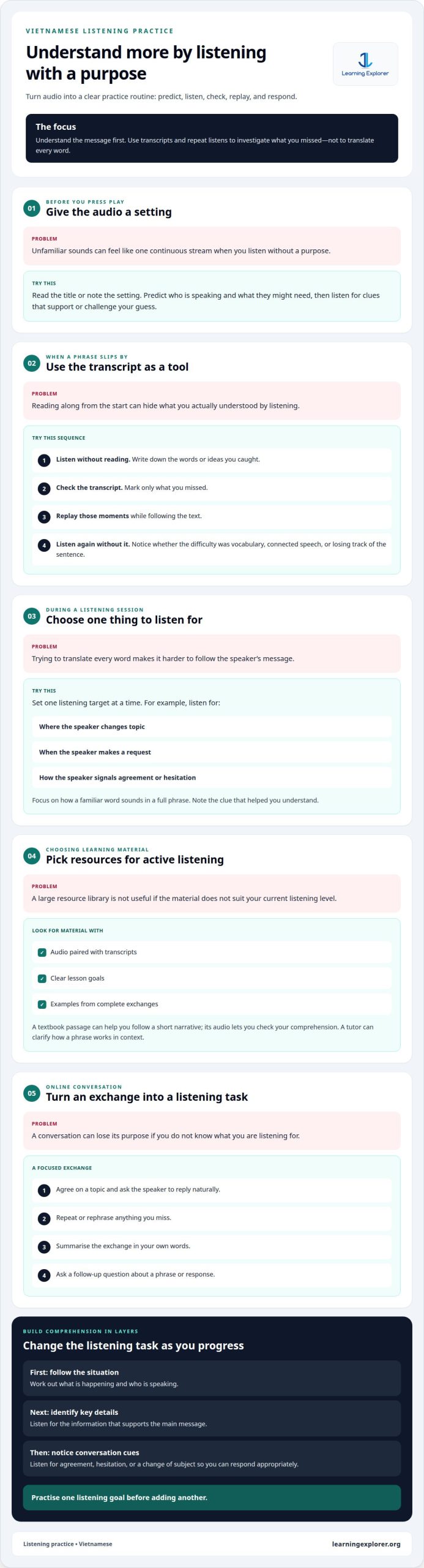
Make each listening session a small investigation. Before playing a clip, read its title or note the setting. Predict who is speaking and what they might need, then listen for clues that support or challenge your guess. This turns audio into a meaning-focused task instead of a stream of unfamiliar sounds. To learn Vietnamese fast, focus on understanding messages, not collecting recordings.
Listening Through Comprehensible Input
Use a transcript strategically. Listen once without reading, then write down the words or ideas you caught. Check the transcript afterward and mark only what you missed. Replay those moments while following the text, then listen again without it. This sequence helps you identify whether the difficulty came from unfamiliar vocabulary, connected speech, or losing track of the sentence.
Try selective listening next. Set one target, such as noticing where a speaker changes topic or makes a request. Don’t try to translate every word. To develop pronunciation awareness, focus on how a familiar word sounds in a full phrase, where neighbouring sounds can affect what you hear. Keep a short note about the clue that helped you understand.
Selecting Learning Resources
Choose apps, courses, tutors, and textbooks based on how well they support active listening. Look for audio paired with transcripts, clear lesson goals, and examples from complete exchanges. A transcript helps you investigate missed phrases; a tutor can clarify how a phrase works in context. Avoid building a resource library before testing whether the material suits your current listening level.
Use each resource to meet a different need. For example, choose a textbook passage to practise following a short narrative, then use its audio to check your comprehension. Note the speaker, setting, and central message. These details make it easier to return to useful material without replaying everything from the beginning.
Planning Daily Practice and Online Conversation
For an online exchange, agree on a topic and ask the speaker to reply naturally. Repeat or rephrase anything you miss. After listening, summarise the exchange in your own words and ask a follow-up question about a phrase or response. This gives the conversation a clear purpose and tests whether you understood the meaning, not just individual sounds.
Change the listening task as your comprehension develops. First follow the situation, then identify key details, and finally listen for how the speaker signals agreement, hesitation, or a change of subject. These cues help you respond appropriately. If you’re deciding how to learn Vietnamese fast, choose material that lets you practise one listening goal before adding another.
Grammar learned through everyday sentences
Build Vietnamese grammar through complete sentences, not isolated rules. A pattern is easier to remember when connected to a familiar task, such as asking for help or describing a meal. Start with one model sentence, identify its parts, then change one part at a time. This keeps each practice step concrete and manageable.
Vietnamese follows subject-verb-object order, as English does. Use that familiar structure to identify who acts and what happens. In “I understand the lesson,” “I” is the subject, “understand” is the verb, and “the lesson” is the object. Keep the word order steady as you learn new verbs, then practise the same structure with a different subject or object.
Vietnamese verbs don’t change form according to the subject. You can practise one verb with different subjects without memorising separate endings. Time markers communicate when an action happens: đã marks the past, đang an ongoing action, and sẽ the future. Study each marker in a sentence, then notice how its position shapes the meaning.
For negation, practise the pattern in “Tôi không hiểu,” meaning “I don’t understand.” Focus on how không appears before the verb. Read the positive meaning, then compare it with the negative example. This contrast helps you recognise a useful sentence structure without learning a new verb form. Revisit the pattern with familiar vocabulary as you progress.
Adjective placement differs from English: in Vietnamese, an adjective follows the noun it describes. Notice that sequence whenever you encounter a description in a sentence. Rather than translating word by word, identify the noun first, then the descriptive word that follows. This simple reading step helps you understand the sentence in its original order.
Vietnamese nouns don’t change form to show plural. Context indicates whether a noun is singular or plural, so look at the surrounding sentence instead of searching for an added ending. Classifiers also appear between numbers and nouns. Examples include cái for most objects, con for animals, and quả for round things. Learn each classifier with an example noun.
Use a short practice cycle to make these patterns usable. First, read a sentence and identify its subject, verb, and object. Next, find any time marker or negation word. Then check noun descriptions and classifiers. For instance, ask whether đang signals an ongoing action or whether không makes the statement negative.
Keep each practice round focused on one change. Take a familiar sentence and compare its positive and negative forms, or examine how a time marker affects meaning. Don’t change every element at once. Isolating one grammar feature helps you see how Vietnamese builds meaning through word order, markers, and context rather than verb endings or plural forms.
Vietnamese social pronouns and forms of address
In Vietnamese, your choice of address also shapes how you refer to yourself. English often uses “I” and “you” across many situations; Vietnamese choices can reflect age, relationship, and context. A useful first step is to learn pronouns as pairs, not isolated translations. For example, practise saying who you are and how you address your conversation partner.
Tôi is a common way to say “I,” especially in more formal or neutral exchanges. Bạn can mean “you” or “friend,” but it doesn’t suit every relationship. In a simple practice exchange, say Tôi là…, meaning “I am…,” then listen to how the other person addresses you. Treat these as starting points, not universal choices.
Many everyday forms draw on family terms. Anh can refer to an older brother or older man; chị can refer to an older sister or older woman. Em may refer to a younger sibling or younger person. The same term can address someone and refer to yourself in relation to them. Learn each pair together.
Context guides the choice. Consider the person’s relative age, your relationship, and the setting before selecting a form. For example, a learner might address an older woman as chị and refer to themselves as em. That differs from an exchange between people of similar age. Regional habits and personal preference can also shape forms of address, so notice the wording used by speakers around you.
Practise with short, realistic exchanges instead of memorising a long list. Start with a greeting, introduce yourself, and ask a simple question. Then repeat the exchange with another relationship pair, such as anh and em. Keep the sentence structure familiar while changing the forms of address. This isolates the social choice and makes its role easier to notice.
A conversation partner’s introduction can offer clues, but don’t assume their age from appearance alone. Listen to the terms they use for themselves and for you. If a speaker calls themselves anh, notice whether they address you as em. Record the exchange and review each term’s role. If the context remains unclear, ask politely which form they prefer.
Build a compact reference card with three columns: the term, its relationship, and an example sentence. Add tôi and bạn, then include anh, chị, and em. Note who is speaking and who is being addressed. Reviewing the examples aloud connects each form with a real interaction, rather than a single English equivalent.
Finally, practise switching roles. Say the same greeting as an older speaker, then as a younger speaker. Keep the situation constant so you can focus on how pronouns change. This deliberate comparison builds awareness without turning each conversation into a grammar exercise. With repeated examples, you’ll make more thoughtful choices and follow forms of address more confidently.
Daily study time and consistency
A steady routine makes Vietnamese practice easier to sustain. Aim for twenty minutes every day, rather than four hours once a week. Use that daily block for a clear task, not an open-ended study session. For example, focus on listening, sentence practice, or reviewing notes. A small plan gives each session a purpose and makes progress easier to notice.
Set a reliable cue for your practice. Link Vietnamese to an existing part of your day, such as settling in after breakfast or opening your notebook after work. Keep your materials ready so starting doesn’t require another decision. If a session is interrupted, return to the same task later. Protecting the routine matters more than creating an elaborate schedule.
Give each session a simple sequence. First, revisit a phrase or note from the previous day. Next, work on one new item, such as a sentence pattern or useful expression. Finish by recalling it without looking. This cycle keeps practice active and gives you a specific result to carry forward. Write that result in a notebook before you stop.
Use a practice log to track actions, not vague impressions. Add the date, the task, and an example you can now recognise or produce. For instance, record a sentence you recalled without prompts. On a busy day, choose a smaller task, such as reviewing one note. Keeping the habit flexible helps you return without treating a missed session as failure.
Plan milestones around what you can do. Basic phrases and recognition of common words may take one to two months. Basic conversations, understanding slow speech, and reading simple Vietnamese content may take six to twelve months. Work-level fluency may take one and a half to two years for consistent learners. Treat these as planning estimates, then measure your progress through real tasks.
At each review, compare a recent task with an earlier one. Can you introduce yourself, follow a familiar exchange, or recall a useful phrase more easily? Note the specific change. If a task still feels difficult, keep it in your routine instead of adding several new topics. This makes your next practice choice clear and keeps the workload focused.
Consistency doesn’t mean studying the same way every day. Keep the twenty-minute commitment, but vary the activity to match your needs. One day, review notes; another, practise a short conversation or write a few sentences. Choose one clear goal before starting. This balance supports regular contact with Vietnamese while making each session purposeful and manageable.
Learning the Vietnamese alphabet
Vietnamese uses the Latin alphabet with diacritical marks. Those marks carry information, so don’t treat them as decoration. A mark can change a vowel’s sound or show a tone. Read each complete spelling carefully, including every mark. This helps you connect written words with pronunciation instead of guessing from familiar English letters.
The writing system is called quốc ngữ. Vietnamese adopted this Latin-based system during the 17th-19th centuries. For beginners, that history offers useful context, but the practical lesson is simple: learn the marks alongside the letters. Copying a word without its marks changes what you are studying. Keep examples accurate in your notes and practice materials.
Start by comparing related vowel shapes. For example, a, ă, and â are distinct letters in Vietnamese spelling. The same applies to o, ô, and ơ, as well as u and ư. Write each group side by side, then read the letters aloud. This makes the visual differences easier to notice.
Next, pay attention to the mark above or below a letter. Write a marked vowel beside its unmarked form, then compare the spelling carefully. For instance, practise copying a and á without dropping the mark. Treat the letter and mark as one written unit. This habit reduces errors when reading or entering Vietnamese text.
Use a short, repeatable study sequence. First, read a marked word from your lesson. Then copy it exactly, including its diacritics. Cover the example and write it again from memory. Finally, compare both versions, checking every mark. If they differ, rewrite the word correctly before moving to another example. One careful correction is better than a page of unchecked copying.
Keep a small reference list organised by letter pattern. Add a clear example beside each unfamiliar form, then revisit the list during reading practice. When you meet a new word, identify its letters before trying to pronounce it. This separates spelling recognition from guesses based on English sound patterns. Over time, you’ll spot familiar marks more quickly.
Make your notes easy to scan. Use consistent handwriting for each mark, and leave enough space between examples. When typing, preserve all diacritics instead of replacing them with plain letters. Compare your typed word with the lesson’s spelling, character by character. This catches small omissions before they become repeated habits.
Link alphabet study to real reading. Choose a short phrase, mark the letters you recognise, and copy one unfamiliar word accurately. Then read the phrase aloud, keeping its written details in view. For more structured support connecting Vietnamese spelling with speaking practice, explore guided Vietnamese practice.
Learning Explorer: Conversational Vietnamese Course
Learning Explorer’s Conversational Vietnamese Course offers a guided next step when self-study leaves you unsure how to use new words aloud. It provides a structured setting to practise everyday communication and build speaking confidence. Lessons are interactive and taught by bilingual, native-speaker instructors, helping connect language practice with real conversation.
Turn to a course when you want regular guidance with pronunciation, useful expressions, and speaking practice, rather than choosing every resource alone. Bring the phrases and questions you’ve been working on, then use them as conversation starters. A clear learning structure can help keep your practice focused as you develop practical Vietnamese skills.
If you’d like to explore guided Vietnamese learning, contact Learning Explorer.
Keep Your Vietnamese Practice Moving
Choose a next step that fits the conversations you want to have. If you’re deciding how to learn Vietnamese fast, focus on making your practice useful beyond the page: set a clear speaking goal, then practise regularly toward it. A goal such as introducing yourself comfortably or joining a simple conversation can help you decide what to work on next.
Learning Explorer’s Conversational Vietnamese Course offers a structured way to continue building conversational skills. Learning Explorer also offers a Conversational English Course, a Business English Course, and a Conversational Mandarin Course for learners with other language goals. Choose the course that matches the language you want to use, and take your next step with a learning plan that supports real communication.
Contact Learning Explorer to discuss your Vietnamese learning goals. Every useful phrase you practise brings you closer to joining conversations with greater confidence. Keep going, one practical step at a time.
Frequently Asked Questions
How Long Does It Take?
Basic phrases and recognition of common words may take one to two months. Basic conversations, understanding slow speech, and reading simple Vietnamese content may take six to twelve months. Use these as planning milestones, then test your progress with practical tasks. Can you introduce yourself, understand a familiar question, and give a short reply? These abilities offer a more useful measure than counting lessons completed or words memorised.
What is the fastest way to learn Vietnamese for beginners?
Combine understandable listening with active speaking and focused review. Choose one real-life goal, such as ordering a meal, then learn the phrases needed for that situation. Listen to a short exchange, practise replying without reading, and revisit any phrase you couldn’t recall. This gives each study session a purpose. Keep the situation constant while changing one response, so you practise flexibility without starting from scratch.
How many hours a day should you study Vietnamese to make rapid progress?
A useful daily target is twenty minutes, rather than four hours in one weekly session. Choose a consistent time and a specific task, such as reviewing a dialogue or recording a short reply. If your schedule allows more practice, add another focused activity instead of stretching one session until your concentration fades. Keep the daily habit realistic so it can continue through busy workdays and weekends.
What daily study plan helps you learn practical Vietnamese quickly?
Build a repeatable session around a practical situation. Start by recalling yesterday’s phrases, listen to a short exchange, then answer aloud without looking at your notes. Finish by writing down one phrase that needs more practice. For example, use a café scenario to practise ordering, asking a follow-up question, and responding to a simple reply. Rotate situations over time and record what you can say independently.
What common mistakes slow down Vietnamese learners, especially with tones and pronunciation?
A common mistake is treating tone marks as optional or guessing pronunciation from English spelling. Copy each Vietnamese word exactly, then listen to a clear recording before repeating it. Don’t practise only silently: speaking aloud helps reveal which sounds remain uncertain. Another pitfall is switching pronunciation models between lessons. Choose one consistent reference for practice, and ask a speaker to repeat or model a phrase when its sound remains unclear.
How long does it take to reach basic conversational Vietnamese with intensive study?
For basic conversations, use six to twelve months as a planning range. Intensive study adds more contact with Vietnamese, but the milestone depends on what you can do in conversation, not simply the time spent studying. Test yourself with familiar situations: introduce yourself, ask a simple question, and follow a slow reply. If one part feels difficult, use it to shape your next practice session rather than restarting your whole plan.
What are the best apps, courses, tutors, and textbooks for learning Vietnamese?
Choose resources with audio and transcripts, clear lesson goals, and examples from complete exchanges. A tutor can clarify how phrases work in context.