What if the goal isn’t to sound perfect, but to feel comfortable being understood? If you’re feeling embarrassed by your English pronunciation, that discomfort can make speaking in public feel harder than it needs to be. You can build confidence by noticing your progress, treating mistakes as part of learning, and practising aloud in manageable steps.
It’s understandable to worry that people will notice every mispronounced word. But you don’t need to erase your accent or copy someone else’s voice to communicate clearly. Focus on speaking with greater ease, and give yourself room to improve one phrase at a time.
This guide shows you how to review recordings without comparing yourself with others, respond to mistakes with patience, and practise for real conversations. You’ll also find American English examples, including a simple way to break down “feel embarrassed” and practise its sounds. Start small, listen back with curiosity, and let each practice round help you feel more prepared to speak up.
Key Takeaways
- Record a short phrase and listen for one improvement at a time, comparing your progress with your own earlier attempts.
- Treat pronunciation slips as useful practice, not proof that you shouldn’t speak.
- Build comfort speaking in public by focusing on your message instead of planning every word as you talk.
- Use American English examples, sound practice, and shadowing to make pronunciation practice more manageable.
- For structured support with everyday or workplace speaking, explore Learning Explorer’s Conversational English Course or Business English Course.
1. Recording and reviewing your speech
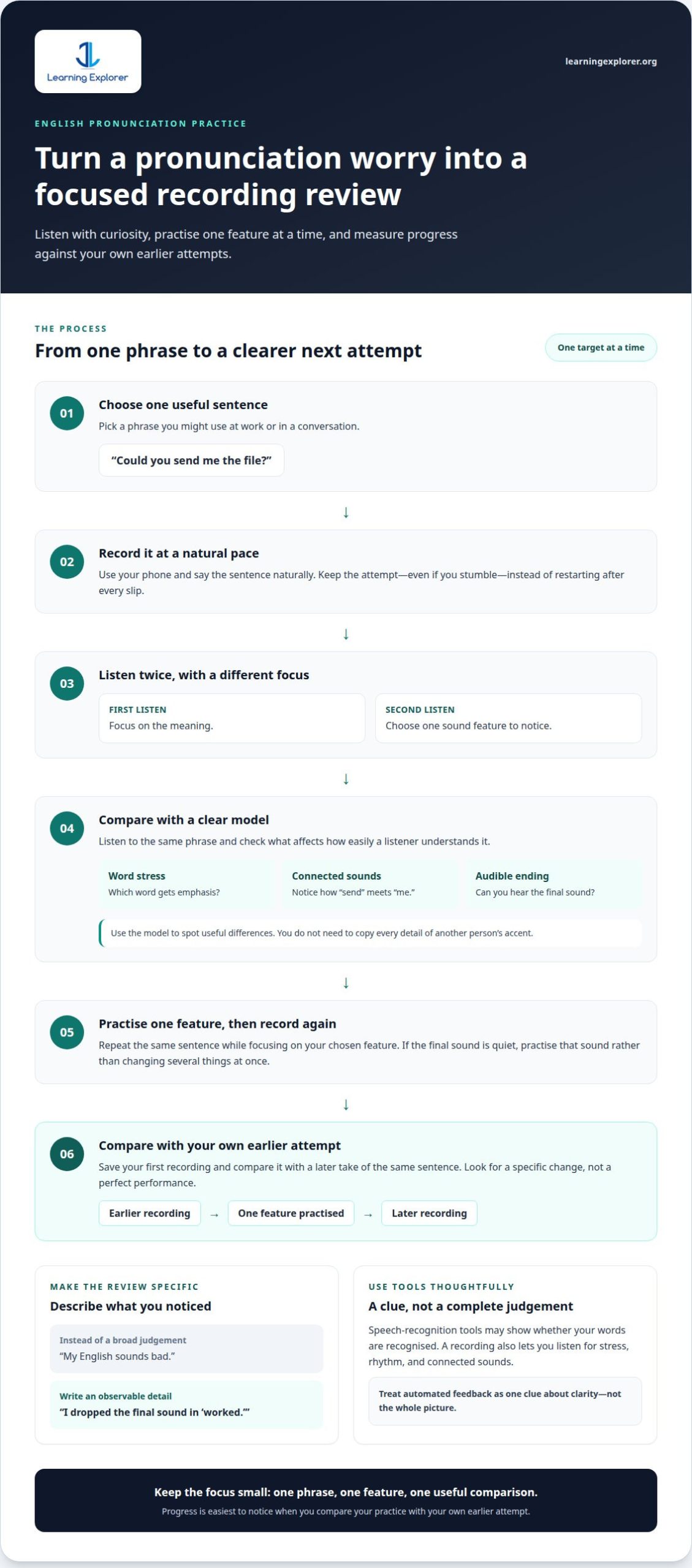
A recording turns a vague worry about pronunciation into something you can examine. Choose one short phrase, such as “Could you send me the file?”, and say it naturally. Record it on your phone, then listen once for meaning and again for specific sounds. If you catch yourself thinking, “I’m feeling embarrassed by my English pronunciation,” use that thought as a cue to focus on one phrase, not your entire speaking ability.
Compare your recording with a clear model of the same phrase. Listen for which word the speaker stresses, how sounds connect, and whether the ending is audible. For example, in “send me,” notice how the final sound of “send” meets the beginning of “me.” You don’t need to copy every detail of another person’s accent. Focus on differences that affect how easily a listener understands the phrase.
Keep the comparison fair by measuring your progress against your own earlier recording. Save your first attempt, practise one feature, then record the same sentence again later. If the first recording has a quiet final consonant, focus on that rather than trying to change several sounds at once. A past recording gives you a useful reference point and helps you notice changes that can be hard to hear from day to day.
Use a simple review routine:
- Choose one sentence you might use at work or in a conversation.
- Record it at a natural pace, without restarting after every stumble.
- Listen for one target, such as word stress, a final sound, or a pause.
- Repeat the sentence and record another attempt for comparison.
Pronunciation apps and speech-recognition tools can support this process. They may show whether a tool recognises your words, while a recording lets you listen for stress, rhythm, and connected sounds. Treat automated feedback as one clue, not a complete judgement of how clear your speech is.
Make your review specific and kind. Instead of writing “My English sounds bad,” note an observable detail: “I dropped the final sound in ‘worked.’” If you’re feeling embarrassed by my English pronunciation, write down what triggered that feeling, then choose one sound to practise. Try the word in a sentence, such as “I worked on the report yesterday.” You can also record a short reading, a song line, or a spoken summary of your day. Each format gives you different material to review, while practising one feature at a time keeps your efforts focused and manageable.
Practise evaluating your pronunciation by comparing a recording with the original. Keep practising aloud by reading, singing, or speaking to yourself, and measure progress against your own earlier attempts.
2. Accepting mistakes and other people’s reactions
A pronunciation mistake is information, not a verdict on your English. Treat it as part of language learning: notice what happened, clarify the message if needed, then continue. If you say “beach” when you mean “peach,” for example, repeat the intended word clearly and finish your sentence. The listener gets the meaning, and you get a specific sound to practise later.
Separate a useful correction from an unhelpful reaction. If someone says, “The stress is on the second syllable,” you can try the word again and hear the difference. If a person simply laughs or looks surprised, you don’t have to guess what they think. Return to your point, or ask them to explain what they need clarified.
Practising how to receive feedback can make constructive criticism feel less personal. Try asking a trusted conversation partner for one clear observation, such as whether the ending of “asked” was audible. Listen without interrupting, repeat the word in a sentence, and decide what you’ll practise. One focused correction is easier to use than a general comment like “Your accent sounds strange.”
How can you ask someone to repeat or clarify something without feeling awkward? Keep the request brief and specific: “Could you say that again, please?” or “Do you mean the meeting starts at three?” These phrases show that you’re checking the message, not apologising for speaking English.
Prepare a calm response for moments when you lose a word. You might say, “Let me put that another way,” then explain the idea using simpler English. For example, if “appointment” slips your mind, say, “the time I’m meeting the dentist.” Paraphrasing keeps the conversation moving while you search for the word.
When feedback feels uncomfortable, use a small routine instead of replaying the moment in your head:
- Name the exact word or sound that caused confusion.
- Ask what the listener heard, if their response was unclear.
- Repeat the corrected phrase once, then return to your message.
You don’t need to imitate a British, American, or Australian accent to speak effectively in Singapore. The National Library Board Singapore explains that Singaporeans need not use those accents; the goal is English that the international community understands. Aim for clear words and a steady message, rather than treating every difference from a particular accent as an error.
Try a low-pressure exchange today, such as asking a colleague to clarify a meeting detail. Notice whether you understood each other, not whether every sound was perfect. That practical measure helps you respond to mistakes with curiosity and keep participating.
Fear of speaking English in public
Public speaking can feel risky when you’re monitoring every sound instead of sharing your idea. Give your attention a practical job: explain one point, answer one question, or welcome someone to a meeting. For example, before a team update, choose the key message you want colleagues to remember. You don’t need to script every sentence. A clear purpose gives your mind somewhere useful to focus.
Build up to larger speaking situations through familiar, everyday exchanges. Start by asking a colleague about a project, then contribute one comment during a small meeting. Later, share a short update with a bigger group. Each step makes public speaking more familiar without turning practice into a test. During the conversation, smile and maintain eye contact when it feels natural. These cues can help you stay engaged with listeners rather than retreating into self-monitoring.
Try not to analyse your pronunciation while you’re speaking. Listening to every sound and planning the next sentence at the same time can distract you from the conversation. If you lose your place during a presentation, pause, look at your main point, and continue with the next idea. A short pause is more useful than abandoning your message to correct every word.
Singaporeans don’t need to adopt a British, American, or Australian accent. The National Library Board Singapore explains that the goal is English the international community understands. Prioritise clear words and meaningful delivery. For instance, if you’re presenting a project update, make the task, timing, and next step easy for your audience to follow.
Where can you find affordable English conversation groups in Singapore? Look for local conversation meetups through community noticeboards, library event listings, and local groups. Compare any stated fees and meeting formats, or practise with a friend if you want a no-cost option.
Before joining a group or speaking event, prepare a small participation goal. You might introduce yourself, ask one question, or share one opinion about the discussion topic. A specific goal gives you a manageable way to take part without measuring success by perfect pronunciation. If the conversation moves quickly, listen for a key idea and respond to that point. You can also practise a short introduction by phone with someone you trust before using it at a gathering. Keep the introduction simple: your name, what you do, and one detail you’d like to share. Then take a breath and focus on the person listening. Each exchange is practice in communicating, not a performance that requires an accent without variation.
4. American English pronunciation examples
Use American English examples to practise specific sounds, not to judge your accent. Start with “feel embarrassed,” a useful phrase for naming the emotion behind speaking anxiety. Say it slowly, then at a natural pace. Listen for clear word boundaries and a steady rhythm, rather than trying to make every sound identical to a model.
The phrase “feel embarrassed” can be practised as a sequence of spoken sounds. A pronunciation guide can offer one way to represent the sounds in “feel embarrassed,” though you can practise the phrase without memorising symbols. These symbols show sounds rather than ordinary spelling. You don’t need to memorise the notation. Use it as a reference when a dictionary or pronunciation resource provides an audio model.
Try the suggested sound chunks aloud: “feel im,” “barr,” and “uhst.” First say each chunk slowly, then join them into “feel embarrassed.” Keep the first word clear and avoid inserting a long pause between “feel” and “embarrassed.” Finally, use the phrase in a sentence: “I feel embarrassed when I speak in a large meeting.” That context helps you practise connected speech, not just isolated sounds.
Should you aim for a Singaporean, British, or American English accent? Choose a consistent model for focused pronunciation practice, such as American English for these examples, but make clear communication your priority. You don’t have to erase your accent or imitate every feature of a speaker.
American English also offers useful examples of how sounds change in connected speech. In “better,” the middle consonant may sound closer to a quick, light “d” in many American pronunciations. Listen to the whole word, then practise it in “That sounds better.” Notice the middle sound without forcing it; your goal is to recognise and produce the pattern comfortably.
Use a short practice sequence with “feel embarrassed” and “That sounds better”:
- Listen to a clear American English model of each phrase.
- Repeat each phrase slowly, keeping its main words easy to hear.
- Say each sentence at a natural pace and focus on one sound.
- Use the sentence in a short spoken example about work or daily life.
If one version feels unfamiliar, return to the individual word before repeating the full sentence. For example, practise “better” alone, then “sounds better,” then the complete sentence. This progression takes you from noticing a sound to fluent speech without demanding a perfect accent. A reliable model and a clear message matter more than copying every detail of American speech.
The National Library Board Singapore notes that Singaporeans need not use British, American, or Australian accents; they should speak English that the international community understands. Let that aim guide your practice: choose a pronunciation reference when it helps you hear a sound, then check whether your own sentence remains easy to follow. If a sound is difficult, slow down, practise the word in a phrase, and return to the full thought. Keep your attention on clear words, a comfortable rhythm, and communicating your meaning. A steady, understandable way of speaking is a more useful target than trying to sound exactly like a particular speaker.
5. How can I practise English pronunciation on my own for free?
Build a simple routine using free materials you already have: a book, radio programme, song, or English-language video. Choose one practice goal each day, such as clearer word endings or smoother sentence rhythm. A focused goal makes independent practice easier to manage than trying to improve every sound at once.
Start with minimal pairs, words that differ by one sound. Practise “ship” and “sheep,” or “bit” and “beat,” and notice how the vowel changes the word. Say each pair aloud, then put the words in short sentences. For example, try “The ship is here” and “The sheep is here.” The contrast helps you listen closely to sounds that can be difficult to distinguish.
Next, try shadowing. Listen to a short sentence, then repeat it immediately while matching the speaker’s pronunciation and intonation. Choose a short clip from English-language radio or television. Replay the same sentence until you can follow its rhythm, then practise it without the audio. Focus on one feature, such as rising intonation in a question or linking words smoothly.
Reading aloud gives you control over pace and repetition. Read a couple of pages from a book, or choose a short passage that feels comfortable. Mark pauses at commas and full stops, then read again while keeping the sentence meaning in mind. You can also sing along with an English-language song to practise connected words and changes in stress. Pick a song whose lyrics you can follow.
Set a small daily target. For example, practise five regular past-tense verbs aloud: “worked,” “played,” “called,” “wanted,” and “needed.” Listen for the ending in each word, then use it in a sentence about your day. Spend 10 minutes daily on quizzes and tests if you want a structured confidence-building activity.
Choose one accent model, such as US or UK English, for a particular practice session. Sticking with one model makes it easier to notice its sound patterns, but it doesn’t mean you need to change your identity or erase your accent. For variety, practise a sentence from a book, then listen to the same sentence in a recording.
Films can provide another listening exercise. Watch a scene in its original version after seeing a dubbed version, and notice how the actors connect words and express emotion. Repeat a short line, then adapt it to your own situation. A steady routine built from minimal pairs, shadowing, reading, and listening gives you practical pronunciation practice without paid materials.
Learning Explorer
Learning Explorer can help you build confidence when you want guided support beyond solo pronunciation practice. Its Conversational English Course supports everyday speaking goals, while the Business English Course is relevant if you want to communicate more confidently at work. Choose the course that fits the situations where you most want to speak up, whether that’s a casual conversation or a workplace discussion.
Structured language learning can give you a place to practise expressing ideas and develop your spoken English. You can keep using the recording and self-practice techniques from this guide alongside your learning.
For support with your English learning goals, contact Learning Explorer.
Make your next conversation a fresh start
Confidence grows through participation, not by waiting until every sound feels perfect. Choose a real conversation you want to join, then decide what you’d like to contribute. A question, a short opinion, or a simple introduction can be enough to take the next step. Keep your attention on the exchange and the person listening, rather than on an imagined score for your pronunciation.
If you’re feeling embarrassed by your English pronunciation, let that feeling point toward a specific goal, not a reason to stay silent. You might aim to speak once in a meeting or introduce yourself at a gathering. Afterward, notice what helped you communicate and carry that insight into your next conversation.
Progress doesn’t require a dramatic leap. Give yourself permission to speak, pause, and continue. Each conversation gives you another opportunity to express your ideas and feel more at ease in public.
If you’d like support with your next step, contact Learning Explorer. Your voice deserves to be heard, and every time you use it, you move forward.
Frequently Asked Questions
How do you overcome fear?
Make the speaking situation more predictable before you enter it. For a work presentation, write down your opening sentence and the one point you want colleagues to remember. Bring a simple visual cue, such as a note card showing your main ideas. Once you begin, focus on explaining those ideas rather than monitoring each sound. A clear purpose can help you stay engaged even when nerves appear.
Who cares what other people think?
Some listeners may notice an accent, but that doesn’t mean they’re judging your ability or value. Most conversations are about sharing information, making plans, or solving a problem. If someone responds to your point and the conversation continues, that’s a useful sign your message is getting through. Choose whose feedback matters: a respectful colleague can offer specific guidance, while a passing expression may not tell you anything reliable.
How can I build confidence speaking English with an accent?
Connect your accent practice to the situations that matter to you. If you often speak with international clients, practise names, dates, and industry terms that come up in your conversations. Say them clearly in complete sentences, such as, “The delivery is scheduled for Thursday.” Confidence comes from being able to share your meaning and participate, not from sounding identical to a particular speaker.
What are practical exercises to improve English pronunciation?
Practise word stress with pairs that change meaning, such as “REcord” as a noun and “reCORD” as a verb. Say, “I kept a record,” then, “Please record the meeting.” Notice which syllable carries emphasis. Another useful exercise is grouping a sentence into thought units: “After lunch / I’ll call the supplier / about the order.” These activities develop stress and phrasing without requiring special equipment.