You can learn to speak Mandarin without starting with Chinese-character reading. Lunchtime Mandarin classes near Changi Business Park may suit busy professionals who want to build spoken confidence around their workday, focusing first on listening, useful phrases and conversation. The right approach depends on your goals: speaking with colleagues, handling everyday interactions or developing business communication all call for practical language practice.
It’s understandable to wonder whether character-free study will give you enough to use Mandarin in real situations. A speaking-first approach can help you get started, though it may not suit every learner or every goal. This guide explains who may benefit from learning through conversation, what to consider when choosing class schedules and teachers, and what to expect from trial lessons and practical activities. You’ll also find out how to match a class to your current level and the situations where you want to use Mandarin, so you can make a confident, informed choice without adding unnecessary strain to your workday.
Key Takeaways
- You can begin building spoken Mandarin without starting with Chinese-character reading, especially when your immediate goal is conversation.
- Choose a class schedule that fits your workday, and use a trial lesson to experience the teaching approach before committing.
- Practical workplace and everyday scenarios can help you focus on language you want to use in real conversations.
- Consider a teacher’s language-teaching experience and ability to support adult learners when deciding which class is right for you.
- Interactive activities can make speaking practice more engaging and help you build confidence step by step.
Can a Mandarin class help me learn to speak Mandarin without reading Chinese characters?
Yes. A speaking-focused Mandarin course can teach pronunciation, listening and conversation without requiring Chinese-character reading first. For example, a beginner can practise saying their name, greeting a colleague and asking for a meeting time before learning to read those phrases. Romanised prompts can support pronunciation practice while the teacher models the spoken language. Character reading can be added later if it becomes useful for messages, signs or your study goals.
For adults in Singapore, the right course depends on the situations they want to handle. Conversational lessons can focus on everyday exchanges, such as ordering lunch, asking for directions or making small talk with a neighbour. Business Mandarin lessons can instead practise workplace interactions, such as introducing a colleague, arranging a meeting or clarifying a delivery time. Both approaches build speaking skills, but they use different vocabulary and role-play scenarios.
Daily conversational Mandarin is most useful when lessons go beyond memorised greetings. A practice sequence might start with listening to a short exchange, repeating key phrases, then adapting them in a role-play. For instance, learners could practise ordering a drink, then change the order or ask a follow-up question. This connects pronunciation and listening to a practical response, even before character reading enters the lesson.
Whether a class is within walking distance of Changi Business Park depends on its exact classroom address and the walking route. Changi Business Park covers a work and commercial area, so the district name alone does not establish a class’s proximity. Expo MRT and Changi City Point are useful landmarks, but their presence does not show that a Mandarin classroom is nearby. A lunchtime journey also depends on your starting building, the destination entrance and your available break time.
Group classes, private lessons and workplace courses are distinct formats, but the venue alone does not show which a nearby provider offers. Group learning gives colleagues a shared setting for conversation practice; private tuition focuses on one learner’s speaking needs. Workplace lessons can centre on tasks such as greeting visitors or joining a team discussion. The suitable format depends on learner numbers, goals and where teaching takes place.
Registration requirements, payment terms and cancellation policies depend on the course provider, not on the phrase “lunchtime Mandarin.” Enrollment terms explain what information is needed, when payment is due and how schedule changes are handled. Read them alongside the class timetable, especially if a meeting could overlap with a lesson. A trial lesson can also help you assess whether the teacher’s pace and conversational activities suit your goals.
Class schedules and trial lessons
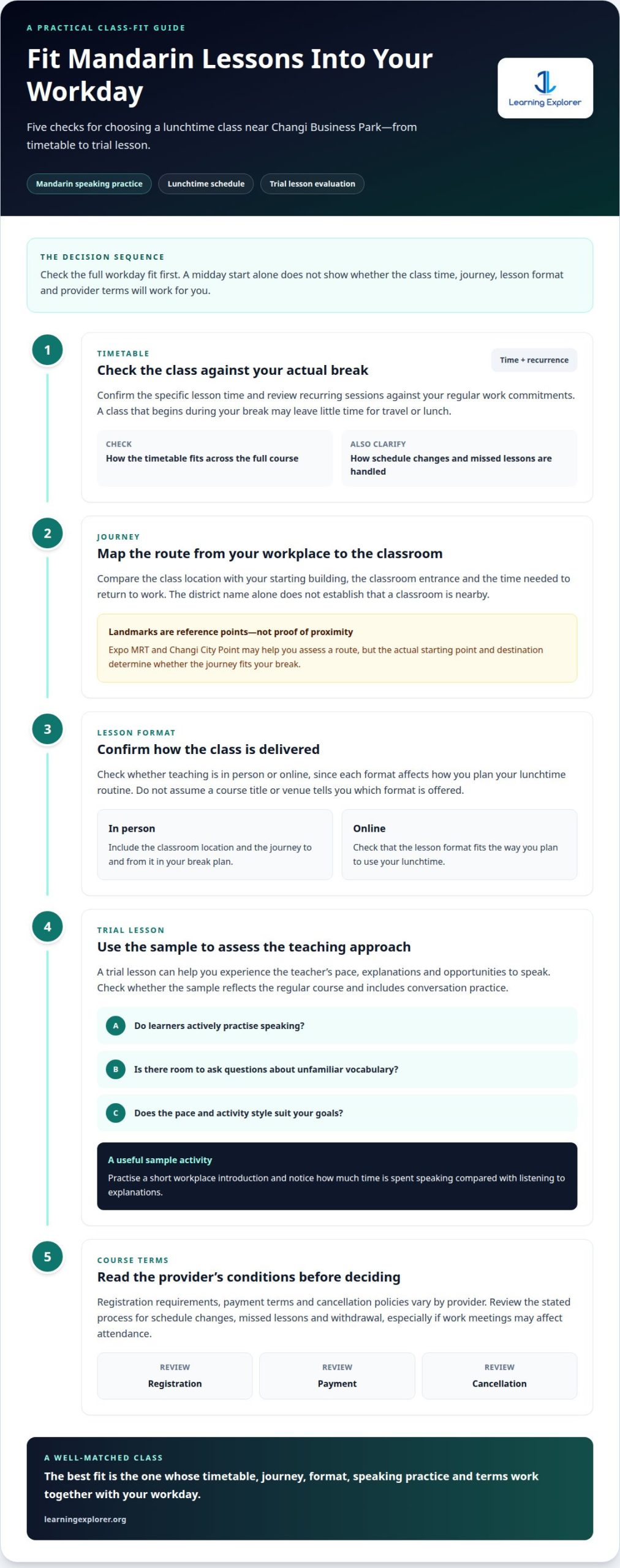
A lunchtime timetable needs to fit both the lesson and the journey from your workplace. Compare the class time, location and format with your actual break before deciding whether it works.
Lunchtime Class Availability
Which Mandarin schools offer lunchtime classes near Changi Business Park depends on their timetables and teaching locations. A Chinese course title alone doesn’t establish that lessons run at midday or nearby. When comparing lunchtime Mandarin classes near Changi Business Park, check the specific lesson time, classroom address and suitability for your starting level. A class that begins during your break may leave little time for travel or lunch.
Consider how the schedule works across the full course, not just on the first day. Review recurring lesson times and how they fit around your regular work commitments. If a meeting could overlap, check the provider’s stated process for schedule changes and missed lessons. Also note whether teaching is in person or online, since each format affects how you plan your lunchtime routine.
Trial Lesson Options
A trial lesson lets prospective learners experience a teacher’s approach before choosing a course. Use the session to assess the pace, speaking opportunities and explanations of unfamiliar vocabulary. For example, notice whether you practise a short workplace introduction or mainly listen to explanations. These details can help you decide whether the lesson style suits your goals and preferred way of learning.
Trial arrangements differ between schools, so distinguish an introductory session from a regular class before making plans. Consider whether the sample reflects the course format, includes conversation practice and fits your workday. A sample lesson with active speaking can show how much participation to expect and whether the teacher’s pace leaves room for questions.
For a busy professional, schedule fit involves more than a midday start time. Consider the route from your office, the classroom entrance and the time needed to return to work. A location near Expo MRT may suit one workplace, while Changi City Point may be more convenient for another. Your starting building and destination determine whether either option fits your break.
Before enrolling, review the registration steps, payment terms and cancellation policy. Each provider sets its own conditions, so understand how it handles changes, missed lessons and withdrawal. A meeting that runs late, for example, could affect attendance. Knowing the relevant process helps you plan around work commitments without assuming every school handles changes the same way.
Use a trial to assess how the teacher balances guided practice with learner speaking time. Try an exchange such as greeting a colleague and asking to reschedule a meeting. Notice whether feedback helps you improve pronunciation and choose useful phrases. For professionals considering lunchtime Mandarin classes near Changi Business Park, this can show whether the lesson feels practical within a limited break.
If structured speaking practice suits your goals, explore a conversational Mandarin course as one option for building a regular learning routine.
Mandarin for everyday and workplace situations
Useful Mandarin lessons connect language practice to situations you actually encounter. For everyday use, practise greeting a neighbour, ordering lunch, asking for directions and confirming a takeaway order. Each exchange involves listening, responding and adapting when the other person adds information. A lesson can build from a short model dialogue to a role-play with changed details, such as choosing a different dish or asking where to collect it.
Workplace conversations need different vocabulary and a more deliberate tone. Practise introducing yourself to a colleague, arranging a meeting and asking someone to repeat a point. For example, rehearse a project update, then respond to a follow-up question without switching immediately to English. This develops language for a specific task, rather than a list of isolated phrases, and helps you notice which words you need most often.
In an international team, the same exchange may involve colleagues with different language backgrounds and communication styles. A practical exercise could involve welcoming a visiting teammate, explaining where a meeting is taking place and checking whether they understood the arrangement. Focus on clear pronunciation and active listening. If something is unclear, practise asking for clarification rather than guessing. This makes Mandarin more useful in shared workplace interactions.
Choose lesson scenarios according to your role and immediate goals. Someone who speaks with customers may practise welcoming a visitor and answering a simple service question. A project coordinator may need to discuss timelines, confirm responsibilities or report a delay. An office-based learner might focus first on introductions and everyday exchanges. These examples give a teacher a clear basis for choosing relevant vocabulary and conversation practice.
Advanced learners can practise extending a conversation beyond prepared lines. For instance, give a brief opinion about a proposal, support it with a reason and respond to a different view. Another useful exercise is summarising a colleague’s point before adding your own. These tasks combine listening, sentence building and appropriate responses, rather than relying on recall alone. The right level of challenge depends on what you can already say comfortably.
Practical speaking activities can follow a clear sequence: introduce the situation, model useful language, practise the exchange, then change one detail. In a meeting role-play, change the time, agenda item or participant so learners must adapt their response. Feedback can focus on a specific point, such as pronunciation or word choice, instead of correcting every sentence at once. This keeps practice targeted and helps learners apply it in the next conversation.
Before lessons begin, identify a few situations where Mandarin would make communication easier. Bring examples such as greeting a business contact, ordering lunch or coordinating a meeting. A focused set of goals helps shape practice around real needs while leaving room to develop broader conversational skills. As confidence grows, familiar exchanges can become longer discussions with follow-up questions and more spontaneous replies.
Teacher qualifications and experience
A Mandarin teacher’s language ability matters, but so does the ability to explain it clearly. Native-speaker instructors who are bilingual can model natural pronunciation and clarify meaning in English. For a beginner, that support can help turn repeating a phrase into understanding when to use it. For example, a teacher can model a greeting, explain its tone and guide a learner through a reply.
Look for teaching that adapts to your starting point. A beginner may need clear sound patterns, everyday vocabulary and short guided exchanges. Someone with prior study may benefit from longer conversations and more precise corrections. In either case, useful feedback identifies a specific improvement, such as a pronunciation adjustment or a more natural phrase, then gives you a chance to try again.
Business Mandarin requires sensitivity to purpose and context. A teacher can connect language practice to situations such as welcoming a visitor, arranging a meeting or asking a colleague to clarify a point. The same phrase may need a different level of formality depending on the relationship. Role-play helps learners practise choosing suitable wording, listening to the response and keeping the exchange moving.
Teaching experience is also reflected in how a lesson is structured. A focused session might introduce a small set of phrases, model them in context, then use them in conversation. For example, learners could practise introducing themselves before adapting the exchange for a client meeting. Clear transitions between explanation, guided practice and independent speaking help learners understand what they are practising and why.
For a lunchtime class, pacing matters. The teacher needs to make each activity purposeful, whether learners are practising introductions or asking for directions. A lesson can build from a model exchange to paired practice, then a fresh scenario that requires a different response. This keeps learners active and shows whether they can use the language beyond memorised lines.
Use a trial lesson, if available, to observe the teaching itself. Notice whether the instructor gives learners time to speak, explains corrections clearly and adapts examples to their goals. A beginner might need support forming a simple introduction, while an employee preparing for business Chinese may need to practise a meeting exchange. These different needs call for distinct vocabulary and practice.
Native-speaker ability alone doesn’t describe a teacher’s classroom approach. Look at how the instructor connects pronunciation, meaning and use. For instance, after modelling a phrase for confirming an appointment, the teacher can invite learners to change the time and respond naturally. This sequence combines language accuracy with communication practice, showing learners how to apply what they learn.
Teaching methods and learning activities
Effective Mandarin courses turn new language into purposeful practice. A lesson might introduce phrases for confirming an appointment, then use them in a short dialogue. Learners hear the expression, practise saying it and use it in a fresh exchange. This links listening and speaking instead of treating vocabulary as a list to memorise.
Are classes taught in person, online or in a hybrid format? Each describes a different setup: in-person lessons meet in a classroom, online lessons happen remotely, and hybrid learning combines both. Learning Explorer offers in-person and online classes. Consider which format fits your workday and preferred way of practising.
Role-play gives learners a clear purpose for each conversation. One activity could simulate welcoming a visitor, asking their name and guiding them to a meeting room. The teacher can introduce a change, such as a different destination, so learners practise responding rather than repeating a fixed script. This makes the exchange more adaptable to an actual workplace interaction.
Listening tasks can prepare learners to respond with confidence. For example, a teacher might say a meeting time or repeat a short request at a natural pace. Learners identify the key information, then answer with a relevant phrase. This activity brings together sound recognition, meaning and response, all essential parts of spoken communication.
Pair work can make speaking practice more active. One learner asks for a lunch recommendation, while the other suggests a dish and answers a follow-up question. Then they switch roles and change the meal or preference. A familiar setting gives beginners a manageable starting point, while the extra question encourages learners to go beyond a memorised exchange.
Useful feedback focuses on one improvement at a time. After a short introduction, for instance, a teacher could correct a pronunciation point and invite the learner to repeat the full introduction. The learner then uses it in a new scenario, such as meeting a colleague. This cycle makes corrections practical and shows how a small change affects the complete conversation.
Reading materials can support learning without taking over a speaking-focused lesson. A short dialogue or vocabulary prompt can help learners recall phrases before practising them aloud. For example, learners might use a prompt about arranging a meeting, then continue the conversation without reading each line. This connects written cues with spoken use of Mandarin.
Choose learning activities by the situations you want to handle, such as workplace introductions or lunch conversations. To build structured practice around speaking goals, explore Mandarin learning options.
Learning Explorer
Learning Explorer can help you choose Mandarin lessons suited to your goals and workday. Its Conversational Mandarin Course supports practical speaking, while the Business Mandarin Course focuses on workplace communication. Interactive lessons are taught by bilingual native-speaker instructors, helping learners connect language practice with real conversations.
If you’re deciding whether to begin with spoken Mandarin or need language for work, consider which situations matter most: everyday exchanges, colleague conversations or business interactions. That starting point can help shape a relevant, manageable learning path. Contact Learning Explorer to discuss your Mandarin learning goals.
Make Mandarin practice part of your next step
Choose a learning goal you can picture using in your workday, such as greeting a colleague or contributing to a meeting. Let that goal guide your decision about schedule, class format and the speaking practice you need. Choosing lunchtime Mandarin classes near Changi Business Park is not only about fitting a lesson into your calendar; it’s about creating a practical path from study to real conversations.
Learning Explorer offers a Conversational Mandarin Course, alongside a Conversational English Course and a Business English Course. If you’re ready to discuss which learning direction fits your goals, contact Learning Explorer about classes. Take the next step at a pace that works for you, and build confidence through focused language practice.
Frequently Asked Questions
Can beginners join, and how do I find my starting level?
Yes, beginners can start by describing what they already understand or can say in Mandarin. For example, note whether you can introduce yourself, recognise familiar spoken phrases or hold a short exchange. Use these abilities and your learning goals to discuss a suitable starting point. You don’t need to begin with Chinese-character reading if your immediate priority is spoken communication.
Who are these courses for?
These classes suit adults who want Mandarin for everyday communication or workplace interactions, including professionals who hope to speak with colleagues or clients. One learner might want to handle a basic conversation during lunch, while another needs Mandarin for business meetings. Children and corporate learners may have different learning needs, so match the course purpose to the learner and the situations they want to manage.
What lunchtime Mandarin class schedules are available near Changi Business Park?
Timetables depend on the course arrangement and teaching location. Before choosing lunchtime Mandarin classes near Changi Business Park, compare the lesson time with your work commitments, journey and break length. A midday start alone doesn’t show whether a class is practical for your building. Learning Explorer offers in-person and online learning formats, which can shape how you plan around your workday.
What Mandarin proficiency levels and class sizes are offered?
Learning Explorer offers conversational and business-focused Mandarin learning in private and group formats. Your starting ability and intended use help guide the level of practice. For instance, a learner who can introduce themselves but struggles to follow replies may need different support from someone preparing to contribute in meetings. Consider whether individual guidance or conversation with other learners better suits your goals.