Private English lessons aren’t automatically the better choice. Small-group English classes in Singapore can suit learners who want guided practice with other people, while private lessons may suit those who need focused one-to-one support or a more flexible pace. The right format depends on your goals, budget, schedule and how you learn best.
Choosing small-group English classes in Singapore is about more than finding time to study. If you want to build everyday confidence, conversation with classmates gives you relevant practice and opportunities to listen and respond. If you need to focus on particular communication challenges, individual attention may be more useful. For foreign workers, practical conversational English can support everyday exchanges at work and around Singapore.
This guide compares group and private lessons, explains how class size and teaching approach shape the learning experience, and outlines what to weigh when balancing cost, scheduling and learning preferences. You’ll also learn how to match your priorities with an English course, so you can make a clear choice without losing sight of your goals.
Key Takeaways
- Match an English course to your current proficiency and the situations where you want to communicate with more confidence.
- Group learning can create useful chances to practise speaking and respond to other learners.
- Consider private lessons if you prefer focused individual attention; weigh that against the interaction a group provides.
- Choose a format that fits your budget, schedule and preferred pace so learning can work with your routine.
- For foreign workers, practical conversational English can help with everyday exchanges at work and in Singapore.
Which English Course in Singapore Is Right for You?
Choose an English course by matching your current ability to the situations you want to handle, such as everyday conversations or workplace discussions. Proficiency can help international students identify a suitable class level, while visa eligibility depends on individual circumstances and applicable Singapore rules. Choosing a course does not determine immigration eligibility.
Courses by Proficiency Level
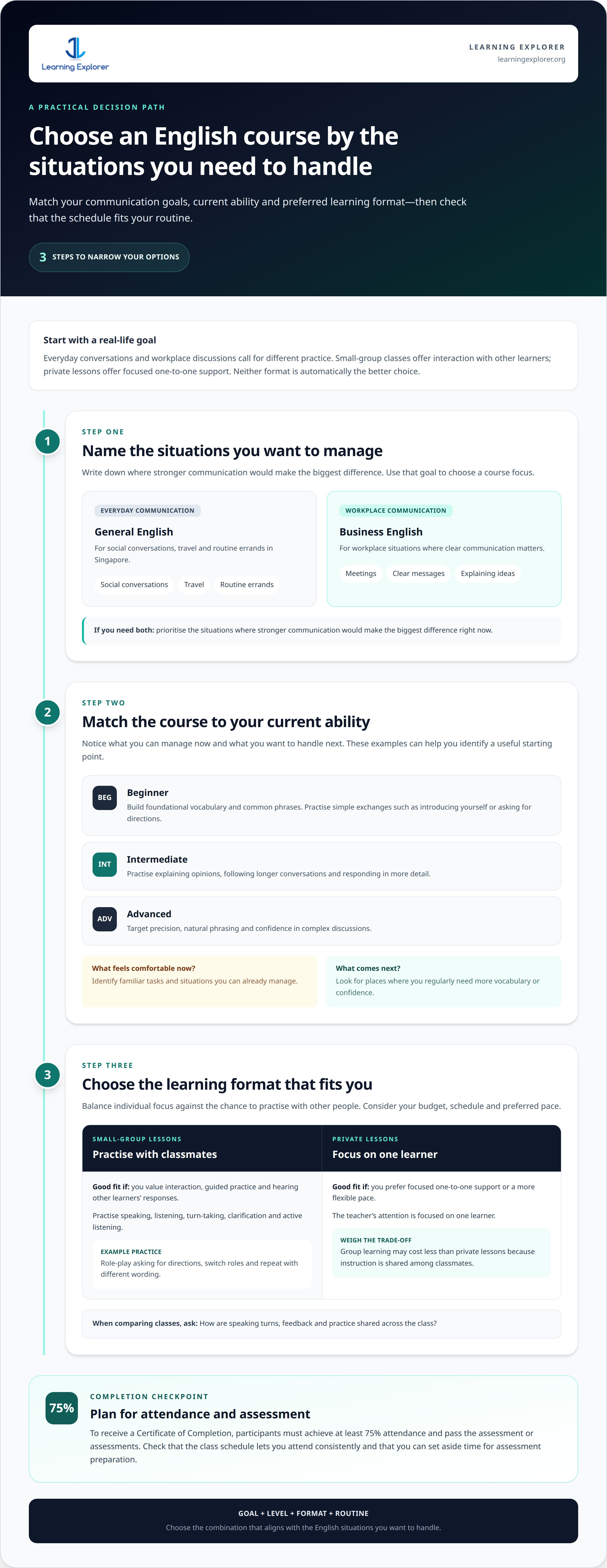
At beginner level, focus on foundational vocabulary, common phrases and simple exchanges, such as introducing yourself or asking for directions. Intermediate learners can practise explaining opinions, following longer conversations and responding in more detail. Advanced learners can target precision, natural phrasing and confidence in complex discussions. Use the tasks you can manage now and the situations you want to handle next to guide your level choice.
General and Business English
General English develops communication for everyday situations, including social conversations, travel and routine errands in Singapore. Business English focuses on workplace communication, such as contributing to meetings, writing clear messages and explaining ideas to colleagues. Choose the course that matches your immediate goal. If you need English for both daily life and work, prioritise the situations where stronger communication would make the biggest difference.
Ask how a course identifies your starting level and progresses from familiar language to more demanding tasks. If you understand written instructions but struggle to speak, regular conversation practice may help. If you speak comfortably in social situations but feel unsure in meetings, business-focused vocabulary and workplace scenarios may be more relevant. These examples help connect a course level with practical learning needs.
A Certificate of Completion has specific requirements: course participants must achieve at least 75% attendance and pass the assessment or assessments to receive one. Treat attendance and assessment as separate parts of course completion. Before choosing, consider whether the class schedule lets you attend consistently and whether you can set aside time for assessment preparation alongside your other commitments.
When setting a budget, consider the format and your learning priorities, not just the headline fee. Compare what matters to you: guided practice, feedback, course focus and a schedule you can maintain. Small-group learning may suit you if you value interaction with classmates; private tuition may fit if you want concentrated attention. No single format suits every goal, so weigh the learning experience against your budget.
Use these steps to narrow your options:
- List the English situations you want to manage, such as daily conversations or workplace meetings.
- Identify what feels comfortable now and where you regularly need more vocabulary or confidence.
- Select a course level and focus that address those needs, then consider attendance and assessment requirements.
How do small group English classes improve communication skills?
Small-group lessons create structured opportunities to speak, listen and respond to other learners. Learning Explorer’s English courses are taught by certified native-speaker instructors who are also bilingual.
Speaking Practice and Social Interaction
Conversation practice helps turn vocabulary into language you can use in real exchanges. For example, classmates can practise greeting a colleague, asking a follow-up question and responding politely. You hear different phrasing and learn to keep a conversation moving. This interaction also gives you practice with turn-taking, clarification and active listening, not just prepared answers.
Class Size and Speaking Opportunities
In a small group, classmates can take turns with short speaking tasks instead of relying on one extended teacher-led exchange. For example, partners can role-play asking for directions, switch roles and repeat the conversation with different wording. This creates opportunities to hear varied voices and adapt your response. Ask how lessons share speaking turns, feedback and practice across the class.
Teachers and Speaking Skills
Certified native-speaker teachers who are also bilingual can model natural pronunciation and explain language choices. You can practise social greetings, such as introducing yourself to a neighbour or welcoming a new colleague. A teacher can help refine word choice, tone and clarity during these exchanges. Consider whether lesson activities include speaking feedback and everyday examples relevant to your goals.
Progress comes from using new language in different contexts. You might first practise a greeting, then build on it by asking about someone’s day. The class can explore how tone changes between a friendly chat and a more formal introduction. Repeating a familiar exchange with new details encourages flexible speaking skills instead of memorising a fixed script.
Group learning may cost less than private lessons because instruction is shared among classmates, while still offering teacher guidance and peer interaction. Private lessons focus the teacher’s attention on one learner; a group adds classmates’ responses and perspectives. The right balance depends on whether you value individual focus or practice with others. Compare the format with your priorities and budget, without assuming either option suits everyone.
To make speaking practice purposeful, choose a class that connects activities to situations you encounter. For daily communication, practise greetings, requests and short conversations. For workplace confidence, rehearse introducing an idea or clarifying a message. These examples give teachers a clear direction for feedback and help you track specific skills, such as clearer pronunciation or more confident turn-taking.
If guided conversation practice matches your goals, explore English speaking lessons as a next step.
Small group classes compared with private lessons
Both formats can develop English communication, but they create different learning conditions. In a group, classmates contribute varied questions and responses; in private lessons, one learner receives the teacher’s attention throughout. Compare the format with your goals, preferred pace and opportunities to practise. Someone preparing for workplace discussions may value focused feedback, while a learner seeking daily conversation may enjoy varied group exchanges.
General English works in either format. Group lessons can practise shared situations, such as asking for directions or making small talk, and let classmates try different responses. Private lessons can focus on an individual difficulty, such as forming questions or explaining an opinion clearly. The choice is not simply group versus individual. Consider whether you learn more from hearing several approaches or focusing lesson time on your own communication needs.
Packages and unlimited group lesson offers use different pricing structures. A package sets a defined amount of instruction, while an unlimited model may provide access to multiple group lessons under stated conditions. Compare the lesson types included, booking rules, attendance expectations and course duration. A lower apparent cost may not suit you if you can attend only occasionally. A defined package may be easier to plan around when work or family commitments limit your study time.
Trial lessons and English level checks can help you understand a class before committing. A useful level check considers more than vocabulary recognition: speaking, listening, sentence formation and comprehension can reveal different strengths. A trial lesson can show how much time students spend speaking, how feedback is delivered and whether the pace feels manageable. Treat these as assessment opportunities, not guarantees of future progress.
Some learners combine formats as their needs change. Group lessons provide regular peer interaction, while an occasional private session can focus on a presentation or recurring pronunciation challenge. This approach may suit someone who wants broad communication practice and targeted support. It also takes planning: choose your main priority first, then consider whether another format fits your schedule and budget.
Use these practical comparisons to decide:
- Choose group learning if classmates’ varied contributions help you practise spontaneous conversation.
- Choose private lessons if you want focused attention on a specific proficiency gap.
- Compare package terms with your likely attendance and preferred lesson frequency.
- Use a level check to identify whether your main need is speaking, listening or language accuracy.
The right fit is the format that supports consistent practice and addresses the communication tasks you care about, from meeting colleagues to chatting in daily life.
Choosing a class format based on budget, schedule and learning style
As an adult learner in Singapore, weigh lesson timing, class participation and learning goals together. A workable format is one you can attend consistently and apply in everyday or professional situations.
For IELTS, TOEFL or another exam, look for lessons that explicitly practise that exam’s tasks, timing and assessment format. General English can develop communication skills, but it does not automatically provide exam preparation.
Families and adults can look for classes designed around learners’ ages and goals. Adults may prioritise workplace communication or everyday conversations, while children may need age-appropriate topics and activities.
Reviews can offer useful context when they describe specific experiences, such as teacher feedback, lesson structure or speaking opportunities. Compare those details with course information, including learning outcomes and teacher qualifications.
There is no single maximum class size for every English school in Singapore. Limits can differ by course, so use the stated class size to judge how much individual speaking time may be possible.
Schedules and Attendance
Choose a schedule that fits your work, family commitments and travel time. Attending English classes twice a week is one possible routine in Singapore, but the best frequency is one you can sustain. A professional with rotating shifts may need a different arrangement from an adult with fixed evenings. Include lesson preparation and travel when assessing your routine.
Class Size and Learner Participation
Class size shapes how learners take turns, hear different voices and receive feedback. In a discussion about ordering lunch, for example, students might practise making requests, asking follow-up questions and responding naturally. A smaller group can make it easier to contribute regularly, while a larger group may offer more varied peer interaction. Consider which setting helps you participate without feeling rushed.
The Common European Framework of Reference for Languages, or CEFR, provides a shared way to describe language progress from beginner to proficient use. Ask how a course connects its learning outcomes with proficiency development, rather than assuming every course follows the same pathway. Someone aiming to handle work meetings needs different outcomes from a learner focused on everyday conversation.
Budget involves more than the lesson fee. Consider transport, materials and how often you can attend. Group learning shares teacher-led instruction among classmates, while private lessons focus on one learner. Choose the format that balances your resources with the practice and attention you need. A realistic schedule and clear learning goals help adults and professionals fit learning into daily life.
Basic conversational English for foreign workers in Singapore
Basic conversational English is designed for foreign workers in Singapore. The most useful focus is language they can apply in everyday situations, such as greeting someone, asking for clarification or explaining a simple need. Lessons built around practical scenarios connect speaking practice with daily life.
Start with common exchanges. Practise introducing yourself to a colleague, asking where to collect an item or confirming a meeting time. Build each conversation from a short phrase into a complete exchange: listen, respond, then ask a relevant follow-up question. Repeating the situation with different details helps you practise flexible language rather than rely on a memorised line.
A supportive class environment can make it easier to try unfamiliar words aloud. In a small-group activity, learners can take turns playing a customer, colleague or supervisor. The teacher can guide practice towards clear pronunciation, polite phrasing and understanding the other speaker. You also hear how classmates express similar ideas, which can introduce useful alternatives for the same situation.
Useful practice themes include:
- At work: greeting a colleague, asking for instructions or saying that a task is complete.
- In public: asking for directions, checking a location or requesting help.
- In conversation: introducing yourself, making a simple request and responding courteously.
If you feel unsure speaking English, break each exchange into manageable steps. Practise the key words first, then use them in a short sentence and a complete conversation. For example, learning to ask someone to repeat an instruction gives you a practical way to handle a communication gap. This gradual approach can support confidence without requiring an intensive pace.
Choose lesson activities around the situations that matter most to you. If you need to understand workplace instructions, prioritise listening and clarification phrases. If you want to feel more comfortable meeting people, focus on greetings and introductions. These priorities make class practice relevant and give you specific language goals to work towards.
Regular attendance gives you repeated opportunities to revisit phrases and use them in new scenarios. Between lessons, notice moments when a greeting, request or clarification phrase could be useful, then bring that situation into future practice. The aim is practical communication: understanding a message, responding clearly and keeping an everyday conversation moving.
Build practical English conversation skills through guided learning focused on everyday communication.
Learning Explorer
Learning Explorer helps learners match their English goals with a suitable course focus. Choose the Conversational English Course for everyday communication or the Business English Course for workplace needs. The right choice depends on where you want to use English, the skills you want to develop and the learning format that fits your routine.
If you’re weighing group learning against private lessons, consider which setting best supports your participation and goals. A clear focus makes it easier to choose a practical next step and build confidence in the conversations that matter to you.
Contact Learning Explorer to discuss your English learning goals and course options.
Make Your Next English-Learning Step Count
The best class format supports the conversations you want to have and fits alongside your everyday commitments. When considering small-group English classes in Singapore, focus on the setting where you’ll feel ready to participate and keep practising. A personal goal, such as speaking up in a meeting or handling a daily conversation, gives your learning direction.
Learning Explorer offers a Conversational English Course, a Business English Course and a Conversational Mandarin Course. Choose a course focus that aligns with communication at work or in daily life. Select the language and course that reflect what you want to do next, then take a practical step towards making that goal part of your routine.
Contact Learning Explorer to discuss classes and find a learning direction that fits your goals. Each conversation you practise can help you move forward with greater confidence.
Frequently Asked Questions
How much do small-group English classes cost in Singapore, including registration and materials fees?
Tuition varies by language, proficiency level and course duration; one-time registration and learning-material fees may also apply. The total may include administrative processing and required physical or digital materials. Learning Explorer provides course pricing after a quote request. Ask for the complete amount, including applicable fees, before deciding so you can compare the full commitment with your budget.
How do small-group English classes compare with private tutoring and large classes in Singapore?
Small-group English classes in Singapore offer interaction with classmates, while private tutoring focuses lesson time on one learner. A larger class may bring more peer perspectives, but individual speaking turns can vary with the lesson structure. Consider how you learn best: someone preparing for a specific presentation may value individual focus, while a learner practising spontaneous conversation may prefer group discussion.
What English course levels and skills do Singapore small-group classes cover?
Course levels and skills should match your current proficiency and intended use of English. Relevant goals may include building vocabulary, understanding spoken instructions, speaking clearly and forming complete sentences. If you follow conversations but struggle to respond, prioritise spoken practice. General English suits broad communication goals, while Business English focuses on workplace use.
What are the class schedules, locations, and online options for English classes in Singapore?
English classes in Singapore may be held in person or online, and Learning Explorer is based in the CBD. Schedule options depend on the course and format. An adult with a long commute, for example, may prefer online lessons, while someone who benefits from face-to-face discussion may favour classroom learning. Compare timing, travel and your preferred participation style when planning.
How can students assess their English level and choose the right class in Singapore?
Match a level assessment with your communication goals to choose more confidently. Consider practical questions: can you explain a familiar task, follow a short conversation and ask for clarification? These situations reveal different strengths than written vocabulary alone. Then select a course focus, such as everyday communication or workplace English, that supports the next skill you want to develop.
Are there trial lessons, refunds, make-up classes, or cancellation rules at Singapore English schools?
Trial lessons, refunds, make-up sessions and cancellations are governed by each course’s enrolment terms. Read the written conditions for each before committing, including deadlines, eligibility requirements and rules for missed lessons. Treat trial availability and refund eligibility as separate matters: attending a trial does not, by itself, establish whether a course fee can be refunded.
What small-group English classes are available in Singapore for adults and children?
The listing shows 27 English courses in Singapore, but its small-group course filter shows 0. It does not identify separate options for adults and children.