What if the reason you haven’t mastered a second language yet isn’t because you lack ‘the gift,’ but because you’ve been using tools designed for children? For many Singapore-based professionals, the struggle is real. You juggle corporate responsibilities in the CBD and then try to squeeze in five minutes on a mobile app that feels like a game rather than a growth tool. You want to speak confidently with international clients or navigate social circles in a new country without the fear of looking foolish. Finding the best way to learn a new language for adults in 2026 means moving beyond repetitive rote learning and embracing methods that respect your logic and your limited time.
In this guide, we’ll reveal the science-backed strategies that help busy adults achieve fluency faster. You’ll discover how to leverage your existing professional discipline to communicate with impact. We’ll explore why modern, interactive environments beat solitary app usage and how you can transform your career through bilingualism. From localized training right above Tanjong Pagar MRT to practical immersion techniques, we’re showing you how to reach your goals without the frustration of traditional classrooms.
Key Takeaways
- Understand why biological age isn’t a barrier to fluency and how adult logic can actually accelerate your linguistic progress.
- Discover why a structured, input-based curriculum is the best way to learn a new language for adults who want to move beyond basic mobile apps.
- Learn to avoid the “gamification trap” and focus on natural acquisition techniques that build real-world conversational confidence.
- Implement the “No Zero Days” rule to integrate consistent language practice into your busy corporate schedule without feeling overwhelmed.
- Align your learning goals with specific professional outcomes to communicate more effectively with international clients and partners.
Why Adults Struggle with Language Learning (and How to Flip the Script)
Many professionals believe that once they hit 30, the window for fluency slams shut. This idea stems from the Critical Period Hypothesis, which suggests our brains lose their linguistic flexibility after puberty. While it’s true that children pick up sounds subconsciously, it doesn’t mean adults are incapable of mastery. In fact, the best way to learn a new language for adults often involves unlearning the rigid, grammar-heavy methods we were taught in school. Your brain hasn’t lost its ability; it has simply changed its strategy.
The real hurdle isn’t biology. It’s psychology. Adults often suffer from a perfectionist trap, fearing they’ll look foolish in front of international clients or colleagues. This performance anxiety creates a mental block that shuts down the brain’s ability to process new information. Traditional adult education frequently fails because it ignores this, focusing on abstract rules rather than comprehensible input. Without messages you actually understand and care about, your brain treats the new language as a chore rather than a tool for connection.
To better understand how to shift your mindset from studying rules to actually acquiring a language, watch this helpful video:
Debunking the “Too Old” Myth
Your brain remains remarkably adaptable through neuroplasticity. While children are like sponges, adults are like architects. You can use your analytical skills to spot patterns and logical structures that a child would miss. Understanding the process of second-language acquisition reveals that your life experience is actually a secret weapon. You already know how communication works; you’re just swapping the code. Choosing the right language courses in Singapore provides the structured environment needed to channel this analytical power into real-world fluency.
The Time Management Challenge for Professionals
For a busy professional in the CBD, “no time” is the most common excuse. However, it’s usually a matter of priority and efficiency rather than a lack of hours. The best way to learn a new language for adults is to balance micro-learning, like short bursts of vocabulary during a commute, with deep work sessions that involve active conversation. Having a supportive environment helps maintain momentum when work gets demanding. Finding a training center situated directly above Tanjong Pagar MRT makes it much easier to integrate consistent practice into your professional lifestyle.
The Science of Adult Language Acquisition: Input, Patterns, and Practice
The best way to learn a new language for adults isn’t found in a dusty textbook full of conjugation tables. It’s found in the science of acquisition. Stephen Krashen, a pioneer in linguistics, argues that we acquire language in only one way: by understanding messages, or ‘comprehensible input.’ His i+1 formula suggests that we progress most effectively when we’re exposed to language just one level above our current proficiency. This approach shifts the focus from ‘learning’ (memorizing abstract rules) to ‘acquisition’ (developing a natural feel for the language through use).
Rather than drilling grammar, focus on ‘noticing.’ This is the cognitive process of identifying patterns in real-world speech. Recent studies into the neuroscience of adult language learning show that our brains are naturally wired to seek these patterns. Bilingual native-speaker instructors play a vital role here. They don’t just speak the language; they understand the specific linguistic hurdles Singaporean learners face. They provide the necessary bridge between your primary language and your new one, helping you notice nuances that a mobile app would miss.
The Power of Comprehensible Input
Input is ‘comprehensible’ when you can follow the gist of the story even if you don’t know every word. Choose materials that spark genuine interest, whether it’s a business podcast or a regional news clip. Remember the natural order: listening always precedes speaking. Just as a child listens for months before their first word, your brain needs time to build a robust mental map of sounds and rhythms before it’s ready to produce them. Selecting content that is interesting but not overwhelming is key to staying engaged without burning out.
Moving from Passive Input to Active Output
Don’t rush into speaking if you aren’t ready. Respect the ‘silent period’ where your brain processes what it hears. When you’re ready to start producing sounds, try ‘shadowing.’ This involves repeating audio clips immediately after hearing them to mimic native intonation and rhythm. Eventually, you’ll want to transition into low-stakes environments to build social confidence in English or your chosen language. If you’re looking for a structured path to this level of fluency, joining a community at Learning Explorer can provide the expert guidance you need to turn theory into practice.
Apps vs. Classrooms: Finding the Right Balance for Your Schedule
While mobile apps have democratized access to linguistic tools, they’ve also created a false sense of security for many professionals. You might maintain a 300-day streak on your phone, yet find yourself unable to order a coffee or navigate a meeting in Seoul or Madrid. This is often called the ‘Duolingo Trap.’ Gamification makes you feel productive, but it rarely demands the deep cognitive engagement required for real-world fluency. The best way to learn a new language for adults is to treat apps as the ‘gym equipment’ rather than the ‘personal trainer.’
Success in a new language isn’t just about repetition. Recent research on brain networks indicates that adult learners rely heavily on attention and cognitive control systems. Apps often provide a passive experience that fails to activate these high-level networks. In contrast, a structured environment forces your brain to stay alert, process nuances, and adapt to unpredictable conversational turns. This is how you move past the intermediate plateau where self-study often stalls and frustration begins to set in.
Why Guided Instruction Still Wins for Busy Adults
Busy professionals don’t have the luxury of trial and error. You need a curriculum that’s efficient and strategically aligned with global standards like the CEFR or JLPT. A best language school in Singapore provides this roadmap, ensuring every hour you invest translates into measurable progress. Immediate feedback is the biggest advantage here. When you mispronounce a tone in Mandarin or use the wrong tense in Spanish, an instructor corrects you before the mistake becomes a permanent habit. This prevents the administrative burden of having to unlearn errors later in your journey.
Personalization: Private vs. Group Learning
Deciding between group and private formats depends on your specific professional needs. Group classes offer a social dynamic that mimics real-world social situations, providing diverse voices and built-in accountability. If you’re preparing for a high-stakes negotiation or have a very narrow industry focus, private 1-on-1 tutoring allows for total customization. Whether you’re a visual learner who needs diagrams or an auditory learner who thrives on dialogue, a professional setting can pivot to match your style. Our CBD location, situated right above Tanjong Pagar MRT, offers the flexibility to switch between these formats as your corporate responsibilities shift, ensuring you never lose momentum.
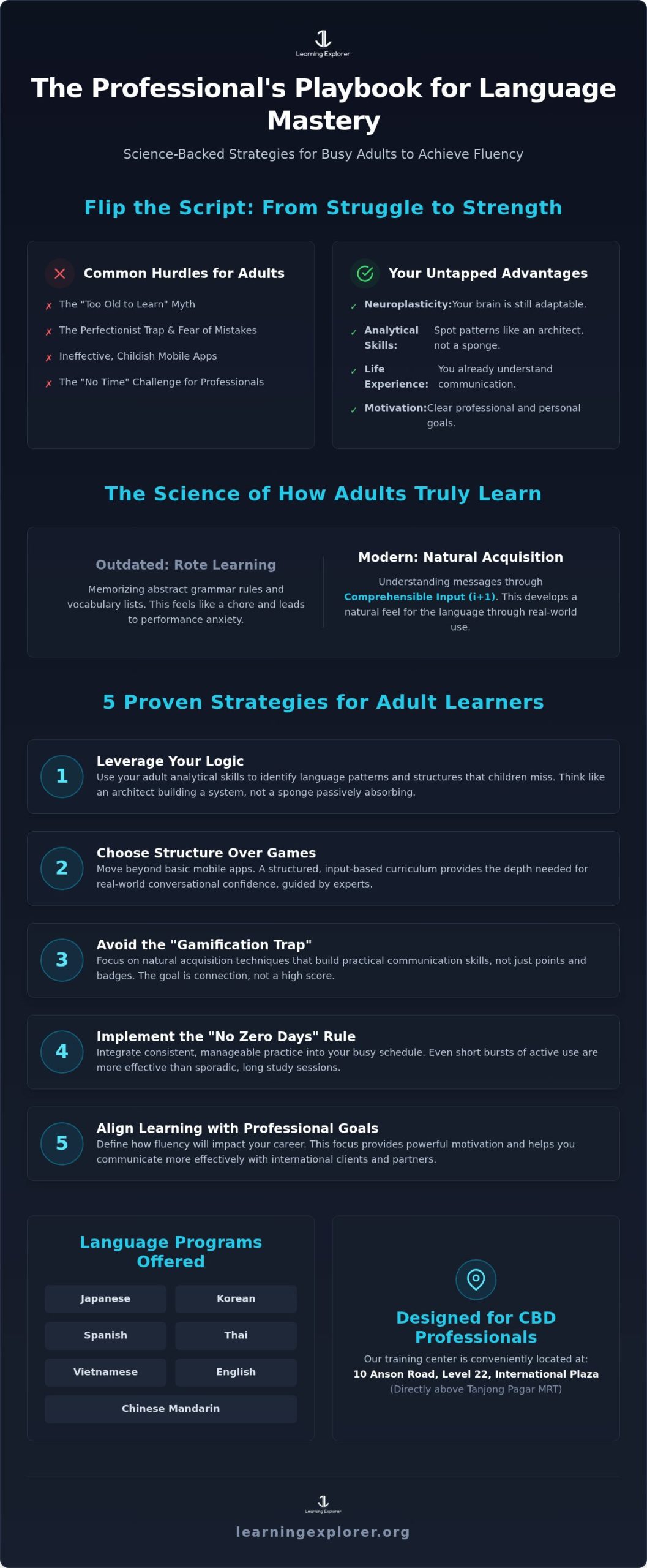
5 Proven Strategies for Adult Learners in Singapore
Mastering a new tongue in a high-pressure global hub requires more than just good intentions. It demands a tactical approach that fits into the gaps of a corporate schedule. The best way to learn a new language for adults living in Singapore is to treat linguistic growth as a professional skill rather than a hobby. This means moving beyond casual study and implementing systems that ensure consistency even during your busiest weeks.
Strategy 1: Goal Setting for Real-World Use
Vague ambitions like “I want to learn Japanese” often lead to burnout because there’s no clear finish line. Instead, define your “Why” with surgical precision. Are you aiming to build better rapport with clients using a Business Mandarin Course? Or is your goal to successfully order dinner and navigate a subway in Tokyo? By setting SMART goals, Specific, Measurable, Achievable, Relevant, and Time-bound, you can track incremental progress. Focus your energy on high-frequency vocabulary relevant to your specific industry to see immediate returns on your time investment.
Strategy 2: Creating an Immersion Bubble in the CBD
You don’t need to move abroad to experience immersion. Singapore’s diverse professional landscape is a goldmine for practice. Find language exchange partners within your corporate circles or attend cultural workshops held near Tanjong Pagar. A simple but effective trick is changing your phone and social media settings to your target language. This forces you to interact with the language hundreds of times a day in a natural, low-stakes environment. Contextualizing your learning by labeling items in your office or using your new skills during daily transactions at the hawker center further solidifies these connections.
To maintain momentum, adopt the “No Zero Days” rule. Even on days filled with back-to-back meetings, dedicate at least 15 minutes to immersion. Use your MRT commute as a mobile classroom; a short trip from Tanjong Pagar can be the perfect window for a listening exercise. Most importantly, schedule your learning sessions like a high-priority boardroom meeting. If it’s on your calendar, it’s a commitment. For those who need a structured environment to stay on track, our center at 10 Anson Road, level 22, International Plaza, Singapore 079903, situated directly above Tanjong Pagar MRT, provides the professional accountability you need to succeed. Start your journey today by exploring our language courses in Singapore to find the right fit for your career goals.
Accelerate Your Fluency with Learning Explorer’s Expert-Led Courses
As we’ve explored, the best way to learn a new language for adults involves shifting from passive study to active acquisition. Learning Explorer is built on this mission, providing a professional sanctuary for CBD residents and workers who want to master a new skill without the administrative burden of unvetted materials. We understand that your time is your most valuable asset. Our approach combines modern instructional design with a supportive atmosphere that inspires confidence from your very first lesson.
The core of our success lies in our team. We utilize native-speaker instructors who are also bilingual, allowing them to bridge the gap between your current linguistic framework and your target language. Whether you are interested in a Conversational Japanese Course or a Business Mandarin Course, our experts provide the real-time feedback that apps simply cannot replicate. Our training center is conveniently located at 10 Anson Road, level 22, International Plaza, Singapore 079903, situated directly above Tanjong Pagar MRT, making it easy to transition from the boardroom to the classroom.
Tailored Solutions for Singapore Professionals
We offer a diverse range of programs designed specifically for the local corporate landscape. Our curriculum is strategically aligned with global standards, focusing on high-frequency vocabulary and cultural nuances that matter in a professional setting. You can choose from several formats to fit your lifestyle:
- Conversational Courses: Available in English, Mandarin, Japanese, Korean, Spanish, Thai, and Vietnamese.
- Business-Centric Courses: Specialized training for English and Mandarin to help you navigate international trade and client relations.
- Flexible Formats: Select from private 1-on-1 tutoring for maximum personalization or group classes to benefit from social accountability.
Our high-quality, vetted materials reduce the labor of seeking resources, allowing you to focus entirely on the satisfaction of discovery and progress.
How to Get Started on Your Language Journey
Embarking on a new linguistic path doesn’t have to be overwhelming. We begin with an initial proficiency assessment to ensure you start at the level that matches your current skills. This prevents the frustration of “re-learning” what you already know or feeling lost in a class that’s too advanced. From there, you can decide between intensive short-term courses for a quick boost or long-term mastery programs for deep fluency. The best way to learn a new language for adults is to have a partner who understands your goals. Contact our team today for a personalized consultation and take the first step toward becoming a confident bilingual professional.
Master Your Next Language with Confidence
Achieving fluency as a professional isn’t about finding more hours in the day; it’s about using the time you have more effectively. We’ve seen that the best way to learn a new language for adults is to leverage your analytical strengths while immersing yourself in high-quality, comprehensible input. Moving away from the “gamification trap” and into a structured, expert-led environment allows you to bypass the intermediate plateau and start communicating with impact.
Our certified native-speaker instructors are ready to guide you through flexible learning formats that respect your corporate schedule. Whether you prefer private tutoring or collaborative group sessions, our center is conveniently located at International Plaza, situated directly above Tanjong Pagar MRT. This accessibility ensures that your professional growth doesn’t have to wait for a less busy season.
Start your journey to fluency at Learning Explorer today and transform your professional potential. You have the logic, the experience, and now the strategy. It’s time to turn your linguistic goals into a reality.
Frequently Asked Questions
Is it harder for adults to learn a new language than children?
Adults often assume they’ve lost their natural brain plasticity, but research shows the brain remains capable of forming new connections throughout life. While children acquire language subconsciously, adults excel at analytical learning and spotting logical patterns. Your existing life experience acts as a framework, helping you grasp complex concepts faster than a child. The best way to learn a new language for adults is to use these cognitive strengths rather than fighting them.
How many hours a day should an adult study to become fluent?
Consistency is far more effective than marathon study sessions once a week. Aim for at least 15 to 30 minutes of daily immersion combined with two to three hours of structured weekly lessons. This “No Zero Days” approach keeps the language fresh in your mind. High-intensity practice helps, but short, focused bursts fit better into a corporate schedule and prevent the burnout that often stops adult learners from progressing.
What is the most effective language to learn for business in Singapore?
Mandarin and English remain the primary drivers of commerce in the region. However, as Singapore strengthens its position as a global hub, Japanese and Korean have become increasingly vital for professionals in tech and finance. Learning a regional language like Thai or Vietnamese can also provide a unique competitive edge in Southeast Asian markets. Choosing a language that aligns with your specific industry goals ensures the highest return on your effort.
Can I learn a new language while working a full-time job?
Yes, most of our students are busy professionals balancing high-pressure roles. The key is choosing flexible learning formats that adapt to your corporate calendar. You can utilize your MRT commute for mobile practice and attend evening or weekend sessions for deeper instruction. Our center near Tanjong Pagar MRT is designed specifically to make learning accessible for those working in the CBD, ensuring your career growth doesn’t stall due to scheduling conflicts.
How long does it take for a beginner to reach conversational fluency?
Most beginners can reach basic conversational fluency within six to twelve months of consistent, structured study. The exact timeline depends on the language’s complexity and your level of weekly immersion. Languages like Thai or Vietnamese might take longer to master than Spanish or English due to different writing systems or tones. Setting specific, incremental goals helps you track progress and stay motivated throughout this journey toward achieving professional bilingualism.
Should I focus on grammar or speaking first as an adult learner?
Focus on speaking and comprehensible input before diving deep into complex grammar rules. Adult learners often get trapped in “grammar paralysis,” where they’re too afraid of making mistakes to speak. Natural acquisition happens when you understand messages and practice active output. By prioritizing conversation, you build the social confidence needed to use the language in real-world business settings, letting the formal rules fall into place through guided practice.
Are language schools better than free mobile apps for adults?
Mobile apps are excellent for building basic vocabulary, but they often lead to a false sense of progress. The best way to learn a new language for adults who need real-world fluency is through a structured school environment. Professional courses provide immediate feedback from native speakers and a community for accountability. This expert guidance helps you navigate the “intermediate plateau” where self-study learners frequently get stuck and eventually lose momentum.
Where can I find professional language classes in the Singapore CBD?
You can find expert-led courses at Learning Explorer, located at 10 Anson Road, level 22, International Plaza, Singapore 079903. Our training center is situated directly above Tanjong Pagar MRT, making it a convenient stop for professionals working in the city. We offer specialized programs in English, Mandarin, Japanese, Korean, Spanish, Thai, and Vietnamese. Our bilingual native-speaker instructors provide the high-quality, interactive experience needed to achieve your fluency goals efficiently.