What if the biggest barrier to your hotel’s growth isn’t your occupancy rate, but a simple lack of vocabulary? With Singapore’s tourist arrivals projected to reach up to 18 million in 2026, the pressure on frontline teams to deliver flawless, hyper-personalized service has never been higher. You’ve likely felt the sting of a negative review caused by a linguistic mix-up, or the frustration of seeing talented staff leave because they lack the confidence to interact with international guests. Implementing corporate language training for hospitality industry singapore is no longer a luxury; it’s a strategic necessity for guest safety and service excellence.
We understand that proving the tangible value of soft-skills training to stakeholders can be difficult. That’s why we’re providing a complete framework and template to help you justify these investments with data-driven results. You’ll gain a clear roadmap to improve your guest satisfaction (CSAT) scores and reduce turnover by empowering your team. Based at 10 Anson Road, level 22, International Plaza, Singapore 079903, right above Tanjong Pagar MRT, we’ve seen how targeted training in Japanese, Korean, or Mandarin transforms service delivery. This article breaks down the ROI of communication, giving you the tools to build a bulletproof business case for your organization.
Key Takeaways
- Understand why language proficiency is a critical infrastructure for Singapore’s 2026 tourism landscape and guest safety standards.
- Discover how corporate language training for hospitality industry singapore directly boosts Guest Satisfaction Scores (CSAT) and improves staff retention rates.
- Access a structured business case template designed to align communication goals with your hotel’s brand values and financial objectives.
- Learn practical strategies to overcome common management objections regarding training costs and scheduling through micro-learning solutions.
- Identify the key criteria for selecting a training partner, focusing on native-speaker expertise and customized curricula for specific hospitality workflows.
Why Hospitality Needs Targeted Language Training in 2026
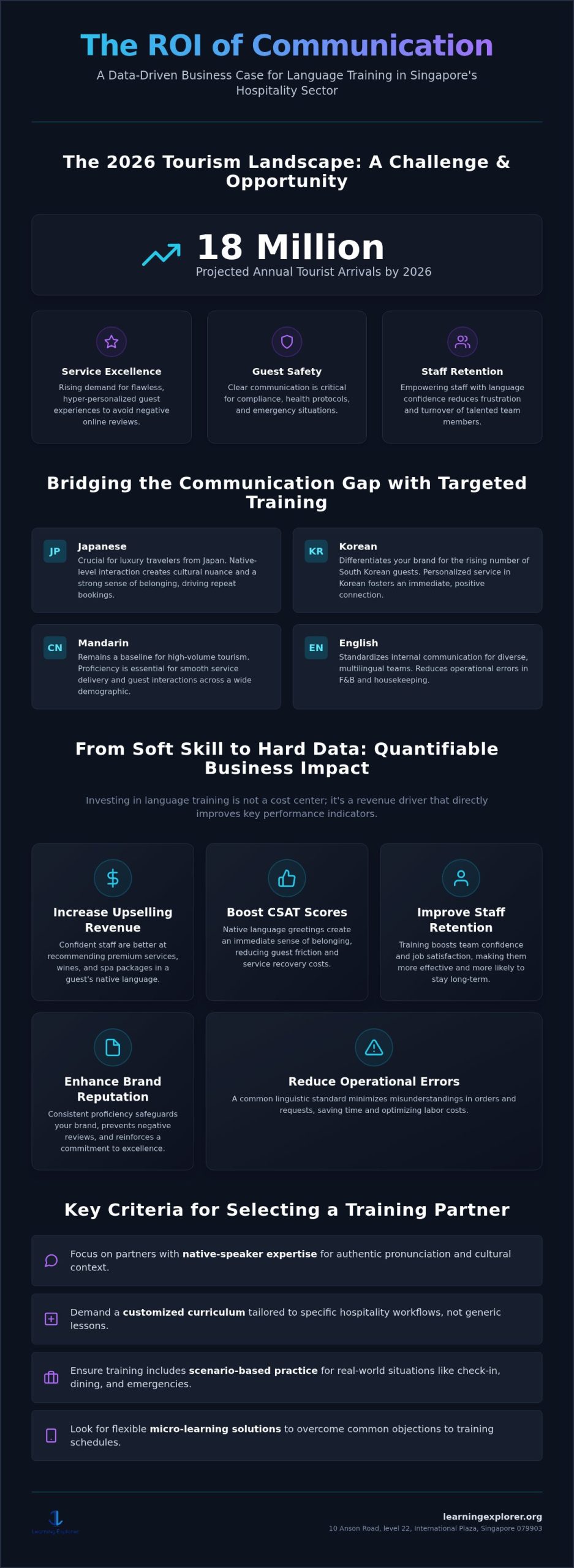
Singapore’s tourism sector is entering a period of unprecedented activity. With arrivals forecasted between 17 million and 18 million in 2026, the demand for high-tier service is skyrocketing. In this environment, corporate language training for hospitality industry singapore acts as a critical bridge between your brand promise and the actual guest experience. It’s a strategic investment that pays dividends in guest loyalty. When frontline staff can’t communicate effectively, the result is often a surge in negative TripAdvisor or Google reviews. These digital marks are difficult to erase and directly impact your bottom line.
Beyond marketing, clear communication is a pillar of safety and compliance. During health emergencies or fire drills, your team must lead with clarity. Research into how adults acquire language proves that specialized, scenario-based training is far more effective than generic lessons. This ensures your staff can handle high-pressure health protocols or emergency evacuations without hesitation. By empowering your team with the right words, you reduce the risk of operational errors and ensure guest safety remains the top priority.
Bridging the Gap for North Asian Tourists
We’re seeing a significant rise in luxury travelers from Japan and South Korea. These guests value the cultural nuance that comes with native-level interaction. For front-of-house teams, learning Japanese language is a powerful way to differentiate your property from competitors. While Mandarin remains a baseline for high-volume tourism, the ability to offer personalized service in Korean or Japanese creates a sense of belonging. This emotional connection is what drives repeat bookings and high guest satisfaction scores in the luxury segment.
English for Internal Coordination
Internal friction often arises when a diverse, multilingual team lacks a common linguistic standard. Operational errors in F&B orders or housekeeping requests usually trace back to simple misunderstandings. By engaging an English language school Singapore, you can standardize service delivery across all departments. This reduces the administrative burden of correcting mistakes and empowers your staff to work with confidence. Investing in corporate language training for hospitality industry singapore ensures your hotel remains a leader in the competitive 2026 market. Our training center at 10 Anson Road, level 22, International Plaza, Singapore 079903, provides the perfect environment for your team to master these essential workflows.
Identifying Key Performance Indicators (KPIs) for Your Case
To secure a budget for staff development, you must translate the “feeling” of good service into hard data. Metrics allow you to show stakeholders that corporate language training for hospitality industry singapore isn’t just a cost center; it’s a revenue driver. By tracking specific KPIs, you can demonstrate how linguistic confidence impacts the bottom line through higher Guest Satisfaction Scores (CSAT) and increased upselling opportunities. When management sees a direct link between training and financial performance, the path to approval becomes much clearer.
Confident staff are naturally better at recommending premium services. When a concierge or waiter can fluently describe a high-end wine or a spa package in a guest’s native tongue, the likelihood of a sale increases. This direct link to upselling revenue is a powerful argument for any business case. Additionally, you’ll see a marked improvement in operational efficiency. Your team spends less time clarifying misunderstood instructions and more time delivering world-class service, which optimizes your daily labor costs.
Linking Language to Guest Loyalty
There’s a profound psychological impact when a Korean or Japanese guest is greeted in their native language. It creates an immediate sense of belonging and reduces the friction of travel. This rapport significantly lowers “service recovery” costs because guests who feel understood are often more forgiving of minor issues. Consistent language proficiency across your team serves as a vital safeguard for your brand reputation, ensuring that every guest interaction reinforces your hotel’s commitment to excellence.
The Cost of Staff Turnover
Singapore’s labor market is notoriously tight. The cost of recruiting and onboarding a new employee often far exceeds the cost of upskilling an existing one. Offering corporate language training for hospitality industry singapore signals to your team that you’re invested in their professional growth. This level of engagement is a proven tool for staff retention, as employees value employers who prioritize their long-term career skills and professional confidence. For a deeper dive into the numbers, check our executive guide on calculating ROI on corporate language programs singapore.
If you’re ready to see how these metrics apply to your specific team, exploring tailored corporate language solutions can be your first step toward achieving higher CSAT scores and a more loyal workforce.
The Corporate Language Training Business Case Template
To move from a concept to a confirmed budget, your internal proposal needs a professional structure that speaks the language of management. An effective business case for corporate language training for hospitality industry singapore starts with an Executive Summary that ties linguistic proficiency to your hotel’s specific brand values. If your property prides itself on heritage service, explain how native-language greetings reinforce that legacy. The Problem Statement should then quantify the cost of current communication gaps, such as the time wasted on service recovery or lost upselling opportunities mentioned in previous sections.
Your proposed solution should focus on department-specific modules. Front Office teams need different vocabulary than F&B or housekeeping staff. According to The Future of Jobs and Skills in Singapore’s Hotel Industry report, upskilling in communication is vital for the sector’s long-term resilience and digital transformation. Finally, set clear projected outcomes. Success milestones at the 6-month mark might include a 10% rise in specific CSAT metrics, while the 12-month goal should focus on a measurable reduction in staff turnover rates.
Section 1: The Strategic Alignment
Aligning your training with the ‘Singapore Heart’ service philosophy ensures that your staff don’t just speak a language; they deliver hospitality with genuine warmth. This is especially crucial as Singapore prepares for major regional trade events and hotel expansions throughout 2026. For example, conversational mandarin singapore training creates a powerful synergy between retail and hospitality. It allows your concierge and retail teams to guide guests through Singapore’s premier shopping districts with confidence, enhancing the guest’s overall perception of your service standards.
Section 2: Budget and Logistics
Stakeholders often worry about the logistics of pulling staff away from their shifts. We address this through flexible scheduling, offering both on-site hotel training and classes at our CBD center. Our facility is situated at International Plaza, directly above Tanjong Pagar MRT, making it a convenient hub for staff commuting between shifts. By presenting a plan that balances direct costs with long-term value, you demonstrate that corporate language training for hospitality industry singapore is a manageable and high-impact investment that respects the hotel’s operational rhythm.
Overcoming Common Management Objections
Management often views training as a disruption rather than a catalyst for better service. When you propose corporate language training for hospitality industry singapore, you might encounter resistance centered on immediate operational costs. These objections usually stem from a short-term view of productivity. Reframing these concerns allows you to show that the real risk lies in maintaining the status quo and letting guest satisfaction slip while competitors modernize their approach.
The ‘Time’ Fallacy in Hospitality
Hospitality is a 24/7 machine, and finding a spare moment feels impossible. However, failing to train leads to a cycle of constant service recovery. Comparing two hours of proactive training to twenty hours spent managing a single guest’s public complaint puts the investment in perspective. You can implement “Lunch and Learn” sessions or schedule blocks during off-peak morning hours to minimize floor disruption. Micro-learning for hospitality staff involves delivering short, highly focused bursts of language content that employees can practice immediately during their shift.
Human Connection vs. AI Apps
In the luxury segment, high-net-worth guests expect cultural nuance, not a team staring at phone screens. While translation apps provide basic utility, they lack the warmth and emotional intelligence required for five-star service. Body language and vocal tone are markers of respect that an algorithm cannot replicate. Additionally, providing professional development serves as a retention magnet for Gen Z staff who value growth over static roles. They are more likely to stay with an employer that prioritizes their long-term skills and professional confidence.
The “too expensive” argument falls apart when you calculate the lifetime value of a lost guest. A single misunderstanding can lead to a guest never returning and sharing their negative experience with others online. Investing in corporate language training for hospitality industry singapore protects the millions spent on marketing and property upgrades. Rather than staff leaving after training, employees who feel the company is invested in their future develop a stronger sense of loyalty. Training creates a professional bond that high-turnover competitors simply cannot match. If you want to see how these programs fit your schedule, explore our flexible corporate language solutions to find a plan that works for your team.
Selecting the Right Training Partner in Singapore
Selecting a partner for corporate language training for hospitality industry singapore is the final step in turning your business case into reality. It isn’t just about finding a teacher; it’s about finding a strategic ally who understands the nuances of five-star service. A generic language course won’t cut it when your team needs to handle high-pressure guest interactions. You need instructors who are native speakers with bilingual capabilities, ensuring they can bridge the gap between a staff member’s native tongue and their new professional vocabulary with precision and empathy.
Evaluation should focus on the provider’s ability to customize. Your F&B team needs different linguistic tools than your concierge or housekeeping staff. A partner that can build curriculum around your specific hotel workflows will deliver much faster results than one using a standard textbook. Additionally, verify their experience with corporate group dynamics. Managing a diverse team of adult learners requires a specific skill set that balances engagement with professional rigor. This ensures that the training feels like a career opportunity rather than an administrative chore.
Why Learning Explorer for Hospitality?
We offer a comprehensive multi-language suite including English, Mandarin, Japanese, Korean, Thai, and Vietnamese. This makes us a convenient one-stop-shop for hotels dealing with a global guest list. Our strategic location in the CBD, situated directly above Tanjong Pagar MRT, ensures that your staff can attend sessions with minimal disruption to their shift patterns. We mirror the hospitality industry’s own standards by maintaining an approach that is visionary yet accessible, positioning ourselves as a partner that truly understands your operational hurdles.
Next Steps: Requesting a Pilot Program
If you’re facing resistance from stakeholders, suggest starting with a pilot program. Focus on a single high-impact department, like the Front Office, to prove the ROI quickly. By setting clear benchmarks for this phase, such as improved guest sentiment or increased staff confidence, you create a data-backed foundation for a full-scale rollout. Starting small reduces the administrative burden and allows you to fine-tune the training to your property’s specific needs before expanding across the entire organization.
Ready to elevate your guest experience and build a more confident team? Connect with our corporate team today to build a multilingual workforce that sets your hotel apart in the competitive 2026 market.
Elevating Singapore’s Hospitality Excellence for 2026
The shift toward hyper-personalized guest experiences requires more than just modern facilities; it demands a team that can communicate with cultural nuance. By framing corporate language training for hospitality industry singapore as a strategic infrastructure investment, you align your hotel with the high-growth tourism trends of the coming years. We’ve explored how tracking KPIs like guest satisfaction and staff retention transforms soft skills into measurable revenue drivers that stakeholders can’t ignore.
Don’t let language barriers be the reason a guest chooses a competitor. Our native-speaker instructors provide customized training frameworks for over seven languages, ensuring your F&B and front-office teams are ready for every interaction. With our convenient CBD location at International Plaza, we make it easy to integrate professional development into your busy operational schedule. It’s time to transition from managing communication gaps to leading with linguistic excellence.
Build your business case with Learning Explorer’s corporate experts today. Your team’s confidence is the catalyst for your hotel’s next level of success and we’re ready to help you achieve it.
Frequently Asked Questions
How long does it take to see results from corporate language training?
Results often manifest in two distinct phases. You’ll notice an immediate boost in staff confidence and morale within the first few weeks as they apply basic phrases to their daily tasks. For measurable shifts in Guest Satisfaction Scores (CSAT) or a reduction in service recovery incidents, we typically recommend a three to six-month assessment period. This timeline allows the new vocabulary to become a natural part of your team’s service delivery.
Can training be customized for specific hotel departments like F&B or Concierge?
Customization is vital for the success of corporate language training for hospitality industry singapore. We design specific modules for F&B teams focusing on menu descriptions and dietary requirements, while Concierge training emphasizes local recommendations and complex problem-solving. By using role-play scenarios specific to your hotel’s environment, your staff learn exactly what they need to excel in their unique roles without wasting time on irrelevant general vocabulary.
Is it better to have group classes or 1-on-1 sessions for hospitality staff?
Group classes are generally more effective for frontline hospitality staff as they encourage teamwork and standardized service delivery. Learning together allows colleagues to practice role-plays and support one another on the floor. However, one-on-one sessions are an excellent choice for senior management or department heads who require intensive, high-level business communication skills. We offer both formats to ensure every level of your organization receives the most appropriate support.
What languages are most in-demand for the Singapore hospitality sector in 2026?
In 2026, Japanese and Korean are highly sought after due to the surge in luxury travelers from North Asia. Mandarin remains a core requirement for high-volume tourism, while English is essential for internal coordination among a diverse workforce. We also see growing interest in Thai and Vietnamese as regional trade increases. Providing your team with these linguistic tools ensures your hotel remains competitive and welcoming to a broad international demographic.
How do we measure the success of a language program for our employees?
Success is best measured through a combination of qualitative and quantitative data. You should track improvements in specific guest review categories related to communication and staff helpfulness. Additionally, monitor internal metrics such as employee engagement scores and staff retention rates after the program concludes. Many hotels also see a rise in upselling revenue as staff become more confident in describing premium amenities and services in a guest’s native language.
What happens if our staff have different levels of language proficiency?
We handle varying proficiency levels by conducting initial assessments for every participant. This allows us to group staff into tiers, ensuring that beginners aren’t overwhelmed and advanced learners remain challenged. By utilizing tiered corporate language training for hospitality industry singapore, we ensure that every employee makes progress at a pace that suits their current ability. This structured approach prevents frustration and maximizes the training ROI across your entire workforce.
Is on-site training at our hotel more effective than classroom learning?
Both formats offer unique benefits depending on your hotel’s operational needs. On-site training minimizes travel time for your team and allows them to practice in their actual work environment. Conversely, attending classes at our CBD center can provide a focused atmosphere away from the distractions of the hotel floor. We provide flexible options for both settings, allowing you to choose the location that best supports your staff’s learning and shift patterns.
How do we ensure staff remain motivated throughout the language course?
Motivation stays high when staff see a direct link between their new skills and their career progression. We keep our sessions interactive and fun, moving away from dry textbooks to focus on real-world hospitality scenarios. Recognizing staff achievements through internal certificates or linking language milestones to professional development reviews also builds a culture of continuous learning. When employees feel that the hotel is invested in their growth, their loyalty naturally increases.