The best business English idiom isn’t always the cleverest one. In Singapore, a phrase like “touch base” may sound natural in an international meeting, while a more casual expression may not suit a client email. Learning business english idioms singapore professionals may encounter is about more than memorising definitions: tone, audience, and timing matter, too.
If you’ve ever understood an idiom but hesitated to use it, you’re not alone. Idioms often mean something different from their literal words, and a friendly phrase can feel too informal in the wrong setting. Clear communication matters more than trying to sound like a native speaker.
This guide explains useful business English idioms, what they mean, and how they sound in workplace conversations. You’ll see examples for common situations and learn how to decide whether a phrase fits a meeting, message, or formal discussion. It also distinguishes standard Business English idioms from local colloquial expressions, so you can choose your words with greater confidence. With practice and context, you can use these phrases naturally without letting them get in the way of your message.
Key Takeaways
- Learn how familiar expressions can carry meanings beyond their literal words, and why they appear in workplace communication.
- Explore common business English idioms with clear meanings and realistic examples you can adapt to your own conversations.
- Use business english idioms singapore workplaces may encounter selectively, considering your audience, setting, and need for clarity.
- Build a practical routine: notice an expression, check its meaning, create an example, and rehearse it in context.
- See how guided practice through Learning Explorer’s Business English Course can support learning idioms alongside broader workplace communication.
What Are Business English Idioms, and Why Do They Matter at Work?
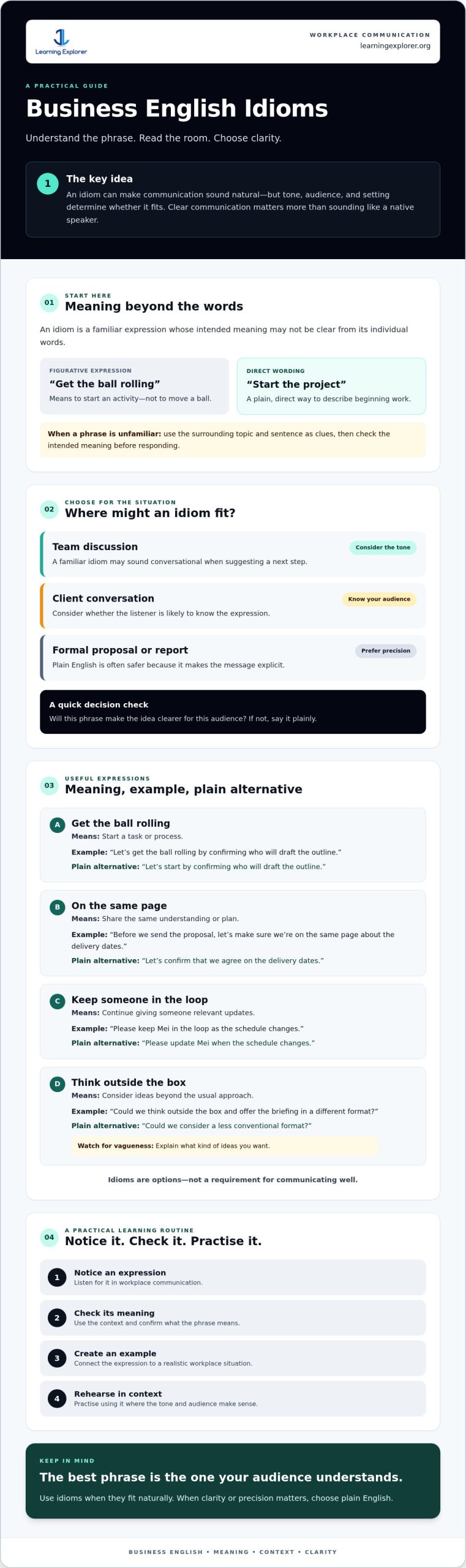
An idiom is a familiar expression whose intended meaning isn’t always clear from its individual words. For example, “get the ball rolling” means to start an activity, not to begin moving a ball. Business English idioms are established expressions used to communicate workplace ideas in a concise, conversational way. They can make speech feel natural, but only when listeners recognise the expression and its tone.
In Singapore, you may hear idioms in a project discussion, presentation, or informal email between colleagues. Language choices vary by organisation, team, and speaker, so there’s no single rule for every workplace. It also helps to distinguish standard business expressions from local colloquial speech. The overview of Singapore Standard English offers context on the varieties of English used locally.
For a quick introduction to workplace expressions, watch this video:
How Is an Idiom Different from a Literal Business Phrase?
Compare “get the ball rolling” with “start the project.” Both can mean beginning work, but the first is figurative and often sounds more conversational; the second is direct and suits a wider range of settings. Translating an idiom word for word may suggest someone is talking about a real ball. When you hear an unfamiliar phrase, use the surrounding topic and sentence as clues, then check the intended meaning before responding.
Where Might You Hear Business Idioms in Singapore?
A colleague might use an idiom while suggesting a next step in a team meeting. A presenter may use one to keep a talk conversational, and colleagues may include familiar expressions in informal business messages. In a client conversation, consider whether the listener is likely to know the phrase. Usage depends on the people and setting, not just the location.
For a formal proposal or report, plain English is often the safer choice because it makes the message explicit. An idiom may work in a relaxed discussion, but it can sound too casual or obscure the point in a formal document. When considering business english idioms singapore professionals may encounter, ask whether a phrase makes the idea clearer for this audience. Choose clarity first, and use an idiom only when it fits naturally.
Common Business English Idioms: Meanings and Workplace Examples
These expressions are widely used in English-language workplace conversations, but you don’t need to use them to communicate well. Treat each as an option, not a requirement. A plain-English alternative is often the clearest choice, especially if you’re unsure whether everyone knows the phrase.
Idioms for Progress, Deadlines, and Priorities
- Get the ball rolling: start a task or process. In a project discussion: “Let’s get the ball rolling by confirming who will draft the outline.” Plain alternative: “Let’s start by confirming who will draft the outline.”
- On the same page: share the same understanding or plan. During a team update: “Before we send the proposal, let’s make sure we’re on the same page about the delivery dates.” Plain alternative: “Let’s confirm that we agree on the delivery dates.”
- Keep someone in the loop: continue to give someone relevant updates. In a project message: “Please keep Mei in the loop as the schedule changes.” Plain alternative: “Please update Mei when the schedule changes.”
These phrases can make a discussion sound conversational, but a direct version may be more precise in a deadline update or written instruction. If the wording needs to tell someone exactly what to do, state the action and the information they need.
Idioms for Challenges, Decisions, and Teamwork
- Think outside the box: consider ideas beyond the usual approach. In a planning meeting: “Could we think outside the box and offer the briefing in a different format?” Plain alternative: “Could we consider a less conventional format?” The expression can feel vague unless you explain what kind of ideas you want.
- Get down to business: begin focusing on the main task. At the start of a meeting: “We’ve covered the updates, so let’s get down to business and review the proposal.” Plain alternative: “Let’s begin reviewing the proposal.” Depending on delivery, it can sound brisk, so a neutral alternative may suit a client discussion better.
- Back to the drawing board: return to planning because an idea or approach hasn’t worked. After feedback on a draft: “The client needs a different approach, so it’s back to the drawing board.” Plain alternative: “We need to revise the plan.”
Context helps turn an unfamiliar string of words into a useful meaning. In Singapore, workplace language choices vary by organisation and situation. Reporting by The Straits Times describes Singlish as increasingly accepted in the workplace, but that doesn’t make Singlish and international business idioms interchangeable.
As you build confidence with business english idioms singapore teams may encounter, practise a few expressions in realistic examples and compare them with direct wording. Guided learning can also give you space to explore meaning and tone as part of broader workplace communication. Learn more about the Business English Course at Learning Explorer.
Are Business Idioms Appropriate in Formal Singapore Workplaces?
Sometimes, but an idiom that feels easy in a team chat may sound too casual or unclear in a formal report. Even familiar expressions can land differently depending on the listener, the relationship, and the purpose of the conversation. In Singapore, workplace expectations vary across organisations and teams, so pay attention to how colleagues communicate and whether everyone understands the phrase.
It also helps to separate standard Business English idioms from Singlish. They aren’t interchangeable, and neither is automatically right for every setting. The National Library Board’s overview offers background on Singlish and its place in Singapore’s language landscape, including why some formal language guidance discourages the use of Singlish. Use that context without assuming every workplace follows the same expectations.
Rule of thumb: choose an idiom only when it makes your message clearer, not just more colourful.
When Should You Choose Plain English Instead?
For formal reports, instructions, sensitive topics, or audiences who may not know the expression, direct wording reduces guesswork. Compare “We need to get our ducks in a row before the review” with “We need to organise the documents before the review.” The first is figurative; the second states the action plainly. In a written update, a specific request is often easier to follow and act on.
That doesn’t mean idioms are forbidden in formal Singapore workplaces. Consider the document’s purpose and the readers’ familiarity with the phrase. If an expression could distract from an important point, replace it with precise wording.
How Can You Check an Idiom’s Tone Before Using It?
Before using an expression, consider your relationship with the listener, the formality of the setting, and whether the people involved already use similar language. A phrase that works among familiar teammates may feel abrupt in a first client conversation. Observe colleagues, but don’t assume their preferences apply to every audience.
If you’re unsure of the meaning, check a reliable dictionary or language reference, then ask a trusted colleague or instructor how the phrase might sound in that situation. Practise both the idiom and a plain-English alternative. This gives you a clear fallback when the wording feels uncertain and helps you focus on the message rather than worrying about sounding natural.
For learners exploring business english idioms singapore professionals may encounter, the goal isn’t to use more expressions. It’s to choose language that suits the audience and makes the point easy to understand.
How to Learn and Practise Business English Idioms Naturally
Memorising a long list can leave you knowing an idiom’s definition but unsure how to use it in conversation. Build familiarity in context instead. Choose a few expressions that suit your work, then follow a repeatable routine: notice the phrase, check its meaning and tone, create your own example, and rehearse it aloud.
A personal phrase log makes this practice easier to revisit. For each expression, record:
- The phrase and where you heard or read it.
- Its meaning and context, including who was speaking and what the conversation was about.
- Your own example and a plain-English alternative.
For instance, if you note “keep me in the loop,” include the situation where it appeared and write a direct equivalent such as “please keep me updated.” That context helps you remember not only what the idiom means, but when it may be useful. For more guidance on choosing a suitable English course, explore this English course for adults guide.
How Can You Practise Idioms Before a Meeting?
Start with the meeting topic, not a phrase you want to show off. Choose one relevant expression and prepare a sentence that would genuinely help you contribute. Say it aloud, then rehearse the plain-English version. For example, prepare both “Let’s get the ball rolling with the agenda” and “Let’s start with the agenda.” You’ll be ready to choose the wording that feels clearest in the moment.
Keep your focus on the message. You don’t need to insert an idiom into every exchange, and a direct sentence is always a useful fallback if the phrase feels forced.
How Can You Build Idioms into Everyday English Practice?
Listen for expressions in workplace conversations and notice them in reading or listening materials. Record the original sentence, speaker, and situation before looking up the meaning in a reliable reference. Then make a new example that fits your own work context. Avoid collecting phrases without context; it’s harder to judge their tone that way.
Practise your examples during structured speaking practice or a language lesson, and invite feedback from a trusted instructor or colleague. Learning Explorer’s Business English Course can provide a setting to practise broader workplace communication with guidance. If you’re building confidence with business english idioms singapore learners may encounter, connect phrase practice to a wider Business English course rather than studying expressions in isolation.
Build Practical Business English Skills with Guided Practice
Knowing an idiom’s definition is only part of using it well. In conversation, you also need to judge its tone, decide whether it suits the listener, and respond without losing your train of thought. Guided practice can help learners work through these choices in context, alongside broader professional communication skills.
Learning Explorer offers a Business English Course in Singapore. Its programmes are taught by certified native-speaker instructors who are also bilingual. Learners can explore private, group, and intensive formats, then consider which option best fits their preferences and learning needs.
What Can Learners Practise in a Business English Course?
Use a speaking activity to consider how the same idea might sound in a meeting, a client conversation, or a more formal exchange. You can ask an instructor about an idiom’s meaning and register, then compare it with a direct alternative. This kind of guided discussion connects expressions to practical workplace communication without requiring you to use an idiom every time you speak.
Practice can also help you prepare spontaneous responses. For example, listen to a workplace prompt, decide what you want to say, and try expressing the idea in both conversational and plain English. An instructor can help you reflect on whether your wording is clear and appropriate for the context. The aim is to build judgement, not memorise a script.
What Is a Practical Next Step for Singapore Learners?
Think about how you prefer to learn. Private learning may suit those who value individual attention, while a group setting gives learners the chance to practise with others. An intensive format may appeal if you prefer a more concentrated approach. Check the available details and choose based on your goals, schedule, and preferred learning environment.
If you’re comparing local options, read this English language school guide for Singapore. It can help you consider what to look for as you explore English learning. For focused workplace communication, review the information about Learning Explorer’s Business English Course.
Learning business english idioms singapore professionals may encounter doesn’t mean collecting as many phrases as possible. Choose expressions carefully, practise them steadily, and keep clarity at the centre of every conversation.
Make Your Workplace English More Confident
Business idioms can add a conversational touch, but they’re most useful when your listener understands them and they suit the setting. For business english idioms singapore professionals may encounter, focus on meaning and tone, and keep a plain-English alternative ready when clarity matters most.
Build confidence step by step: notice expressions in context, check what they mean, create your own examples, and practise saying them aloud. A few well-understood phrases can be more useful than a long list you’re unsure how to use.
For structured guidance, Learning Explorer offers a Business English Course in Singapore, with private, group, and intensive learning formats available. Explore Learning Explorer’s Business English Course to learn more. Keep practising, choose words that fit your audience, and let clear communication lead.
Frequently Asked Questions
What are business English idioms?
Business English idioms are familiar expressions used in professional conversations whose intended meaning may not be obvious from the individual words. “Get the ball rolling,” for example, means to begin an activity, not to move a ball. Learn each expression with its context, tone, and a plain-English alternative. In Singapore workplaces, this can help you recognise idioms colleagues use and decide whether they suit your own message.
Which English idioms are useful in business conversations?
Useful examples include “get the ball rolling” for starting an activity, “on the same page” for sharing an understanding, and “think outside the box” for considering creative ideas. Their suitability depends on the workplace and conversation. Check each phrase’s meaning and tone before using it, then consider whether it sounds natural in that situation. If it might distract from your point, choose a direct alternative instead.
Are idioms appropriate in formal business emails?
Some familiar idioms may appear in less formal workplace messages, but plain English is often the safer choice for formal emails, proposals, and instructions. Consider your relationship with the recipient and the purpose of your message. For instance, “keep me in the loop” can become “please keep me updated.” If an idiom might be misunderstood or sound too casual, use wording that states your meaning directly.
How can I learn business idioms without sounding unnatural?
Learn expressions through examples instead of memorising them as isolated phrases. Check what each one means, note the situation where you encountered it, and write a sentence relevant to your work. Practise saying both the idiom and a plain-English alternative. This gives you a choice in conversation. Use the expression only when it feels appropriate and helps your listener understand, rather than inserting it simply to sound fluent.
Can idioms make my business English harder to understand?
Yes, an idiom can cause confusion if your listener doesn’t know it, if it’s used in the wrong context, or if its tone doesn’t suit the situation. Idioms are optional tools, not a requirement for professional communication. Choose direct wording whenever clarity matters most, especially when giving instructions or communicating with an unfamiliar audience. If you’re unsure, state the idea plainly and check that your message is understood.
How can I practise business English idioms in Singapore?
Start with situations you encounter, such as meetings, presentations, or conversations with colleagues. Keep a short record of phrases you hear, check their meaning, and create examples that fit your own context. Practise speaking with a colleague, study partner, or instructor, and ask whether the expression sounds clear and appropriate. For learners exploring business english idioms singapore workplaces may use, practising with feedback can help connect meaning to tone and setting.
Do I need to use idioms to sound fluent in English?
No. Fluency isn’t measured by how many idioms you use. Clear, well-organised communication matters more, and straightforward language is often the strongest choice for professional messages. Understanding common idioms can help you follow conversations, while knowing a plain-English alternative gives you flexibility. Focus on expressing your ideas clearly, then use an idiom only when it fits your audience, setting, and purpose.