Professional fluency in high-stakes meetings isn’t about how many words you know; it’s about how effectively you use strategic transitions and diplomatic interjections to own the room. You likely know the frustration of relying on repetitive starters like “I think” or “Yes” while your brain works overtime to translate complex thoughts in real time. It’s exhausting to feel your confidence slip when you need to interrupt a senior stakeholder or pivot a conversation that has veered off-track. We understand that the mental load of translating mid-conversation can be a significant barrier to your professional impact.
In this guide, you’ll master the essential business english phrases for meetings and strategic communication techniques needed to lead and participate with absolute authority. We’ll explore how to navigate Singapore’s nuanced corporate landscape in 2026, from managing mandatory ESG reporting discussions to mastering the art of the soft “no” in a consensus-driven environment. Whether you’re visiting our training center at 10 Anson Road, level 22, International Plaza, Singapore 079903, or applying these tips in the boardroom, you’ll learn to reduce administrative burdens and increase engagement. Get ready to transition from the labor of seeking the right words to the satisfaction of driving better outcomes for your team.
Key Takeaways
- Establish immediate authority in the first 60 seconds by using professional opening phrases that set a clear, strategic purpose for every session.
- Upgrade your vocabulary with high-level business english phrases for meetings, replacing basic starters with more persuasive terms like “advocate” and “propose.”
- Discover facilitation strategies like the “Parking Lot” technique to gracefully manage off-topic discussions and maintain efficient time management.
- Master the art of closing a session by assigning accountability and summarizing action items to ensure your meetings produce tangible results.
- Understand how cultural nuance and local context impact communication for professionals in Singapore’s CBD to ensure your delivery is always impactful and diplomatic.
Setting the Stage: Essential Phrases for Opening a Meeting
The first minute of any professional gathering dictates the energy and hierarchy for the rest of the hour. If you fumble your opening, you spend the next fifty minutes trying to regain lost ground. Understanding what is a meeting? in a modern context means recognizing it as a structured tool for decision-making, not just a casual chat. Using the right business english phrases for meetings from the moment you step into the boardroom at 10 Anson Road, level 22, International Plaza, Singapore 079903 ensures you’re seen as a leader rather than a passenger. Authority isn’t just about what you know; it’s about how you command the space.
To better understand how to navigate the digital and physical boardroom, watch this helpful video on common phrases:
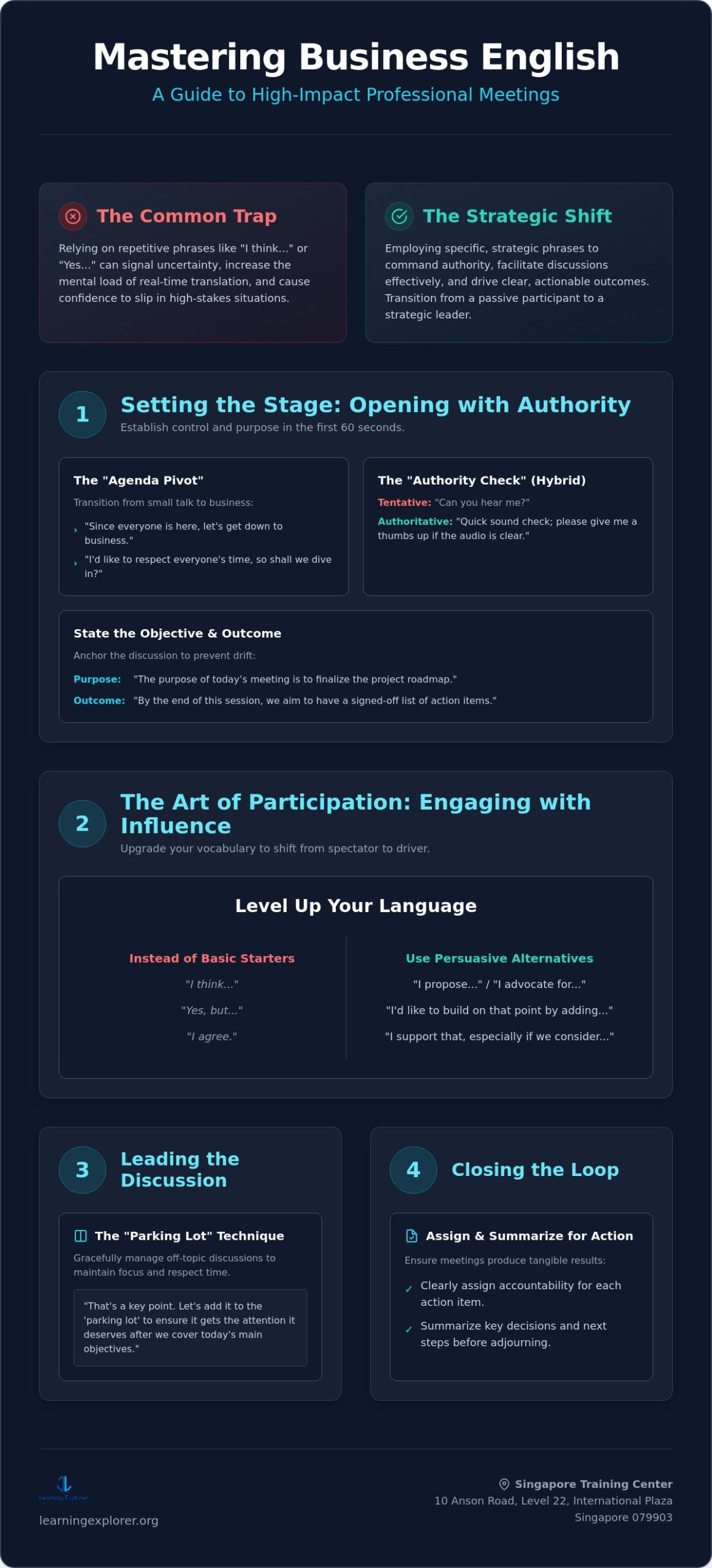
Small talk is essential for rapport, but lingering too long on weekend plans can erode your schedule. Use an “Agenda Pivot” to signal the transition. Phrases like “Since everyone is here, let’s get down to business” or “I’d like to respect everyone’s time, so shall we dive in?” work perfectly. In 2026, hybrid meetings require a brief technical pulse check before starting. Don’t ask “Can you hear me?” which sounds tentative. Instead, use authoritative checks like “Quick sound check; please give me a thumbs up if the audio is clear on your end.” This shows you’re in control of the technology and the time.
Formal vs. Informal Greetings
Your choice of words depends on the room’s temperature. For a high-stakes board meeting, “Thank you all for coming; your presence is appreciated” sets a respectful tone. In a fast-paced agile stand-up, “Let’s get started” is more efficient. If you’re introducing a new consultant or team member, use: “I’d like to introduce [Name], who is joining us to provide expertise on our latest project.” Setting ground rules early prevents later friction. Try saying, “To keep us on track, please save your questions for the end of the presentation.”
Stating the Objective Clearly
Ambiguity is the enemy of productivity. Start with a direct focus by saying, “The purpose of today’s meeting is to finalize the project roadmap.” Follow this with a desired outcome statement like “By the end of this session, we aim to have a signed-off list of action items.” These business english phrases for meetings transform a vague discussion into a mission-driven event. An Objective Statement is a single-sentence tool that anchors the discussion to a specific result, preventing the conversation from drifting into unproductive territory.
The Art of Participation: Sharing Ideas and Handling Disagreement
True professional fluency isn’t just about waiting for your turn to speak; it’s about knowing how to insert your voice into the conversation with precision. Many professionals fall into the trap of using “I think” for every contribution, which can inadvertently signal a lack of certainty. By shifting your vocabulary toward higher-level verbs, you transform your perceived role from a spectator to a driver of the agenda. Mastering specific business english phrases for meetings allows you to navigate these moments without the anxiety of being misunderstood or overlooked by senior stakeholders. Mastering Professional Communication is a career-long journey that begins with these small, intentional shifts in how you present your ideas.
When you want to build on a colleague’s point, use the “Yes, and” technique. Instead of starting a new thread, try saying, “I’d like to build on that point by adding…” or “I advocate for that approach, especially if we consider…”. This fosters a collaborative atmosphere, which is highly valued in Singapore’s consensus-driven business culture. It shows you’re actively listening rather than just waiting for a gap to speak. If you need to show engagement without interrupting, use short, supportive phrases like “That makes sense” or “I see where you’re coming from” to maintain the flow of the discussion.
Phrases for Constructive Disagreement
In Singaporean business environments, disagreements are often expressed in soft or ambiguous terms to maintain cohesion. You don’t have to say “no” directly to be effective. Use diplomatic starters like “I see your point; however, have we considered the impact on the timeline?” This acknowledges their perspective before introducing your own. Probing questions are also powerful tools for challenging a point without being confrontational. Try asking, “Could you help me understand how this aligns with our current ESG reporting requirements?” This shifts the focus from a personal disagreement to a shared goal of compliance and excellence.
Clarification and Repetition
There’s no shame in asking for clarity; in fact, it often prevents costly errors later. If a point is unclear, don’t just say “I don’t understand.” Instead, use professional alternatives like “Could you elaborate on the financial implications of that step?” or “So, if I understand correctly, you’re saying we should prioritize the Q3 rollout?” These phrases show you’re processing the information deeply. You can also naturally start overcoming your fear of speaking english by using “buying time” phrases. If you’re put on the spot, say “That’s an interesting perspective; let me reflect on that for a moment” to give yourself space to formulate a high-quality response. If you’re looking to refine these skills further, exploring a Business English Course can provide the practice you need to feel truly confident in any boardroom.
Leading the Discussion: Facilitation and Time Management
Leading a high-stakes meeting in Singapore’s CBD isn’t about being the loudest person in the room. It’s about facilitation, which is the art of guiding the collective intelligence of the group toward a specific goal. While dictation shuts down creativity, facilitation opens doors. As a leader, your role is to manage the flow of ideas while ensuring the clock remains your ally. Using strategic business english phrases for meetings helps you maintain this balance without appearing overly aggressive or losing your team’s respect. You’re there to act as the conductor, ensuring every voice contributes to a harmonious and productive outcome.
One of the most effective tools for maintaining focus is the “Parking Lot” technique. When a conversation drifts into a tangent, don’t let it derail your agenda. Instead, say, “That’s a valid point, but it’s slightly outside our current scope; let’s put it in the ‘parking lot’ and revisit it at the end if time permits.” This validates the speaker while protecting the group’s time. You should also actively invite expertise from those who haven’t spoken yet. Try saying, “I’d like to hear what [Name] thinks about this, given their experience with the project.” This ensures inclusivity and prevents a few dominant voices from hijacking the final decision.
Managing Transitions and Flow
Smooth transitions prevent the meeting from feeling like a series of disjointed segments. When you’re ready to advance, use phrases like “Moving on to the next point on our agenda” or “Let’s pivot to the budget discussion.” If a debate becomes long-winded, summarize the key points before moving forward. You might say, “To recap, we’ve agreed on the timeline but still need to finalize the vendors.” If the group wanders, follow this simple guide to re-focus: acknowledge the current discussion, reference the original objective, and use a refocusing phrase like “In the interest of time, let’s bring the conversation back to our primary goal.”
Handling Interruptions and Dominant Speakers
Regaining control from a dominant speaker requires a blend of politeness and firm resolve. If someone interrupts, use a phrase like, “If I could just finish this point, I’ll be happy to take your questions.” This reinforces your authority as the facilitator without causing friction. Professional Assertion in a CBD corporate context is the ability to maintain the meeting’s trajectory with diplomatic firmness while respecting the hierarchy and social harmony of the group. If you find these high-pressure situations challenging, a Business English Course can provide a safe environment to practice these interactions. Use time-check phrases such as “We have ten minutes left, so let’s focus on the final decision” to ensure everyone leaves with clear, actionable next steps.
Closing the Loop: Action Items and Follow-Ups
A meeting without a final summary is a meeting wasted. You’ve spent valuable time navigating complex discussions; now you must ensure those ideas translate into tangible results. Closing effectively is the hallmark of a high-level professional. It ensures everyone leaves the room with a unified understanding of the next steps. By mastering these specific business english phrases for meetings, you eliminate the ambiguity that often plagues project timelines and corporate accountability. When you wrap up with precision, you demonstrate that you value the time and effort of every participant. This final stage is where the strategic communication techniques discussed earlier finally pay off in concrete deliverables.
In the fast-paced environment of Singapore’s CBD, efficiency is everything. If you leave a session without clear owners for each task, the administrative burden of following up later doubles. Use direct, imperative language to assign responsibility. Phrases like “Who is the lead on this task?” or “Who will be responsible for the final sign-off?” are not aggressive; they are necessary for project success. This clarity protects your team from the frustration of overlapping duties or missed deadlines. It transforms a vague conversation into a structured plan of action, ensuring that the momentum generated during the meeting isn’t lost the moment everyone returns to their desks.
The Five-Minute Summary
The Five-Minute Summary is your insurance policy against misalignment. It’s the moment you convert abstract ideas into concrete commitments. Dedicate the final moments to recapping the session’s highlights. Start by saying, “To recap what we’ve discussed today, we’ve reached a consensus on the new ESG reporting workflow.” This prevents miscommunication and ensures digital trust among stakeholders. Next, confirm action items with precision. Try saying, “Just to be clear, [Name] will handle the data migration by next Tuesday.” This transition from discussion to documentation is crucial for maintaining momentum. Always close with a positive, forward-looking statement like, “I’m confident this new strategy will significantly improve our Q4 outcomes.”
Post-Meeting Follow-Up Phrases
A professional follow-up is the bridge between the meeting and the actual execution of tasks. It’s not just a record; it’s a catalyst for action. Your follow-up email should be concise and benefit-driven. Use phrases like, “Thank you for your valuable contributions today; please find the minutes and action items attached.” This is also an excellent opportunity to ask for feedback on the meeting’s effectiveness. Ask, “Do you have any suggestions on how we can make our next sync even more efficient?” As you continue your journey toward professional fluency, choosing the right language school is the strategic next step for your career growth.
Ready to lead your next meeting with absolute authority? Join our Business English Course and master the communication techniques that drive real business results.
Mastering Professional Communication in Singapore’s CBD
Navigating a boardroom in Singapore’s high-pressure financial hub requires more than just a memorized list of terms. It’s about understanding the subtle dance of hierarchy and consensus that defines our local corporate culture. While business english phrases for meetings provide the necessary foundation, true professional fluency comes from applying them with cultural precision. In a landscape where directness is often softened and stakeholders value social harmony, your communication style must be both authoritative and diplomatic. Mastering these nuances ensures your ideas aren’t just heard; they’re respected and acted upon by senior leaders.
Certified native-speaker instructors play a vital role in this transformation. They don’t just teach you words. They guide you through the “soft” skills that textbooks often miss. This includes understanding the art of the soft “no” or knowing how to use strategic pauses to invite participation. By practicing these scenarios in a supportive environment, you reduce the mental load of translating mid-conversation. This transition from the labor of seeking the right words to the satisfaction of discovery is what separates a participant from a leader. Corporate training also offers practical benefits for teams, fostering a unified communication standard that reduces administrative friction and increases engagement.
Learning Explorer: Your CBD Ally
Our training center is designed to be a reliable ally for busy professionals. Our location at International Plaza is situated directly above Tanjong Pagar MRT. This prime spot makes it incredibly convenient for working adults to attend sessions before or after their office hours. We utilize an interactive, global-standard curriculum that moves away from dense jargon and toward action-oriented learning. Our goal is to provide the creative catalyst you need to achieve better outcomes in every meeting you lead or join.
Next Steps for Your Career
Moving beyond simple phrases means mastering the natural, conversational flow that defines modern business. A structured Business English Course provides the consistent, high-quality practice required to build this long-term confidence. As you refine your command of professional English, you’ll find that leadership opportunities become more accessible. Clear, persuasive communication is the cornerstone of management, especially in the diverse and fast-paced environment of Singapore. Take the next step in your professional journey and join our English Language School Singapore for a transformative experience that will enhance your professional impact and career trajectory.
Step Into the Boardroom with Confidence
You’ve now gained the tools to transform your presence in every corporate interaction. From setting a clear objective in the first sixty seconds to assigning accountability during the final wrap-up, you’re equipped to lead with authority. Mastering business english phrases for meetings is more than just learning a list of words; it’s about reducing your mental load and increasing your professional impact. You can now navigate diplomatic disagreements and facilitate complex discussions without the anxiety of being misunderstood or the frustration of repetitive language.
Ready to put these techniques into practice? Master your professional communication at Learning Explorer’s Singapore CBD center today. Our certified native-speaker instructors provide an interactive and fun learning environment designed for the modern professional. We are conveniently located in the heart of the CBD, situated directly above Tanjong Pagar MRT. Transition from the labor of translating mid-conversation to the satisfaction of effortless discovery. Your future as a confident, fluent global leader starts now.
Practise These Phrases in a Real Class
To practise meeting and presentation language with a trainer, English Explorer — the group’s CBD English school — offers:
- Business English course — for meetings, presentations, email and negotiation
- Conversational English course — for everyday speaking confidence
- General English course — structured learning on the Oxford University Press syllabus
- private & corporate English training — one-to-one lessons and tailored team training
- online English classes — live online lessons from anywhere
Not sure of your level? Start with a free English placement test, browse all English courses, or contact English Explorer to book a trial.
Learn more about Business English course in Singapore at English Explorer, above Tanjong Pagar MRT.
Frequently Asked Questions
What are the most common Business English phrases for starting a meeting?
Start your session with direct, welcoming phrases such as “Thank you all for coming” or “I appreciate everyone being here on time.” Once the initial greetings are finished, use an “Agenda Pivot” like “Let’s get down to business” to signal the transition to the core discussion. This establishes your authority immediately and respects the busy schedules of your colleagues.
How can I politely disagree with my boss in an English-speaking meeting?
Use diplomatic openers like “I see where you’re coming from; however, have we considered the impact on our timeline?” Focus on asking “probing questions” rather than making flat denials. This approach allows you to challenge a perspective while maintaining social harmony and professional respect, which is essential in Singapore’s consensus-driven corporate culture.
What should I say if I didn’t hear what someone said in a virtual meeting?
Use an authoritative check like “Sorry, the audio cut out for a moment; could you please repeat that last point?” Don’t feel anxious about asking for clarity. In hybrid settings, you can also say, “Could you elaborate on that for those of us joining remotely?” to ensure the entire team stays aligned on the details.
How do I interrupt someone professionally in a business discussion?
Wait for a brief pause and use a polite bridge like “If I could just jump in here for a second” or “Sorry to interrupt, but I have a quick point regarding the budget.” This allows you to insert your voice without appearing aggressive. It’s a vital skill for ensuring your expertise is included in high-speed discussions.
What are some phrases for assigning tasks at the end of a meeting?
Assign accountability by asking “Who is the lead on this task?” or stating “[Name], will you be responsible for the final sign-off by Friday?” Using clear business english phrases for meetings ensure that action items are documented and owners are identified before the session concludes, reducing the administrative burden of follow-up emails later.
Is there a difference between formal and informal meeting language in Singapore?
Yes, the choice of language depends heavily on the room’s hierarchy and the specific context of the gathering. High-stakes board meetings require formal starters like “I’d like to welcome everyone to today’s session,” while casual team syncs allow for “Let’s get started.” Adapting your tone shows cultural awareness and professional maturity in the CBD landscape.
How can I sound more confident when presenting my ideas in English?
Replace low-certainty words like “I think” with high-level verbs such as “I propose,” “I advocate,” or “I suggest.” Using these business english phrases for meetings shifts your perceived role from a passive participant to a strategic contributor. This simple change reduces the mental load of translating and significantly increases your professional impact during presentations.
What are the best phrases for summarizing a meeting’s key points?
Close the loop with phrases like “To recap what we’ve discussed today” or “Just to be clear, our main takeaways are…” This ensures consensus and prevents miscommunication before everyone leaves the room. Ending with a summary allows the team to move forward with a unified understanding of the project’s next steps and goals.