What makes a conversational English course useful is not necessarily an intensive schedule, but practice that relates to conversations you have every day. If you’re comparing a conversational english course singapore, look beyond the course title: check how learners practise speaking, what guidance they receive, and whether the lessons relate to the situations they want to handle.
It can be hard to judge these details from a course description. A class might suit your schedule but offer less speaking practice than you expect, or provide time to talk without the feedback you need. The right fit depends on your goals, preferred learning environment, and the conversations you want to manage with greater ease.
This guide will help you compare private, group, and intensive formats, identify useful speaking practice, and prepare questions before enrolling. Learning Explorer offers all three formats, but lesson activities, schedules, and feedback methods are details to check with the school. You’ll also find practical points to consider when choosing a class in Singapore, including whether a CBD location works for your routine. Use these criteria to narrow your options and find a course that fits your needs and gives you a structured setting to practise everyday English conversations.
Key Takeaways
- Set speaking goals around situations you want to handle, from everyday chats to workplace conversations.
- Compare group, private, and intensive classes by interaction, individual attention, scheduling, and learning preference.
- When comparing a conversational english course singapore, ask how lessons balance speaking practice with instructor guidance and feedback.
- Separate essential needs from preferences, then confirm practical details such as schedules and lesson activities.
- Learning Explorer offers private, group, and intensive Conversational English Course formats in Singapore.
What to expect from a conversational English course in Singapore
A conversational English course is structured learning centred on speaking, listening, and interaction. Rather than treating English only as a subject to study, it focuses on using the language to express ideas and respond in conversation. A conversational english course singapore may suit learners looking for guided opportunities to practise, but course content and outcomes vary by provider.
Your goals might include handling everyday exchanges, joining social conversations, or contributing more comfortably at work. In Singapore, you may also encounter different forms of English in daily life. Read more about English in Singapore to understand the context, including Standard English and Singlish.
For a workplace-related example, watch this video:
Before choosing a class, name the conversations you want to handle. You might want to explain an idea to a colleague, keep a casual conversation going, or follow what someone says and respond clearly. Use those situations to assess whether a provider’s lesson focus fits your needs. Ask what learners do during lessons and how instructors guide practice rather than assuming every course follows the same approach.
Who benefits from conversational English lessons?
These lessons may appeal to adult learners who want more practice expressing their thoughts and following spoken conversations. You might understand English but find it harder to speak comfortably in the moment. You don’t need to fit a particular learner profile to explore a course. Start with the situations where you’d like to communicate more easily, then ask whether the provider can explain how its lessons address those needs.
How conversation classes differ from general English study
The main difference is the learning focus. A conversation class prioritises spoken communication and interaction, while general English study may cover a broader range of language-learning goals. Conversation practice can still include listening and instructor guidance. Ask how lessons balance these elements and whether learners have opportunities to interact. For broader selection advice, see this English course for adults guide.
A course description may not tell you how much speaking practice to expect. Before enrolling, ask about lesson activities, the balance between learner speaking time and instructor guidance, and how feedback is provided. Confirm details directly with the provider, since schedules, levels, class arrangements, and outcomes can differ. These answers help you decide whether the course fits your goals and expectations.
How conversational English lessons build useful speaking practice
Understanding English and using it in a live conversation place different demands on a learner. Regular opportunities to speak and listen let you practise forming a response, following another speaker, and making your meaning clear. Practice alone can’t guarantee a particular rate of progress, but it can help you notice which moments feel difficult and decide what you want to work on next.
For learners considering a conversational english course singapore, the value lies not just in having time to talk, but in how that practice is guided. The Center for Strategic and International Studies describes English proficiency as critical for a successful modern society, underscoring why communication skills can matter beyond the classroom.
What to look for in speaking activities
Ask whether lesson activities connect with the conversations you want to manage, whether social, everyday, or workplace-related. Find out how learners practise taking turns, responding to others, and expressing ideas clearly. You can also ask how instructors balance learner speaking time with explanation or guidance. These questions help reveal whether the course offers purposeful interaction rather than assuming that any conversation practice will match your goals.
Check that learners have opportunities to listen as well as speak. Listening practice can help you follow another person’s point and respond in context. Ask the provider which activities are included; don’t assume role-play, group discussion, or any other specific format is part of the course unless the school confirms it.
Why feedback and a supportive class environment matter
Useful feedback is clear, respectful, and connected to what you’re trying to communicate. It might help you notice where a listener could misunderstand your meaning or where a response could be clearer. Ask how instructors give feedback and support learners with different confidence levels. A supportive environment should make it easier to practise, make mistakes, and try again without feeling judged.
If speaking feels stressful, this guide to overcoming fear of speaking English offers another perspective to consider as you prepare for class. You can also explore the Conversational English Course offered by Learning Explorer, then ask the school which activities and feedback methods are included.
Assess a course by checking how often learners speak and listen, what feedback they receive, and whether practice reflects the situations they want to handle. Those details give you a practical basis for comparing options without relying on broad promises about outcomes.
Group, private, or intensive English classes: compare your options
Class format affects how you practise, how much individual attention you may receive, and how lessons fit around your commitments. There’s no single format that suits every learner. Compare the options against your speaking goals and routine, then confirm current arrangements with the school. In Singapore, the Speak Good English Movement reflects the value placed on clear communication, but your own reasons for learning will help determine which class format makes sense.
| Format | Interaction | Individual attention | Scheduling needs and learning preference |
|---|---|---|---|
| Group | Ask how learners take part and interact during lessons. | Ask how instructor guidance is shared across the class. | Consider whether a shared learning environment suits you, and confirm the timetable. |
| Private | Ask how speaking and listening practice is organised. | Consider this format if individual attention is important to you. | Check available times and whether the arrangements fit your routine. |
| Intensive | Ask how practice is structured across the course. | Confirm what instructor guidance is included. | Consider this option if a more concentrated schedule suits your plans, and verify the timetable. |
When a group conversational English class may fit
A group class may appeal if you’re comfortable practising in a shared setting and want to learn alongside other participants. Don’t assume a particular class size, peer activity, or mix of learners. Ask how participants take turns, how much opportunity each person has to speak, and how the instructor guides practice and gives feedback.
When private or intensive lessons may fit
Private learning is worth asking about if you value individual attention or want to discuss your communication goals directly with an instructor. Intensive learning may be worth considering if a more concentrated schedule fits your plans. Neither format guarantees a particular outcome, and the right choice depends on the arrangements a provider can offer. Check availability, timetable, lesson details, and how practice is delivered before deciding.
Learning Explorer offers private, group, and intensive formats for its Conversational English Course. If you’re comparing a conversational english course singapore, use the table as a starting point, then confirm current schedules and class arrangements with the school. Focus on the trade-offs that matter most to you: interaction, individual attention, and the time you can realistically commit.
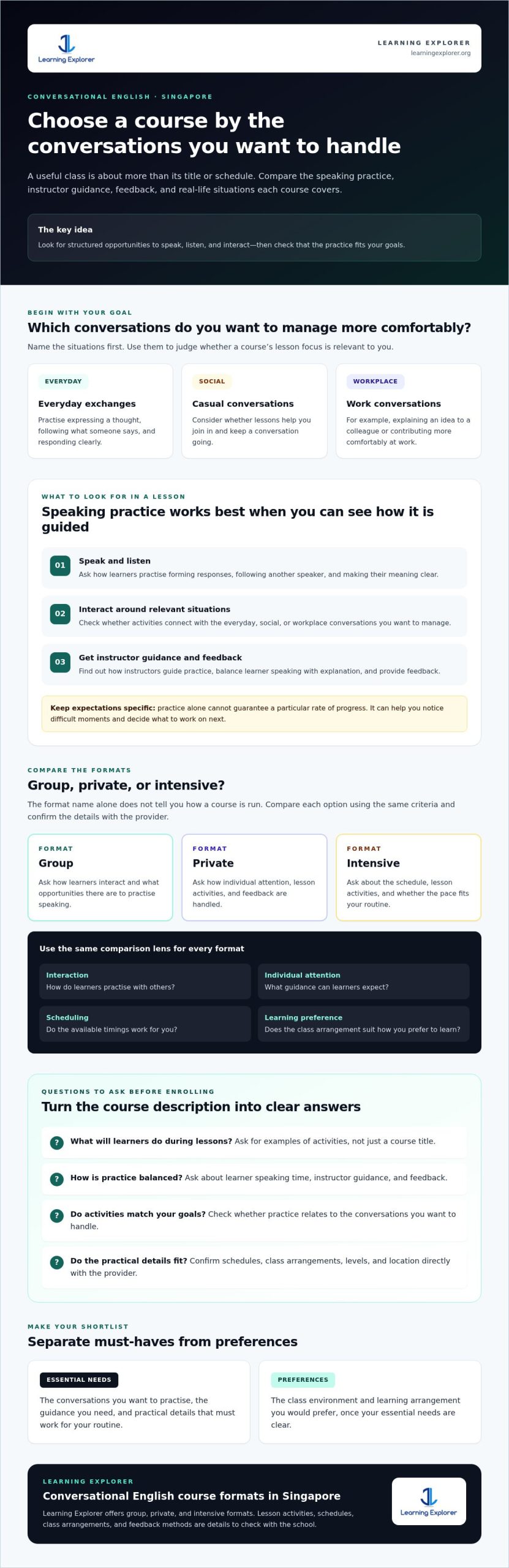
How to choose a conversational English course in Singapore
Use a simple sequence to focus your search: define the conversations you want to handle, compare class formats, ask how lessons support practice, then confirm practical details. Before contacting a provider, separate essentials from preferences. You may need a schedule that fits around work, while your preferred class format may be flexible.
Questions to ask before enrolling
Ask direct questions and compare the answers. A provider should be able to explain its course arrangements, but details can vary, so confirm current information before you decide.
- Speaking goals: What situations is the course designed to support, such as everyday, social, or workplace conversations?
- Practice and support: How do learners practise speaking and listening? How does the instructor guide learners and give feedback during lessons?
- Learning focus: How does the course balance conversation practice with other areas of English study?
- Logistics: What are the current fees, materials, schedule, and enrolment arrangements? Ask the provider to clarify anything that affects your decision.
These questions help you look beyond a course title. If your priority is speaking up at work, for example, ask how the provider’s confirmed lesson focus relates to that goal. Don’t assume specific activities, materials, or outcomes are included unless the school confirms them.
How to assess whether a class matches your goals
Match your main speaking goal to the provider’s course information. Then consider whether group, private, or intensive learning fits your routine and how you prefer to practise. Ask what instructor guidance is available and whether the current timetable works for you. For more local context on evaluating providers, read this English language school guide for Singapore.
Location can be part of the decision, too. Learning Explorer’s centre is at 10 Anson Road, level 22, International Plaza, Singapore 079903, above Tanjong Pagar MRT. If you work or study nearby, consider how the journey fits into your routine, and confirm current course arrangements directly with the school.
A conversational english course singapore should make sense for both your communication goals and your day-to-day commitments. Keep your essential questions handy as you compare options. To check the Conversational English Course details, contact Learning Explorer.
Explore Learning Explorer’s conversational English course in Singapore
Learning Explorer is a Singapore language school offering a Conversational English Course for learners seeking structured speaking practice. The available learning formats are private, group, and intensive classes. Each may suit different preferences, so consider how you learn best and which conversations you want to feel more comfortable joining before asking the school which format may fit.
Learning Explorer describes its instructors as certified native speakers who are also bilingual. If instructor background matters to your choice, ask how their experience and bilingual ability support the course. It’s also helpful to ask what learners do during lessons, how much opportunity there is to speak, and what kind of feedback instructors provide. Confirm these details directly rather than assuming a particular activity or teaching approach is included.
What learners can confirm with Learning Explorer
Start with your goal. You might want to share ideas more comfortably, follow conversations more easily, or practise English for situations at work. Explain what you’re looking for and ask how the course’s learning focus relates to it. Then discuss whether private, group, or intensive learning suits your preferences and routine.
Before deciding, confirm current course information with the school. Ask about:
- Available schedules and class arrangements
- Current fees and any materials learners need
- Levels or entry expectations, if relevant to your situation
- How lessons include speaking practice, instructor guidance, and feedback
- Enrolment arrangements and any details you need before committing
These questions help you understand what to expect and compare the answers against your priorities. Course details can change, so check current information directly. A course can provide a setting for guided practice, but avoid relying on promises of guaranteed fluency or a fixed outcome.
Take the next step towards more confident conversations
Make your next step simple: write down one or two speaking goals, choose the format you’d like to ask about, and prepare questions about practice and logistics. If you’re still weighing up a conversational english course singapore, a focused enquiry can help you find out whether the course aligns with your needs before you decide.
Explore the course and ask Learning Explorer about fit, current arrangements, and enrolment when you’re ready: Explore conversational English learning with Learning Explorer.
Choose a course that supports your next conversation
The right conversational english course singapore starts with your real speaking goals. Decide which situations you want to feel more comfortable in, then compare group, private, and intensive formats against your learning preferences and schedule. Before enrolling, ask how lessons balance speaking practice with instructor guidance, what feedback you can expect, and whether the current course details fit your needs.
Learning Explorer offers all three formats. The school describes its instructors as certified native speakers who are also bilingual. Confirm current schedules, fees, levels, materials, and enrolment arrangements directly so you can make your decision with clear expectations.
Ready to explore your options? Explore conversational English learning with Learning Explorer and ask which format may suit your goals.
Frequently Asked Questions
Is a conversational English course suitable for beginners?
It may be, depending on the course’s intended level and the support provided. Ask the school whether beginners can join, how it checks a learner’s starting point, and how instructors guide speaking practice. If you understand some English but feel hesitant speaking, explain that when enquiring. Confirm the course’s level expectations before enrolling so you can choose a class that feels manageable and relevant to your current needs.
What do you learn in a conversational English course?
A conversational English course focuses on using spoken English in interactions. Lessons may involve expressing ideas, listening and responding, and taking turns, but the exact content varies by provider. Ask what speaking situations the course covers and how instructors guide practice and feedback. If your goal is everyday conversation, check how the provider’s confirmed course focus relates to that aim.
How can I practise speaking English in Singapore?
You can build practice into everyday interactions, such as greeting someone, asking a question, or explaining a preference in English. Engaging in interactive hobby workshops—such as the hands-on sessions offered at pictorial.com.sg—also provides natural opportunities to converse with instructors and peers in an informal environment. At work or in study settings, try contributing a thought or asking a follow-up question when it feels appropriate. A structured conversational English course in Singapore can add guided practice and feedback. Ask the provider how lessons balance speaking, listening, and instructor support, since activities differ across courses.
Are group or private conversational English lessons better?
Neither format is automatically better; the right choice depends on your learning preferences and routine. A group class may suit you if you’re comfortable learning alongside others, while private lessons are worth considering if individual attention matters to you. Ask how learners participate, how instructors provide guidance, and what scheduling options are currently available. Compare those details with your goals before choosing, rather than relying on the format name alone.
Can a conversational English course help with workplace communication?
It may support workplace communication if the course’s confirmed learning focus matches the situations you want to handle, such as sharing an idea or responding in a discussion. Ask the provider whether lessons address workplace conversations and how learners practise speaking and listening. Learning Explorer also offers a separate Business English Course. Compare its focus with the Conversational English Course, then confirm which option better fits your goals.
Where can I find conversational English classes in Singapore?
Learning Explorer is a Singapore language school offering a Conversational English Course in private, group, and intensive formats. Its centre is in the Central Business District, which may be convenient if you work or study nearby. The school describes its instructors as certified native speakers who are also bilingual. Contact the provider to confirm current schedules, course arrangements, and which format may suit your needs.
How do I choose a conversational English course that fits my schedule?
Start by deciding how much time you can realistically set aside, then compare that commitment with each provider’s current timetable. Ask about available class formats, lesson days and times, duration, and enrolment arrangements. Don’t assume an intensive, group, or private option follows a particular schedule. Confirm the details directly with the school, and weigh convenience alongside your speaking goals so the course is practical to attend.