Speaking Spanish with confidence takes more than studying grammar. It takes regular chances to use what you learn. If you’re considering a conversational Spanish course Singapore learners can attend, you may be weighing group lessons, private tuition and independent practice. You may also wonder how to fit lessons around work, family and everyday life in Singapore, or worry about making mistakes in front of others.
Guided practice gives you a place to try, get feedback and build useful skills step by step. Learning Explorer offers conversational Spanish in group, private and intensive formats, taught by certified native-speaker instructors who are also bilingual. The best format is the one that supports your goals and suits the time you can set aside for learning.
This guide explains what to look for when comparing course formats, how structured speaking practice can support beginners and how to make Spanish study part of a busy routine. Use the suggestions to identify a practical starting point and feel more prepared to speak in everyday situations.
Key Takeaways
- Learn why recognising Spanish vocabulary doesn’t always make it easy to speak, and how guided exchanges help you practise using it.
- See how moving from useful words to supported conversations gives you practice recalling vocabulary in context.
- Compare group, private and intensive formats by interaction, personalisation and learning preferences.
- Use a simple plan to connect your speaking goal with a course format and a routine that works around life in Singapore.
- Consider what matters when choosing a conversational Spanish course Singapore learners can fit into everyday life.
Why take a conversational Spanish course in Singapore?
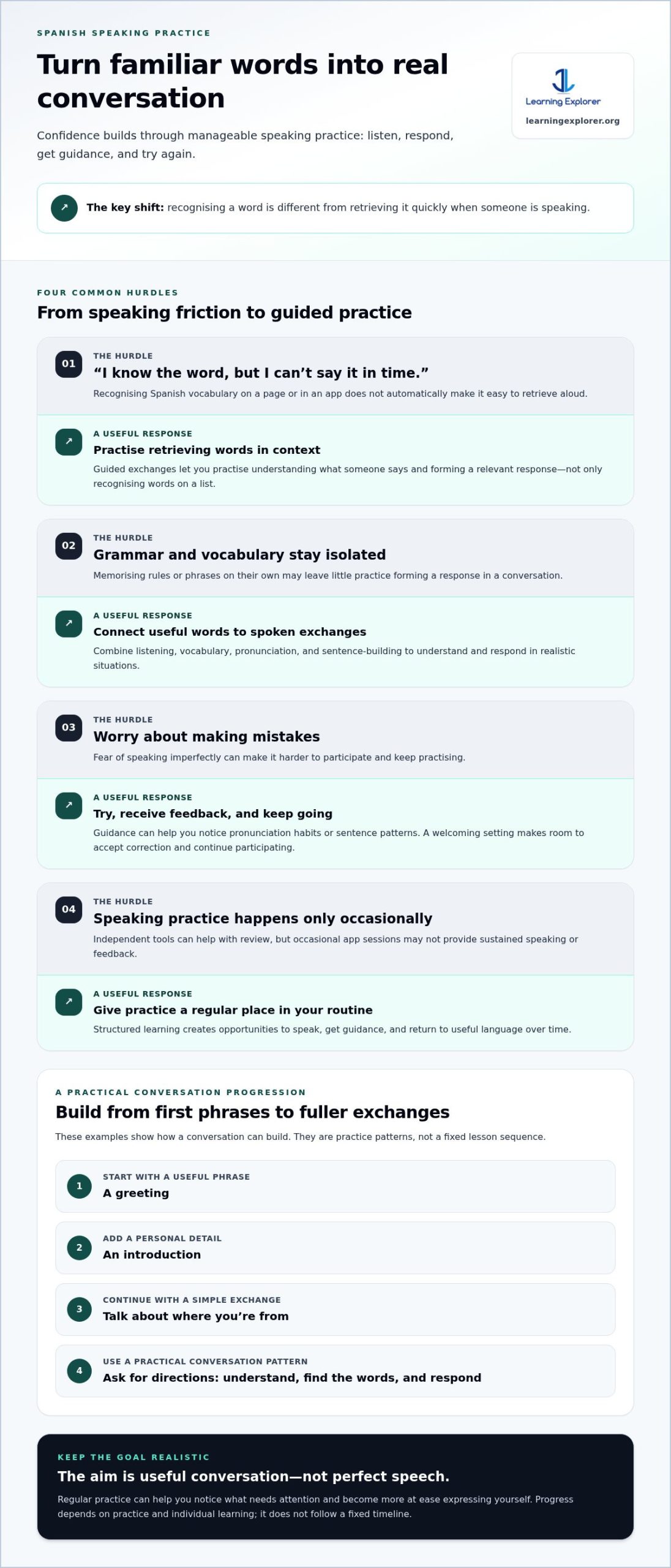
You may recognise Spanish words on a page or in an app, then hesitate when it’s time to say something aloud. Recognising a word and retrieving it quickly in conversation are different skills. A conversational Spanish course Singapore adults can attend regularly gives them a supportive setting to practise speaking, make mistakes and keep going.
Conversational learning focuses on useful spoken exchanges, guided practice and feedback. Rather than memorising rules in isolation, you practise understanding what someone says and forming a relevant response. For adult learners, a course can make speaking practice a regular part of study instead of something left to occasional app sessions.
For a glimpse of beginner Spanish instruction, watch this introductory lesson:
Regular practice can support different goals, from preparing for travel to exploring Spanish-language culture or becoming more comfortable with everyday conversations. It won’t make you fluent overnight. Instead, guided learning gives you a path to practise, notice what needs attention and gradually become more at ease expressing yourself. Teaching methods can vary; this overview of language education methods provides background on ways second-language instruction can be structured.
What does conversational Spanish practice involve?
Practice centres on understanding and responding in realistic exchanges. Listening helps you catch the meaning, vocabulary gives you words to use, pronunciation supports clearer speech, and sentence-building helps you put ideas together. Guidance and feedback help you work through uncertainty instead of relying only on memorised phrases. The goal is to build the foundations for conversation, not to speak perfectly.
Who benefits from a conversational Spanish course?
Complete beginners can build confidence step by step, while returning learners can refresh familiar language and get comfortable speaking again. Adults may be motivated by travel, personal interest or a desire to connect with Spanish-speaking cultures. General conversation is different from workplace or trade-specific Spanish, which uses more specialised vocabulary and situations. Identifying your main goal helps you focus your practice.
Independent tools can help you review between lessons, but using an app occasionally may leave little opportunity for sustained speaking and feedback. A structured course gives practice a regular place in your routine. Learning Explorer’s conversational Spanish classes are taught by certified native-speaker instructors who are also bilingual, supporting learners as they develop skills for everyday conversation.
How a structured Spanish course builds speaking confidence
Speaking confidence grows through manageable steps, not a sudden leap into complex conversation. A structured course can take you from useful words to short exchanges, then to supported practice and more independent speaking. This progression gives you time to see how phrases fit together before responding more spontaneously.
From first phrases to fuller conversations
Start with language that has an immediate purpose. A greeting can lead to an introduction, which can become a short exchange about where you’re from. Asking for directions adds another practical pattern: understand a question, identify the words you need and form a response. These examples show how conversations can build, rather than promise a particular lesson sequence.
When familiar words appear in different contexts, you practise retrieving them when they’re useful instead of only recognising them on a list. Short phrases can gradually become fuller exchanges. Progress depends on regular practice and individual learning, so there’s no need to measure it against a fixed timeline or promised proficiency level.
Why feedback and repetition matter
It’s easy to miss a pronunciation habit or repeat a sentence pattern that doesn’t quite express what you mean. Instructor feedback can help you notice those details and work on them. Learning Explorer’s conversational Spanish classes are taught by native-speaker instructors who are also bilingual, bringing language knowledge and bilingual support to guided learning.
Revisiting vocabulary gives you another chance to connect a word with its meaning and use. When a similar moment comes up in conversation, the word may be easier to retrieve. A welcoming classroom matters too: when learners aren’t expected to speak perfectly, they can try, accept correction and keep participating. That willingness is part of building confidence.
Consistent guided speaking practice turns isolated vocabulary into usable conversation. Structure gives you opportunities to practise, receive guidance and return to useful language over time, rather than leaving speaking to chance. Spanish is also an important world language, as Ohio University explains, making it a meaningful choice for personal learning and connection across cultures.
Explore Learning Explorer’s conversational Spanish course and consider which format best supports your speaking goals.
Group, private, or intensive Spanish classes: which format fits?
The right format depends on how you like to practise, the support you want and the time you can make for learning. A conversational Spanish course Singapore learners can maintain should suit their goals as well as their routine. Use the comparison below to find a starting point. Your preferred format is the one that helps you participate consistently.
| Format | Interaction | Personalisation | Flexibility and learning preference |
|---|---|---|---|
| Group | Practise listening and responding with other learners. | Shared learning experience with instructor guidance. | May suit learners who enjoy peer interaction and a classroom setting. |
| Private | Focus on instructor-learner conversation. | Attention is centred on one learner’s needs. | May suit learners who prefer focused, individual learning. |
| Intensive | Speaking practice within a more concentrated study routine. | Depends on the chosen learning arrangement. | May suit learners who prefer to dedicate a focused period to study. |
When group Spanish classes are a good fit
Group learning adds a social dimension to speaking practice. Taking turns gives you a chance to listen to different speakers, follow what they say and respond in Spanish. Shared practice can make participation feel less like being put on the spot: everyone is learning, and each exchange offers another opportunity to try. If you value learning with peers and prefer a classroom environment, a group course may be a natural fit.
Consider what helps you stay motivated. Do you find it easier to keep practising when you learn with others? Would hearing different attempts at an exchange help you stay engaged? If so, peer interaction may be an important factor in your decision. Learning Explorer offers group Spanish classes in Singapore for learners who want to study in a shared setting.
When private or intensive lessons may suit your goals
Private lessons focus attention on one learner, which may appeal if you prefer an individual learning experience. Intensive study suits learners who want a more concentrated routine. Neither format guarantees faster progress. Consider which structure you can engage with and maintain.
For general conversation, compare your preference for peer exchange, individual focus or concentrated study. If your aim is Spanish for workplace communication or trade, your needs are more specialised than everyday conversation. Read the separate Business Spanish for Trade article for guidance on that focus.
Plan Spanish speaking practice around life in Singapore
A study plan works best when it fits the week you already have. For adults balancing work, commuting and weekend plans, consistency matters more than an unrealistic routine. Start with a clear speaking goal, choose a format that supports it, set practical times to practise and review what feels easier and what still needs attention.
Set a realistic speaking goal before enrolling
Think about where you hope to use Spanish. Do you want to introduce yourself while travelling, ask a simple question or enjoy a short conversation connected to a cultural interest? Turn that purpose into a small milestone, such as introducing yourself or sustaining a brief exchange. These goals can help you decide whether group interaction, individual attention or concentrated study feels right. Use them to guide your learning choice, not as a promise of a fixed result.
Next, consider how a lesson could fit into your routine. If you work in the CBD, an in-person class at 10 Anson Road, Level 22, International Plaza, above Tanjong Pagar MRT, may be convenient to include around your workday. If commuting or weekend commitments shape your availability, factor them into the format and practice routine you choose. Explore the wider range of language courses in Singapore as you plan your learning.
Build a repeatable practice routine
Choose a small amount of time you can set aside regularly between structured lessons. Review words and phrases from class, say useful expressions aloud and jot down questions for your next session. A short review during a commute or a quiet moment at home can keep Spanish present without turning every spare minute into study time.
Use this simple planning sequence:
- Set a goal: Name a real situation where you’d like to speak Spanish.
- Choose a format: Match group, private or intensive learning to your preferred way of practising.
- Schedule practice: Pick repeatable moments that work around workdays, travel across Singapore or weekend plans.
- Review progress: Notice which phrases come more readily and identify questions for your next class.
A conversational Spanish course Singapore adults choose should support a routine they can maintain. Learning Explorer offers group, private and intensive formats, so you can choose a structure that aligns with your goal and availability. If you’re weighing one-to-one learning, the Spanish tutor guide offers another perspective on that option.
Ready to make speaking practice part of your routine? Explore conversational Spanish learning options and take the next step towards a plan that fits your life in Singapore.
Start learning conversational Spanish with Learning Explorer
Choosing a course becomes clearer when you connect three things: what you want to say in Spanish, how you prefer to practise and what kind of study routine fits your life. You might want to manage simple conversations while travelling, explore Spanish-language culture or build a foundation for continued learning. Let that goal guide your choice. You don’t need to know everything before you begin.
What learners can expect from Learning Explorer
Learning Explorer is a Singapore language-learning provider offering structured conversational Spanish courses. Choose a group, private or intensive format according to whether you value practising with others, focused individual learning or a more concentrated routine. Classes are taught by certified native-speaker instructors who are also bilingual.
The learning format can help you put your speaking goal into practice. Group learning offers peer interaction, while private lessons focus attention on one learner. Intensive study offers a more concentrated approach. If one-to-one tuition feels like the best fit, see the Spanish tutor Singapore article for a closer look at private learning.
If you’re considering a conversational Spanish course Singapore beginners can join, start by thinking of a situation where you’d like to speak. Choose a format and routine that feel manageable, then build your skills through steady practice. You don’t need perfect Spanish to begin. You need a reason to start and a willingness to keep practising.
Take the next step toward speaking Spanish
Explore Learning Explorer’s conversational Spanish course and consider which format aligns with your goals and preferred way of learning. A practical first step is to write down one conversation you hope to manage, such as introducing yourself or asking a simple question. Use that goal to focus your learning and make practice more purposeful.
If you’re also exploring another language, Learning Explorer offers courses in English, Mandarin, Japanese, Korean, Thai and Vietnamese. For now, keep your Spanish goal in view and choose a learning path that fits everyday life in Singapore.
Take your next step towards speaking Spanish
Speaking confidence grows through guided, regular practice that suits your goals. Whether you’re starting from scratch or returning to Spanish, choose a manageable format. Learning Explorer offers private, group and intensive conversational Spanish courses in Singapore, taught by certified native-speaker instructors who are also bilingual.
Keep your next step simple: set a speaking goal, decide how you prefer to learn and make room for regular practice. For learners in the CBD, the training centre is above Tanjong Pagar MRT, making it easy to fit an in-person class around a workday.
If you’re ready to move from recognising Spanish words to using them in conversation, explore conversational Spanish courses with Learning Explorer. A conversational Spanish course Singapore learners can fit into everyday life gives you a practical way to work towards a clear goal. Begin at your own pace, keep practising and let each conversation build your confidence.
Frequently Asked Questions
Is a conversational Spanish course suitable for complete beginners?
Yes. Complete beginners can start with a conversational Spanish course, even without prior knowledge of the language. Begin with a simple goal, such as introducing yourself, and build through useful words, short exchanges and supported speaking practice. A structured class gives you guidance as you learn, so you can practise forming sentences and expressing ideas without expecting yourself to speak perfectly from the start.
How long does it take to speak basic Spanish through a course?
There’s no fixed timeline for speaking basic Spanish. Progress depends on your starting point, learning pace and how regularly you practise between lessons. Define what “basic” means for you: greeting someone, introducing yourself or managing a short everyday exchange. A clear goal helps you notice progress without comparing yourself with someone else or relying on a guaranteed timeframe. Regular review can reinforce what you practise in class.
Can I learn conversational Spanish in a group class?
Yes. Group classes provide a setting to practise conversational Spanish with an instructor and other learners. Taking turns gives you a chance to practise listening as well as responding, while shared learning creates opportunities to speak with peers. This format may suit you if you enjoy a classroom environment and find group interaction encouraging. Learning Explorer offers group Spanish classes for learners building practical speaking skills in Singapore.
What is the difference between private and group Spanish lessons?
Private lessons focus attention on one learner, while group lessons create opportunities to interact with peers. Consider how you prefer to practise: one-to-one learning may suit you if individual attention feels more comfortable, while a group offers varied listening and speaking exchanges. Learning Explorer also offers intensive study for learners who prefer a concentrated routine. Choose the format that best matches your goals, preferences and schedule.
How much does a conversational Spanish course in Singapore cost?
The cost of a conversational Spanish course in Singapore varies according to the language, proficiency level and course duration. Fees apply to structured group and individual language programmes, and registration and learning materials may also involve fees. Compare the course format, level and duration with your budget and study plans when reviewing the available options.
Do conversational Spanish lessons teach grammar as well as speaking?
Conversational learning puts spoken communication at the centre, while grammar patterns help you form clear, meaningful sentences. Vocabulary, pronunciation, listening and sentence-building all support conversation. Rather than treating grammar as an isolated goal, learners can connect language structure to expressing an idea and understanding a response. The balance between explicit grammar instruction and speaking practice can vary by course, but communication remains the focus of conversational learning.
Where is Learning Explorer’s Spanish training centre in Singapore?
Learning Explorer’s training centre is at 10 Anson Road, Level 22, International Plaza, Singapore 079903, directly above Tanjong Pagar MRT. Its Central Business District location can be convenient for people working or studying nearby, or those planning an in-person class around time in the area. Learning Explorer offers conversational Spanish in private, group and intensive formats, giving learners different ways to organise their studies in Singapore.