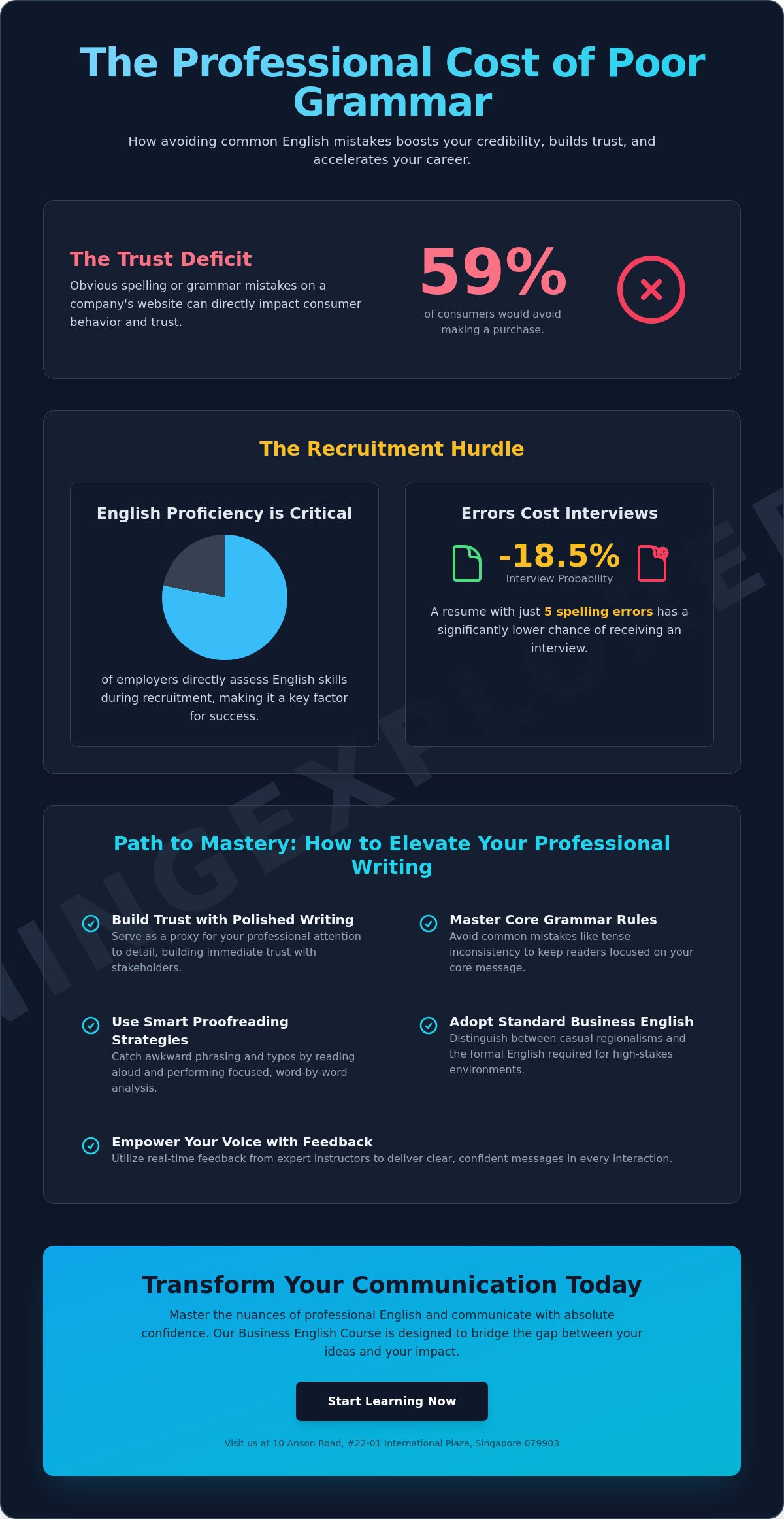
Did you know that 59% of consumers would avoid making a purchase from a company with obvious grammar or spelling mistakes on its website? In the fast-paced CBD workplace, a single typo can be the difference between closing a deal and losing a client’s trust. You probably already know how it feels to spot a misplaced comma just seconds after hitting send. It’s a common struggle that many professionals face while trying to balance complex tenses and formal tones. This guide will show you exactly how to avoid common english grammar mistakes to boost your professional credibility and help you communicate with absolute confidence.
Research from 2026 shows that 78% of employers now directly assess English proficiency during recruitment. In fact, a resume with just five spelling errors carries an 18.5% lower probability of receiving an interview compared to an error-free document. We’ve curated this guide to help you master sentence structures and eliminate the noise of the open internet. You’ll learn to leverage modern tools and refine your business communication for maximum impact. Whether you visit our training center at 10 Anson Road, level 22, International Plaza, Singapore 079903, right above Tanjong Pagar MRT, or study remotely, we’re here to simplify your path to mastery. Discover how to transform your daily writing into professional lessons your students and colleagues will love.
Key Takeaways
- Discover how polished writing serves as a proxy for your professional attention to detail and builds immediate trust with stakeholders.
- Master techniques to avoid common english grammar mistakes like tense inconsistency and subject-verb agreement to keep your readers focused on your message.
- Simplify your editing process with smart proofreading strategies that catch awkward phrasing through auditory cues and focused word-by-word analysis.
- Streamline your communication by distinguishing between casual regionalisms and the standard English required for high-stakes business environments.
- Empower your voice with real-time feedback from expert instructors who help you deliver clear, confident messages in every professional interaction.
Why Avoiding Grammar Mistakes Matters for Your Career
In the competitive landscape of Singapore’s CBD, your writing serves as a silent ambassador for your professional brand. When you successfully avoid common english grammar mistakes, you do more than just follow academic rules; you signal to clients and peers that you value precision and excellence. Many industry leaders view grammatical accuracy as a direct proxy for your overall attention to detail. If an internal report or a client-facing proposal contains basic errors, stakeholders may question if your technical data or strategic insights are equally flawed. This creates a significant emotional cost, often manifesting as “grammar anxiety” during high-stakes presentations or board meetings. It’s hard to lead with confidence when you’re worried about a misplaced verb.
Mastering these skills to avoid common english grammar mistakes allows you to communicate with absolute confidence, ensuring your message lands with the intended impact. A 2024 study by Global Lingo found that 59% of people would avoid doing business with a company that displays obvious spelling or grammar errors. In a corporate setting, this lack of trust can lead to missed promotions or stalled projects. Polished English sets you apart as a visionary leader who understands that clarity is a form of respect for your audience’s time. It’s the difference between being heard and being ignored.
To better understand how these small errors impact your professional image, watch this helpful video:
The Impact on First Impressions
Your digital presence, from your LinkedIn bio to your CV, is often your first point of contact with a potential employer. A single error in these documents can be incredibly costly, as 78% of employers in 2026 now directly assess English proficiency during the recruitment process. There’s an undeniable link between grammatical accuracy and perceived authority. When your writing is clean and structured, you project a sense of mastery that commands respect before you even speak. Clear grammar reduces administrative friction by ensuring your instructions are understood immediately, preventing the noise and chaos that often result from ambiguous communication.
Credibility in Corporate Communication
Effective email communication is the heartbeat of any successful organization. Poor syntax or confusing tenses can lead to your core message getting lost, which often results in expensive project delays. Professionalism in reports and documentation is non-negotiable for anyone looking to climb the corporate ladder. Understanding common English usage misconceptions helps you navigate the complexities of the language without falling into common traps that plague even native speakers. Our Business English Course is specifically designed to help you bridge these gaps. We focus on the grit of daily professional life, providing the spark for better classroom and workplace experiences. Join us at our training center located at 10 Anson Road, level 22, International Plaza, Singapore 079903, right above Tanjong Pagar MRT, to refine your skills and deliver results your team will respect.
The Top 5 High-Frequency Grammar Mistakes to Watch For
While English grammar contains hundreds of nuanced rules, focusing on the most frequent errors can radically transform your professional image. You don’t need to be a linguist to write well; you simply need to avoid common english grammar mistakes that distract your reader from your core message. In a high-stakes environment, these small slips act as “noise” that can drown out your best ideas. By mastering a few key areas, you’ll ensure your communication remains seamless and authoritative.
Subject-verb agreement is the most persistent hurdle in corporate documentation. If your subject is singular, your verb must be singular. For example, “The team plans the event” is correct, while “The team plan the event” is not. Homophone hazards are equally dangerous. Mixing up “its” and “it’s” or “their,” “there,” and “they’re” is a common trap. Remember that “it’s” is always a contraction for “it is,” while “its” shows possession. These errors are often flagged as common writing errors in academic and professional circles alike, signaling a lack of careful proofreading.
Mastering Verbs and Tenses
Consistency is vital when recounting business events. Use the simple past tense for actions that happened at a specific, finished time, such as “We finalized the budget last Tuesday.” Irregular verbs often cause confusion; remember that the past tense of “lead” is “led,” and “forecast” usually remains “forecast” in a professional context. To describe an action that started in the past but continues now, use the present perfect tense. The rule is simple: use “have” or “has” plus the past participle to link the past to the present moment without specifying a exact date.
Misplaced modifiers can accidentally change your entire sentence’s meaning. If you write, “Only the manager signed the document,” it means no one else signed it. If you write, “The manager only signed the document,” it suggests they did nothing else but sign it. Clear placement of these descriptors ensures your logic remains airtight and your instructions are never misunderstood.
Punctuation and Sentence Structure
Run-on sentences are the primary enemy of clarity in executive summaries. They force your reader to work too hard to find the main point. Similarly, comma splices occur when you join two independent thoughts with just a comma. You should use a semicolon or a period to separate these distinct ideas instead. You can overcome your fear of speaking English and writing by simplifying your sentence structure. Short, punchy sentences carry more weight and reduce the chance of grammatical collapse.
If you’re looking to refine these skills in a supportive environment, our team at 10 Anson Road, level 22, International Plaza, Singapore 079903, can help. Located right above Tanjong Pagar MRT, we offer a Business English Course designed to help you communicate with absolute confidence. Stop searching for the right words and start finding your professional voice with us today.
Smart Proofreading Strategies Beyond Spell Check
Digital assistants in 2026 are more sophisticated than ever, yet they often fail to grasp the specific context of your professional message. While tools like Grammarly or LanguageTool catch obvious typos, they don’t always understand the nuance of a high-stakes business proposal. A 2026 report found that 81% of employers believe AI adoption has actually increased the need for strong English skills, as professionals must now evaluate and refine AI-generated text. To truly avoid common english grammar mistakes, you need a toolkit of active strategies that engage your brain in new ways.
One of the most effective methods is the “Read Aloud” technique. When you read your text out loud, your ears often catch clunky syntax or missing words that your eyes skipped over during the writing process. If a sentence feels like a struggle to speak, it’ll likely be a struggle for your client to read. Another powerful strategy is reading your document backwards, starting from the last sentence and moving to the first. This disrupts your brain’s tendency to fill in gaps based on expectation, forcing you to see individual words and punctuation marks in isolation. It’s a simple way to find the “noise” and “chaos” that digital tools might overlook.
Time is your best ally in the proofreading process. The 24-hour rule suggests that you should never edit your work immediately after finishing a draft. When your writing is fresh, your brain remembers what you meant to say rather than what is actually on the page. By stepping away for a full day, you return with a “Trusted eye” and a clear mind, making it much easier to spot inconsistencies in tone or tense. This gap allows you to transition from a creator to a critical editor, ensuring your final delivery meets the standards of curated excellence your career demands.
Active Proofreading Habits
Success in professional writing comes from tracking your progress. Start a personal “mistake log” to record the specific errors you repeat most often. Whether it’s a struggle with subject-verb agreement or a tendency to use comma splices, seeing these patterns helps you stay alert. You should also consult authoritative resources like the University of Wisconsin-Madison’s guide to common errors to deepen your understanding of complex rules. Before hitting send on any important email, run through a quick checklist: verify the recipient’s name, check your attachments, and scan specifically for your most frequent errors. Focusing on just one type of mistake at a time prevents you from feeling overwhelmed.
Leveraging Peer Feedback
Constructive feedback is the spark that ignites professional growth. In a corporate setting, having a colleague review your work can catch subtle tone shifts that might alienate a stakeholder. Accepting this feedback with humility is a hallmark of a knowledgeable guide. Our group classes at Learning Explorer provide a supportive feedback loop where you can practice these skills in real-time. By interacting with expert instructors and peers, you’ll streamline your learning and build the confidence needed to deliver lessons your students or colleagues will love. This collaborative approach simplifies the “grit” of daily communication, helping you move from searching for the right words to finding them with ease.
Navigating English Grammar in the Singapore Context
Living in a vibrant multicultural hub like Singapore means we often switch between different ways of speaking. While Singlish is a powerful tool for social bonding and community identity, its unique structures can bleed into your professional writing and diminish your authority. To avoid common english grammar mistakes in the workplace, you must recognize where regional colloquial habits interfere with standard English. Standardizing your voice isn’t about losing your identity; it’s about ensuring your message carries the necessary weight in a global business environment where 78% of employers now directly assess English proficiency during recruitment.
One recurring habit in local speech is reduplication, such as saying “can-can” or “wait-wait” for emphasis. While these phrases add warmth to casual conversation, they appear unprofessional in formal reports or board presentations. Similarly, the “discuss about” error is a frequent pitfall. In standard English, “discuss” is a transitive verb that doesn’t require a preposition. You should simply say, “We will discuss the project,” rather than “discuss about the project.” These small shifts streamline your communication and remove the “noise” that can confuse international stakeholders or clients.
Article and Preposition Mastery
Articles like “a,” “an,” and “the” are often dropped in casual speech, but they’re essential for clear sentence structure. A common rule to remember: do not use “the” for general plural concepts. For example, say “Teachers value student engagement,” not “The teachers value student engagement,” unless you’re referring to a specific, previously mentioned group. Prepositions also require careful attention to detail to ensure your logic remains airtight. Use “at” for a specific point or address, like “meet at the office,” and use “in” for an enclosed space or a larger geographic area, such as “working in Singapore.”
Standardizing Your Professional Voice
Transitioning from colloquial speech to formal writing requires a conscious shift in mindset. Context determines your grammatical choices, and what works at a hawker center won’t always land well in a corporate boardroom. As of 2026, Singapore’s bilingual policy remains a cornerstone of the professional landscape, with the Speak Good English Movement continuing to promote internationally understood English. This is particularly vital because 81% of employers believe strong English is now a baseline skill for evaluating AI-generated content. Finding a Language School Singapore that understands these local nuances is the first step toward mastery.
Our curriculum is built by educators who understand the “grit” of daily life in the CBD and seek to provide the “spark” for better workplace experiences. We help you move from searching for the right words to finding a professional voice that commands respect. Discover how our English course for adults can empower your career and help you deliver lessons your colleagues will respect.
Transform Your Communication with Learning Explorer
Mastering the nuances of English isn’t just about memorizing rules; it’s about building a toolkit that empowers your voice in every professional interaction. While digital assistants provide a basic safety net, they can’t offer the deep, contextual understanding required for high-stakes leadership. At Learning Explorer, we position ourselves as your reliable educational ally. Our expert native-speaker instructors provide real-time corrections during active, engaging sessions. This immediate feedback loop is the most efficient way to avoid common english grammar mistakes and build lasting confidence. We understand the daily grit of teaching and corporate life, and we’re here to provide the spark for a better classroom and workplace experience.
Our curriculum moves beyond surface-level fixes. We focus on the underlying logic of the language, helping you transition from searching for rules to finding true fluency. By utilizing curated excellence in our materials, we filter out the noise and chaos of the open internet. You’ll work with learning objects that are specifically designed for the professional landscape of 2026. This approach doesn’t just improve your writing; it streamlines your entire communication process, saving you time and reducing administrative stress. We deliver lessons your students and peers will love because they’re rooted in clarity and professional impact.
Our Approach to Grammar Mastery
We simplify complex linguistics through structured modules that are easy to scan and master. Our small group sizes ensure that you aren’t just another face in a crowded room. You receive personalized attention that addresses your unique challenges, whether you’re struggling with tense consistency or preposition pitfalls. This tailored support transforms the learning process from a chore into a visionary journey. You’ll discover how to plan and deliver messages that command respect, all within a supportive, teacher-first environment that celebrates your progress.
Join Us Right Above Tanjong Pagar MRT
Located at 10 Anson Road, level 22, International Plaza, Singapore 079903, our center is designed for the modern professional. We’re situated right above Tanjong Pagar MRT, making it easy to fit a session into your busy schedule. We offer flexible timing for our Conversational English Course and Business English Course to respect your limited time. Our mission-driven atmosphere is both authoritative and humble, ensuring you feel comfortable as you refine your skills. Don’t let grammar anxiety hold you back from your next promotion or project. Book your Conversational English trial class today! and start your journey toward seamless professional communication.
Elevate Your Professional Voice Today
Mastering grammar is the spark that transforms your daily communication from functional to visionary. You’ve discovered how a single error can impact your authority, especially since 78% of employers in 2026 now directly assess English proficiency during recruitment. By applying active proofreading habits and understanding the nuances of the Singaporean workplace, you can finally avoid common english grammar mistakes with absolute confidence. This isn’t just about memorizing rules; it’s about delivering messages that your colleagues and stakeholders will truly respect.
Our team at Learning Explorer is ready to serve as your reliable educational ally. We offer curated excellence through a curriculum designed for the grit of the modern CBD. With native-speaker teachers and a supportive environment, we help you move from searching for words to finding your unique fluency. Our training center is conveniently located right above Tanjong Pagar MRT to suit your busy professional schedule. Master your English with our expert-led courses in Singapore and start communicating with the clarity you deserve. Your journey toward professional mastery begins now.
Frequently Asked Questions
Is it “who” or “whom” in a professional email?
Use “who” when referring to the subject of a sentence and “whom” when referring to the object. A simple trick is to see if the answer would be “he” (who) or “him” (whom). While modern business English is becoming more casual, using “whom” after prepositions, such as in “To whom it may concern,” still projects a high level of authority. This small distinction helps you avoid common english grammar mistakes that might signal a lack of attention to detail.
How can I tell the difference between “affect” and “effect”?
Remember that “affect” is almost always a verb meaning to influence, while “effect” is typically a noun meaning the result. You can use the acronym RAVEN: Remember Affect Verb, Effect Noun. For example, you might say, “The new policy will affect our workflow,” or “The effect was immediate.” Mastering this pair is essential for clear business documentation and maintaining your professional credibility in the competitive Singaporean workplace.
Why does my grammar check miss so many mistakes?
Digital tools often fail to grasp the specific context or professional tone of your message. While software catches simple typos, it doesn’t understand the nuance required for a high-stakes proposal. A 2026 report found that 81% of employers believe AI tools have actually increased the need for human proficiency. You still need a knowledgeable guide to evaluate and refine AI-generated text to ensure it meets the standards of curated excellence your career demands.
What are the most common grammar mistakes in Singapore?
Subject-verb agreement and preposition misuse are the most frequent hurdles found in the local professional landscape. Many professionals also struggle with colloquial interference, such as saying “discuss about” instead of the standard “discuss.” Recognizing these regional patterns allows you to streamline your communication and remove the noise that can confuse international stakeholders. This awareness is a vital step toward achieving error-free professional communication in the CBD.
Can I improve my grammar as an adult learner?
Yes, adults can make significant progress by focusing on the underlying logic of the language rather than just memorizing rules. Our curriculum is specifically designed for the grit of daily professional life, providing the spark needed for better workplace experiences. By using structured modules and small group sessions, you can empower your voice and move from searching for rules to finding true fluency with confidence and ease.
How long does it take to see progress in an English course?
Most students notice a measurable improvement in their writing confidence and accuracy within 8 to 12 weeks of consistent study. This timeframe allows you to internalize new sentence structures and actively apply them to your daily emails or presentations. Real-time correction from native-speaker instructors accelerates this transformation, helping you avoid common english grammar mistakes much faster than self-study or using generic online resources alone.
What is the best way to practice grammar daily?
Integrate active proofreading into your existing routine by reading your outgoing emails aloud before hitting send. This simple habit engages your ears to catch clunky phrasing or missing words that your eyes might skip. You should also keep a personal mistake log to track and review recurring errors. Consistent, bite-sized practice helps simplify complex linguistics and ensures your professional communication remains impactful and seamless every single day.
Is there a difference between British and American grammar rules at work?
The primary differences involve spelling and how collective nouns are treated in a sentence. For instance, British English often treats “the team” as plural, while American English treats it as singular. In Singapore, British standards are traditionally favored in formal business contexts. Consistency is more important than the specific style you choose; pick one and stick to it to maintain a professional and coherent voice.