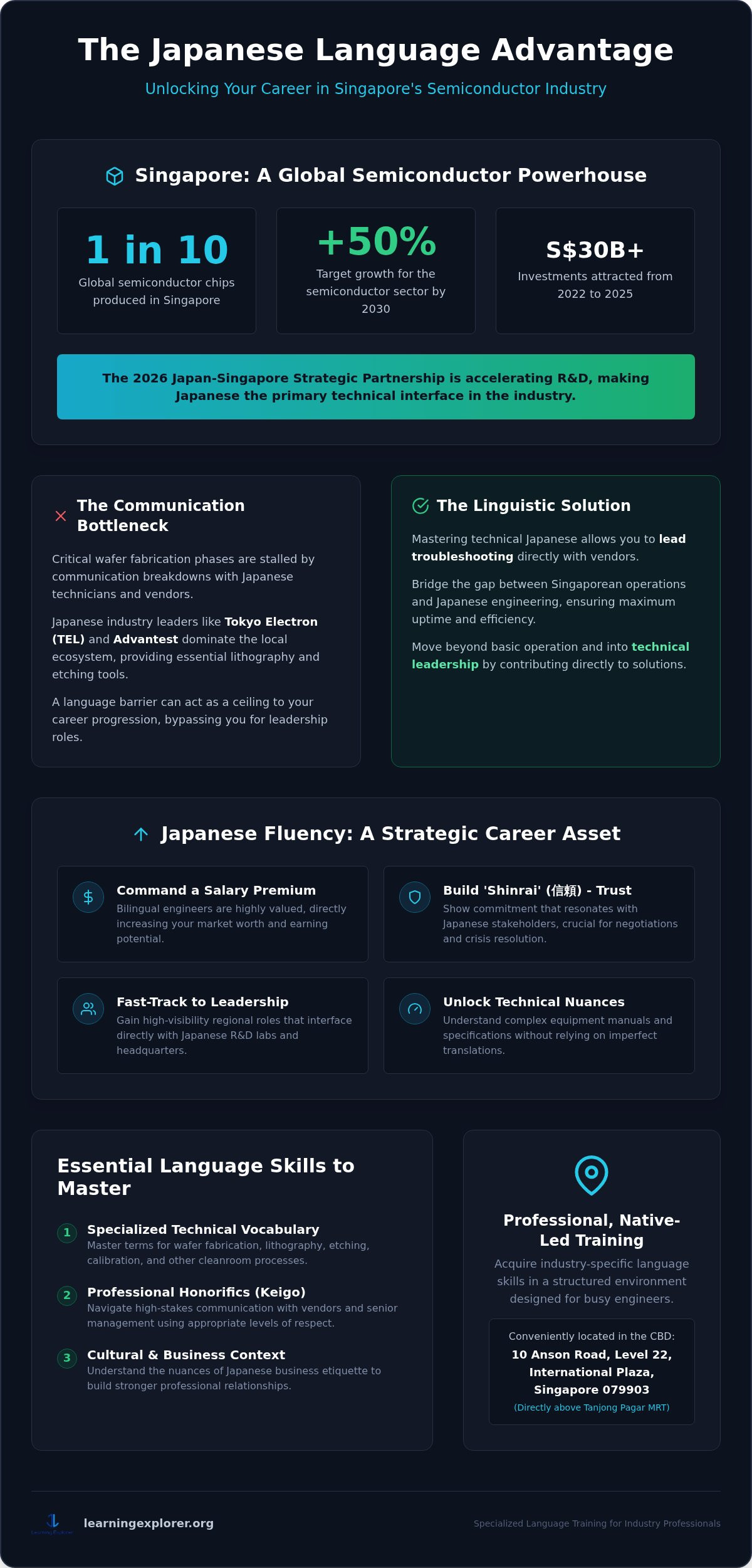
Did you know that Singapore now produces one out of every ten semiconductor chips globally? With the 2026 Strategic Partnership between Japan and Singapore accelerating R&D in next-generation technologies, the ability to communicate with Japanese engineers has become the industry’s most valuable “soft” skill. It’s frustrating to face communication breakdowns during critical wafer fabrication phases or feel bypassed for regional leadership roles because you lack the language skills to bridge the gap with Japanese vendors. You’re an expert in your field, but the language barrier often acts as a ceiling to your career progression.
We understand that your time is your most precious resource, and general language courses often miss the technical nuances required in a cleanroom. This guide shows you how mastering specialized japanese for semiconductor industry professionals sg can transform your career trajectory, helping you secure high-impact roles and significantly increase your salary potential. We’ll explore why Japanese fluency is the ultimate 2026 career catalyst and how you can acquire these technical language skills right in the heart of the CBD at 10 Anson Road, level 22, International Plaza, Singapore 079903, located directly above Tanjong Pagar MRT.
Key Takeaways
- Understand how the 2026 strategic partnership between Singapore and Japan is creating a massive demand for bilingual engineers in the electronics and precision engineering sectors.
- Learn how mastering japanese for semiconductor industry professionals sg acts as a career catalyst, unlocking significant salary premiums and regional leadership roles within top-tier firms.
- Discover the essential technical Japanese vocabulary and honorifics needed to navigate high-stakes communication in wafer fabrication and R&D environments.
- Explore why professional, native-led training in the CBD provides the specific linguistic nuances and cultural context that generic language apps cannot replicate.
- Find out how to integrate efficient language modules into a busy engineering schedule at a convenient training location situated directly above Tanjong Pagar MRT.
The 2026 Singapore Semiconductor Landscape and the Japanese Connection
Singapore’s ambition is clear. By 2030, the nation aims to grow its semiconductor sector by 50%. This surge isn’t just about volume; it’s about complexity. As a cornerstone of Singapore’s highly developed market economy, the electronics industry now accounts for a massive portion of manufacturing output. In 2026, we’re seeing a decisive shift toward high-end R&D and advanced packaging. This evolution requires a workforce that can do more than follow a manual. It demands professionals who can collaborate directly with the architects of the technology.
For those seeking japanese for semiconductor industry professionals sg, 2026 represents a unique window of opportunity. As more Japanese tech giants establish regional hubs here, the language of the fab is increasingly becoming Japanese. Understanding the technical nuances of the equipment you use every day can be the difference between a stalled project and a promotion.
To better understand the global context of Japan’s influence on the chip industry, watch this helpful video:
Singapore as a Global Chip Hub
The momentum is backed by over S$30 billion in investments attracted between 2022 and 2025. JTC industrial lands are now hosting some of the world’s most advanced high-precision fabs. These facilities aren’t just assembly lines; they’re sophisticated ecosystems where Singapore’s stability meets Japanese innovation. In March 2026, the two nations established a Strategic Partnership to focus on next-generation semiconductor technologies. This government-level commitment ensures that Japanese firms will remain the primary drivers of growth in the local circuit. Working in this hub means you’re at the center of a global supply chain where Japanese is the primary technical interface.
The Critical Role of Japanese Equipment Vendors
You can’t run a world-class fab without Japanese hardware. Industry leaders like Tokyo Electron (TEL), Advantest, and Screen Holdings dominate the local ecosystem, providing the lithography and etching tools necessary for high-volume manufacturing. When equipment fails or requires calibration, the communication gap between local engineers and Japanese technicians can become a bottleneck.
Mastering japanese for semiconductor industry professionals sg solves this. It allows you to lead the troubleshooting process and ensure maximum uptime. By speaking the language of the vendor, you move beyond basic operation and into technical leadership. You aren’t just waiting for instructions; you’re actively contributing to the solution. This ability to bridge the gap between Singaporean operations and Japanese engineering is what defines a top-tier professional in 2026.
Why Japanese for Semiconductor Industry Professionals in SG is a Strategic Asset
Investing in japanese for semiconductor industry professionals sg is one of the most direct ways to increase your market value. In an industry where precision is everything, the ability to communicate fluently with Japanese headquarters or equipment manufacturers isn’t just a “nice to have” skill. It’s a strategic asset that commands a salary premium. Bilingual engineers often find themselves fast-tracked for regional leadership roles, moving from purely local operations to high-visibility positions that interface directly with Japanese R&D labs.
Beyond the financial incentives, language proficiency builds Shinrai (trust). In the high-pressure environment of Singapore’s semiconductor landscape, technical expertise alone isn’t always enough to secure a deal or resolve a supply chain crisis. Being able to negotiate in Japanese shows a level of commitment that resonates deeply with stakeholders. This cultural alignment often leads to more favorable terms and stronger long-term partnerships that benefit the entire organization.
Navigating the Supply Chain Communication Gap
Direct communication with Japanese suppliers can significantly reduce lead times. When you can discuss technical specifications and logistics without waiting for a translator, you eliminate the risk of costly misunderstandings. This is particularly vital when applying the concept of Genba, the actual place where the work happens. On the fab floor, immediate clarity between Singaporean engineers and Japanese field technicians ensures that equipment uptime is maximized and manufacturing errors are minimized. You become the bridge that keeps the production line moving.
Unlocking High-Level Technical Knowledge
Much of the cutting-edge research in wafer fabrication and material science originates in Japan. Often, the most detailed technical manuals and R&D papers are published in Japanese months, or even years, before they are translated into English. Professionals who master the language gain a first-mover advantage, accessing “hidden” knowledge that can be applied to local joint ventures. This facilitates a smoother technology transfer, positioning you as an indispensable link in the global innovation chain. If you’re ready to bridge this gap, a Business Japanese Course tailored for the technical sector can provide the specific linguistic tools you need to excel.
Essential Language Skills for the Semiconductor Workplace
Mastering japanese for semiconductor industry professionals sg involves more than just basic conversation. It requires a deep dive into “Technical Japanese,” the specific dialect used within cleanrooms and high-tech fabs. This includes understanding how to describe wafer defects, etching rates, and lithography precision. You aren’t just learning words; you’re learning the technical interface of your equipment. For an engineer, this fluency means you can read a sensor’s error log in its native language or explain a complex yield issue without relying on a third-party translator. This precision ensures that your expertise is never lost in translation during critical production phases.
Mastering Keigo in Technical Negotiations
In the semiconductor world, hierarchy matters. Using the correct level of honorifics is crucial when presenting a project update to a Japanese director or lead engineer. You’ll need to distinguish between Sonkeigo (respectful language for others) and Kenjougo (humble language for yourself) during project meetings. Many Singaporean professionals make the mistake of using overly casual Japanese in formal boardrooms, which can inadvertently signal a lack of professionalism. Specialized keigo and japanese honorifics training singapore provides the foundation you need to show respect and build confidence during high-stakes technical negotiations. By mastering these nuances, you align yourself with the corporate culture of your Japanese partners, fostering deeper professional bonds.
Technical Vocabulary: Beyond the Data Sheet
Beyond standard grammar, you need industry-specific Kanji for manufacturing and quality control. Terms like Seizou (manufacturing) or Hoshu (maintenance) appear constantly in technical manuals and internal memos. Interestingly, much of the tech world uses “Katana-go” (loanwords) for specific components. Words for wafers or cleanrooms are essential for daily fab operations. Learning these allows you to discuss equipment installation or maintenance schedules directly with field engineers, ensuring nothing gets missed. It’s about having the right phrases for equipment installation and maintenance discussions that happen on the floor, not just in the boardroom.
Effective reporting is another pillar of success. Japanese corporate standards for emails and reports are highly structured. Knowing how to open an email with the appropriate professional acknowledgment can set the tone for a productive collaboration. By adopting these standards, your reports will resonate more effectively with headquarters. This proves that you aren’t just a technical expert, but a culturally fluent partner. This level of detail is what distinguishes a senior professional in the 2026 market. Investing in specialized japanese for semiconductor industry professionals sg ensures your contributions are recognized at the highest levels of the organization. For professionals who also represent their firm at industry events, mastering japanese for attending trade shows in japan is equally critical, as exhibitions like Manufacturing World Osaka are prime venues for building the vendor relationships that drive fab-floor success.
Overcoming Learning Barriers for Busy Engineers
Many engineers believe their schedule is too packed for language study. The constant cycle of fab shifts and maintenance windows makes traditional courses seem impossible. However, the idea that you’re “too busy” is often a myth that holds your career back. Integrating japanese for semiconductor industry professionals sg into a demanding schedule is about strategy, not just finding more hours. Micro-learning techniques allow you to absorb technical vocabulary during short breaks, turning downtime into a competitive advantage. Don’t let the cognitive load of your daily tasks stop you from acquiring a skill that simplifies your future workload.
Generic apps won’t help you troubleshoot a lithography error or navigate a high-stakes boardroom discussion. You need the expertise of native-speaker instructors who understand the specific business contexts of the electronics sector. These mentors provide the cultural bridge that software simply can’t replicate. If you work in the city, evening japanese lessons near raffles place offer a structured way to build these skills without sacrificing your work-life balance. It’s about finding a rhythm that fits your professional life.
Balancing Fab Shifts with Language Learning
Fab life is unpredictable. Between urgent equipment repairs and tight project deadlines, flexibility is essential. You need a learning partner that understands these pressures. Consider these strategies for creating a sustainable study plan:
- Opt for flexible modules that allow you to work around maintenance windows.
- Use private 1-on-1 coaching to focus exclusively on department-specific jargon.
- Set realistic weekly goals that respect your shift rotation to avoid burnout.
This targeted approach ensures you reach technical fluency quickly. By focusing on the terminology relevant to your specific role, whether in wafer fabrication or R&D, you make every minute of study count toward your career progression.
Structured Learning in the Singapore CBD
Location is a major factor in maintaining consistency. Our training center is located at 10 Anson Road, level 22, International Plaza, Singapore 079903, situated directly above Tanjong Pagar MRT. This makes it easy to transition from the office to the classroom. When comparing language schools in singapore cbd, look for programs that prioritize professional networking. Sitting in a classroom with other semiconductor professionals allows you to share industry insights and practice active communication. You’ll move from passive listening to confidently leading technical discussions with Japanese partners. Ready to take the next step? Enroll in a Conversational Japanese Course today and start your journey toward professional fluency.
Specialised Japanese Training at Learning Explorer Singapore
Learning Explorer understands that for engineers and managers, language is more than a hobby; it’s a tool for career acceleration. Our approach to japanese for semiconductor industry professionals sg is built on the reality of the 2026 market. We don’t just teach grammar; we provide the linguistic framework needed to manage complex Japanese vendor relationships and lead R&D projects. Our bilingual native instructors act as cultural consultants, helping you decode the subtleties of Japanese work culture that are often missed in standard textbooks. They guide you through the transition from the labor of seeking information to the satisfaction of direct discovery.
We offer customised corporate training solutions specifically designed for the semiconductor sector. Whether your team needs to improve communication with Tokyo headquarters or streamline interactions with on-site field technicians, we tailor our modules to your firm’s specific operational requirements. This targeted focus reduces the administrative burden on HR departments while providing engineers with immediately applicable skills. We position ourselves as a reliable ally, helping you navigate the taxing nature of daily professional tasks with greater ease and confidence.
Customised Curriculum for Technical Professionals
Our curriculum is designed to move you efficiently from basic conversational skills to high-level business proficiency. We focus on real-world semiconductor scenarios that you encounter daily. These include:
- Conducting thorough vendor audits with Japanese equipment manufacturers.
- Drafting precise technical reports for global headquarters.
- Participating in high-stakes negotiations regarding supply chain logistics.
By keeping our group sizes small, we ensure that every professional receives maximum speaking practice. This active engagement is the creative catalyst needed to transition from understanding the language to using it with authority in a high-pressure fab environment. Our instructors use industry-standard terminology to ensure your learning is always relevant to the fab floor.
Convenient CBD Learning at International Plaza
We respect your limited time. Our training center is strategically located at 10 Anson Road, level 22, International Plaza, Singapore 079903, situated directly above Tanjong Pagar MRT. This central location minimises travel time, allowing you to attend sessions immediately after your shift or during a gap in your schedule. Our modern facilities are designed specifically for adult learners, providing a professional atmosphere that encourages networking and growth. It’s a space built by practitioners for practitioners, ensuring every lesson feels like a step forward in your career.
The convenience of International Plaza makes our courses accessible for those working in the Tanjong Pagar and Raffles Place areas, as well as those commuting from the Jurong tech corridors. By choosing a location in the heart of the CBD, you integrate your professional development into your daily routine without added stress. This logistical ease, combined with our vetted content and expert guidance, ensures that your journey toward mastering japanese for semiconductor industry professionals sg is both efficient and deeply rewarding. We’re here to help you increase your professional impact while simultaneously enhancing your efficiency.
Secure Your Lead in the Global Chip Race
The semiconductor landscape in 2026 demands more than technical expertise; it requires a bridge to the world’s most advanced engineering minds. By mastering japanese for semiconductor industry professionals sg, you’ve seen how you can unlock high-level R&D documentation, build lasting trust with key stakeholders, and resolve critical fab issues with speed. You’re no longer just following a manual; you’re leading the technical conversation. This skill isn’t just about communication; it’s about positioning yourself as an indispensable asset in Singapore’s thriving electronics sector.
Don’t let a demanding fab schedule hold you back. Our native-speaker instructors with corporate experience provide the creative catalyst you need to achieve professional fluency. With flexible learning formats and a convenient CBD location right above Tanjong Pagar MRT, achieving your career goals has never been more accessible. Take the next step toward your regional leadership role and increase your impact within the global supply chain.
Enrol in our Japanese for Professionals course at International Plaza today!
The future of the industry belongs to those who speak its language. We’re ready to help you reach that next level of professional success with confidence and clarity.
Frequently Asked Questions
Is Japanese actually necessary if most semiconductor companies use English?
While English is the corporate standard, Japanese remains the technical and relationship standard. Most high-end equipment vendors and R&D headquarters are Japanese. Speaking the language allows for direct troubleshooting and trust-building that English alone cannot achieve. It differentiates you in a market where technical collaboration is deepening. You’ll move from just following instructions to actively participating in the innovative process with your Japanese partners.
How long does it take for an engineer to reach professional Japanese proficiency?
Proficiency depends on your starting point and intensity. Most professionals reach a functional business level within 12 to 18 months of consistent study. By focusing on japanese for semiconductor industry professionals sg, you prioritize technical jargon and workplace etiquette, which accelerates your ability to lead projects. Structured modules help you move from basic phrases to complex technical discussions efficiently. This targeted approach ensures your time investment results in tangible career growth.
Are there specific Japanese courses for technical vocabulary in Singapore?
Yes, Learning Explorer offers specialized training that bridges the gap between general conversation and technical fab requirements. These courses focus on the vocabulary used in wafer fabrication, cleanroom operations, and equipment maintenance. Instead of learning generic travel phrases, you’ll master terms like lithography, etching, and yield management to ensure you’re ready for the floor. This precision allows you to communicate technical issues with absolute clarity to your vendors.
Why should I choose a school in the CBD like Learning Explorer?
Centrality is the primary factor for busy professionals. Our location above Tanjong Pagar MRT ensures you can transition from the office to the classroom in minutes. This minimizes travel stress and helps you maintain a consistent learning schedule. Being in the heart of the tech corridor also means you’re learning alongside peers who face similar professional challenges. This environment fosters a supportive and visionary atmosphere that encourages long-term skill development.
Can I learn Japanese while working full-time in a semiconductor fab?
Absolutely. We design our learning formats specifically for working adults. You can choose from flexible evening group classes or private one-on-one sessions that adapt to your shift rotation. This flexibility ensures you can maintain your project deadlines in the fab while making steady progress toward your language goals. A sustainable study plan prevents burnout while maximizing career growth. It’s about making the learning process fit your professional life, not the other way around.
What is the difference between general Japanese and Business Japanese for engineers?
General Japanese focuses on daily life and travel. Business Japanese for engineers prioritizes technical terminology and workplace hierarchy. For example, while a general course might teach you how to order food, a technical course teaches you how to report a wafer defect to a Japanese director. Mastering japanese for semiconductor industry professionals sg ensures your communication is precise and culturally appropriate for the boardroom. This distinction is vital for maintaining professional respect.
Do I need to learn Kanji to be effective in the semiconductor industry?
You don’t need to be a calligrapher, but recognizing industry-specific Kanji is vital. Many technical manuals, sensor logs, and internal reports from Japanese headquarters use Kanji for manufacturing terms. Learning to identify characters for maintenance, operation, and safety allows you to interpret critical data without waiting for a translation. This visual literacy is a key component of professional technical fluency. It empowers you to handle technical documentation with greater independence and accuracy.
How does Learning Explorer customise lessons for corporate semiconductor clients?
We start by analyzing your company’s specific operational needs. Whether your team deals with vendor audits or R&D technology transfers, we tailor our curriculum to mirror those real-world scenarios. Our native instructors use your firm’s specific jargon and internal reporting standards to create a highly relevant learning experience. This customized approach ensures that the training provides an immediate return on investment for the organization. It transforms the learning process into a strategic business advantage.