You’ve just wrapped up a high-stakes presentation for a Japanese delegation, but as the room clears, a familiar sense of dread settles in. Did you accidentally use a casual verb with the Managing Director, or was your humble form actually an honorific mistake? It’s a heavy burden to carry when you’re trying to build lasting corporate relationships. We understand that for many executives, the fear of sounding inadvertently rude often outweighs the desire to speak at all. You shouldn’t have to choose between silence and a potential social faux pas.
Mastering keigo and japanese honorifics training singapore is about more than just memorizing grammar; it’s about gaining the cultural intelligence to lead with authority and respect. In this guide, you’ll learn how to navigate the intricate levels of Japanese business etiquette through practical, scenario-based training. We’ll preview the essential shifts from administrative struggle to communication mastery. By joining our sessions at 10 Anson Road, level 22, International Plaza, Singapore 079903, you’ll discover how to use language as a precise tool for rapport. Get ready to transform your professional presence and engage with your Japanese partners with newfound clarity and ease.
Key Takeaways
- Understand why basic Japanese falls short in high-stakes corporate environments and how Keigo builds essential trust with regional directors.
- Differentiate between polite, respectful, and humble language to ensure you always match the status of your clients and superiors correctly.
- Master practical scenarios like phone etiquette and business card exchanges through specialized keigo and japanese honorifics training singapore.
- Streamline your learning by focusing on the “Big Five” verbs that cover the majority of business interactions, reducing your daily mental burden.
- Discover how native-speaker instructors in the CBD can help you transition from communication anxiety to professional confidence.
Understanding the High Stakes of Keigo in Singapore’s Corporate Landscape
Basic conversational Japanese might help you order lunch in Shinjuku, but it won’t help you secure a multi-million dollar contract in a Tanjong Pagar boardroom. For professionals in Singapore, the stakes are significantly higher than simple translation. You aren’t just communicating facts; you’re signaling your deep understanding of respect, hierarchy, and corporate culture. Mastering keigo and japanese honorifics training singapore becomes a vital asset when you need to bridge the gap between local operations and Japanese headquarters. It’s the difference between being a functional employee and a trusted partner.
The Reality of Working in a Japanese MNC in Singapore
Singapore serves as a massive regional hub for Japanese multinational corporations. Within these organizations, the hierarchy is often more pronounced than in Western firms. If you’re a corporate secretary or an executive, a single linguistic ‘faux pas’ can create unnecessary friction with senior leadership. Sounding ‘too casual’ isn’t just a minor mistake; it’s often perceived as a lack of professional awareness. This is why comparing language schools in singapore cbd is essential for finding a program that prioritizes business-specific nuances over general travel phrases. You need a curriculum that reflects the actual pressures of the Singaporean boardroom.
Keigo as a Tool for Professional Impact
Think of Keigo as a strategic tool rather than a grammatical hurdle. When you use honorifics correctly, you transform from someone who is simply seeking information into a discovery partner who understands the nuances of the brand’s mission. This shift increases engagement and builds a unique level of trust with regional directors who may be wary of cultural disconnects. Professional training reduces the administrative burden on cross-border teams by streamlining communication.
Consider these benefits of refined honorific usage:
- Eliminate misunderstandings in formal emails and monthly reports.
- Project confidence and authority during high-pressure meetings.
- Build immediate rapport with Japanese clients who value traditional etiquette.
- Reduce the mental fatigue of second-guessing your politeness levels.
By investing in specialized keigo and japanese honorifics training singapore, you move away from the fear of making mistakes. Instead, you project the kind of authoritative yet humble presence that accelerates career growth. Our training center at 10 Anson Road, level 22, International Plaza, Singapore 079903, is strategically located to help CBD professionals make this transition seamlessly. Stop worrying about your word choice and start focusing on your professional impact.
The Three Pillars of Keigo: A Practical Breakdown for Professionals
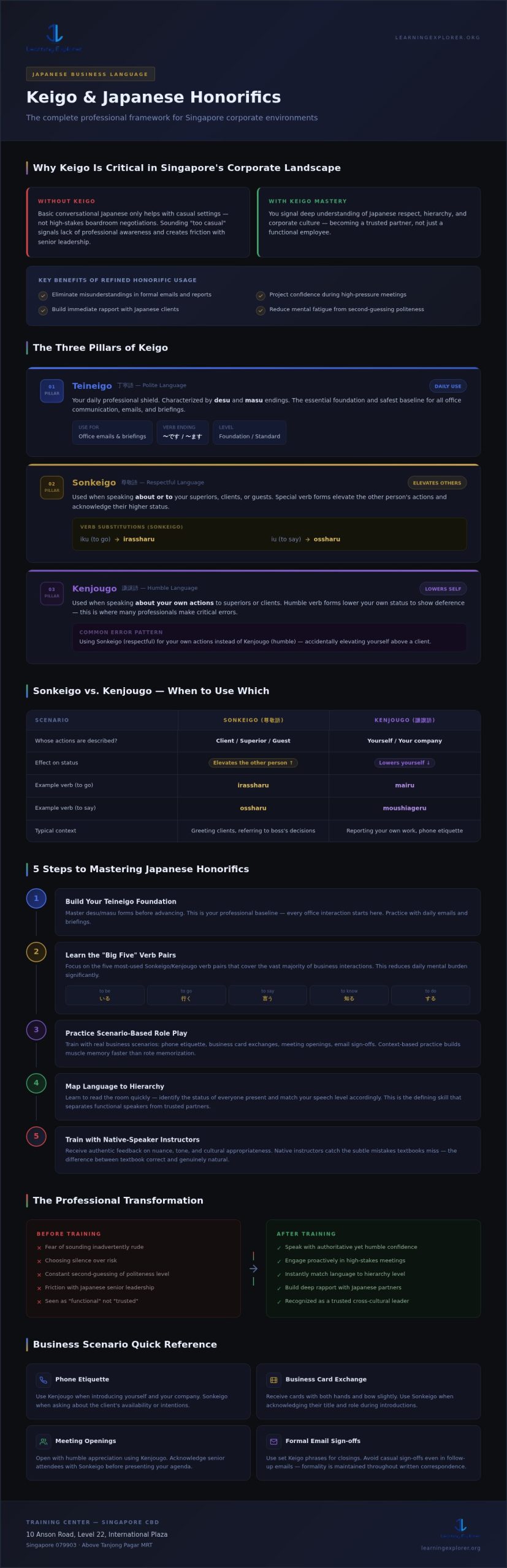
Keigo is a system of social positioning through language that defines the hierarchy between the speaker and the listener. It functions as the invisible architecture of every professional encounter. By participating in keigo and japanese honorifics training singapore, you learn how to adjust this architecture in real-time. You’ll move beyond simple translation and start managing the social distance between yourself and your Japanese counterparts with precision and ease.
Teineigo: Your Daily Professional Shield
Teineigo serves as your daily professional shield. It’s the polite form characterized by “Desu” and “Masu” endings. While it’s the safest baseline for office chatter, it can feel cold or overly distant if used exclusively with long-term partners or during high-stakes negotiations. We focus on helping you use it effectively in emails and briefings to maintain a professional standard without sounding like a rigid textbook. It’s the essential foundation you need before you can tackle more complex honorifics in the boardroom.
Sonkeigo and Kenjougo: The Power Dynamics of Business
Sonkeigo and Kenjougo are where you truly influence power dynamics. Sonkeigo (Respectful Language) elevates your client or boss by using special verb forms. You’ll learn to swap common verbs like “iku” (to go) for “irassharu” and “iu” (to say) for “ossharu.” This isn’t just about being nice; it’s about acknowledging the status of the person you’re addressing. Mastering these shifts demonstrates a high level of cultural intelligence that Japanese partners deeply value.
Kenjougo (Humble Language) does the opposite by lowering your own position to show professional modesty. It’s a powerful way to build rapport by showing you value the other person’s time and status. A key concept here is the “Uchi-Soto” (In-group/Out-group) rule, which is particularly relevant for Singaporean teams. This rule dictates that you must speak humbly about your own colleagues when talking to an external client. Even if you’re referring to your own manager, you use humble forms because they’re part of your “In-group.”
This nuance often trips up non-native speakers, but it’s vital for projecting a professional, unified company image. If you’re ready to master these subtleties and reduce the mental fatigue of second-guessing yourself, exploring a Conversational Japanese Course designed for business can provide the creative catalyst you need for better outcomes. You’ll move from the labor of seeking the right words to the satisfaction of effortless, respectful discovery. Professionals in technical fields such as electronics manufacturing will also find that these same honorific principles are foundational to japanese for semiconductor industry professionals sg, where precise communication with Japanese engineers and vendors is equally critical.
Navigating Business Scenarios: When to Use Sonkeigo vs. Kenjougo
Understanding the mechanics of honorifics is just the first step. The real challenge lies in the heat of a live business interaction where you must switch between respectful and humble forms instantly. In a fast-paced hub like Singapore, Japanese partners value efficiency, but they value respect even more. Our keigo and japanese honorifics training singapore focuses on bridging this gap, moving you from textbook knowledge to boardroom fluency. Whether you’re scheduling a regional sync or greeting a visitor at our center at 10 Anson Road, level 22, International Plaza, Singapore 079903, your choice of words defines your professional standing.
Consider the act of scheduling. When you offer your own availability, you use Kenjougo to modestly position your time. However, when asking for a client’s schedule, you must pivot to Sonkeigo. This linguistic dance ensures no one feels slighted. In professional emails to headquarters, starting with “Osewa ni natte orimasu” (Thank you for your support) isn’t just a courtesy; it’s a vital signal that you understand the “Uchi-Soto” dynamics we discussed earlier. It sets a tone of partnership and mutual respect before the first agenda point is even reached.
The Corporate Secretary’s Keigo Toolkit
If you’re a corporate secretary, you’re the first point of contact and the primary guardian of your Director’s image. Answering the phone requires a blend of polite Teineigo for general inquiries and humble Kenjougo when describing your team’s actions. You’ll need to master phrases like “Moushiagemasu” instead of just “Iimasu” to convey messages with the appropriate weight. Engaging in evening japanese lessons near raffles place provides the perfect environment to role-play these scenarios, ensuring your responses become second nature rather than a source of stress.
Keigo for Executive Networking
For executives, networking at Singapore-Japan business mixers is an exercise in social positioning. A strong first impression relies on a flawless “Jiko-shoukai” (self-introduction). A common pitfall is using honorific suffixes like “-san” for your own colleagues when speaking to a client. This breaks the “Uchi-Soto” rule and can make you sound unprofessional. Instead, use Kenjougo to describe your team’s roles. This subtle shift demonstrates that you’re a seasoned professional who respects the hierarchy of the relationship. It projects a level of authority that basic Japanese simply cannot achieve, allowing you to focus on building the partnership rather than worrying about your grammar. The same principles apply when representing your company at major exhibitions, where japanese for attending trade shows in japan demands an equally precise command of honorifics to build the “Shinrai,” or trust, that closes high-value deals on the exhibition floor.
5 Steps to Mastering Japanese Honorifics Without the Stress
Stop viewing honorifics as an insurmountable hurdle. With a structured approach, you can transform your professional communication from a source of anxiety into a competitive advantage. Effective keigo and japanese honorifics training singapore provides the roadmap you need to navigate these complexities with confidence. By breaking the learning process into manageable actions, you’ll reduce the mental fatigue often associated with high-level business Japanese.
- Step 1: Audit your current Japanese level. Identify the specific moments where you feel most “stuck.” Is it answering the phone or greeting a regional director? Target these professional pain points first to see immediate results.
- Step 2: Master the “Big Five” Keigo verbs. Focus on the honorific and humble forms of iku (go), kuru (come), iru (be), suru (do), and iu (say). These verbs appear in approximately 80% of formal business dialogues.
- Step 3: Practice role-playing with a native-speaker instructor. A supportive environment allows you to test different levels of politeness before you’re in a high-stakes meeting. This builds the social confidence required for the boardroom.
- Step 4: Use shadowing techniques. Listen to audio recordings of formal business exchanges and repeat them immediately. This builds the muscle memory required for the rhythmic flow of professional Japanese.
- Step 5: Apply one new phrase per day. Use a single Keigo expression in your office and ask a trusted colleague for feedback. Real-world application is the fastest path to mastery.
Overcoming the Fear of Making Mistakes
Most professionals hesitate because they fear sounding rude. However, a sincere effort to use Keigo is almost always appreciated by Japanese colleagues. If you make a mistake, don’t panic. Simply correct yourself gracefully and move on. The goal isn’t textbook perfection but building a supportive learning habit that fits your CBD work schedule. Consistency matters more than cramming, and small, daily wins lead to long-term professional impact.
Leveraging Native Speaker Feedback
Self-study apps can’t replicate the nuance of a bilingual, native instructor who understands the specific culture of a Japanese MNC in Singapore. Interactive group classes provide immediate correction that prevents bad habits from forming. To accelerate your growth, bring specific scenarios from your workday to your training sessions. This ensures your learning is always relevant to your professional goals and reduces administrative friction in your daily tasks.
If you’re ready to replace communication stress with professional impact, join our Conversational Japanese Course today and start your transformation from a seeker of information to a confident discovery partner.
Elevate Your Career with Keigo Training at Learning Explorer Singapore
Your journey to professional fluency doesn’t have to be a solitary struggle. At Learning Explorer, we’ve designed our keigo and japanese honorifics training singapore to meet the specific demands of the modern workplace. We bridge the gap between textbook theory and the actual social dynamics you face in your daily tasks. Our modules aren’t generic; they’re built for professionals who need to see immediate results in their corporate interactions. Whether you’re a corporate secretary managing a Director’s schedule or an executive leading regional syncs, our training provides the specific linguistic tools required for success.
Our native-speaker instructors aren’t just language teachers; they’re specialists in business etiquette and honorifics. They understand the pressure of working in a Japanese MNC because they’ve helped hundreds of executives in Singapore navigate similar challenges. They’re bilingual professionals who can explain the logic behind every phrase you learn, ensuring you understand the cultural weight of your words. By aligning our curriculum with global standards, we ensure you’re receiving high-quality, vetted material that projects a sense of modern innovation and respect.
Flexible Learning Options for Busy CBD Professionals
We know your schedule is taxing. That’s why we offer three distinct paths to mastery. You can choose private one-on-one coaching to focus on your unique professional pain points, or join our evening group classes to learn alongside fellow CBD executives. For those facing an upcoming deadline or a major project launch, our intensive workshops provide the creative catalyst needed for rapid Keigo mastery. Each format prioritizes interactive discovery over passive listening, ensuring you can apply what you learn the very next morning.
Visit Our Training Centre at Tanjong Pagar
Our training center is located at 10 Anson Road, level 22, International Plaza, Singapore 079903, situated directly above Tanjong Pagar MRT. It’s an environment built by practitioners for practitioners, designed to reduce the administrative burden of learning and increase your professional engagement. When you step into our classroom, you’re entering a space that values your time and understands your goals. We position ourselves as a partner in your career growth, offering a supportive atmosphere that encourages you to push past your comfort zone.
Take the first step toward reducing communication friction and increasing your impact today. You’ll find that with the right guide, the transition from hesitation to confidence is much shorter than you think. By mastering these nuances, you aren’t just learning a language; you’re unlocking a higher level of professional discovery and influence.
Ready to Transform Your Professional Presence?
Mastering the nuances of Japanese business etiquette is a journey from the labor of seeking the right words to the satisfaction of discovery. You’ve learned that Keigo is a strategic asset for building trust with headquarters and that navigating the Uchi-Soto rules is essential for a unified professional image. By focusing on the “Big Five” verbs and practicing in a supportive environment, you can eliminate the fear of sounding rude in high-stakes meetings.
Our keigo and japanese honorifics training singapore is designed specifically for busy CBD professionals who want to increase their impact. With native-speaker instructors focused on business etiquette, you’ll gain the confidence to lead in any boardroom. Visit us at 10 Anson Road, level 22, International Plaza, Singapore 079903, directly above Tanjong Pagar MRT, to experience a learning atmosphere built for practitioners.
Book Your Professional Keigo Training at Learning Explorer Today!
Your professional growth shouldn’t be stalled by linguistic hesitation. Take this step to unlock new opportunities and lead with authentic respect. We’re here to help you navigate every step of your professional journey with ease and confidence.
Frequently Asked Questions
Is Keigo really necessary for working in a Japanese company in Singapore?
Keigo is essential if you work in a Japanese firm or handle Japanese clients in Singapore. While basic Japanese helps you survive, honorifics allow you to thrive by building trust with regional directors and headquarters. Correct usage demonstrates your cultural awareness and professional maturity. It’s often the deciding factor in how your Japanese counterparts perceive your reliability and attention to detail during high-stakes corporate interactions.
How long does it take to learn basic Japanese business honorifics?
Learning the foundations of business honorifics typically takes about three to six months of consistent, focused training. While mastering every nuance is a lifelong journey, you can acquire the “Big Five” verbs and essential email etiquette much faster. Our modules prioritize practical application, allowing you to use polite forms in your daily office tasks almost immediately after starting your first few sessions with our instructors.
What is the difference between Sonkeigo and Kenjougo in simple terms?
Sonkeigo (Respectful Language) is used to elevate the status of your clients, bosses, or anyone outside your in-group. You apply it to their actions. Conversely, Kenjougo (Humble Language) lowers your own position or your team’s position to show professional modesty. Understanding this distinction is a core part of keigo and japanese honorifics training singapore, as it defines the social hierarchy in every business conversation you have.
Do you offer Keigo training for corporate teams at their office location?
We offer customized corporate modules designed specifically for organizations and their unique business needs. Our instructors can conduct sessions for your team, focusing on industry-specific vocabulary and the exact hierarchy of your firm. This approach reduces administrative friction and ensures your staff can represent your company with the highest level of professional etiquette when dealing with Japanese partners or regional headquarters across the globe.
Where is your Japanese language school located in Singapore?
Our training center is conveniently located at 10 Anson Road, level 22, International Plaza, Singapore 079903. We’re situated directly above Tanjong Pagar MRT, making it easy for CBD professionals to attend classes after work. This central location serves as a supportive hub where you can transition from the labor of seeking the right words to the satisfaction of confident, professional discovery in a modern environment.
Are your Japanese teachers native speakers?
Yes, all our instructors are native Japanese speakers who are also bilingual and certified. They specialize in business Japanese and have a deep understanding of the professional landscape in Singapore. This ensures you receive high-quality, vetted feedback on your pronunciation and usage. Their expertise helps you navigate the subtle social cues that self-study apps often miss, providing the creative catalyst for better career outcomes.
Do I need to be fluent in Japanese before starting Keigo training?
You don’t need to be fully fluent to begin your keigo and japanese honorifics training singapore. While having a basic grasp of Japanese grammar is helpful, we offer modules tailored for various proficiency levels. We focus on teaching you the specific phrases and verbs that have the most significant impact on your professional communication. This allows you to build your honorific skills alongside your general conversational ability.
Can I attend trial classes for business Japanese at International Plaza?
We encourage prospective students to experience our interactive learning style firsthand. You can attend trial sessions at our International Plaza center to see how our native-speaker instructors guide you through real-world business scenarios. These sessions help you identify your professional pain points and show you how our structured curriculum can reduce your daily communication stress while increasing your overall engagement with Japanese clients and partners.